
6 Remote Texas Desert Towns That Feel Like Another Planet
Deep in the heart of Texas lies a world unlike any other.
The vast, arid landscapes of West Texas hide tiny pockets of civilization that seem to exist in their own dimension.
I’ve spent years exploring these isolated outposts, and each visit leaves me feeling like I’ve stepped through a portal to somewhere beautifully strange.
These desert towns are more than just dots on a map—they’re gateways to an otherworldly experience you won’t soon forget.
1. Terlingua: Where Ghost Stories Come Alive
The first time I rolled into Terlingua, I thought my GPS had sent me to Mars. This former mining community sits among crimson hills that glow at sunset like embers in a dying fire. The locals—a fascinating mix of artists, outlaws, and desert philosophers—have embraced their town’s ghostly reputation with a wink and a nod.
During the annual chili cookoff, the population explodes from barely 100 to thousands of spice-seeking pilgrims. I spent an unforgettable night stargazing from an abandoned mining shack, the Milky Way spread across the sky like diamond dust.
Don’t miss the Starlight Theatre, once a movie house for miners, now a restaurant where you can sip prickly pear margaritas while local musicians strum guitars on the porch.
2. Marfa: Art Oasis In The Desert Void
“You drove six hours for… this?” my friend asked when we first arrived in Marfa. The question evaporated once night fell and we spotted the mysterious Marfa Lights dancing across the horizon—unexplained orbs that have baffled scientists for generations.
This tiny town of 1,700 souls has become an unlikely art mecca, where minimalist installations rise from the desert floor like alien structures. I stumbled upon a dinner party hosted by local artists in an old gas station, where conversation flowed as freely as the wine.
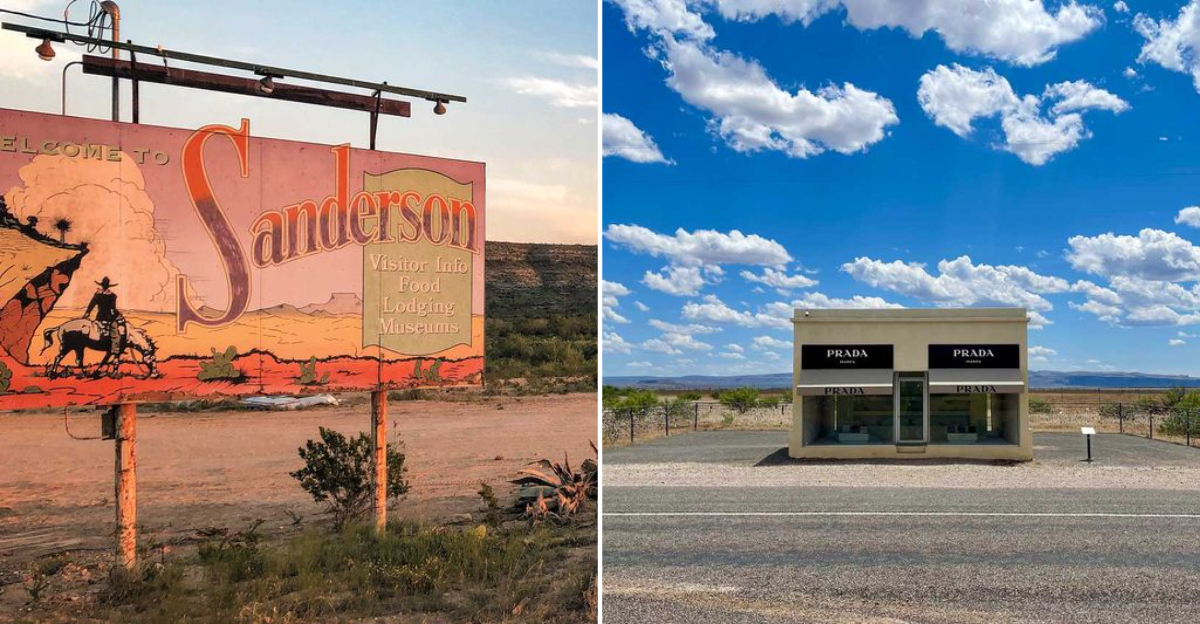
Prada Marfa, the fake designer store standing alone on an empty highway, perfectly captures this town’s delightful weirdness—a luxury mirage in a landscape where your nearest neighbor might be a mile away.
3. Fort Davis: Star-Gazing Capital Of The Desert
“Turn off your headlights!” The astronomer’s voice crackled through my car radio as I approached McDonald Observatory. Fort Davis takes its darkness seriously—it’s home to some of the darkest night skies in the continental United States.
This mountain town sits at 5,050 feet, making it a cool refuge from the blistering desert below. Walking the historic fort grounds, I felt like I’d stepped into a time machine. Soldiers’ barracks and officers’ quarters stand preserved, silent witnesses to frontier life.
The Davis Mountains rise around the town like ancient guardians, creating a microclimate where ponderosa pines grow improbably among cacti. I spent a magical evening at a star party, where Jupiter’s moons appeared through massive telescopes like tiny pearls strung around a giant jewel.
4. Sanderson: The Cactus Capital’s Rugged Charm
We’re the town too tough to fade away,” the waitress told me at the only open diner in Sanderson. After surviving devastating floods and the bypass of Interstate 10, this resilient community wears its “Cactus Capital of Texas” title with prickly pride.
My morning walk revealed limestone buildings from the 1800s standing defiantly against time and elements. The old train depot—once the town’s lifeline—now houses historical exhibits that tell stories of ranchers, railroad workers, and remarkable desert survival.
Surrounded by canyons that hide fossil treasures millions of years old, Sanderson feels suspended between epochs. I spent an afternoon hiking through nearby Sanderson Canyon, where desert bighorn sheep watched me from impossible perches, their silhouettes like ancient petroglyphs come to life.
5. Redford: Forgotten Border Outpost
Crossing the wooden footbridge to Mexico feels like stepping across time itself. Redford—population ninety—sits so close to the Rio Grande that conversations can float across the international border on evening breezes.
Adobe houses blend seamlessly into the landscape, their mud-brick walls telling stories of generations who’ve lived between two worlds. I shared homemade tamales with a family whose ancestors founded the village centuries before borders existed. Their hospitality made political divisions seem as insubstantial as the morning mist that rises from the river.
The tiny church, with its hand-carved santos and flickering candles, serves as the community’s heart. Outside, children play in dusty yards while elders tend gardens that somehow flourish in this harsh environment—living proof of human determination to create home in the most unlikely places.
6. Pandale: The Town That Water Forgot
Tumbleweeds outnumber people in Pandale, a near-ghost town that refuses to completely disappear. My truck rattled over the one-lane bridge spanning the Pecos River—the same crossing used by pioneers, cattle drivers, and outlaws over the centuries.
Only a handful of structures remain standing, including an old schoolhouse with windows that stare out at the emptiness like vacant eyes. I met a rancher whose family has raised cattle here for five generations. “The desert doesn’t give anything easy,” he told me, his face weathered as the limestone cliffs.
Adventure seekers now use Pandale as a launching point for river expeditions, but few stay to explore this haunting place. At dawn, I watched the sun illuminate layers of geological time in the canyon walls—nature’s calendar, marking eons while this tiny human settlement blinks in and out of existence.