
8 Texas Restaurant Chains Locals Still Miss (And Wish Would Come Back)
Growing up in the Lone Star State, some of my fondest memories revolve around family dinners at beloved restaurant chains that have since vanished from our landscape.
These eateries weren’t just places to grab a bite – they were where first dates happened, birthday candles were blown out, and Friday night traditions were born.
While Texas still boasts an incredible food scene, locals like me can’t help but reminisce about these eight restaurant chains that left a hole in our hearts (and stomachs) when they disappeared.
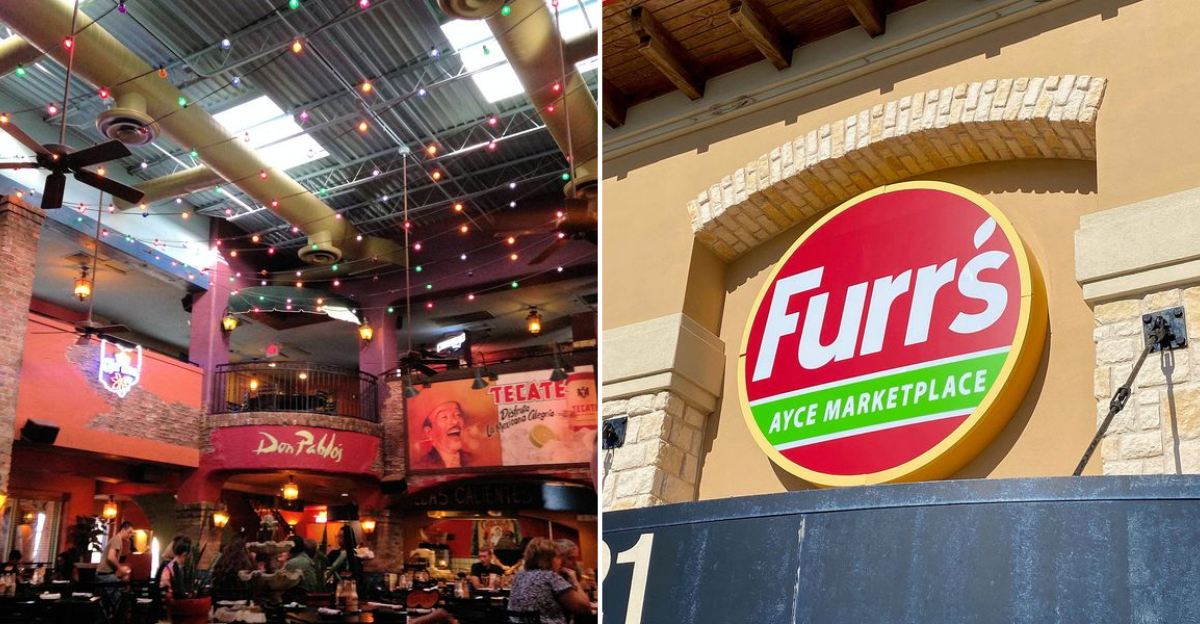
1. Don Pablo’s: Where Tex-Mex Dreams Were Made
Man, I still dream about those warm chips hitting the table the moment you sat down at Don Pablo’s. The restaurant’s hacienda-style décor transported you straight to Mexico with its colorful tiles and rustic wooden beams overhead.
My family made it a Sunday tradition to devour their sizzling fajita platters after church. And those enormous margaritas? Pure Texas-sized bliss!
Founded in Lubbock in 1985, Don Pablo’s grew rapidly across Texas and beyond, becoming a Tex-Mex giant of the ’90s. Sadly, after years of financial trouble and shrinking locations, the last restaurant closed in June 2019. Texans lost more than a place to eat—we lost a gathering spot where generations bonded over queso and mesquite-grilled specialties.
2. Prince’s Hamburgers: A Royal Taste Of Old-School Texas
Before fancy burger joints took over, Prince’s Hamburgers reigned supreme in Houston since 1934. My grandpa would tell stories about pulling up for curbside service in the 1950s, when servers brought juicy burgers right to your car window.
Nothing beat their classic combo – a perfectly grilled patty on a toasted bun with crispy fries and a hand-spun milkshake so thick you needed that wide straw. The original location on Main Street became a time capsule of mid-century Americana.
When the last of the old Prince’s locations shut down in 2017–2018, it felt like watching a piece of Houston history fade away. The distinctive orange-and-white signs once dotted the city, and their absence left a void. A small revival came in 2020 with a new location at Sharpstown Park Golf Course, but for most Houstonians, Prince’s will always live in memory as the burger spot that defined a generation.
3. Bikinis Sports Bar & Grill: The “Breastaurant” That Bought A Town
Only in Texas would someone buy an entire town and rename it after a restaurant chain! In 2012, Bikinis Sports Bar & Grill’s owner Doug Guller bought Bankersmith, TX, and briefly rebranded it “Bikinis.” It was a marketing stunt that made national headlines and embodied the chain’s over-the-top style.
Founded in Austin, Bikinis rode the early-2000s “breastaurant” trend, with servers in cowboy boots and bikini tops delivering wings and burgers while sports blared from giant screens. On weekends, live music spilled onto patios and crowds packed in for rowdy nights.
By 2018, though, expansion fizzled and the last locations shut their doors. Controversial? Absolutely. But love it or hate it, Bikinis remains one of the most audacious restaurant stories in Texas history.
4. Shady Grove: Austin’s Beloved Pecan-Shaded Patio Paradise
Heartbreak doesn’t begin to describe what Austinites felt when Shady Grove closed in May 2020 after 28 years. Tucked under sprawling pecan trees on Barton Springs Road, it was more than a restaurant—it was a summer ritual.
Their Hippie Sandwich, green chile cheese fries, and ice-cold beers fueled countless warm nights while locals crowded picnic tables for the “Unplugged at the Grove” music series. That shiny vintage Airstream trailer out front became one of Austin’s most photographed landmarks.
After nearly three decades, rising costs and changing times finally caught up with the beloved spot. Though offshoot projects like “A Little Shady” have tried to carry on the legacy, nothing captures the original’s laid-back Austin soul.
5. Furr’s Cafeteria: Where Grandmas Ruled And Jell-O Cubes Jiggled
Walking through the cafeteria line at Furr’s was a Texas tradition. Trays slid along shiny metal rails while kids’ eyes widened at the lineup of comfort foods: fried chicken, liver and onions, mac and cheese, and those legendary soft rolls.
And who could forget the colorful cubes of Jell-O wobbling on plates as families carried them to tables? Generations of Texans grew up piling their trays high with hearty classics, served by smiling ladies in hairnets.
By the early 2000s, locations started vanishing, and in 2021, Furr’s parent company filed for bankruptcy, closing the last “Furr’s Fresh Buffet.” With it went more than a cafeteria—it was the end of a Sunday ritual where half your congregation seemed to end up in line.
6. Luby’s: The LuAnn Platter’s Last Stand
“Whatcha having today, honey?” Those words from Luby’s servers are etched into countless Texans’ memories. Founded in San Antonio in 1947, Luby’s grew into a statewide institution, with its signature LuAnn Platter (one entrée, two sides, and a roll) inspiring even King of the Hill’s Luanne Platter character.
In 2020, when the company announced plans to liquidate, fans mourned as if a family member had passed. Dozens of locations did close, and for many communities, it felt like losing a cornerstone of Texas culture.
Yet, against the odds, Luby’s survived. New ownership has kept several dozen restaurants open, mostly in Texas, proving that while its presence is smaller, its legacy is still very much alive. For many, though, the loss of their neighborhood Luby’s remains a sore spot.
7. 59 Diner: Neon Lights And Midnight Milkshakes
Neon signs cast a pink-and-blue glow across Houston parking lots as night owls streamed into 59 Diner. Open 24 hours, its ’50s décor—chrome counters, black-and-white checkered floors, jukebox tunes—made it the perfect refuge for every crowd: doctors after shifts, students cramming, and club-goers sobering up.
Their pancakes were legendary, their burgers juicy, and their milkshakes thick enough to need a spoon. For Houstonians, 59 Diner wasn’t just a meal—it was a safe, familiar spot at 3 AM when nowhere else felt right.
In 2016, financial troubles closed the chain abruptly. Some of the old buildings still stand, repurposed as other restaurants, but the magic glow of those neon signs is gone.
8. Eatzi’s: The Gourmet Market That Pioneered Fast-Casual
Opera music greeted you at the door, and shelves overflowed with chef-prepared meals, artisan breads, and gourmet take-home entrées. Founded in Dallas in 1996 by restaurant visionary Phil Romano, Eatzi’s brought a European-style market experience long before “fast-casual” became a buzzword.
Expansion fizzled outside North Texas, but Dallas-Fort Worth locals still cherish the brand. Today, multiple Eatzi’s locations thrive across the metroplex, while Houstonians and Austinites who lost their neighborhood spots continue to reminisce about the days when a quick stop meant bringing home restaurant-quality dinner without ever lighting the stove.