
11 New York Nostalgia Foods Everyone Grew Up On
New York’s culinary heart isn’t tucked away in Michelin-starred dining rooms. It beats on sidewalks, in corner delis, and under awnings where steam escapes into the street.
These foods weren’t luxuries; they were weeknight dinners, after-school treats, and fuel between subway stops. They’re messy, sometimes simple, often brilliant in their own scrappy way.
Ask ten New Yorkers and you’ll get ten different favorites, but these eleven keep coming back, the edible shorthand for a city that’s always hungry and never sentimental for long.
1. Black-And-White Cookies
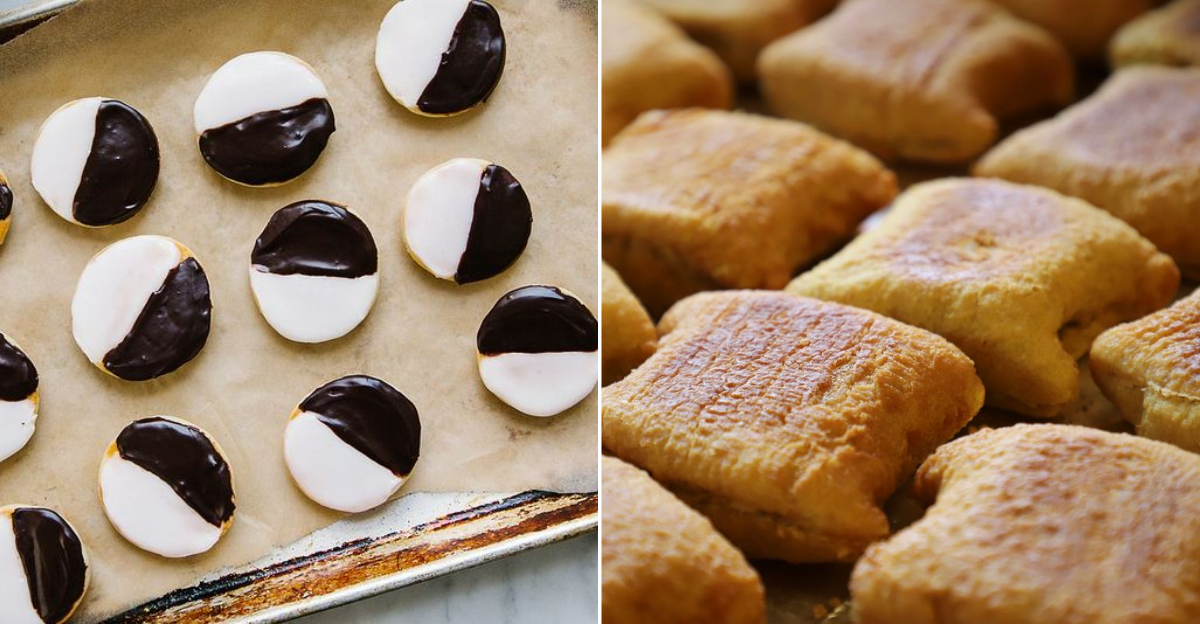
Shiny enough to catch the light, a black-and-white cookie looks almost formal until you bite through its soft, cake-like body. Suddenly it’s not elegant, it’s comforting.
Though its roots stretch back to European baking, the cookie became a New York deli classic. Jewish bakeries made them iconic, turning fondant halves into edible balance.
The eternal argument lingers: do you eat vanilla first, chocolate first, or both in one bite? I’ve tested every method, and the “no wrong answer” rule feels true here.
2. Egg Cream
The sizzle of soda water hitting syrup is a tiny firework in a glass. No eggs, no cream, just milk, fizz, and chocolate.
Born in New York soda fountains in the early 1900s, egg creams became cheap luxuries for kids and late-night pick-me-ups for adults. They’re especially linked to Jewish neighborhoods and corner drugstores.
If you’ve never had one, here’s advice: drink fast. The foam disappears quickly, and watching it vanish is part of the fun, like chasing bubbles in childhood.
3. Bagel With Lox And Schmear
A fresh bagel still warm from the oven resists the knife, its crust glossy and dense. Schmear softens the cut, silky salmon drapes over the top.
Bagels arrived with Eastern European immigrants in the late 1800s, and pairing with lox and cream cheese became standard by the mid-20th century.
Walk into a New York deli on a Sunday morning, and the line for bagels feels like a town hall. I once stood behind a man debating sesame vs. poppy as if it mattered to history.
4. Potato Knish
Steam escapes as you crack open the golden crust of a knish, releasing mashed potato scented with onion and pepper. The texture is soft, wrapped in pastry that flakes slightly.
Knishes came with Eastern European Jewish immigrants and became a New York sidewalk food, sold from pushcarts and later in delicatessens. They gained special fame in neighborhoods like the Lower East Side.
Best tip: go for them hot. Cold knishes dull into heaviness, but fresh from the oven, they’re the kind of snack that feels sustaining and almost noble.
5. New York–Style Pizza Slice
The sharp fold of a thin-crust slice leaves oil trails racing toward your wrist. The bottom stays crisp while the cheese stretches in deliberate strands.
Italian immigrants helped cement pizza into the city’s diet, with Lombardi’s opening in 1905 as America’s first licensed pizzeria. By mid-century, the dollar slice had become cultural shorthand.
My opinion: eaten standing on a sidewalk, pizza tastes better. Sitting down with it feels wrong. The slice belongs in your hand, folded, somewhere near the curb.
6. New York Cheesecake
A chilled fork slides through dense, creamy cheesecake, the bite heavy with cream cheese richness, balanced by a graham or sponge base.
Arnold Reuben is credited with introducing cheesecake to New York in the 1920s, later perfected by Lindy’s and Junior’s, each claiming the definitive style.
This cake is indulgent by design, yet plainness suits it best. A pure slice without toppings feels like New York distilled: unapologetic, straightforward, confident enough not to need decoration.
7. Pushcart Hot Dog With Onion Sauce
The hiss of water in a street cart and the faint vinegar-sweet smell of onions mark the presence of New York hot dogs.
German immigrants popularized frankfurters in the 19th century; Sabrett became synonymous with the pushcart dog, especially topped with its signature onion sauce.
Vendors serve thousands daily. Some swear by mustard alone, others pile on onions and sauerkraut. There’s no single right answer, but the ritual of eating one mid-commute feels like pure city rhythm.
8. Soft Pretzel
Salt crystals cling to the warm surface of a soft pretzel, leaving a trace on fingertips. The dough bends easily, torn into chewable knots.
Brought by German immigrants, pretzels were sold from street carts across the city, a cheap snack through the early 20th century. Many still connect them to stadiums and sidewalks.
In my view, pretzels without mustard feel unfinished. That sharp tang cuts the heaviness, turning a simple bread twist into something that deserves lingering over.
9. Italian Ice
A spoon scraping across Italian ice makes a satisfying crunch, icy crystals giving way to bright flavors: lemon, cherry, mango.
Italian immigrants brought granita traditions, and New York vendors adapted them into small paper cups. Spots like Ralph’s in Staten Island helped define the treat.
Summer heat makes the choice obvious. Crowds line up, kids and adults alike, cups staining lips bright red or yellow. It’s nostalgia disguised as refreshment, a citywide memory with a chill.
10. Spumoni
Layered colors, green pistachio, pink cherry, brown chocolate, mark spumoni, a dessert that feels both old-fashioned and celebratory.
This Italian-American confection arrived with immigrants, tied to Brooklyn’s L&B Spumoni Gardens, where it’s still served in generous scoops alongside thick Sicilian pizza.
Eating spumoni is less about refinement and more about fun. The mix of textures, from candied fruit to nutty cream, resists seriousness. For me, it’s the flavor of summer evenings stretched into night.
11. Pastrami on Rye
The first bite into pastrami on rye crackles with peppered crust, then yields to smoky, juicy meat. Rye bread’s earthiness cuts the richness perfectly.
Romanian Jews introduced pastrami to New York in the late 19th century, with Katz’s Delicatessen becoming a defining landmark. The sandwich remains a deli crown jewel.
Opinion? Half-sandwiches never satisfy. Pastrami on rye should arrive stacked high, unapologetically excessive. It’s the kind of food that insists you slow down and commit fully.