
The Oregon Bridge That Locals Say Offers The Best Views In The State
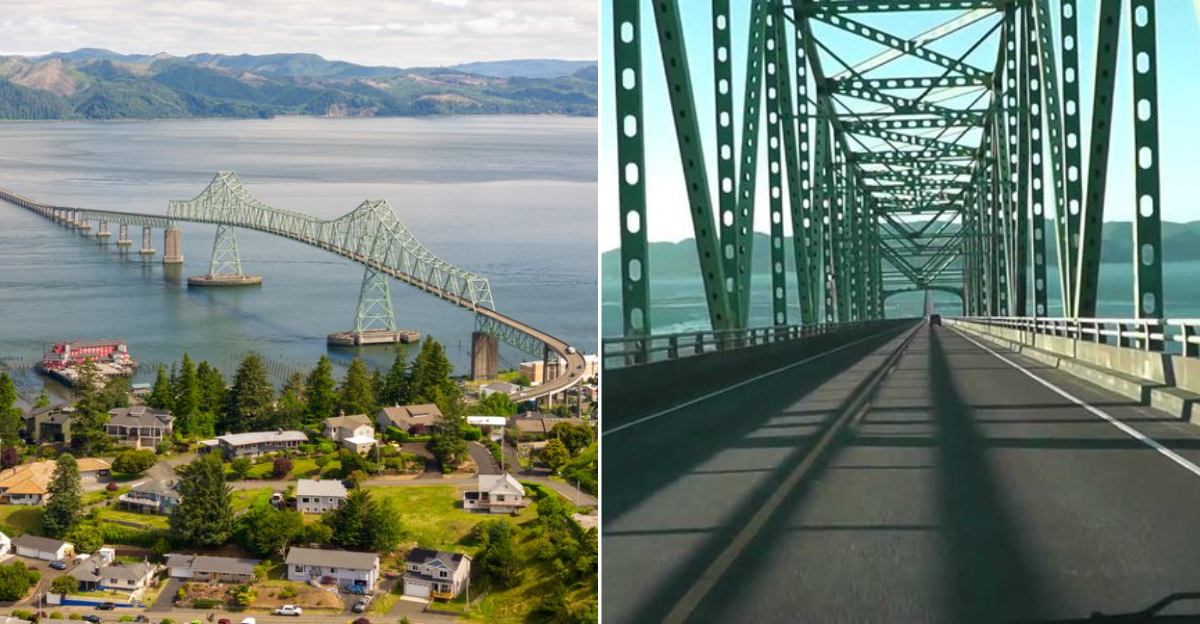
The Astoria–Megler Bridge doesn’t simply ferry cars across the Columbia River, it stages theater on steel and sky. At over four miles long, it stretches like a ribbon between states, equal parts engineering and spectacle.
From Astoria, the climb spirals upward until suddenly you’re soaring, ship masts shrinking below and Washington opening wide ahead. Clouds race, gulls arc, and the water churns with tidal muscle.
Locals insist no other vantage captures Oregon’s coastal might so perfectly. One crossing is enough to see why: this bridge turns travel into drama, every span a front-row seat.
Longest Continuous Truss in North America at 4.1 Miles, Opened 1966
There’s something audacious about driving onto a span that seems to keep stretching into the horizon. This isn’t a quick skip over a river—it’s a marathon in steel.
At 4.1 miles, the Astoria–Megler Bridge holds the title as the longest continuous truss bridge in North America, a feat since 1966.
By the halfway point, you feel suspended between two states and two worlds. Oregon fades in the rearview, Washington drifts closer, and the Columbia rolls endlessly beneath.
Vantage Over The Columbia Just 14 Miles From The Ocean Mouth
Just fourteen miles upriver from the Pacific, the bridge hovers where salt air and river current start to mingle.
This vantage point gives sweeping views of the Columbia River stretching wide before surrendering to the sea. Fishing boats dot the surface like tiny punctuation marks on an endless page.
Tip for travelers: keep your camera close but your hands steady on the wheel. The temptation to gawk is strong, and you’ll want safe spots afterward to capture it.
Clearance of About 196 Feet Lets Ocean-Going Ships Pass Below
Imagine looking down to see a freighter sliding under your tires while gulls wheel at your side mirror. That’s the reality of nearly 200 feet of clearance.
The designers built this truss high so ocean-going vessels could move unbothered toward ports upstream. River and road choreography happens every day here.
I once caught the timing perfectly, a container ship gliding beneath as I drove overhead. The scale made me laugh out loud, steel on water, water under steel.
Designed To Withstand Major River Currents And Powerful Winds
The Columbia doesn’t play nice here. Its currents hammer the pilings, and winter storms whip across with gales that test nerves and steel alike.
Engineers designed the bridge to bend, not break—an intentional resilience against the extremes that pound this corner of the coast.
Drivers sometimes feel the shudder when gusts hit broadside, a reminder of the river’s power. But the bridge holds steady, a quiet testament to human calculation meeting natural force.
US 101 Link Between Astoria And Point Ellice With Washington State Vistas
The truss carries more than traffic, it completes a story. Before 1966, ferries did the job of connecting Oregon to Washington across the Columbia.
With its opening, Highway 101 became a true coastal highway, uninterrupted from Los Angeles to Olympia. That history still gives weight to every crossing.
A tip for road-trippers: take it northbound. The view of Washington’s forested shoreline unfurling ahead makes the drive feel like an arrival rather than a departure.
Great Columbia Crossing 10K Opens The Bridge To Walkers And Runners Each October
Once a year, the bridge becomes a parade ground for sneakers instead of tires. The Great Columbia Crossing 10K closes the span to vehicles and fills it with footsteps.
Locals and visitors alike seize the chance to walk or run the full length, soaking in views usually reserved for drivers.
I joined once, and the feeling was electric. The sheer immensity of steel and water without car noise made every step feel like trespassing in the best possible way.
Everyday Crossings Are For Motor Vehicles And Bicycles Only No Sidewalk For Pedestrians
For all its grandeur, the bridge isn’t built for leisurely strolls. There’s no sidewalk here, only lanes for cars, trucks, and the occasional determined cyclist.
The restriction keeps the flow tight, this is US 101, after all, a working highway that never rests.
Still, there’s a strange beauty in that exclusivity. You experience the bridge in motion, wheels humming on steel, with no chance to stop until you’re across.
Best Photo Angles From The Astoria Riverfront Promenade And Piers
Astoria’s waterfront promenade is more than a place to stretch your legs, it’s a front-row seat to the bridge’s sweep. From the piers, the steel truss frames itself against water and sky.
Local photographers swear by dawn and dusk. Morning light gilds the frame, while sunsets backlight it in silhouette.
Bring patience along with your camera. The longer you watch, the more you catch, fishing boats gliding, lights flicking on, the bridge turning from landmark to living backdrop.
Wide Panorama From The Astoria Column Shows The Whole Span And Bar
Climb 164 steps to the top of the Astoria Column, and the reward is total perspective. The Columbia River bar spreads wide, and the entire bridge snakes across it.
From up here, the truss seems less massive and more delicate, a green line balancing water and forest.
I remember feeling dizzy, not from the climb, but from the scale. Looking down, the bridge seemed like a toy; looking out, it felt like the whole world pivoted around it.
Approach Ramp On The Oregon Side Spirals You Up To The Truss Deck
Unlike most bridges, this one doesn’t just rise, it coils. The Oregon approach curves upward in a spiral, lifting you gradually to the truss deck.
The design solved a problem: Astoria’s flat riverfront needed a gentle climb, not a steep grade, to reach nearly 200 feet of clearance.
The effect is pure theater. As you circle, the river flashes between railings until suddenly the span stretches ahead, and you feel launched into open air.
Riverfront Trolley And Museums Sit Right Under The Southern End
Directly beneath the bridge, Astoria keeps its character intact with a vintage trolley line and maritime museums. The old clatter of wheels and curated exhibits contrast with the modern span overhead.
This area makes it easy to double your visit: one stop for history, one for spectacle.
It’s a pairing that sneaks up on you. Looking up from the trolley, the truss becomes backdrop, proof that the town’s story has always bent toward the river.
Crossing at Sunset Aligns River, Headlands, and Sky for Classic Coast Light
At dusk, the drive becomes performance art. The Columbia reflects streaks of crimson, Washington’s hills sink into silhouette, and the truss shines like a cutout against the sky.
The alignment feels almost intentional, as if the engineers secretly planned for sunsets to crown the experience.
The one time I timed it right, the colors were so fierce I forgot I was driving a highway. For those minutes, the bridge became pure spectacle, steel carried by light.