
11 Forgotten Utah Ghost Towns Tucked Beyond The Pavement
Utah’s backroads carry more than dust, they carry the bones of towns that refused to vanish quietly. These ghost towns aren’t curated displays or tidy timelines.
They are fragments scattered in stone foundations, rusted kilns, collapsing porches, and wind-whipped cemeteries where names fade but stories persist. Driving toward one feels like peeling away years: the sky turns wider, the silence grows heavier, and the desert’s colors sharpen around the ruins.
Some towns endured decades, others only a season, yet all left echoes. Here are eight places where history hasn’t died, it lingers, patient, waiting beyond the last stretch of pavement.
1. Iosepa, Skull Valley, Tooele County
Wind seems louder here, rushing through sagebrush as if to fill the silence of what’s gone. The open valley stretches wide, stark against the Stansbury Mountains.
Iosepa was founded by Hawaiian Latter-day Saint converts in the late 1800s, a settlement meant to root faith in unfamiliar soil. It lasted until 1917, when most families returned to Hawaii.
What lingers are foundations, gravestones, and an annual Memorial Day gathering. That single weekend reanimates the town, turning quiet earth into a reunion ground.
2. Sego, Thompson Canyon, Grand County
A dirt road curls into Thompson Canyon, where sheer walls make Sego’s ruins feel almost sculpted from stone. Crumbling company houses and scattered timbers mark the old grid.
Sego began as a coal town, swelling briefly on the promise of black seams that eventually played out. When the mine closed, the town shrank just as quickly.
I’ve stood here and felt like I was trespassing in a stage set. The canyon amplifies each step, making even your own presence feel ghostlike.
3. Frisco, San Francisco Mountains, Beaver County
Look closely and the skyline bristles with charcoal kilns, beehive-shaped relics that rise surprisingly intact. Their symmetry is eerie, monumental against barren hills.
Frisco was once booming, with silver and copper pulling thousands west in the late 1800s. It also had a reputation for lawlessness, with saloons and violence almost as famous as the ore.
The kilns are irresistible for photographers, but to me they’re more than props. They pulse with the idea of endless work, now frozen into silence.
4. Widtsoe, John’s Valley, Garfield County
Fields of grass and skeletal houses greet you before the mountains grab the horizon. It feels softer here than other ghost towns, less violent in its collapse.
Widtsoe was built on farming and faith in the soil, but drought and poor land beat families back. By the 1930s, most had left, leaving only timber frames behind.
If you visit, give yourself time. It’s not dramatic, but I found its stillness more moving than ruins elsewhere, a whisper of lives lived close to the land.
5. Knightsville, East Tintic Mountains, Juab County
Most mining camps grew rough, but Knightsville never had a saloon. Jesse Knight, who founded it in the 1890s, made family life central to its purpose.
The camp thrived while ore flowed, then declined when veins ran thin. Today, you’ll find stone foundations scattered through grass, markers of an experiment in community.
The lack of rowdiness is its legacy, remembered more for ideals than for spectacle. Bring good shoes, the fragments are tucked into the hillside, easy to miss.
6. Gold Hill, Deep Creek Mountains, Tooele County
The approach alone feels cinematic, endless road unfurling across desert toward Nevada, with mountains brooding at the edge. Suddenly, Gold Hill stirs into view, part living, part ghost.
Born of gold, copper, and arsenic mining, it swelled and fell as markets shifted. A handful of residents remain, keeping the town from being fully abandoned.
I loved this mix of alive and gone. It’s not clean history or pure memory but a liminal space, suspended between survival and surrender.
7. Old Irontown, West Of Cedar City, Iron County
Pine trees ring the site, softening the angles of stone furnaces that stand stubborn against time. The scent of resin mixes oddly with old iron.
In the 1850s, Mormon pioneers founded this industrial outpost to smelt iron and make Utah self-sufficient. Economics and distance doomed it within a decade.
Visitors can still walk among kilns and remnants of homes. The balance between nature and ruin here feels unique: the forest slowly folding industry back into itself.
8. Dewey, Colorado River Crossing, Grand County
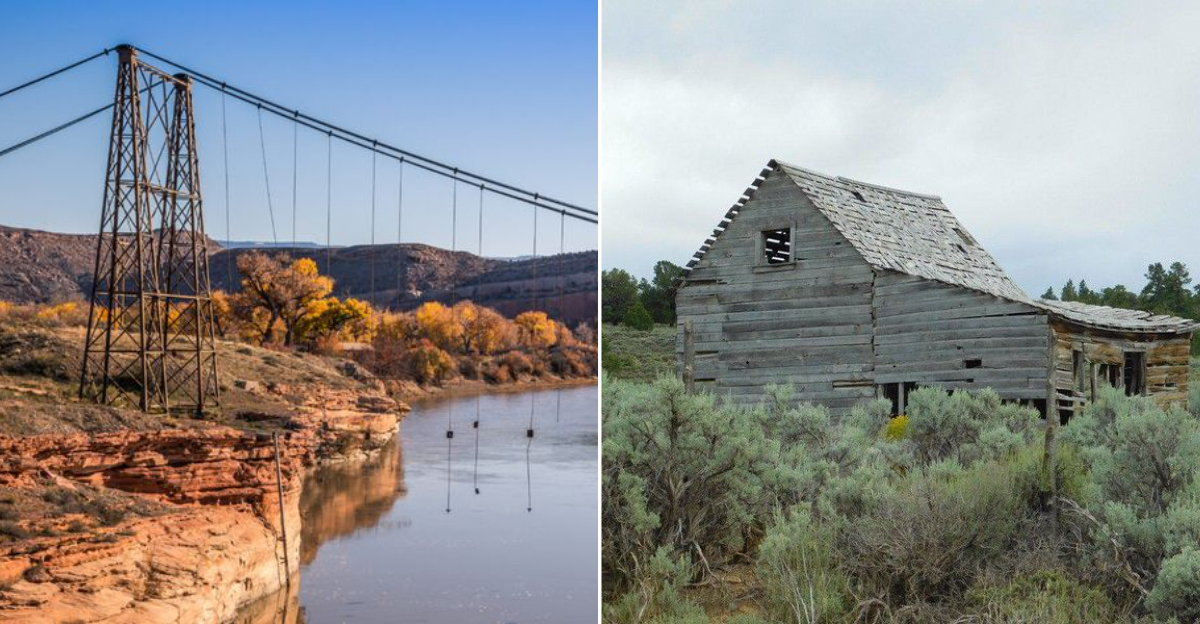
Water defines Dewey’s story more than stone or timber. The Colorado flows steady, its surface dazzling even on the hottest days.
Dewey began as a ferry town, a crossing point for wagons before bridges spanned the canyon. Floods and progress erased most traces, leaving only the bridge’s modern shadow.
Standing here, you sense transition more than absence. I found it strangely peaceful, the town dissolved, but the river endures, carrying memory forward whether anyone’s left to watch or not.
9. Grafton, Virgin River Valley, Washington County
Cottonwoods bend over the Virgin River, throwing long shadows across fields where fences still lean into the wind. The setting feels almost too serene for its past.
Founded by Mormon pioneers in 1859, Grafton endured floods, droughts, and raids, eventually forcing families to move. Its cemetery tells much of the story, with names etched against harsh years.
The backdrop of Zion Canyon gives everything cinematic weight. No wonder filmmakers came here, the ruins look born for wide screens and long silences.
10. Thistle, Spanish Fork Canyon, Utah County
Rail tracks still thread through Spanish Fork Canyon, but beside them sits Thistle, swallowed and scarred by water. What you see today is eerie and incomplete.
In 1983, a massive landslide dammed the river, flooding the town and forcing permanent evacuation. It’s one of the costliest landslides in U.S. history.
I’ve never forgotten my first glimpse: rooftops tilted at odd angles, barns half-consumed. It feels more disaster site than ghost town, grief preserved in mud and rippling water.
11. Osiris, Antimony Canyon, Garfield County
The old creamery looms pale against the canyon walls, its skeletal concrete structure still upright after decades. Birds dart in and out, softening its sharp geometry.
Osiris was a short-lived dairy experiment in the 1920s, meant to turn remote ranching into industry. It faltered quickly, leaving only the factory and scattered foundations.
This place grabbed me. Unlike other ghost towns, it’s defined by one haunting building, a single anchor for the imagination. I left convinced it’s Utah’s strangest ruin.