
The Historic Covered Bridge In Pennsylvania That’s A Must-See Every Fall
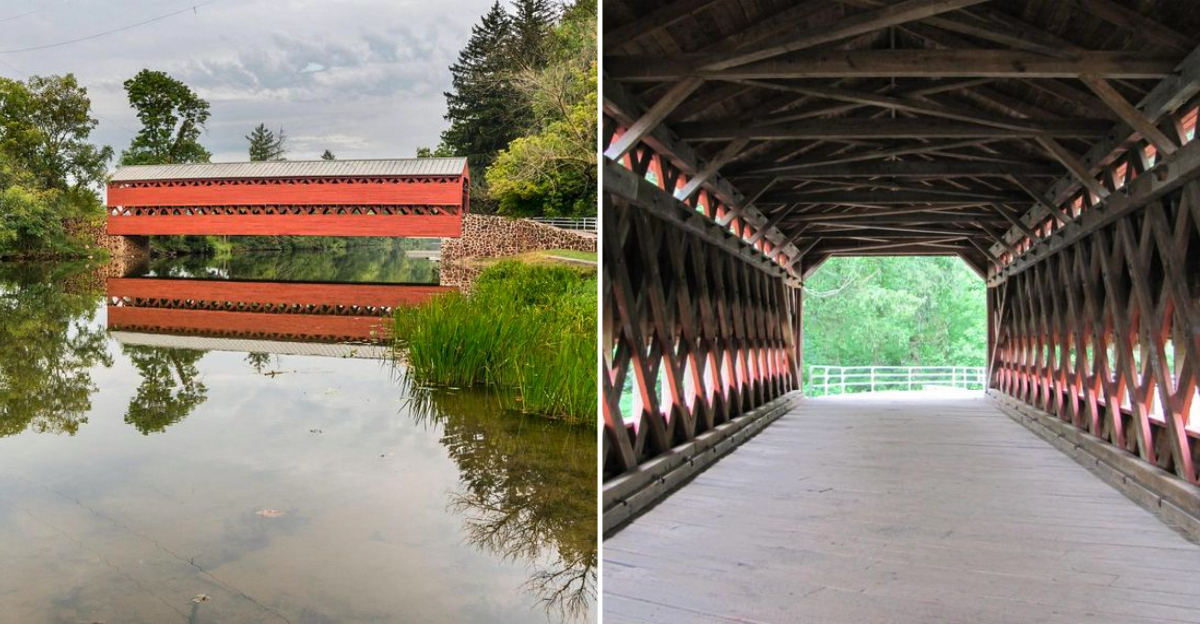
Last October, I found myself standing on weathered planks inside a 170-year-old bridge, watching sunlight filter through lattice timbers while crimson leaves drifted onto Marsh Creek below.
Sachs Covered Bridge sits just outside Gettysburg, Pennsylvania, where history and autumn collide in the most photogenic way imaginable.
Built before the Civil War and still standing strong, this pedestrian-only span offers a front-row seat to fall foliage without the crowds you’ll find on the battlefield.
Pack your camera, lace up comfortable shoes, and prepare to step back in time while nature puts on its annual color show around you.
Where It Is (And Why It’s the Perfect Fall Detour)
Finding this treasure takes about five minutes once you leave downtown Gettysburg. Sachs Covered Bridge crosses Marsh Creek on Waterworks Road and is reached from Pumping Station Road, far enough from the battlefield tours that most tourists miss it entirely.
A small parking area sits right beside the entrance, making access ridiculously simple for anyone who wants to escape the busier historic sites.
Only foot traffic crosses the bridge now, which means you can stroll through at your own pace without dodging cars or worrying about kids. The quiet setting lets you actually hear the creek below and the rustling leaves overhead.
I spent twenty peaceful minutes there without seeing another soul, something nearly impossible at Gettysburg’s main attractions during peak season.
The Autumn Moment: Water, Wood, and Color
Mid-October transforms Adams County into a painter’s palette, and this bridge becomes the star of the show. Oaks and maples surrounding Marsh Creek burst into reds, oranges, and golds that practically glow when the afternoon sun hits them just right.
On windless days, the creek turns into a mirror, doubling the color display and making every angle Instagram-worthy.
Pennsylvania’s official foliage reports help you nail the timing, because peak color shifts a bit each year depending on weather patterns. I checked the state tourism site before my trip and hit the sweet spot perfectly. Locals consider this bridge their secret leaf-peeping headquarters, the spot they return to year after year when autumn fever strikes.
A Bridge With a Battlefield Backstory
Construction crews finished this bridge sometime between 1852 and 1854, just in time for it to witness one of America’s most pivotal battles.
During the three-day clash at Gettysburg in July 1863, Union soldiers marched across these planks heading toward the fight, and later Confederate troops retreated over the same timbers in defeat. The bridge endured thousands of boots and the weight of history itself.
Recognition came officially in 1980 when the National Register of Historic Places added Sachs Covered Bridge to its roster.
Today, visitors come for the scenery and the tangible connection to the past, not because they need to cross Marsh Creek by wagon.
Saved, Restored, and Ready for Strolls
Automobiles stopped crossing in 1968, giving the aging structure a much-needed break from heavy traffic.
But nature threw a curveball in 1996 when a flash flood roared down Marsh Creek, battering the bridge and threatening to sweep away more than a century of craftsmanship.
Community members and preservationists rallied, raising funds and organizing a full restoration that wrapped up in 1997.
The rededication ceremony marked a turning point, transforming Sachs from a fragile relic into one of Pennsylvania’s most beloved pedestrian bridges.
Walking through now, you’re experiencing the best of both worlds: authentic 1850s engineering paired with modern safety updates that let families explore without worry.
What You’ll See Up Close
Step inside and you’re surrounded by a Town lattice truss, a crisscross pattern of timbers that looks almost woven.
The span stretches roughly 100 feet long and 15 feet wide, compact enough to feel cozy but roomy enough for comfortable passage. Through the openings on either side, Marsh Creek flows gently below, adding soft water sounds to your visit.
Photographers love the natural framing here because the portals create ready-made compositions without needing fancy equipment. Planks underfoot, lattice overhead, water reflections beyond – everything lines up beautifully.
I snapped a dozen shots without moving more than ten feet, each one capturing a slightly different play of light through the timbers.
Pair It With a Gentle Fall Drive
Build a perfect autumn loop by starting at the battlefield, where bronze monuments stand against fiery maples, then heading west on back roads that wind past orchards and century-old farmsteads.
The countryside around Gettysburg explodes with color from mid-October through late October, depending on how cold and wet the season has been. Each curve reveals another postcard view.
Circle back toward Sachs Covered Bridge near sunset, when golden light washes over the landscape and shadows stretch long across the fields.
I timed my route to arrive at the bridge with about an hour of daylight left, giving me that magical late-afternoon glow without rushing.
The whole drive took maybe ninety minutes with stops, but felt like a mini vacation.
Photograph It Like a Pro
Golden hour turns this bridge into a photographer’s dream, with warm light streaming through the portals and highlighting every lattice detail. Visit after a calm morning, and the creek reflections stay crisp, doubling your color payoff in a single frame.
A wide-angle lens lets you capture the full lattice interior, while a short telephoto compresses the bridge against the hillside foliage across Marsh Creek.
Because vehicles can’t interrupt your shots, you can set up your tripod, wait for perfect light, and shoot as long as you want. I experimented with different angles for nearly an hour, moving from inside the bridge to the creek bank and back again.
Every position offered something worth capturing.