
8 Forgotten Ghost Towns In Alaska That Are As Isolated As They Are Stunning
Alaska’s wilderness hides more than just glaciers and grizzlies—it’s also home to abandoned towns frozen in time.
Once bustling with miners, fishermen, and hopeful settlers, these ghost towns now stand silent, their weathered buildings whispering stories of boom and bust.
I’ll never forget the eerie feeling I got when I first stumbled across old photographs of these places, realizing how quickly human ambition can fade into the Arctic wind.
1. Portage
Nature reclaimed Portage in the most dramatic way possible after the 1964 earthquake literally sank the town. The ground dropped by six feet, turning the entire area into a tidal swamp that swallowed homes and businesses whole. Now it’s basically Alaska’s version of Atlantis, minus the mermaids.
Visiting Portage feels surreal because you can still see building foundations peeking through the marsh grass. Trees stand like skeletal sentinels, creating an otherworldly landscape that photographers absolutely love. The place gives me chills every time I see photos of it—Mother Nature doesn’t mess around.
Located along the Seward Highway, it’s actually one of the easier ghost towns to access. You can pull over and witness the power of geological forces firsthand.
2. Kennecott
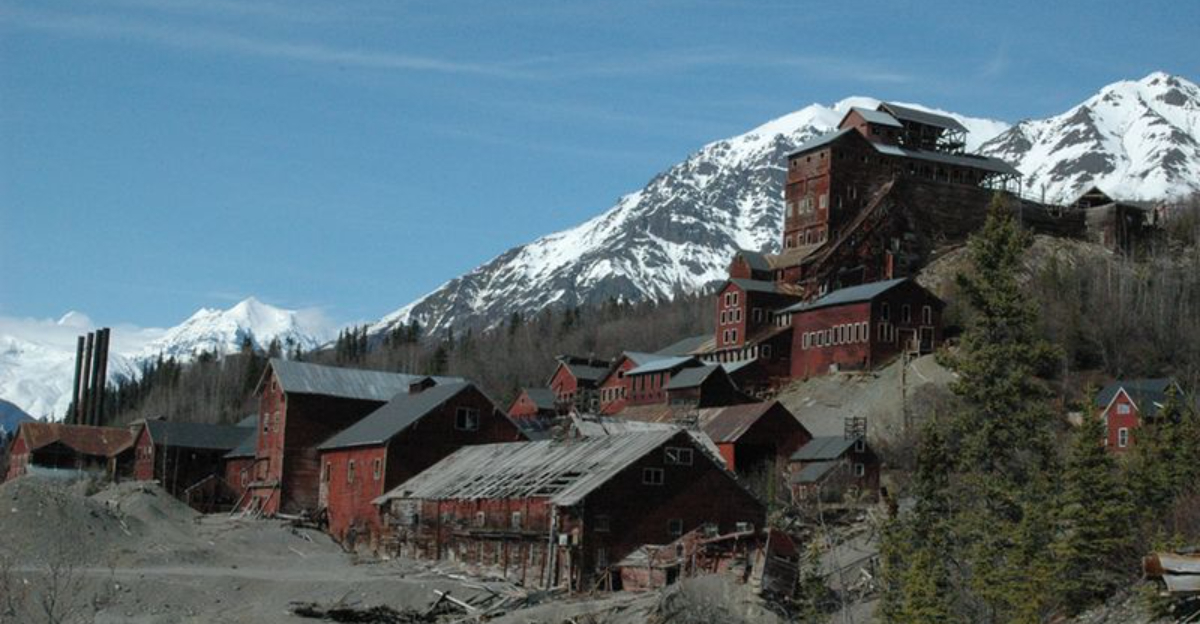
Perched in the Wrangell Mountains like a rusty crown jewel, Kennecott once produced millions of pounds of copper ore. The mining operation shut down in 1938, leaving behind a maze of red buildings that look like they’re auditioning for a movie. Walking through its empty mill feels like stepping into a time machine, complete with tools still hanging on walls.
Getting there requires serious commitment—you’ll need to drive the unpaved McCarthy Road or fly in by bush plane. The isolation adds to the haunting beauty, though. I remember reading about workers who lived here year-round, and honestly, the winters must have been absolutely intense.
Today, it’s a National Historic Landmark, so you can actually explore it legally. The views alone make the trek worthwhile.
3. Ukivok (King Island)
Imagine building your entire village on stilts clinging to a nearly vertical cliff face—that’s exactly what the Inupiat people did on King Island. Ukivok thrived for centuries before residents relocated to the mainland in the 1960s when the Bureau of Indian Affairs closed the local school. Talk about a community forced to pack up and leave.
The island sits smack in the middle of the Bering Sea, making it ridiculously hard to reach. Only the most determined adventurers make it out there now. The abandoned houses still cling to the rocks, defying gravity and time in equal measure.
Fun fact: King Island residents were famous for their incredible ivory carving skills. Their artistic legacy lives on even though the village doesn’t.
4. Unga
Unga’s story reads like a Russian novel—literally, since it started as a Russian-American Company settlement in the 1800s. The town flourished as a fishing and cod processing hub before economic decline sent everyone packing by the 1960s. Now a beautiful Orthodox church stands watch over empty streets, its onion dome still proud despite decades of neglect.
Located on Unga Island in the Aleutians, this place requires a boat or floatplane to visit. The isolation is intense, but that’s what makes it so hauntingly gorgeous. Wildflowers now grow where fishermen once walked, creating a bittersweet contrast.
I’ve heard stories of visitors finding old Russian artifacts scattered around. The cultural layers here run deep and fascinating.
5. Sulzer
Gold fever brought prospectors to Sulzer in the early 1900s, but the fever broke pretty quickly when the mines didn’t pan out as expected. What remains is a scattering of collapsed cabins slowly being devoured by the Alaskan wilderness. Nature’s reclamation project is in full swing here, with trees growing through floorboards and moss covering everything.
Finding Sulzer takes real effort since it’s tucked away in the backcountry without any roads leading to it. Hikers occasionally stumble upon it during wilderness expeditions. The remoteness means it’s been left mostly undisturbed, like a time capsule nobody bothered to open.
Honestly, places like this remind me why Alaska’s nickname is “The Last Frontier.” Some frontiers just don’t work out.
6. Makushin
World War II put Makushin on the map when the military established operations on Unalaska Island. After the war ended, soldiers went home and the town quickly emptied out like a deflating balloon. Old military structures still dot the landscape, rusting reminders of when this remote spot mattered strategically.
Reaching Makushin means flying to Unalaska first, then hiking or boating to the site. The area sits near an active volcano—also called Makushin—which adds extra drama to the scenery. I can’t imagine living in the shadow of a volcano that could blow at any moment.
Did you know? The Makushin Volcano is still considered one of Alaska’s most active. The ghost town literally lives dangerously.
7. Tin City
Sitting on Cape Prince of Wales—the westernmost point of mainland North America—Tin City served as a Cold War radar station. The military abandoned it in the 1970s when better technology made it obsolete, leaving behind a collection of aging buildings facing Siberia across the Bering Strait. You can literally see Russia from here, no joke.
Accessing Tin City requires flying to Wales village first, then making a challenging overland journey. The extreme isolation means few people ever visit. Wind howls constantly across the cape, making the abandoned structures look even more forlorn and forgotten.
The name comes from nearby tin deposits, though mining never really took off. Military purposes ended up being its main claim to fame.
8. Dome City
Gold rush dreams built Dome City in the early 1900s near Wiseman in Alaska’s interior. Miners flocked here hoping to strike it rich, but like so many gold towns, the boom went bust faster than you can say “fool’s gold.” Now only foundation remnants and scattered mining debris mark where hopeful prospectors once lived and worked.
You’ll need to reach Wiseman first via the Dalton Highway, then hike into the wilderness to find Dome City’s remains. The area is seriously remote—we’re talking grizzly country here. Most visitors come in summer when the midnight sun makes exploration safer and more pleasant.
I love how these gold rush towns represent such wild optimism followed by harsh reality. Alaska doesn’t suffer fools gladly.