
These Deserted Ghost Towns In Iowa Still Tell The Story Of The Heartland
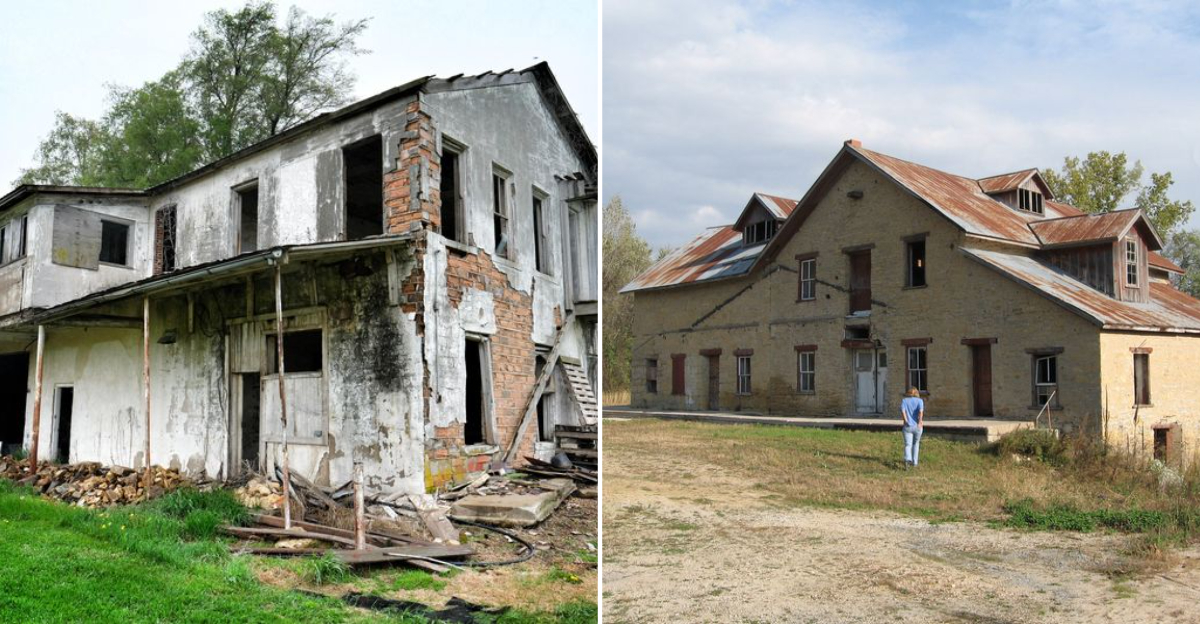
Iowa’s rolling prairies hold secrets beneath their quiet skies. Scattered across the state are towns that once buzzed with miners, merchants, and dreamers but now stand empty or vanished entirely.
These forgotten places tell powerful stories about coal booms, railroad gambles, river floods, and the hard choices farming families faced when industry moved on.
Visit these nine haunted corners of the Heartland and you’ll walk streets that time erased, yet their echoes still shape the Iowa we know today.
1. Buxton – Monroe County
Coal seams beneath Monroe County built one of the Midwest’s most remarkable communities in the 1890s.
Buxton thrived as a racially integrated company town where Black miners outnumbered whites and held leadership roles rare for that era.
Fires gutted businesses in the 1910s, then mine closures and rail shifts drained the population by the 1920s.
Today, the Buxton Historic Townsite sits on the National Register of Historic Places. Visitors find cellar holes, slag heaps, and overgrown streets that whisper tales of a pioneering social experiment.
County museums display photographs and personal accounts that keep Buxton’s legacy vivid for new generations eager to understand Iowa’s complex industrial past.
2. Muchakinock – Mahaska County
South of Oskaloosa, coal veins lured miners from the South in the late 1800s, creating a lively settlement that hummed with picks and shovels.
Muchakinock’s shafts produced tons of black gold until the seams played out and companies relocated operations elsewhere. By the early twentieth century, families packed up, and the town slipped into silence.
Foundations poke through prairie grass, and a small cemetery guards the memory of those early workers. County histories trace the boom-and-bust arc in vivid detail.
Visiting this quiet field, you sense the speed with which fortunes shifted when underground resources ran dry and railroads favored other stops.
3. Conover – Winneshiek County
Railroad fever gripped Winneshiek County in the 1860s, and Conover sprang up overnight with hotels, shops, and saloons lining muddy streets.
Entrepreneurs bet everything on becoming the regional hub, but when rail companies chose nearby towns instead, Conover’s fate was sealed. Within two decades, the buildings stood empty and fields reclaimed the lots.
Today, only plat maps and local tours preserve the memory of those vanished blocks. You can walk the old right-of-way and imagine the clatter of freight wagons that never arrived.
Conover stands as a cautionary tale about speculative booms and the thin line between prosperity and oblivion in frontier Iowa.
4. Iowaville – Van Buren County
Near the Des Moines River, settlers planted a town close to an earlier Ioway village, hoping river commerce would fuel growth.
Iowaville prospered briefly until the catastrophic 1851 flood swept away homes and wharves. When railroads bypassed the site in favor of Eldon, merchants and families followed the tracks.
Farmland now blankets the townsite, yet archaeologists still uncover pottery shards and foundations that reveal both Indigenous and pioneer layers.
Museum collections in Van Buren County preserve artifacts and stories from this double heritage.
Standing on the riverbank, you grasp how quickly water and iron rails could rewrite a community’s destiny in territorial Iowa.
5. Buckhorn – Jackson County
Buckhorn thrived as a farm hamlet anchored by its creamery, where neighbors brought milk cans each morning and swapped news over coffee.
Rural consolidation and shifting dairy markets slowly drained the population through the mid-twentieth century.
Today, an abandoned creamery, a vacant church, and a hillside cemetery stand along Highway 64 as stark monuments to that vanished agricultural rhythm.
Drive past and you see peeling paint and empty windows that once framed community life. The cemetery holds generations of farming families who bet their futures on butter and cream.
Buckhorn reminds travelers how economic forces beyond any single town’s control can erase entire ways of life in a single generation.
6. Donnan – Fayette County
Iowa’s tiniest city made national headlines in 1991 when its seven remaining residents voted to disincorporate rather than maintain municipal services.
Donnan had dwindled for decades at a rural rail junction as younger families moved to larger towns with schools and jobs. The official end came quietly, without fanfare, in a 6–1 vote by residents.
A roadside sign and museum exhibits now commemorate that poignant decision. Historians point to Donnan as a symbol of rural depopulation across the Corn Belt.
Visiting the site, you feel the weight of choices families faced between tradition and practicality, and you understand why sometimes letting go is the only honest answer.
7. Civil Bend – Fremont County
Abolitionist settlers carved homesteads from Missouri bottomlands in the 1850s and made Civil Bend a known waypoint on the Underground Railroad.
Families risked everything to shelter freedom seekers heading north, creating a legacy of courage that outlasted the town itself.
Repeated flooding and regional economic shifts eventually erased the settlement, scattering its residents to higher ground.
County byway guides and Freedom Trail write-ups keep the story alive for modern travelers. You can walk the levees and imagine lanterns signaling safe passage on dark nights.
Civil Bend proves that some places vanish from maps yet remain vivid in collective memory because of the principles people defended there.
8. Red Rock – Marion County
Lake Red Rock drowned several river towns in the 1960s when the Army Corps of Engineers built a massive flood-control reservoir. Red Rock itself lies beneath the waves, its main street and storefronts now home to catfish and bass.
Park signage along the shore recounts how the project rewrote Marion County’s map overnight, submerging several former town cemeteries while Red Rock Cemetery remained above water.
From bluffs and observation towers, you gaze across blue water that covers vanished neighborhoods. Historians debate whether the trade-off was worth the protection downstream communities gained.
Red Rock’s submerged story asks hard questions about progress, sacrifice, and who decides which places get to survive into the future.
9. Littleport – Clayton County
A devastating 1999 Volga River flood convinced most Littleport residents to accept federal buyouts and relocate to safer ground.
Bulldozers razed homes and businesses, leaving green space and scattered markers where a main street once bustled.
Littleport became a textbook case of managed retreat, a modern strategy that acknowledges some river valleys are too dangerous for permanent settlement.
Walking the empty lots, you see nature reclaiming what water claimed first. Local newspapers documented the anguish of families who chose safety over heritage.
Littleport’s story is still unfolding, a twenty-first-century ghost town born not from economic collapse but from climate realities and hard-won wisdom about living with rivers.