
10 Georgia Ghost Town Landscapes Where Nature And History Share The Same Ground
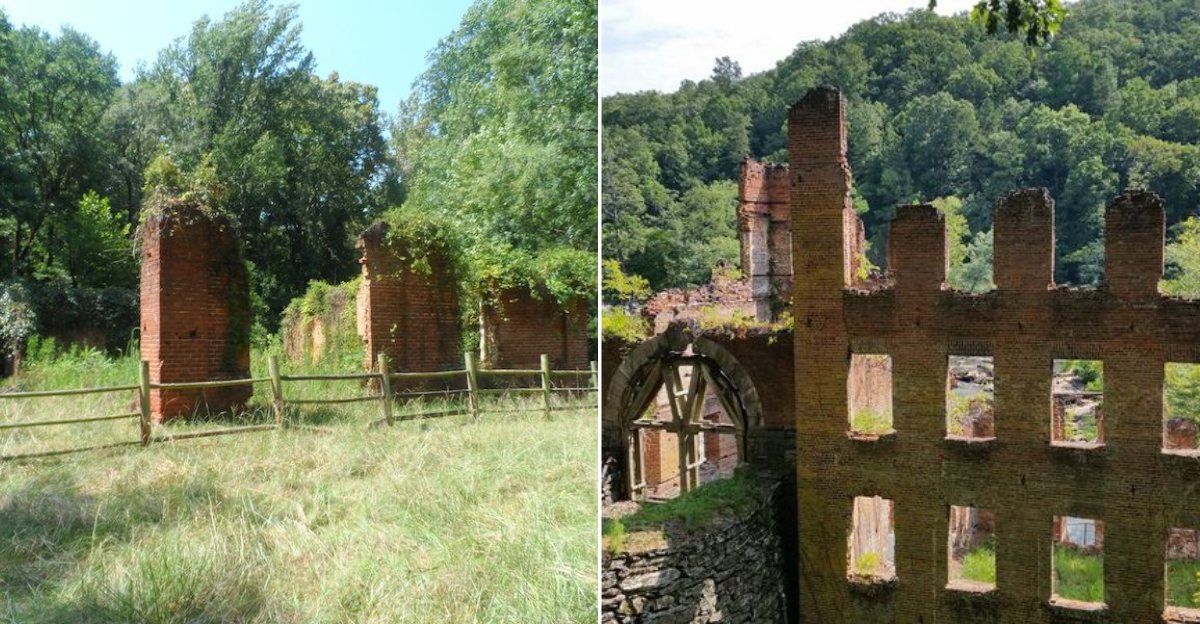
Georgia’s forgotten settlements changed the way I look at maps. I followed faint road lines into places where the pavement simply gives up, and the trees start telling the story instead.
I’ve walked through river-bitten mill ruins where brick arches frame the sky, and cemeteries where tilted stones lean into each other like tired neighbors. Ivy moves in slow, patient waves, covering what people left behind but never quite erasing it.
These stops feel less like attractions and more like rooms the state forgot to lock. If you bring good shoes, a quiet mood, and an open afternoon, you can wander through what’s left and feel history rustling around you, as fragile and present as leaves underfoot in late autumn.
1. Scull Shoals Mill Ruins In The Oconee Woods
Down a sandy road in the Oconee National Forest, Scull Shoals peeks through sycamores like a half-remembered sentence. Brick foundations and millstones nestle in leaf litter, a geometry softened by moss and river fog.
You’ll hear the Oconee’s hush before you see the ruins, and then the past arrives all at once, lint-dusted looms, timbered rafters, wages counted in daylight. Interpretive signs stitch together floods, fires, and the long quiet that followed.
It’s easy to imagine wheel creaks and shouted orders echoing off the water. Today, deer paths thread the old streets, and woodpeckers keep time where engines once did. Bring curiosity, sturdy shoes, and a camera; leave with a timeline pressed between pages of green.
2. High Falls Lost Factory Town By The Waterfall
At High Falls, the river doesn’t whisper, it roars, tumbling past where a textile town once clung to its banks. Foundation lines and scatterings of brick sketch out streets that paper records barely remember. The waterfall’s spray cools a corridor where mill hands hurried, shawls pinched against the damp.
When the dam shifted the river’s work, livelihoods drifted downstream, and the forest picked up the ledger. Today’s footpaths lace through laurel and granite, pointing to stories as much as views.
The overlook frames froth and sky while lizards sun themselves on kiln-warmed brick. Pause, and the rush sounds like machines starting up again. The ruins ask for a few quiet minutes, and pay back with decades.
3. New Manchester Mill Walls At Sweetwater Creek
Sweetwater Creek threads through one of Georgia’s most photogenic ruins, the New Manchester mill, its brick ribs rising like an open book. Civil War flames emptied the pages, but the spine holds: windows frame sky, vines annotate the margins.
The creek chatters below, pulling your eye between water and wall, past and present. Rangers tell of workers marched away, looms seized, a town unspooled overnight. Hike the red trail for intimate views, the white for bigger sweeps of river and stone.
Every season edits the scene, winter bares geometry, summer inks it in green. Stand at the threshold, where sunlight lands on bricks scorched a century and a half ago, and feel time breathing through gaps.
4. Banning Mills Village Remains Above Snake Creek
Tucked into the Snake Creek gorge, Banning Mills layers adrenaline park zip lines over quiet bones of a mill village. Look past the cables and you’ll spot stone raceways, culverts, and ghosted footings where workers’ cottages once stood.
The creek sings through a ravine that powered spindles, while kudzu tries to stitch everything shut. Interpretive plaques pull names from the silence; the wind does the rest. Trails trace the old logistics of water and work, and the swinging bridge offers a bird’s-eye footnote.
If you linger, you can almost hear shift whistles bouncing off rock. The present is loud here, but kneel by the masonry and it lowers, until one brick equals one heartbeat.
5. Sunbury Cemetery Bluffs On The Medway River
Sunbury was once a bustling port; now its cemetery keeps watch over marsh and tide. Weathered headstones tilt like sails caught in a wind that never lands, their inscriptions salted soft by the coast. Live oaks tassel the sky, limbs hung with Spanish moss that sketches gray cursive.
Walk the bluff and you’ll feel the hush of ships gone ghost, warehouses slipped into mud and memory. The river moves like a long sentence, patient and sure.
Here, history is a shoreline erosion writes and rewrites. Bring quiet feet, and the names will speak: merchants, sailors, children, all anchored to a view that outlasted their houses. The town’s absence becomes a spacious kind of presence.
6. Griswoldville Ironworks Echoes In The Pines
Griswoldville’s story is hammered into the ground more than built upon it. The ironworks that armed a war collapsed into cinders, and pines rose where furnaces once glowed. Today, the battlefield wayside and a few scattered foundations outline industry’s afterimage.
Needles carpet the earth, muffling steps; woodpeckers punch timecards in bark. Stand in the clearing and the air feels thick with smoke that isn’t there. Interpretive markers sketch pistols, payrolls, and the march that ended it.
The past hangs like resin, sticky, luminous, complicated. Nature has not erased the lines so much as traced over them in green, inviting a different kind of reading, one that weighs silence as carefully as iron.
7. Barnett Shoals Thread Mill Ghost On The Oconee
Just downstream from Athens, the Oconee curls around the Barnett Shoals site, where a thread mill once spun river power into wages. Today, lichened foundations, a dam remnant, and scattered brick whisper of shifts and spindles.
Kayakers slide past, reading froth and current; hikers pause, reading mortar and shadow. The site feels both open and secret, a clearing that edits itself with each season. Listen for kingfishers strafing the water, for the soft complaint of wind through snagged wire.
These textures, stone, river, leaf, compose a museum without glass. Stand at the edge, and your reflection warps in the shoals, as if the river is still weaving, still stitching moments into something that holds.
8. Jacksonboro Courthouse Shadows In The Cypress
Jacksonboro is a name left behind with a lingering shiver of legend. What remains is a road bend, a cemetery, and the suggestion of civic walls lost to time and floodplain. Cypress knees poke like punctuation marks in wet ground, and the air feels older than the map.
Locals speak of curses, but the power here is quieter; the steady work of water and roots. Stand by the graves and watch dragonflies patrol as if they’re bailiffs of the marsh.
Sunlight cuts through palmetto fans, striping old stones. History thins into atmosphere, and you start to notice small things: a chipped corner, a lichen bloom, the way silence arranges itself into verdict.
9. Oakville Farmstead Quiet Under Kudzu
Oakville isn’t a dot on most GPS screens, but the kudzu knows where it is. Vines drape porches, swallow fence lines, and gently cinch a roofline into a green silhouette. Under the leaves you’ll find the geometry of a farmstead: a stoop, a well cover, a scatter of enamelware winking sky.
The hush here is a summer sound, crickets carving time into neat crescendos. Step softly and you’ll see field edges still reading as straight lines, even as saplings argue otherwise.
The story is subsistence, seasons, and slow letting go. Kudzu gets the headlines, but it’s the light, soft, mottled, generous, that does the kindest editing to what’s left behind.
10. Workmore Crossroads That Time Forgot
Workmore sits at a quiet intersection where the present rarely stops to ask for directions. Empty storefronts and a sagging awning watch the road like patient sentries, their paint peeled to the past. A single gas pump, long dry, still poses for travelers who notice.
The wind carries a whisper of sawdust and diesel, the town’s former perfume. You can almost hear a screen door slap, a bell ring for lunch at the counter that isn’t there.
Power lines hum above, stitching the horizon to memory. It’s a place for respectful wandering, for letting your eye find history’s smaller gestures, handmade brick, a ghosted sign, a doorknob polished by a thousand ordinary days.