
The Longest Cave In Michigan Is Buried Under A Town Lost To Time

Michigan has caves. I know, right?
Most people picture rolling dunes, Great Lakes sunsets, and endless forests when they think of the Mitten State, but underneath one forgotten corner of the Upper Peninsula lies the longest cave system in Michigan.
What makes this story even stranger is that the cave sits directly beneath what used to be a thriving quarry town, now completely vanished into the pines.
I stumbled across this place on a rainy September afternoon, following vague directions and a hunch, and found myself standing at the edge of an abandoned limestone pit, surrounded by the skeletal remains of buildings and streets that once hummed with life.
A Ghost Town in the Pines

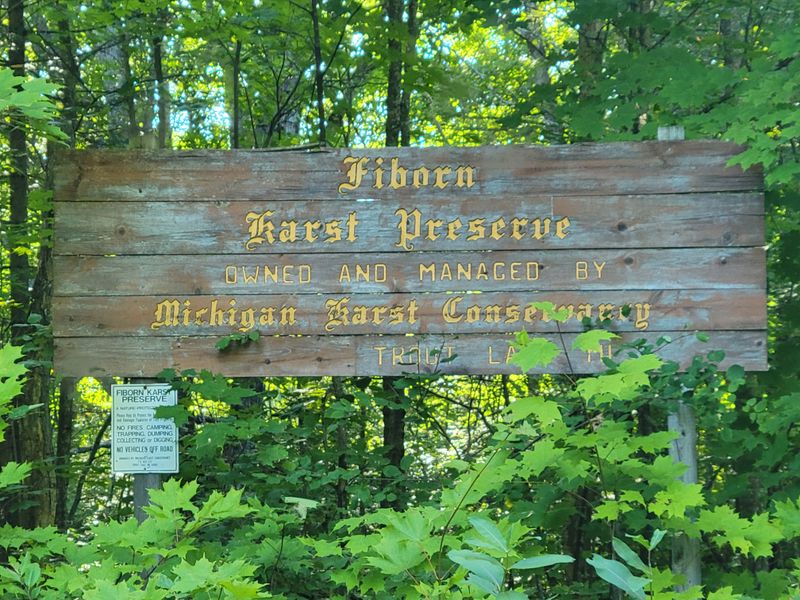
Today, the place is known as Fiborn Karst Preserve, a several-hundred-acre tract of protected land in Mackinac County, not far from Naubinway and Trout Lake.
What you see first is the quarry bowl: a pale, scraped landscape slowly being reclaimed by birch and spruce, with the shell of a limestone processing building watching over it like a stone sentinel.
Fiborn was once a company town built for quarry workers and their families.
The paved streets are gone, the telephone poles and storefronts vanished, but hints of the old community linger.
Rock foundations, rusted relics, and faint lines where streets once ran through the trees tell the story of a place that simply stopped.
I remember crouching down to trace my fingers along a crumbling concrete slab, imagining the footsteps that once crossed it daily, and feeling the weight of all that silence.
The Quarry Town That Time Forgot

Fiborn began with limestone. Around 1904 or 1905, entrepreneurs Chase Osborn and William Fitch opened a quarry here to mine an unusually pure limestone deposit, later incorporating the operation under the name Fiborn, a mash-up of their surnames.
A town quickly grew beside the pit: a boarding house that doubled as town hall, a company store with the only phone in the area, a post office, a schoolhouse where a couple dozen children learned their letters before running off to play among the piles of stone.
Then, as demand shifted and operations moved elsewhere, the quarry closed for good in 1936.
One by one, families left. By the mid-1940s, the last superintendent moved away, and Fiborn slipped into memory, its buildings surrendered to snow, rain, and encroaching forest.
Meet Hendrie River Water Cave – Michigan’s Longest
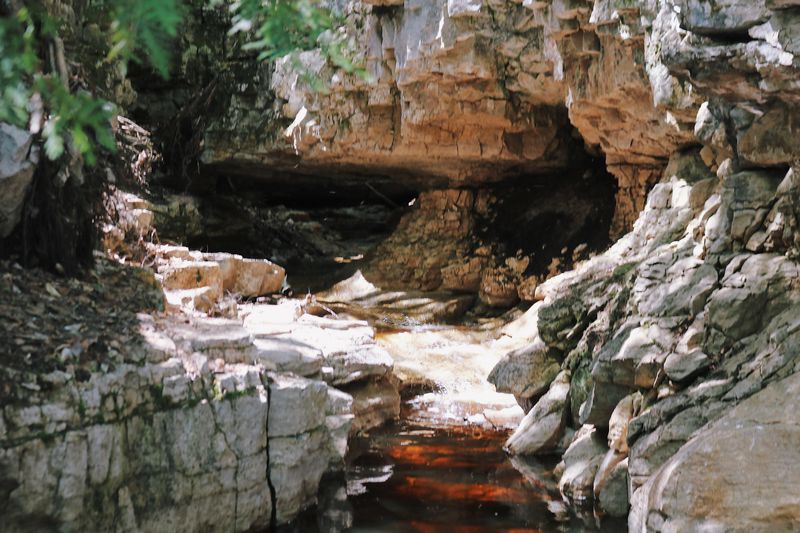
Beneath this quiet town, water was busy writing its own story.
As surface streams sank into fractures in the limestone, they slowly carved an underground corridor now called Hendrie River Water Cave.
Measured at about 1,500 feet of passage, this is the longest known cave in Michigan, with a cold stream running along much of its floor.
The Hendrie River flows directly through it and emerges as a branch of the river a short distance away, making the cave part of a larger underground drainage system feeding into the Tahquamenon River basin.
This is not a show cave with walkways and colored lights.
It is raw, wet, and narrow, a true speleological site overseen by the Michigan Karst Conservancy, which manages both the preserve and the fragile subterranean environment.
Walking the Ruins Above the Darkness
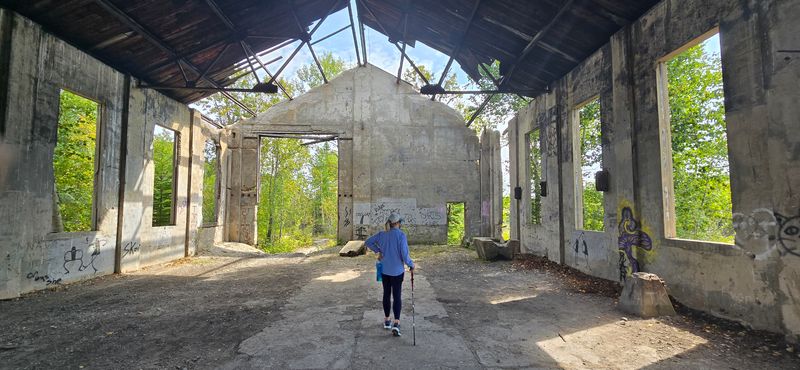
Most visitors never see the inside of the cave, and that is okay, because the surface tells its own compelling story.
Two self-guided trails loop through Fiborn Karst Preserve: one skirting the rim of the quarry and Fiborn pond, the other weaving through sinkholes, disappearing streams, and second-growth forest.
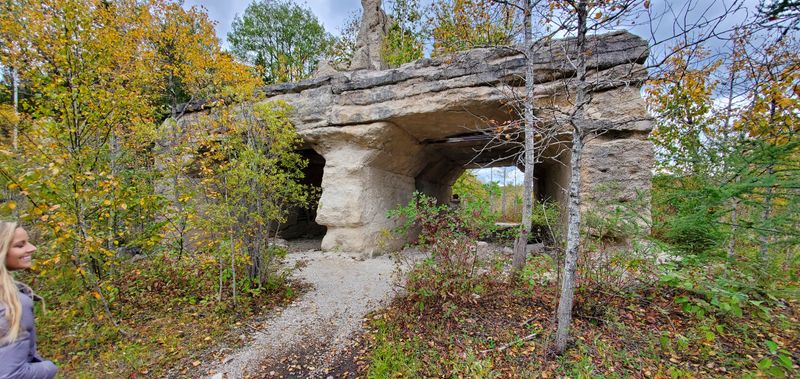
As you walk, you pass the remnants of the loading house, the ore car loader, and other skeletal ruins of the quarry works.
Trees stand where factory floors once shook with machinery.
Wildflowers push up through broken concrete.
It feels less like a museum and more like a place that simply paused in the middle of its own story, letting moss and leaves fill in the missing pages.
I spent an hour just wandering, listening to birdsong and the crunch of gravel underfoot.
Karst Country: Sinkholes, Springs, and Vanishing Streams
Fiborn is more than a town that vanished. It is a textbook example of karst terrain, where soluble rock like limestone dissolves, creating sinkholes, caves, and springs.
On the Sinkhole Trail, you can watch a small creek simply disappear underground, swallowed by fractured rock and re-emerging elsewhere as a spring.
Shallow basins dimple the forest floor, some water-filled, others fringed with ferns and moss.
All of this surface drama is connected to what happens below: water carving pathways through the Hendrie River Water Cave and other, smaller caves in the area, reshaping the landscape grain by grain over thousands of years since the last glaciers melted away.
Standing beside one of those vanishing streams, I felt like I was watching geology in real time, the earth literally drinking the water down.
Inside the Cave: Waterfalls, Diamond Ceilings, and the Goop Loop
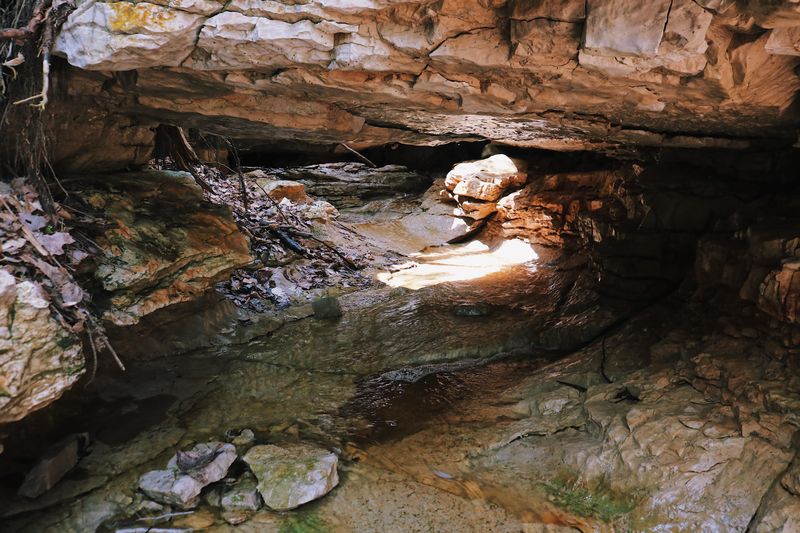
For those with proper training, gear, and written permission, the Hendrie River Water Cave offers a far more intense experience.
The passage is mostly high but narrow, with ankle- to knee-deep water and slick rock underfoot.
Near the far end of the explored passage, the stream drops over a roughly six-foot waterfall into a circular tunnel cavers call the Goop Loop, a muddy, constricted route where the water eventually sumps out and continues unseen.
Look up, and you will see one of the cave’s most delicate sights: condensation beading on the ceiling in tiny droplets.
When a headlamp beam hits them just right, they glitter like a sheet of cold stars, the kind of small, secret beauty that makes the long, wet crawl worth it for serious cavers.
Bats and a Fragile Underground World

Hendrie River Water Cave is not just about rocks and water. It is also a critical habitat.
The cool, stable temperatures make it a seasonal haven for bats, including species like the little brown bat and northern long-eared bat, which use the cave areas for swarming and hibernation.
Because North American bat populations have been hit hard by white-nose syndrome, a fungal disease, cave access is tightly controlled.
Permits, decontamination procedures, and gear requirements are not red tape for the sake of it.
They are part of keeping these sensitive animals, and the cave ecosystem itself, alive and functioning.
Above ground, the same limestone and thin soils that make caves possible also support unusual plant communities, so every off-trail shortcut has more impact here than it might in an ordinary forest.
Planning Your Own Trip Back in Time
Reaching Fiborn feels like following a rumor.
You leave the main highway between St. Ignace and Newberry, turn onto smaller county roads, and eventually bump along a rough track toward the preserve.
There are no flashy signs, and cell service can be patchy.
Once you arrive, expect minimal facilities: trailhead signs, informal parking, and miles of quiet. Bring water, sturdy shoes, and a good sense of direction.
The quarry ruins and karst trails are open for respectful exploration, but any trip inside Hendrie River Water Cave requires prior written permission from the Michigan Karst Conservancy and proper caving equipment.
Walk the trails slowly, listen for water vanishing underground, rest your hand on a sun-warmed limestone wall, and think about the town that rose and fell here in just a few decades.