
This Ohio Mushroom House Shows Why Cincinnati’s Most Whimsical Home Still Stuns Visitors
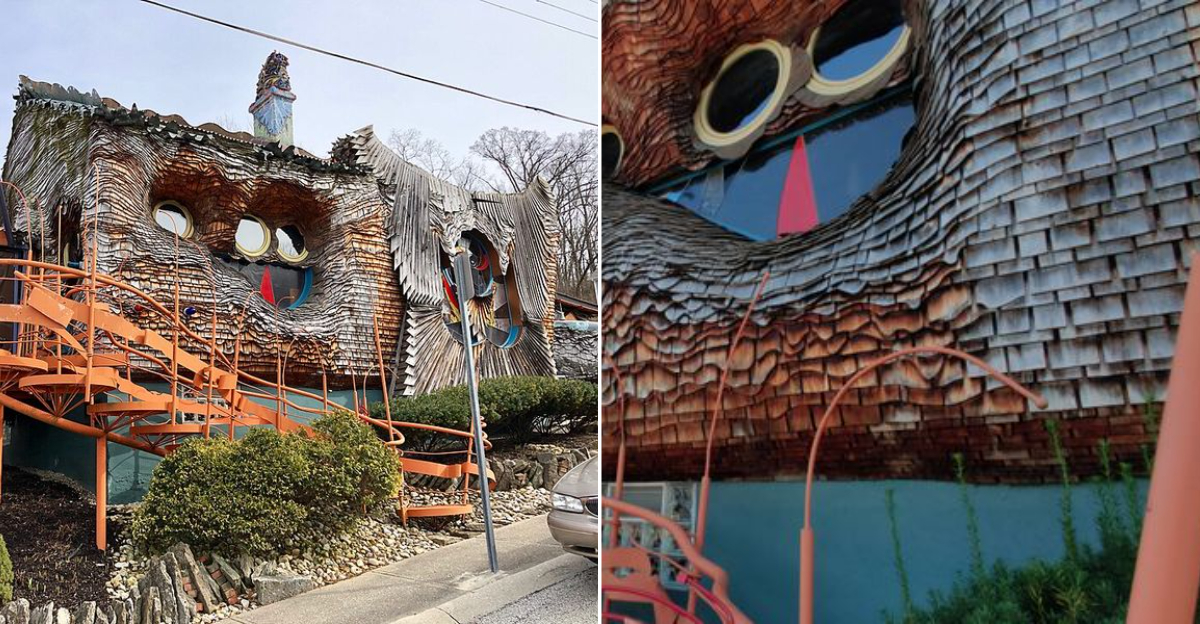
I remember the first time I ended up on Erie Avenue without much intention, slowing down near 1070 Erie Avenue, Cincinnati, OH 45208, because the street itself seemed to shift tone there, as if it were gently insisting that I pay attention before moving on.
The approach is quiet and almost deceptive, lined with ordinary houses that encourage you to stay on autopilot, and then the curves begin to rise, soft and storybook, pulling your eyes upward and outward in a way that feels less like surprise and more like recognition.
I noticed how other people reacted before I fully absorbed it myself, joggers easing into a walk, cyclists coasting, neighbors pointing out details to companions who clearly hadn’t noticed everything yet, and that shared pause became part of the experience.
The Mushroom House doesn’t declare itself as an attraction, and standing there on the sidewalk you realize how much that matters, because it exists fully as a home while quietly behaving like a sculpture that just happens to be lived in.
Knowing that architect Terry Brown designed it as a personal dwelling makes the encounter feel intimate rather than performative, and I found myself imagining daily routines shaped by those rounded walls, light sliding differently across each surface as the hours pass.
What stayed with me long after I left wasn’t just the novelty of the form, but the calm confidence behind it, the sense that playful architecture doesn’t need to shout or explain itself to earn respect.
Visiting this small corner of Cincinnati reminded me that a single, thoughtful building can gently recalibrate how you see a whole neighborhood, if you’re willing to slow down and stand still for a few minutes.
Approach From Erie Avenue
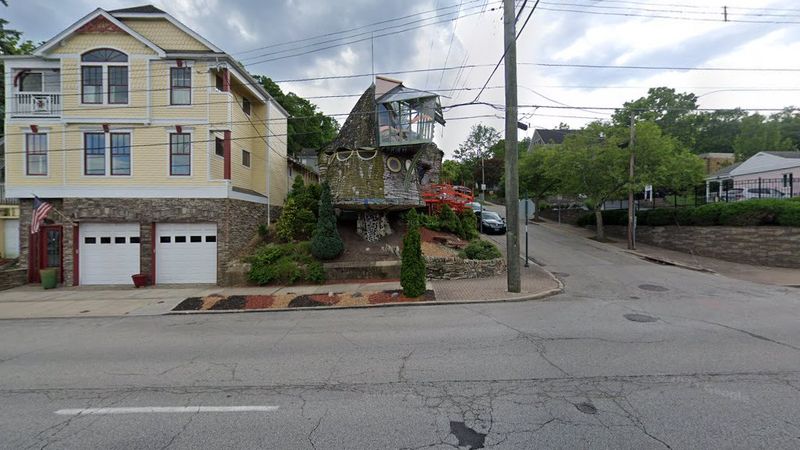
Coming along Erie Avenue, the house reveals itself gradually, with rooflines that dip and rise in uneven rhythms, layered shingles that read like petals or scales depending on the light, and small flashes of color that catch your eye before you fully register the form.
The effect is disarming rather than shocking, as if the street itself momentarily loosens its posture and allows architecture to breathe in a different tempo.
Traffic continues, joggers pass, but the house creates a visual pause that subtly slows the block without ever asserting dominance over it.
Standing back near the crosswalk gives you the clearest sense of the full silhouette, where the curves feel intentional rather than decorative.
Nothing aligns to a rigid grid, yet nothing feels careless, a balance that becomes clearer the longer you stand and look.
The building rewards distance first, detail later, encouraging restraint instead of immediate inspection.
Approaching this way prepares you to read the house as a whole before getting lost in its many parts.
Read The Shingles Up Close
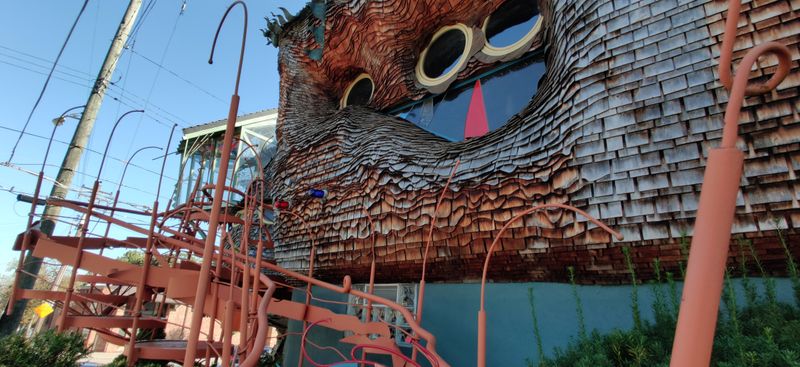
At closer range, the shingles reveal themselves as individually shaped elements rather than uniform repeats, overlapping like leaves or fish scales and casting shadows that shift subtly as clouds pass overhead.
Edges ripple instead of snapping into alignment, creating a surface that feels alive and responsive rather than fixed.
Even from the sidewalk, you can study this texture without stepping onto private space, which keeps the experience respectful and unforced.
The pattern never settles into repetition, preventing your eye from resting too easily or skipping ahead.
This surface reflects years of experimentation rather than a single design gesture, built slowly through iteration and adjustment.
The result feels handcrafted without nostalgia, expressive without chaos.
Spending time here teaches you how much patience is embedded in what first looks spontaneous.
Color Through The Glass
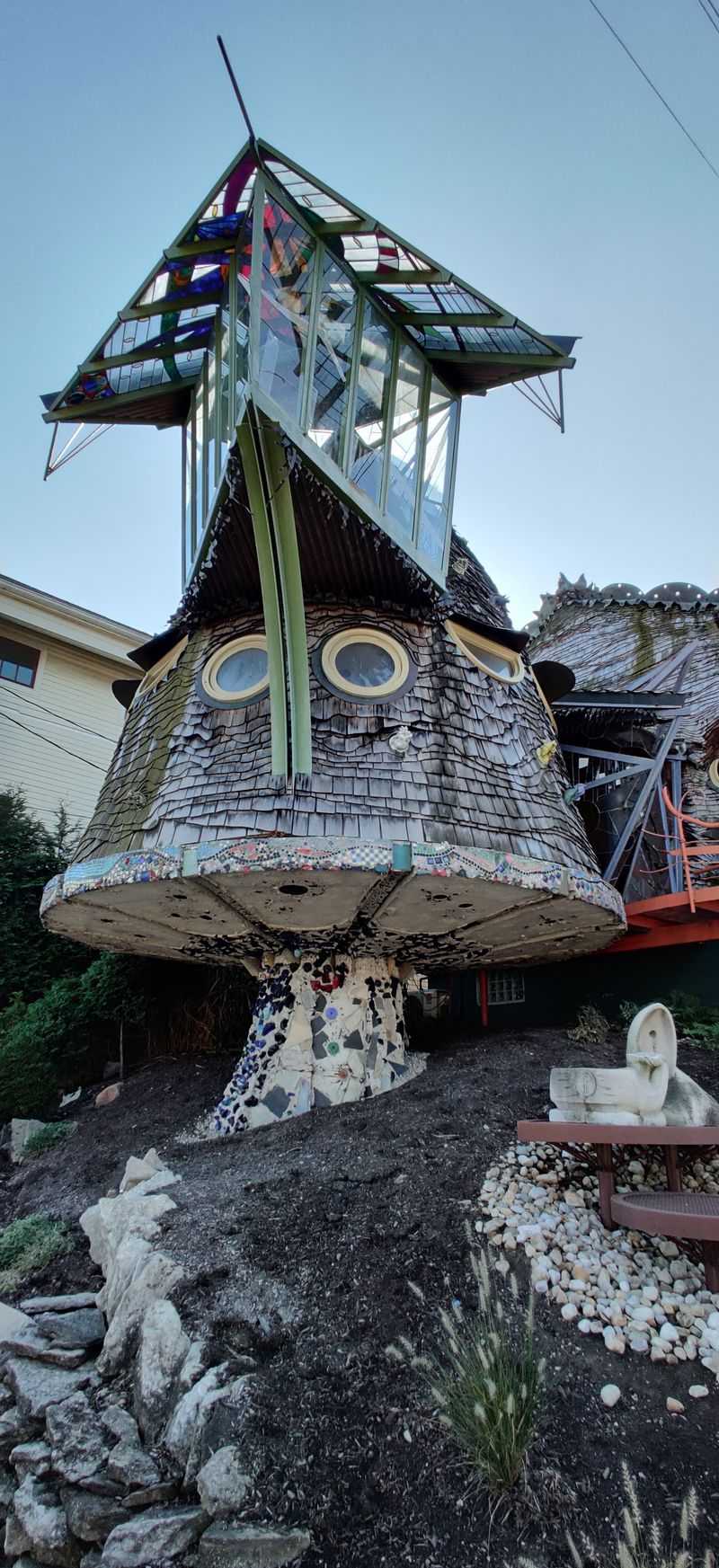
Small panes of colored glass scatter across the facade like quiet punctuation marks, filtering light into greens, ambers, and muted tones that never overwhelm but gently redirect attention.
When sunlight thins or clouds drift, these panes briefly turn the house into a lantern, projecting soft color onto the sidewalk without theatrical brightness.
The frames resist symmetry, which keeps your gaze moving instead of locking into predictable patterns.
This irregularity reflects a philosophy that values variation as structure rather than flaw.
The glasswork connects the house to craft traditions that resist factory sameness and reward handwork.
Dusk offers the most subtle version of this effect, when light and shadow negotiate evenly.
Watching these colors shift reminds you that the house is designed to change with time rather than remain static.
Porch Like A Mushroom Cap
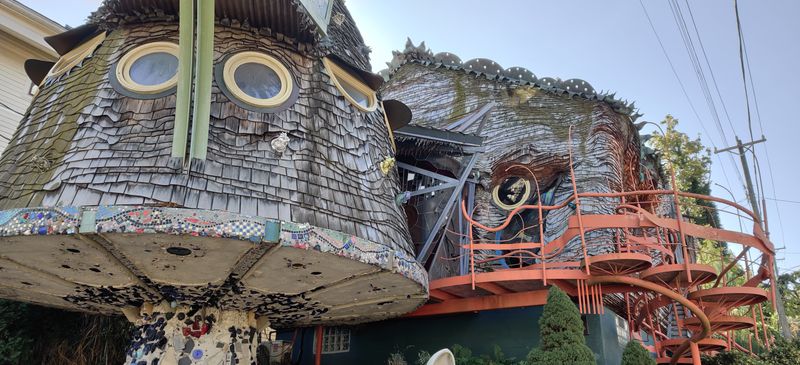
The porch curves outward in a slow, sheltering gesture that immediately reads as both invitation and protection, its rounded form hovering above the entry in a way that feels light and almost buoyant despite the clear structural confidence holding it in place.
What looks playful at first reveals careful balance the longer you study it, because the cantilever never feels exaggerated or showy, instead settling into a proportion that suggests long testing rather than a single dramatic decision.
Rain makes this element especially legible, as water beads and runs along the edge in clean lines that trace the logic of the form far better than drawings ever could.
Brown’s architectural language here borrows from nature without copying it, allowing metaphor to guide shape while structure quietly does the work.
The porch becomes a mediator between street and interior, softening the transition without sealing it off.
Seen from the diagonal, the cap-like curve feels less like a reference and more like a behavior, a way of responding to weather, scale, and movement.
Lingering just long enough to watch light and shadow move across this surface gives you a concentrated lesson in how restraint can make whimsy durable.
Look For Handwrought Metal
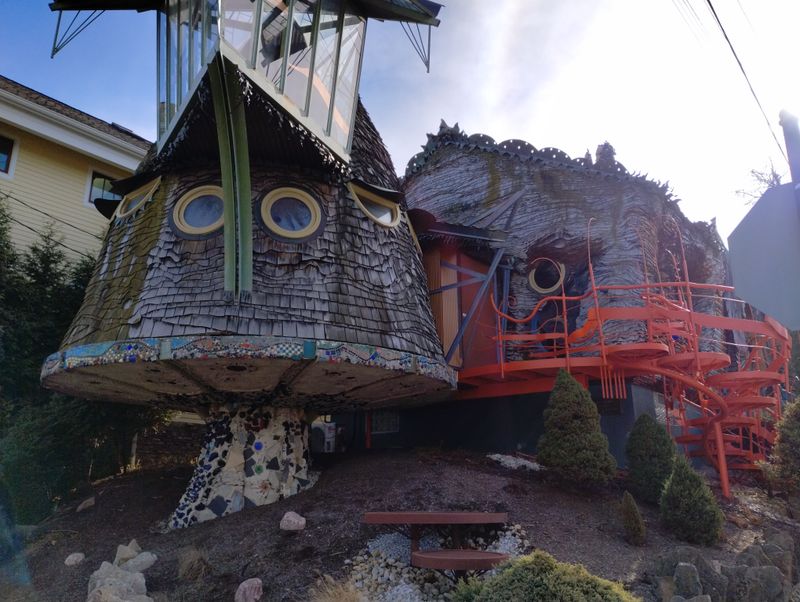
Metal elements appear almost as afterthoughts at first glance, but the longer you look, the more their subtle curves and slight irregularities begin to assert themselves as essential rather than decorative.
Railings twist gently, brackets arc without repeating, and the patina settles into warm tones that sit comfortably against wood and shingle instead of competing for attention.
These details reveal the building’s long evolution, shaped through teaching and making rather than delivered as a finished object.
You can sense the accumulated learning embedded in joints and transitions, where function and ornament refuse to separate cleanly.
Sunlight threading through small gaps activates these pieces briefly, then releases them back into quiet usefulness.
Nothing here feels mass-produced, yet nothing demands reverence either.
Spending time with these metal elements teaches you to read craft not as embellishment, but as accumulated decision-making made visible.
Find The Flowing Stair
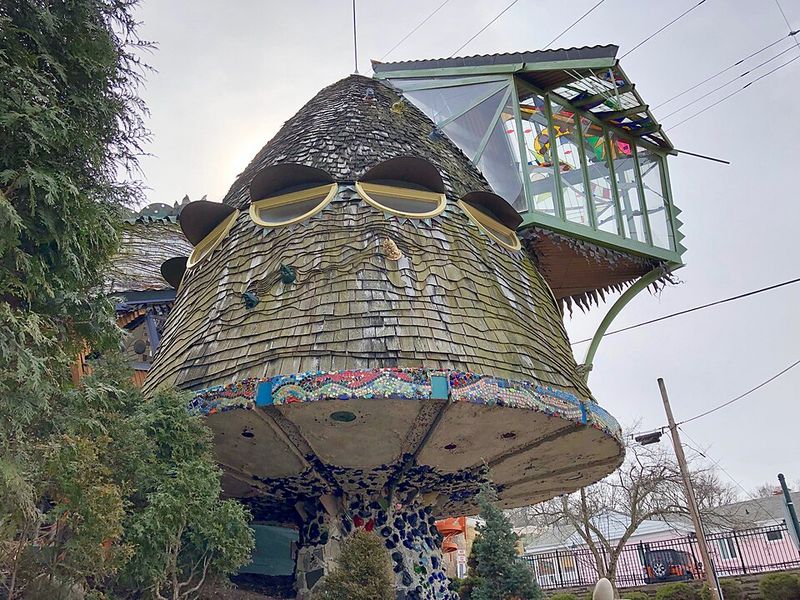
The exterior stair avoids the straight-line authority most architecture defaults to, instead drifting upward with a gentle sway that subtly adjusts how your body imagines moving through the space.
Treads lean toward one another as if in conversation, and the balustrade sweeps alongside them like a single, continuous gesture rather than a sequence of parts.
Even without stepping onto it, you feel your pace slow, as though the stair has already begun choreographing movement from a distance.
This emphasis on motion reflects Brown’s broader design thinking, where buildings remember activity even when unoccupied.
The line between access and sculpture dissolves here, not through abstraction, but through familiarity.
Seen from below, the stair reads like a drawing pulled into three dimensions and then softened by use.
Watching others pass it, you realize how architecture can guide behavior without instruction, simply by suggesting a rhythm worth following.
Seasonal Light In Winter
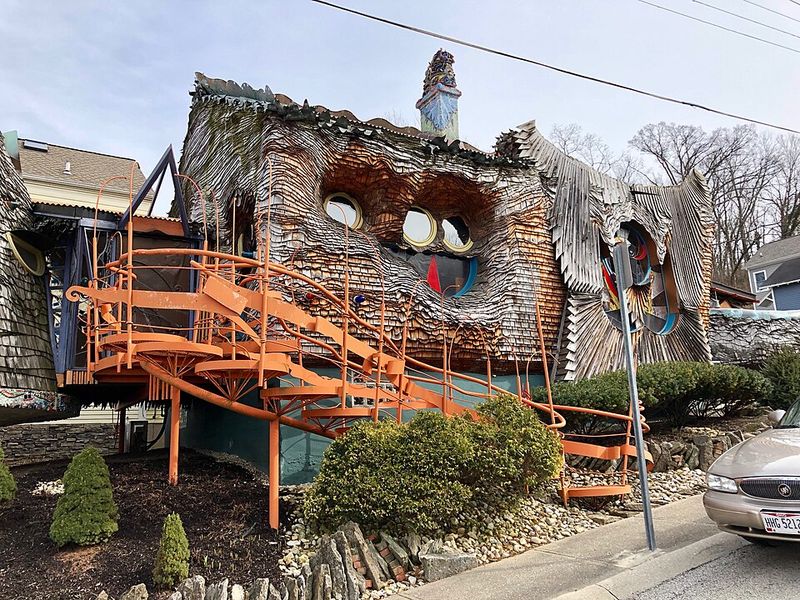
When winter strips the trees along Erie Avenue down to their bare structure, the Mushroom House suddenly reads with an almost architectural clarity, as low sunlight slides across its surfaces and exaggerates every curve, seam, and overlap in a way that summer foliage tends to soften or partially hide.
The absence of leaves allows the silhouette to assert itself fully, turning the roofline into a slow, continuous drawing against the sky, while shadows settle deeper into the shingles and make the texture feel almost topographic.
Cold air seems to suit the building, slowing visitors naturally and encouraging longer pauses where details emerge gradually rather than all at once.
This season also quiets the street, reducing visual noise and letting the house converse more directly with light instead of surroundings.
People who return in winter often notice elements they missed entirely during warmer months, not because the building has changed, but because attention sharpens when distraction falls away.
The house feels less whimsical and more composed in this light, revealing how disciplined its construction really is.
Standing there bundled against the cold, you begin to understand that the building was never meant to be glanced at quickly, but revisited under different conditions until its logic settles in.
Neighborhood Rhythm
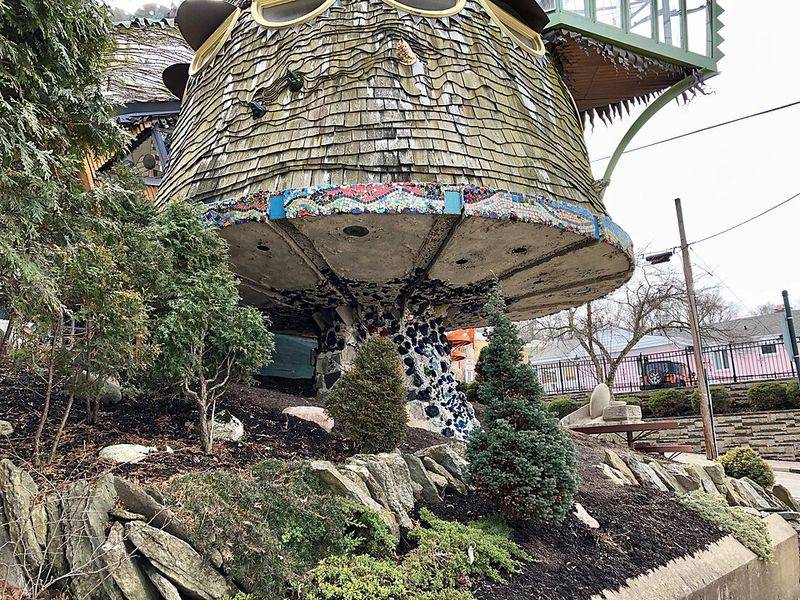
Placed among clipped hedges, conventional porches, and tidy sidewalks, the Mushroom House reads not as a disruption but as a thoughtful aside, something quietly spoken in a neighborhood that values order and continuity.
Dogs tug leashes past it, delivery trucks idle nearby, and daily routines unfold without ceremony, while the house adds a momentary pause rather than demanding attention.
Its scale remains considerate, never overwhelming adjacent homes or asserting dominance through size or height.
That restraint is precisely what allows it to feel generous instead of indulgent, playful without tipping into spectacle.
Hyde Park’s long-standing porch culture and pedestrian rhythm make this contrast feel earned rather than forced.
The house does not ask the neighborhood to adjust to it; instead, it adjusts itself to the pace already there.
Watching ordinary life move around such an unusual structure makes clear that lasting architectural impact often comes from coexistence rather than confrontation.
A Study In Craft Education
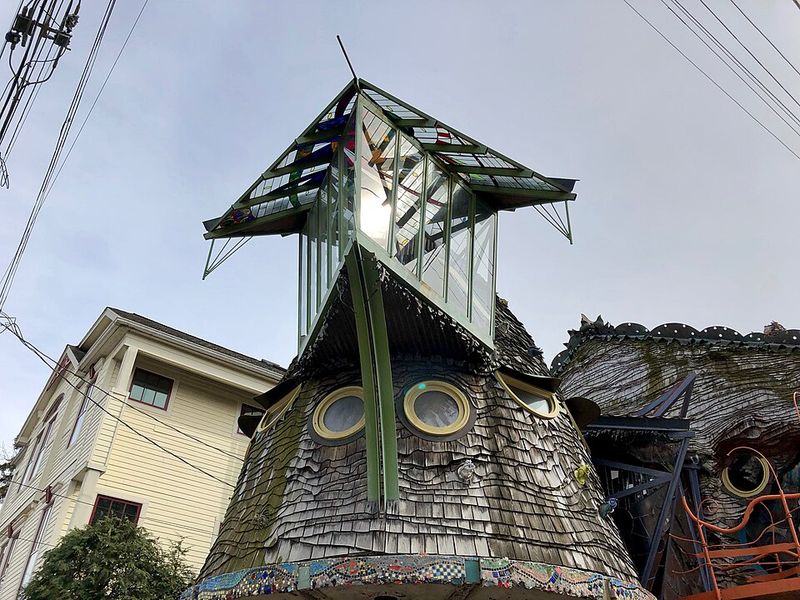
Seen through the lens of its making, the Mushroom House functions less as a finished artifact and more as a long-running studio project, shaped by semesters of teaching, testing, revising, and rebuilding rather than a single closed design phase.
Architect Terry Brown’s role as an educator is embedded everywhere, from experimental joints to unresolved edges that feel intentional rather than incomplete.
This was a place where ideas were tried at full scale, corrected in real time, and allowed to evolve through use.
The house carries evidence of learning, not perfection, which gives it an honesty many polished buildings lack.
Its story matters as much as its form, because the lessons are visible if you know how to look.
Nothing here feels mystical or precious; instead, it feels practical, inquisitive, and persistent.
Understanding the building as an educational process rather than a singular object reframes every curve as a question that was asked, tested, and left partially open.
Photograph Without Fuss
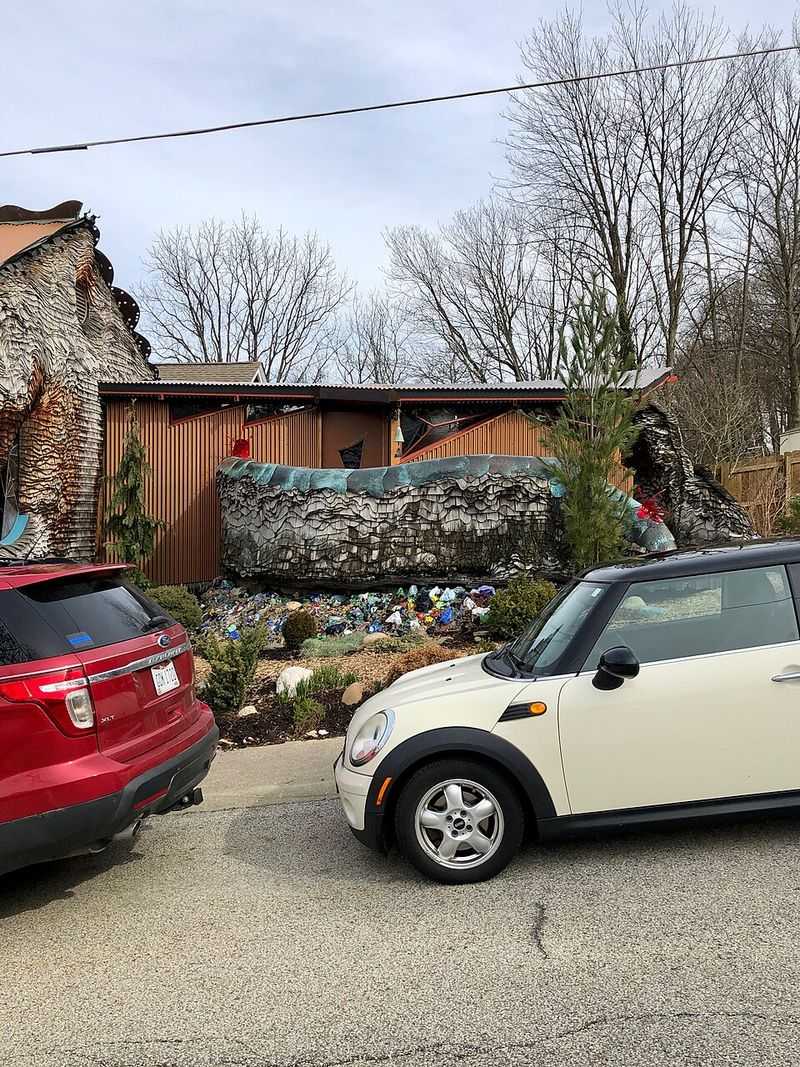
Photographing the Mushroom House rewards speed and restraint, because light shifts quickly, cars pass through frames, and the building itself offers more than enough complexity without aggressive framing or heavy equipment.
Wide shots capture the overall gesture best, while stepping back slightly helps avoid distortion that flattens the curves into novelty.
Details reveal themselves naturally if you let the lens settle instead of forcing angles.
Heavy editing tends to erase texture and nuance, replacing depth with graphic clarity that does not reflect the building’s actual presence.
Simple exposure choices and patient timing preserve the layered surfaces and subtle shadows more honestly.
Remaining on the public sidewalk keeps the interaction respectful and unobtrusive, which matters in a residential setting.
A short, focused visit usually yields better images than extended hovering, allowing you to leave with photographs that feel observed rather than extracted.