
This Otherworldly Ohio Trail Could Easily Have The Most Wonderfully Weird Sculptures Around
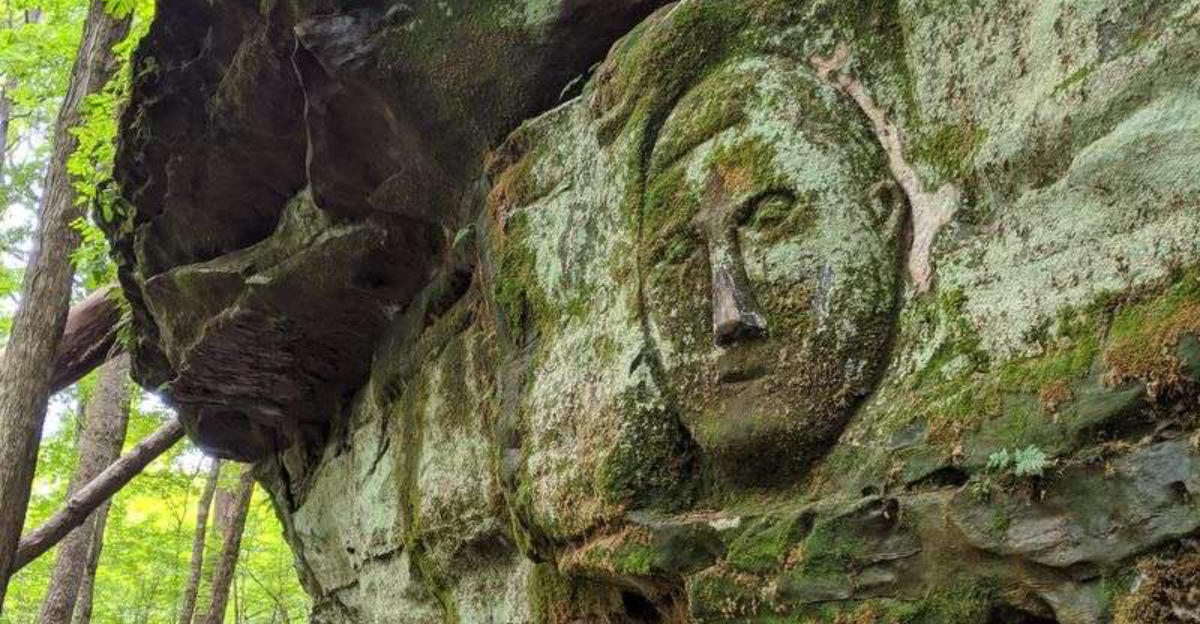
I stumbled upon Worden’s Ledges Loop Trail on a crisp autumn morning, and honestly, I wasn’t prepared for what I found tucked away in Hinckley Reservation.
This short but spectacular 0.75-mile trail combines Mother Nature’s ancient sandstone artistry with some of the most bizarre and captivating hand-carved sculptures you’ll ever encounter.
What makes this place truly special is how seamlessly the natural rock formations blend with human creativity, creating an experience that feels equal parts hiking adventure and outdoor art gallery.
If you’re looking for a quick escape that’ll make you feel like you’ve stepped into another world without leaving Ohio, this trail absolutely delivers.
The Magnificent Sphinx That Guards the Ledges
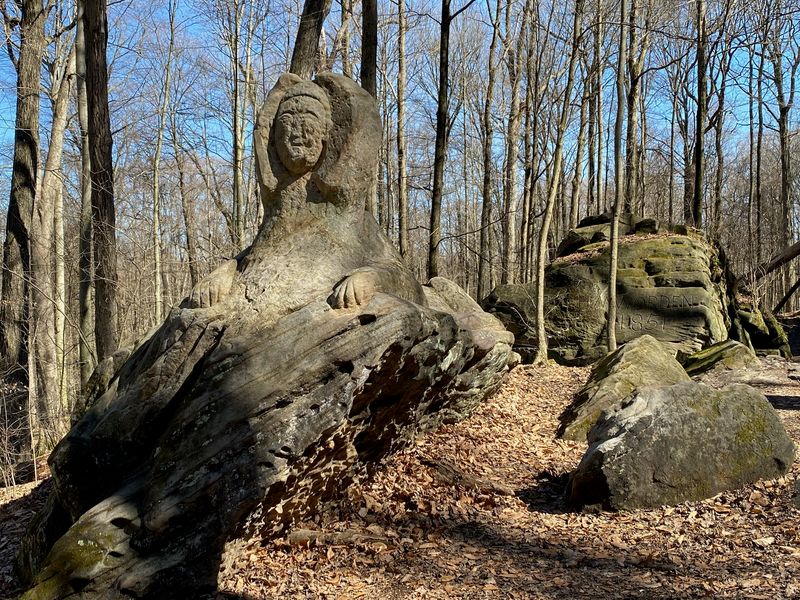
Walking around a bend in the trail, I nearly jumped when I spotted what looked like an Egyptian monument staring back at me from the Ohio woods.
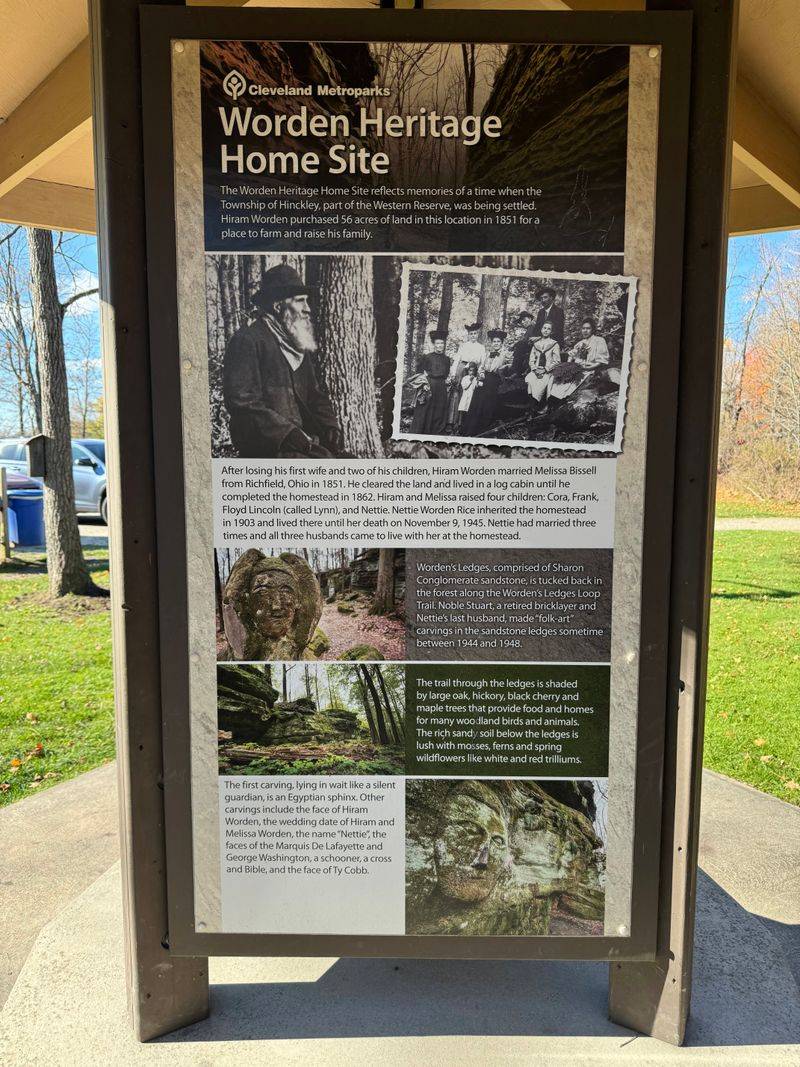
The sphinx carved by Noble Stuart measures over eight feet long and stands nearly four feet tall, and it’s honestly one of the most impressive pieces of amateur rock art I’ve ever seen.
Stuart created this masterpiece in the 1940s using nothing but hand tools and determination.
The level of detail is remarkable-you can make out the facial features, the headdress, and the powerful body of this mythical creature all hewn from a single massive boulder.
What struck me most was how the moss and weathering have actually enhanced the sculpture’s mystique.
It doesn’t look out of place here; instead, it feels like an ancient guardian that’s been watching over these woods for centuries.
I sat on a nearby rock for at least twenty minutes just admiring the craftsmanship.
My friend Sarah, who came with me, kept saying it looked like something from an Indiana Jones movie, and honestly, she wasn’t wrong.
The Mysterious Face Carvings Hidden In Stone
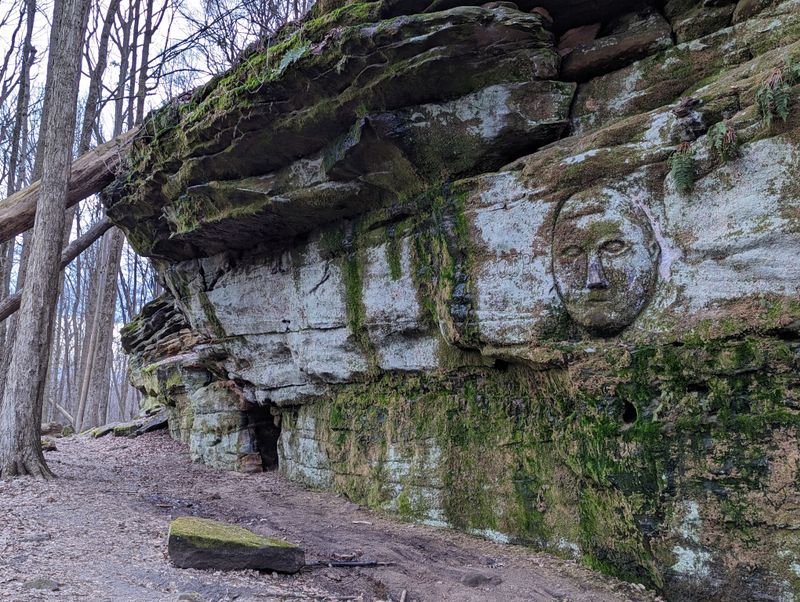
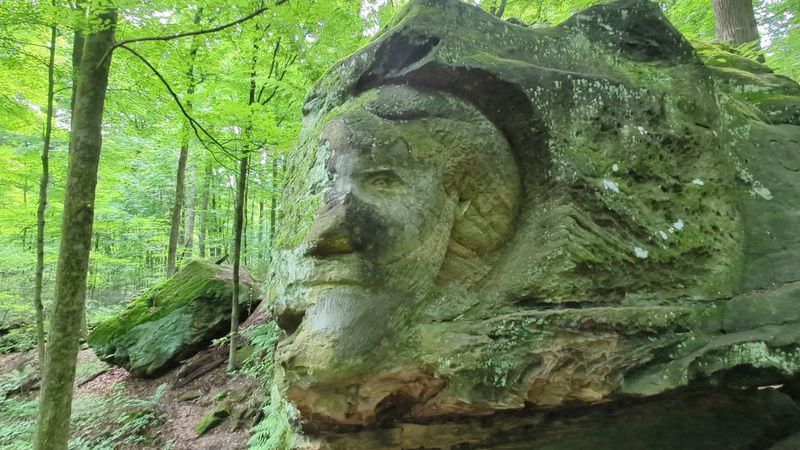
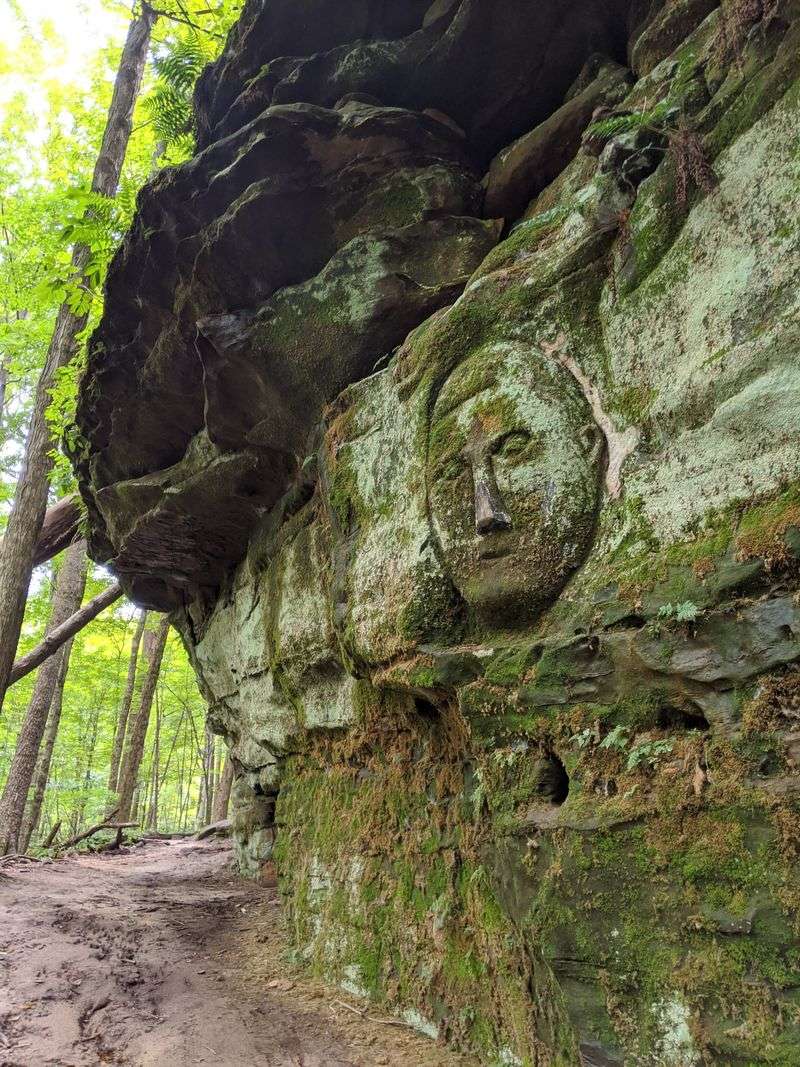
Noble Stuart had a thing for faces, apparently, because scattered throughout the ledges you’ll find several haunting visages peering out from the rock.
One of them is rumored to be Ty Cobb, the legendary baseball player, though I’ll admit I couldn’t quite confirm that from my high school history knowledge.
Each face has its own personality and expression.
Some look serene and contemplative, while others seem almost mischievous, like they’re in on some cosmic joke the rest of us haven’t figured out yet.
Finding these carvings feels like a treasure hunt.
They’re not all obvious or marked with signs, so you have to really explore and look carefully at the rock surfaces.
I remember crouching down to examine one particularly detailed face and noticing how Stuart captured emotion in stone-the furrowed brow, the set of the mouth.
It made me wonder what inspired him to spend countless hours out here creating these silent witnesses to the passing decades.
Sandstone Ledges That Time Forgot
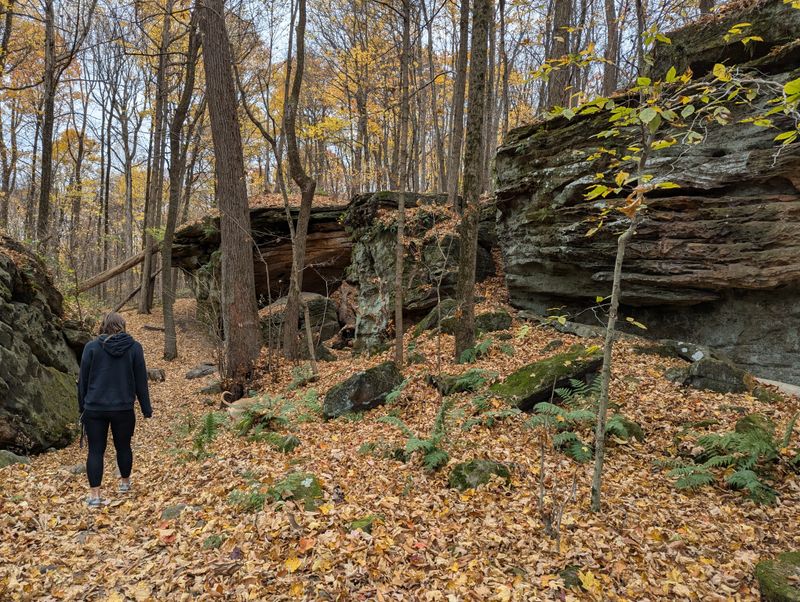
Before humans ever touched these rocks, nature spent millions of years crafting them into the dramatic formations you see today.
The sandstone ledges tower above the trail, creating narrow passages and overhangs that make you feel wonderfully small and insignificant in the best possible way.
Moss blankets nearly every surface in shades of emerald and jade.
Ferns sprout from impossible crevices, and the whole scene looks like something straight out of a fantasy novel.
During my visit, sunlight filtered through the canopy above, creating these magical beams that illuminated patches of moss and made the whole place glow.
I must have taken fifty photos trying to capture it, though none quite did it justice.
The rock formations create natural alcoves and rooms that kids absolutely love exploring.
I watched several families playing hide-and-seek among the ledges, and I’ll confess I was tempted to join them.
The Three-Masted Schooner Sailing Through Stone
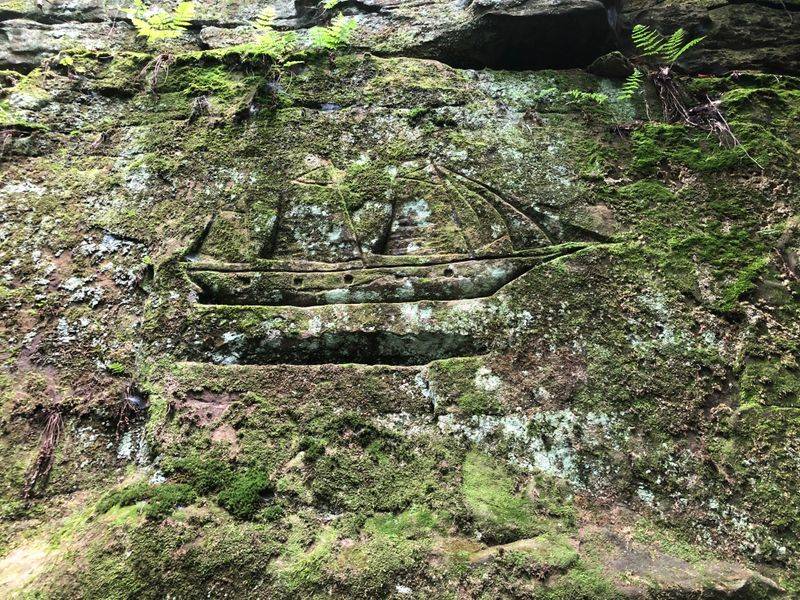
Stuart’s maritime masterpiece caught me completely off guard-a three-masted schooner carved with surprising detail into the sandstone, looking ready to sail off into some imaginary ocean.
Why would someone carve a ship in the middle of landlocked Ohio?
That’s part of the charm and mystery of this place.
The carving shows remarkable attention to detail, with individual masts, rigging lines, and even the hull’s curves all carefully etched into the rock.
You can tell Stuart really studied ships before attempting this piece.
I stood there imagining what must have been going through his mind during the countless hours of chipping and carving.
Maybe he dreamed of ocean voyages while working in these quiet woods.
The schooner has weathered well over the decades, though some details have softened.
Still, it remains one of the trail’s most photographed features, and for good reason-it’s absolutely delightful in its unexpectedness.
Religious Symbols Carved With Devotion
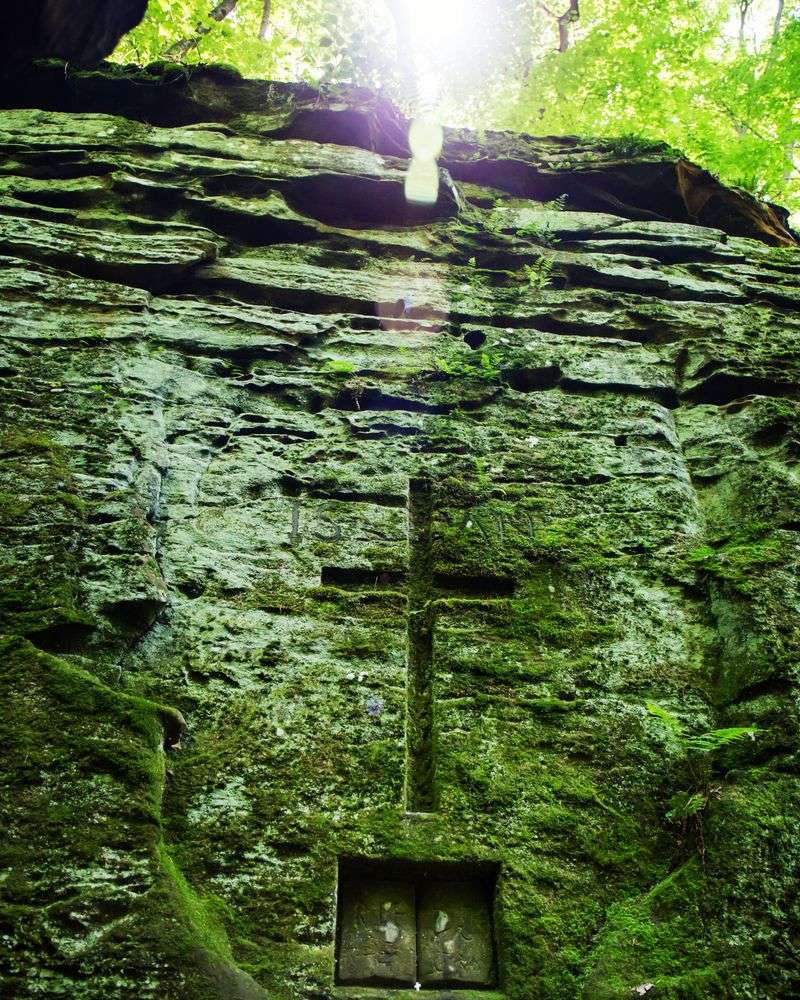
Among the more whimsical carvings, Stuart included deeply personal religious symbols-a cross and an open Bible that speak to his spiritual side.
These carvings feel different from the others, more intimate and reverent somehow.
The open Bible is particularly impressive, with pages clearly defined and readable text carved into the stone.
I couldn’t make out all the words during my visit, but the craftsmanship is undeniable.
What I found touching was how these religious pieces coexist peacefully with the sphinx and other mythological elements.
It’s like Stuart was creating his own personal temple, blending different traditions and symbols into one harmonious outdoor sanctuary.
An older gentleman on the trail told me he’d been visiting these carvings for forty years, and the Bible carving was always his favorite.
He said it reminded him that art and faith can be expressions of the same human need to create meaning.
The Short But Sweet Loop Trail Experience
At just three-quarters of a mile, this loop won’t tire you out, but it packs more punch per step than trails ten times its length.
I completed it in about forty-five minutes, though that included plenty of stops for photos and gawking.
The trail is marked with white diamond signs featuring a raccoon’s face, which is adorable and practical. You can hike it clockwise or counterclockwise, though I recommend clockwise to build anticipation for the main sculpture areas.
The terrain is moderate-mostly flat with some rocky sections that require a bit of scrambling.
I wore regular sneakers and managed fine, though hiking boots would give you better grip on the sometimes-slippery moss-covered rocks.
Families with kids will love this trail because it’s short enough to keep little ones engaged without exhausting them.
I saw several parents with children who were absolutely enchanted by the sculptures and natural formations.
Noble Stuart’s Legacy Lives On
Noble Stuart, son-in-law to Hiram Worden, spent years of his life transforming these ledges into an outdoor art gallery during the 1940s.
I kept thinking about his dedication as I explored-no power tools, no modern conveniences, just one man with hand tools and a vision.
What motivated him remains partly mysterious.
Some say he simply enjoyed working with stone, while others believe he was creating a lasting tribute to the natural beauty he loved.
Whatever his reasons, Stuart left behind something truly special.
His carvings have survived decades of weather, vandalism attempts, and the inevitable wear of time, standing as testament to both his skill and the durability of sandstone.
Walking this trail, I felt connected to Stuart’s creative spirit.
He turned a beautiful natural area into something even more magical, and thousands of visitors now benefit from his artistic impulse and countless hours of labor.
The Celestial Gateway
At the heart of Worden’s Ledges trail stands the mesmerizing Celestial Gateway, a towering wooden arch that feels like a portal to another world.
Visitors are drawn into a space where imagination and myth intertwine, and every carving tells a story. Stars, planets, and mythical creatures adorn the arch, each detail crafted to spark curiosity and wonder.
As sunlight filters through the surrounding trees, the Gateway comes alive, casting playful and shifting shadows that seem to move with the breeze.
Passing beneath it, there is a palpable sense of stepping from the ordinary into something larger, a moment that feels both grounding and otherworldly.
The archway serves as more than an entrance; it is a passage that links the earthly trail to the cosmic imagination, inviting reflection on the mysteries of the universe.
For many, it inspires quiet contemplation, a gentle reminder of how small yet connected we are within the vastness of existence.