
Scenic Michigan Drives Locals Take When They Need To Clear Their Head
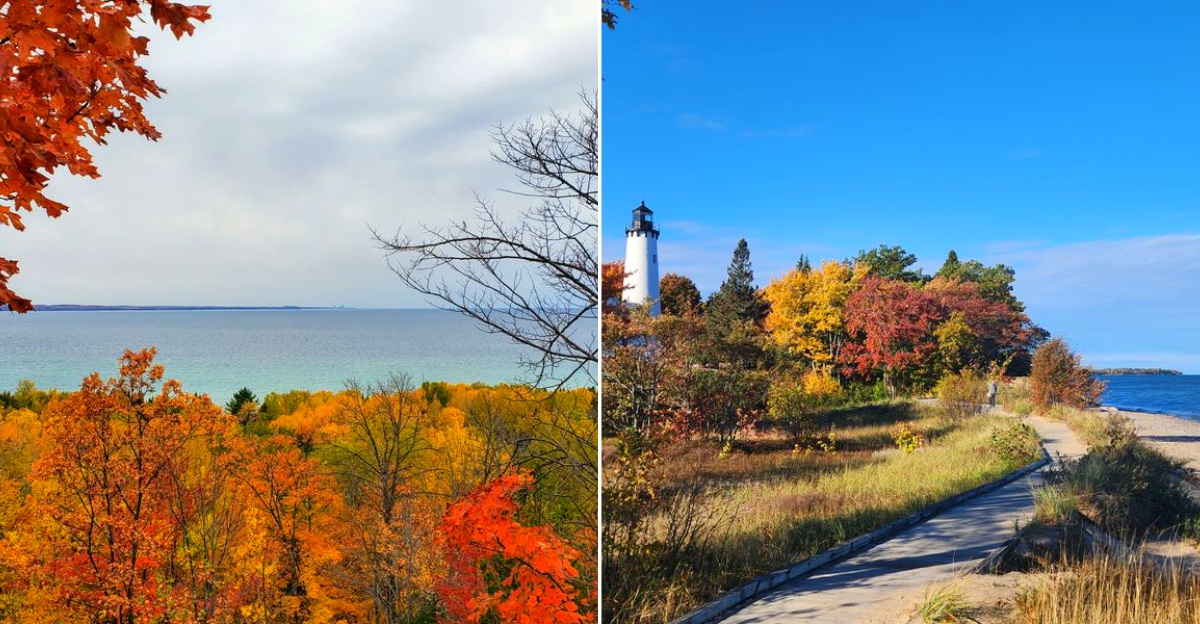
When the mind feels noisy, Michigan has a habit of answering with the steady clarity of water, wind, and long ribbons of open road. These routes are far more than just pretty views framed by a windshield; they are small, necessary lessons in rhythm, where the dunes seem to breathe and the deep forests are vast enough to make their own weather.
Whether you’re heading north toward the rugged, rock-bound reaches of the Upper Peninsula or tracing the gentle, sun-dappled curves of the Lake Huron shoreline, these drives act as an invitation to choose a lane, roll the windows down, and let the state edit your thoughts into something much clearer. Along the way, you’ll discover quiet towns that still hang hand-painted signs and ancient road cuts that tell stories older than language itself.
A Michigan scenic drive is a liquid landscape where the horizon line does the heavy lifting of clearing your head.
I’ve put together this guide to the state’s most restorative stretches of pavement to help you find the turns that lead to the best overlooks and the most peaceful roadside pull-outs. If you’re ready to trade the highway hum for the sound of tires on gravel and wind through the pines, these routes are waiting to show you the way back to yourself.
1. Tunnel Of Trees, M-119: A Sanctuary Of Green And Gold
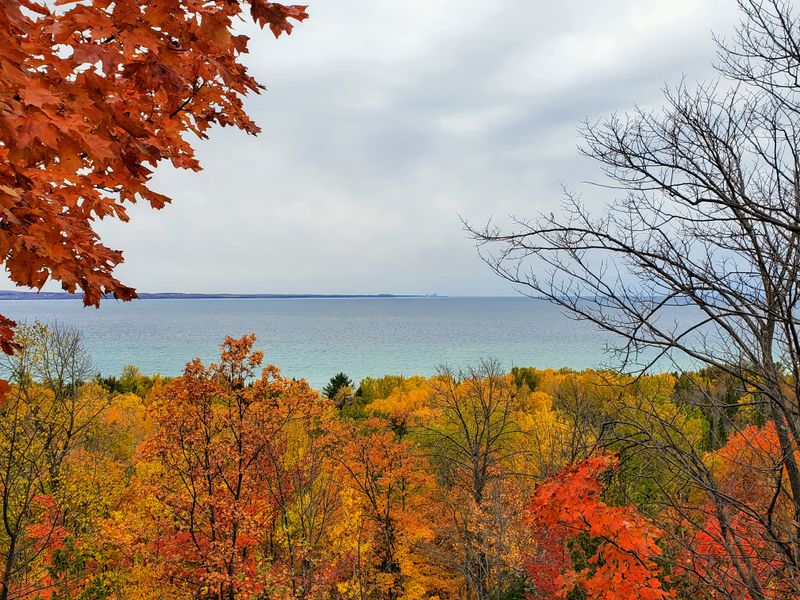
There is a moment on M-119, just north of Harbor Springs, where the world seems to pull a leafy curtain shut behind you. This is the entrance to the Tunnel of Trees, a twenty-mile stretch of road that defies modern engineering.
The pavement narrows until the centerline disappears, the shoulders vanish into steep ravines, and the hardwood canopy knits together overhead to create a cathedral of green.
In the autumn, this cathedral turns to fire. Gold and crimson leaves whisper like backstage actors in a private play.
The drive is an exercise in intimacy. Because the road is so narrow and the curves so frequent, you cannot rush.
You are forced to notice the way the light filters through the maples, or the way Lake Michigan suddenly peeks through the trees like a secret shared mid-conversation.
The houses along this route sit close to the asphalt, their wide porches yawning over the road, inviting a slower pulse. You’ll pass the Devil’s Elbow, a sharp horseshoe bend where legend says the wind carries old spirits.
You’ll feel the temperature drop as the lake breeze gets trapped in the deep woods.
Historically, this corridor follows an ancient Odawa footpath, used long before Model T day-trippers turned it into a delightfully inconvenient scenic route. At the northern end, the legendary Legs Inn waits in Cross Village.
Its driftwood architecture and carved totems feel like something out of a fairy tale, serving as a landmark of Polish heritage in the North.
My advice is to arrive early on weekends to beat the surge. Pullouts are rare, so you have to savor the glimpses when the trees open up.
The drive rewards patience far more than horsepower, it is a place to find the rhythm of the woods.
2. M-22 Leelanau Scenic Drive: The Peninsula Of Plenty
As you loop around the Leelanau Peninsula on M-22, the air begins to lift with the scent of ripening grapes and cold lake spray. This is arguably the most famous drive in the state, and for good reason.
It is a loop that captures the essence of the Third Coast, farm stands appearing with late cherries and cider, vineyard rows marching toward the horizon, and sandy tracks pointing toward quiet beaches where smooth stones click under the retreating waves.
The towns arrive like punctuation marks in a long, beautiful sentence. Suttons Bay offers a refined start with its galleries and boutiques, while Leland provides the soul of the drive.
Here, you’ll find Fishtown, a cluster of weathered cedar shanties where the smell of smoked whitefish hangs heavy and the river rushes toward Lake Michigan with a steady roar.
This isn’t a museum, it’s a working fishery where you can watch the morning’s catch being processed with calm economy.
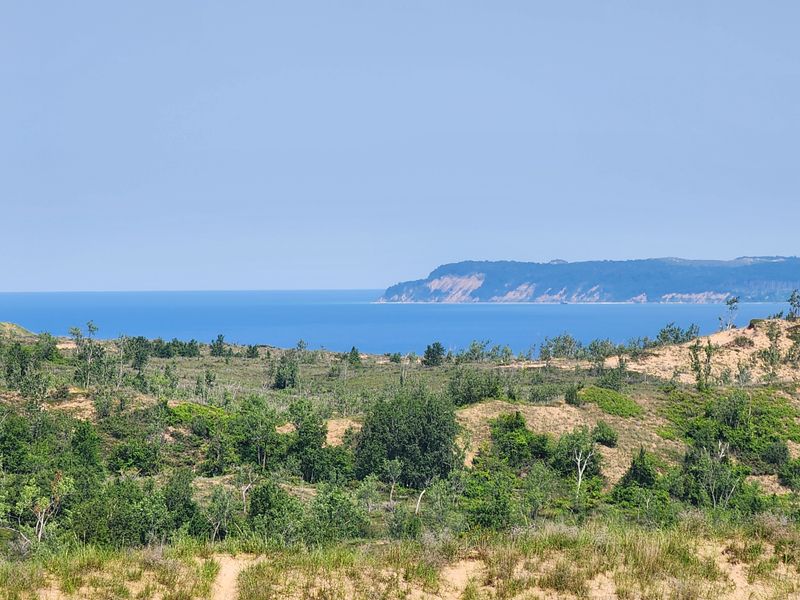
The route eventually skirts the protected lands of Sleeping Bear Dunes National Lakeshore. To drive this stretch is to witness the scale of the Great Lakes.
The dunes rise hundreds of feet above the water, their pale sand contrasting sharply with the deep, bruised navy of the lake.
I always suggest parking once in Glen Arbor to walk the boardwalks, then driving north to the tip of the pinky finger for the lonely, beautiful lighthouse views at Leelanau State Park. Keep a towel in the trunk, the water at Good Harbor Bay is too clear to pass up, even if the temperature is bracing.
On M-22, the reset happens in the transition from the farm to the shore.
3. Pierce Stocking Scenic Drive: A Masterclass In Perspective

If M-22 is the epic novel of Michigan drives, Pierce Stocking Scenic Drive is the focused, brilliant short story. Located within the Sleeping Bear Dunes, this 7.4-mile loop is a masterclass in perspective.
Dune grass hisses like a polite warning as you climb the loop above the immense shifting sands.
The boardwalks lead you to overlooks where the lake’s gradient flips from a pale teal to a deep, royal blue in a single breath.
Created by lumberman Pierce Stocking in the 1960s, the drive was originally a private venture before joining the National Lakeshore. Today, it features thoughtful signage about the fragile nature of dune formation.
You see the structural fencing and planted marram grass, illustrating how human hands are trying to steady these shifting slopes against the relentless wind.
It is a place that makes you feel small, but in a way that is deeply comforting.
The Lake Michigan Overlook (Stop #9) is the climax of the drive. Standing 450 feet above the water, you are treated to a view that rivals any coastal vista in the world.
Cameras rarely capture the true scale of the wind and the height here.
Arrive near sunset to avoid the congestion and to see the dunes turn a soft, honeyed gold. A word of caution from the locals, do not attempt the climb down to the water unless you are prepared for a grueling, hour-long trek back up.
The best way to experience Pierce Stocking is to find a bench, leave your phone in the car, and let the sound of the gulls be your only soundtrack.
4. West Michigan Pike: The Heritage Of The Summer Migration
The West Michigan Pike is more than just a road, it’s a gallery of Americana. Stretching historically from New Buffalo to Mackinaw City, it traces the path of neon signs, Art Deco theaters, and classic beach-town motels.
For a local, driving sections of the Pike feels like flipping through a stack of vintage postcards.
You’ll smell fry-shack vinegar in the air and hear the rhythmic clack-clack of tires on the bridges. You pass through towns that have hosted summer migrations for over a hundred years.
Born in the 1910s as one of the first paved auto trails in the United States, the Pike stitched together disparate lakeside resorts into a coherent seasonal journey. Today, you can still follow the best-preserved sections through Holland, Grand Haven, and Ludington.
Each town has its own personality, Holland with its tidy tulip lanes and Dutch heritage, and Grand Haven with its iconic red pier and musical fountain.
The reset on the Pike comes from the nostalgia. There is something fundamentally grounding about a drive that includes a stop for a hand-dipped ice cream cone or a walk along a lighthouse pier that has stood since the 1800s.
Weekdays are much kinder for traffic, allowing you to appreciate the architecture of the cottage era.
It is a drive that reminds you that while life changes, the appeal of a sunset over Lake Michigan remains a constant, unwavering anchor.
5. Sunrise Coast, US-23: The Freshly Ironed Morning
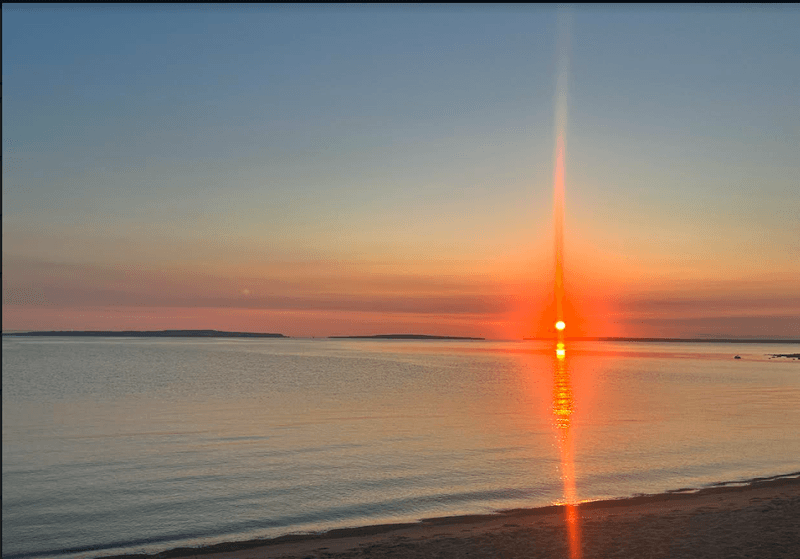
While the west side of the state gets the sunset glory, locals know that morning on US-23 feels freshly ironed. As you drive the Sunrise Coast from Tawas to Alpena, the Huron shoreline brightens with a clarity that is hard to find elsewhere.
Coffee always tastes sharper when you watch the sun lift out of the lake instead of sinking into it.
This corridor grew with the lumber towns that shipped white pine east, eventually pivoting to the fishing and shipbuilding industries that still define the region today.
The drive is marked by a series of stoic lighthouses. Sturgeon Point is a favorite, where the white tower stands against the blue sky with a quiet, lonely dignity.
In Alpena, the drive takes a historical turn at the Great Lakes Maritime Heritage Center. Here, the story of Shipwreck Alley comes to life.
Thunder Bay is home to nearly 100 preserved shipwrecks, and the museum provides a haunting look at the ships that didn’t make it through the fog.
The US-23 reset is quieter than the tourist-heavy west. Even in July, the breezes here have a bracing bite that clears the cobwebs.
I highly recommend pulling into the small, unnamed pocket parks along the route for beach glass hunting.
These hidden spots are perfect for stargazing after the sun goes down, as the light pollution is almost non-existent. A pause at the Oscoda pier is essential.
It’s the best place to overhear old-timers debating the lake’s mood before deciding whether to cast a line or just sit and watch the freighter lights on the horizon.
6. Lake Huron Thumb Drive, M-25: Where Silos Meet The Surf

On M-25, the Thumb of Michigan sketches a slow, beautiful arc where the agricultural heart of the state meets the surf of Lake Huron. It is a drive of contrasts, massive grain silos on your right and storm-scrubbed piers on your left.
The wind here talks through the open fields like a choir warming up.
You can often smell a coming rainstorm fifteen minutes before the first drop hits your windshield.
This is a route of self-reliance and hidden gems. Harbor Beach claims one of the world’s largest man-made harbors, a nod to the days when lake protection was a matter of life and death for the shipping industry.
Further north, Port Austin serves as the crown jewel of the Thumb. While Turnip Rock is the famous destination, reachable only by kayak, the drive itself is the real prize.
You pass through small hamlets like Grindstone City, where the abandoned gritstone wheels sit in the grass like discarded gears of a giant machine.
Fuel up in larger hubs like Bad Axe, as the gaps between services can be wider than you expect. This drive is best experienced during the golden hour, when the white grain elevators and the blue water look like they’ve been freshly repainted.
It is a route that feels honest and unpretentious.
Perfect for when you need to remember that the world is bigger than your to-do list.
7. River Road National Scenic Byway: The Au Sable’s High Overlooks
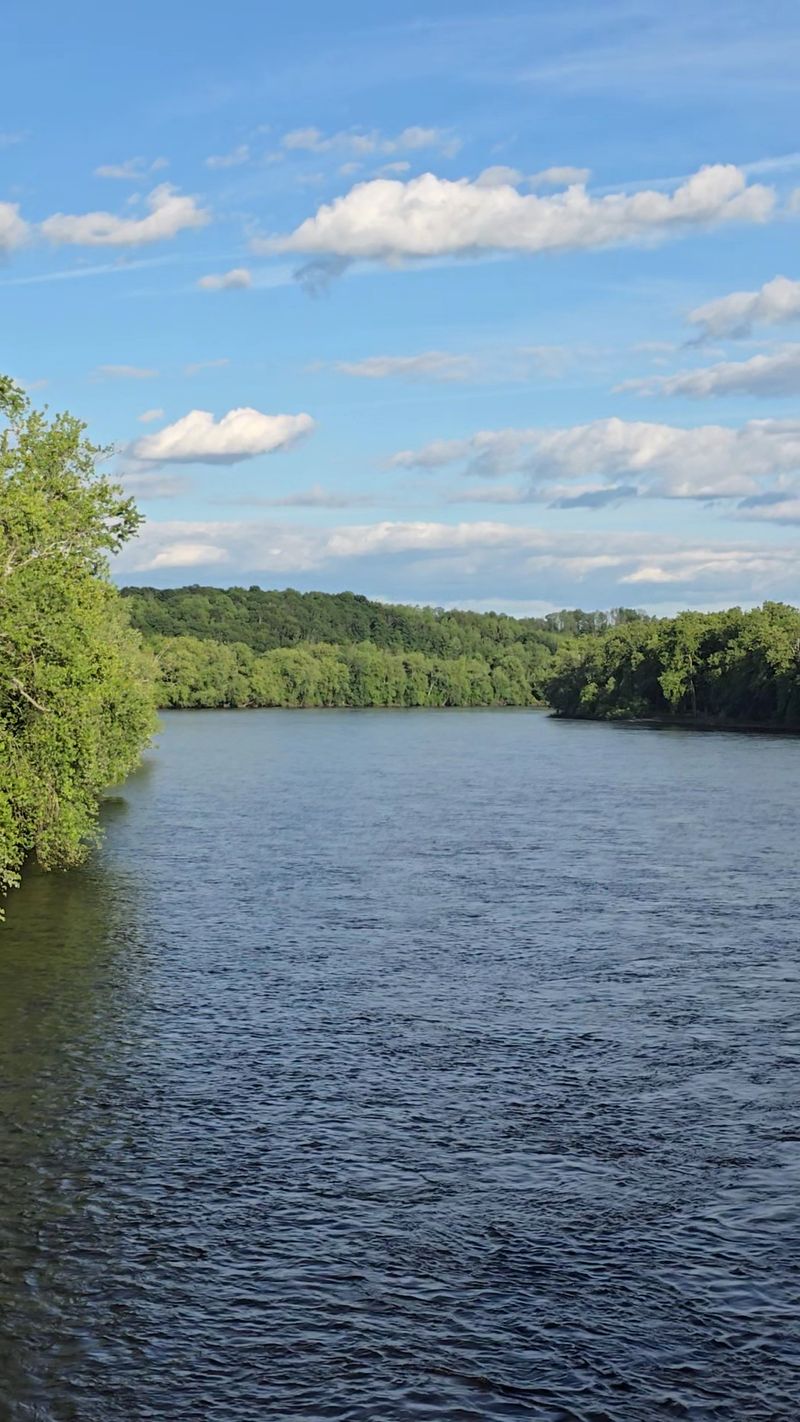
The River Road National Scenic Byway is a twenty-mile stretch that feels like a deep breath. Following the high banks of the Au Sable River, this drive offers a perspective that is entirely different from the lake-level routes.
The river breathes in deep shades of green.
It exhales at high overlooks where bald eagles often ride the thermals just a few feet away from your car window.
This byway links several iconic Michigan landmarks, including Lumberman’s Monument, where a massive bronze statue honors the men who steered millions of feet of white pine toward the Great Lakes. The logging history here isn’t just a story, it’s carved into the landscape.
You can walk down the Iargo Springs stairs, all 300 of them, to see where the water gushes out of the banks.
It is a sacred spot for centuries.
The towering pines maintain a resinous, heavy hush that acts as a natural soundproofing against the outside world. The sand ridges along the road are actually ancient shorelines from thousands of years ago, a quiet reminder of the deep time that has shaped this land.
Stop for some smoked fish in Oscoda before you start, and leave extra time for sunset at the Canoer’s Memorial.
8. Whitefish Bay National Forest Scenic Byway: The Iron Mist
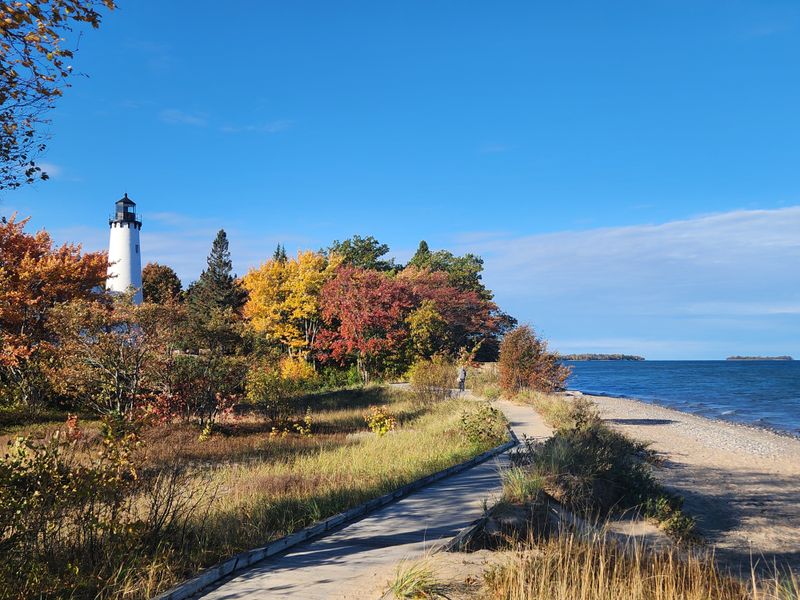
In the Upper Peninsula, the Whitefish Bay National Forest Scenic Byway offers a drive that is both beautiful and sobering. The mist along Whitefish Bay often smells like cold iron, and the waves slap the shore with a punctual, disciplined rhythm that reflects the power of Lake Superior.
The road skirts stands of ghost-white birch whose bark peels away like the parchment of old, forgotten letters.
Out on the horizon, the great freighters, the 1,000-footers, move with the weight of architecture. They are unhurried, enormous, and silent, heading toward the Soo Locks.
This is a drive for those who find comfort in the vastness of the Great Lakes. A detour to Whitefish Point is mandatory.
Here, the Great Lakes Shipwreck Museum houses the bell of the Edmund Fitzgerald. It is a powerful artifact that sets the stakes for life on these waters.
The weather swings hard and fast on Whitefish Bay, moving from bright sunshine to dense fog in a matter of miles. This unpredictability is part of the reset, it forces you to be present.
I always suggest pulling off for a walk at the Point Iroquois Light, where the boardwalks protect the delicate dune grass.
There is a specific kind of peace found in counting the distant horn blasts of the ships as they navigate the bay. It’s a lullaby for the restless mind.
9. Lake Superior Circle Tour: The White Noise Of The North

On the Michigan stretch of the Lake Superior Circle Tour, the lake takes the lead and the highway simply follows. This is the ultimate clear your head drive.
Near Munising, the cliffs of Pictured Rocks darken into deep ochres and burnt sienna after a rain. Waterfalls seem to appear out of nowhere, braiding themselves into the fabric of the day.
The scents trade back and forth between cedar, wet rock, and the faint, sweet smell of campfire smoke.
The Circle Tour is a commitment. Distances are vast, services are thin, and the weather changes with a ferocity that can be humbling.
Michigan’s portion includes some of the most dramatic scenery in the Midwest, from the Hancock lift bridge to the rugged shoreline of Marquette. It is a drive that demands you pay attention to your fuel gauge and your surroundings.
The reset here comes from the white noise of Superior. The lake is so large it creates its own weather and its own sound, a constant, rhythmic crashing that can reorder your thoughts if you let it.
If the space weather cooperates, this is also one of the best routes for chasing the Northern Lights.
There is nothing quite like standing on a dark beach near Grand Marais, watching the green glow of the aurora dance over the coldest lake in the world, to realize that your worries are remarkably temporary.
10. Copper Country Trail National Byway: The End Of The World
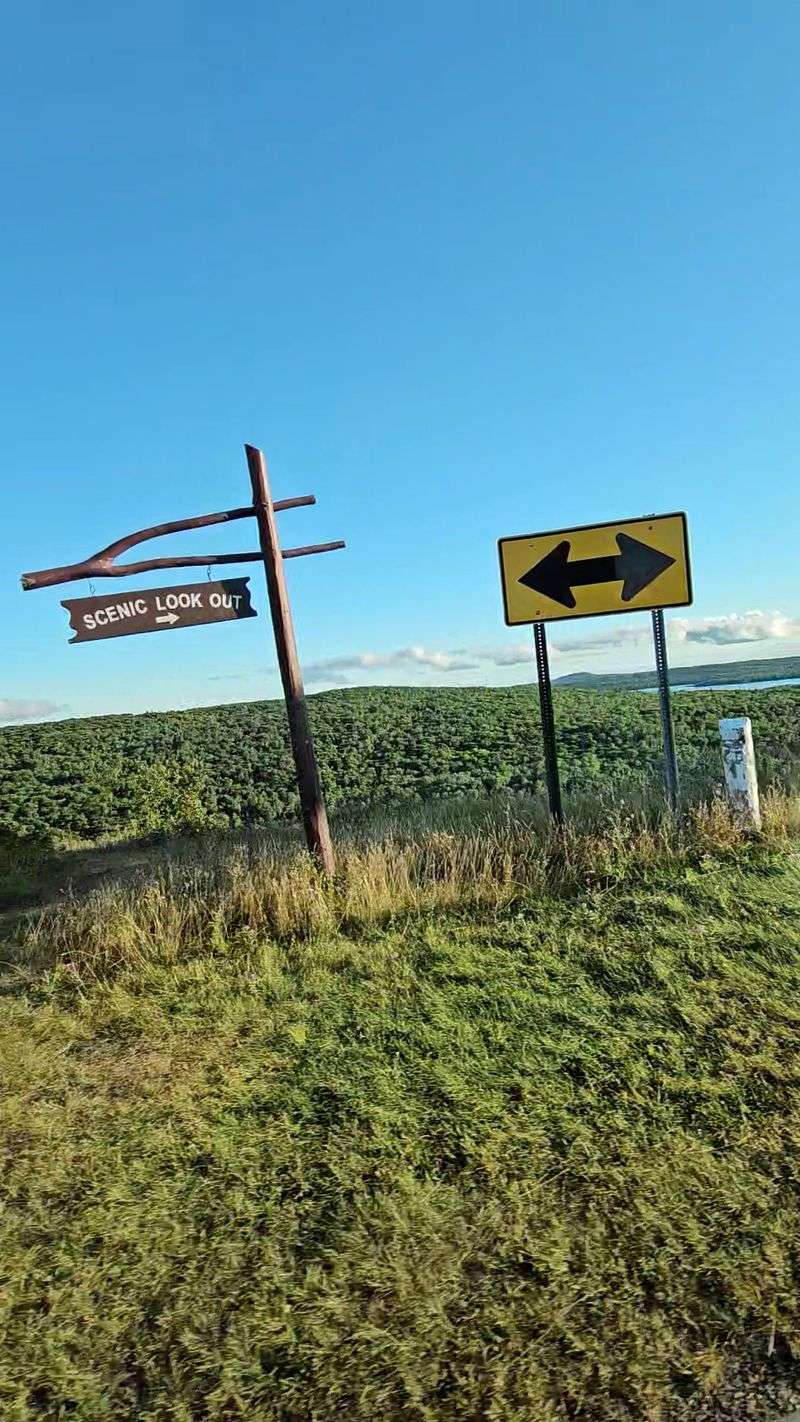
The Copper Country Trail is the drive for those who want to go as far as the road will take them. Starting in Houghton and climbing north into the Keweenaw Peninsula, this byway takes you through a landscape punctuated by rusted iron headframes and mounds of red stamp sand.
It is a place where the labor of the past is still very much a part of the present.
In the winter, this road is a tunnel of white. In the summer, it smells of sweet thimbleberries and the scent of hot brake pads as you navigate the steep grades.
The drive takes you through towns like Calumet, once a candidate for the state capital, now a hauntingly beautiful collection of sandstone architecture. You can feel the physical weight of history here.
The museums at Quincy Mine allow you to see the gargantuan hoist engines that once lowered men thousands of feet into the earth.
The climax of the drive is Brockway Mountain Drive just outside Copper Harbor. It is the highest drive between the Rockies and the Alleghenies, offering a 360-degree view of the peninsula and the lake.
I always tell people to do the detour twice, once in each direction. Stop for a pasty, ketchup or gravy, take your pick, find a local sauna to sweat out the stress, and look out over the water from the tip of the world.
By the time you turn the car around to head back south, the noise in your head will have been replaced by the steady, quiet hum of the North.