
Explore Arkansas’ Best-Kept Waterfall Secret On Foot
Some places don’t announce themselves. They hide. They wait. And if you’re willing to follow the trail far enough, they reward you in ways that feel almost unreal.
Somewhere deep in the Arkansas wilderness, I found one of those places. No crowds.
No noise. Just the steady sound of water echoing through the trees, growing louder with every step. The path felt like a quiet invitation.
Simple at first, then a little wilder, a little more curious. And then it happened.
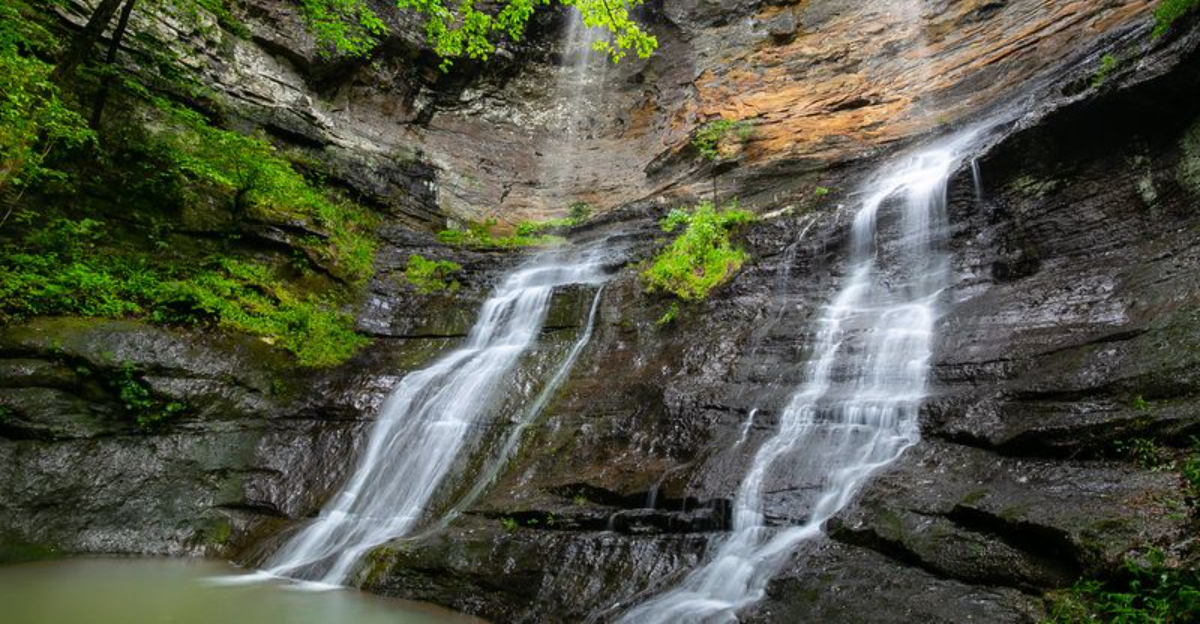
Not one waterfall, but two. Side by side.
Pouring down rugged rock like a perfectly timed reveal. It didn’t feel accidental. It felt staged, like nature showing off just a little.
I stood there longer than I planned, completely still, trying to take it in. Some views don’t need words. They just need you to show up.
The Drive To Pettigrew Sets The Mood
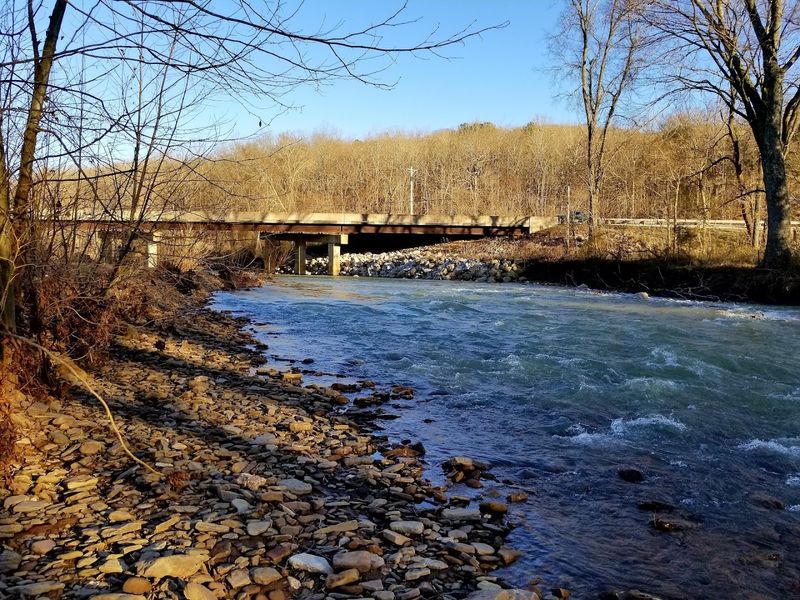
Before I even laced up my boots, the drive to Pettigrew, Arkansas had already started telling me a story. Highway 16 winds through the Boston Mountains like it was drawn by hand, curving around ridgelines and dipping into hollows that feel completely untouched by the modern world.
I had my windows down and my playlist off because the scenery was doing all the talking.
Pettigrew itself is a tiny community that blinks by in seconds, but it carries that quiet, unhurried energy that big cities spend a fortune trying to recreate.
The closer I got to the trailhead, the more the road narrowed and the trees leaned in, like they were whispering, “You’re almost there.” It genuinely felt like the opening chapter of an adventure novel.
The trailhead for High Bank Twin Falls is accessible from the Boxley Valley area, and the drive through that valley alone is worth the trip.
Rolling green pastures meet dramatic limestone bluffs, and elk are known to graze near the road at dawn and dusk. I spotted a small herd on my way in, which I took as a very good omen.
There’s something about arriving somewhere beautiful that makes the destination feel even more earned.
Pettigrew doesn’t have a Starbucks or a welcome center, and honestly, that’s exactly what makes it perfect.
Gearing Up For The Trail Like A Pro

I’ll be honest, I almost wore my casual sneakers, and looking back, that would have been a certified disaster. The trail to High Bank Twin Falls involves creek crossings, root-covered paths, and stretches where the ground is perpetually damp from the surrounding forest canopy.
Proper trail shoes with grip made a genuinely noticeable difference on every single wet rock I stepped on.
My pack was light but intentional: a 2-liter water reservoir, a handful of trail mix, a lightweight rain jacket, and my trusty trekking poles.
The poles weren’t just for show. On the descent toward the falls, where the trail drops in elevation fairly quickly, they gave me the kind of stability that prevented at least two very embarrassing stumbles.
Dressing in moisture-wicking layers also helped, because the temperature under the forest canopy was noticeably cooler than the open road.
One thing I wish someone had told me beforehand: bring a dry bag or a zip-lock for your phone. The mist near the falls is real, and it’s enthusiastic.
My camera lens fogged up twice, which made for some accidentally dreamy photos but also some missed shots I still think about. Sunscreen matters even under tree cover, and bug spray is non-negotiable from late spring through early fall.
Preparation isn’t glamorous, but arriving at a waterfall feeling comfortable instead of miserable is its own kind of reward.
The Trailhead Moment That Changes Everything
Standing at the trailhead, I had that specific feeling I can only describe as “pre-adventure butterflies,” the kind where your stomach does a little flip and your brain says, “Okay, we’re actually doing this.” The trail begins modestly, easing you in with a relatively flat path that moves alongside Big Creek.
The sound of running water is your constant companion from almost the very first step.
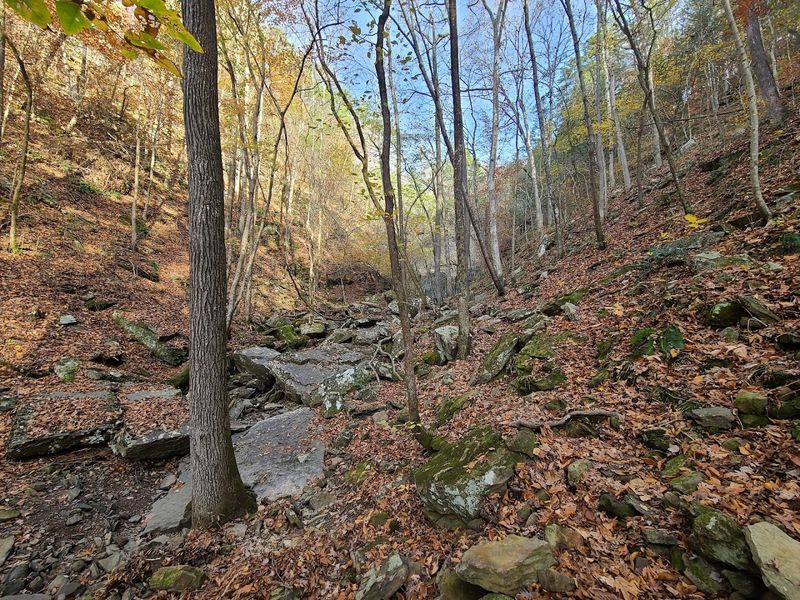
The forest closes in quickly once you pass the trailhead marker, and the canopy overhead creates a natural tunnel of green that filters the sunlight into something soft and cinematic.
I kept stopping to take photos not because I was tired, but because every single angle looked like a desktop wallpaper. Mossy boulders line the creek banks, and the trail occasionally crosses the water on stepping stones that require a little hop-scotch commitment.
What struck me most at the start was how immediately quiet everything became. The road noise disappeared within about two minutes of walking, replaced entirely by birdsong, rustling leaves, and the cheerful babble of Big Creek.
There’s a certain rhythm that kicks in when you’re hiking through a place like this, a slowing down that happens almost without you noticing. By the time I was a quarter mile in, I had completely forgotten about every email, every deadline, and every minor inconvenience that had been crowding my brain.
The trail had done its job before I even reached the good part.
The Trail’s Best Supporting Character
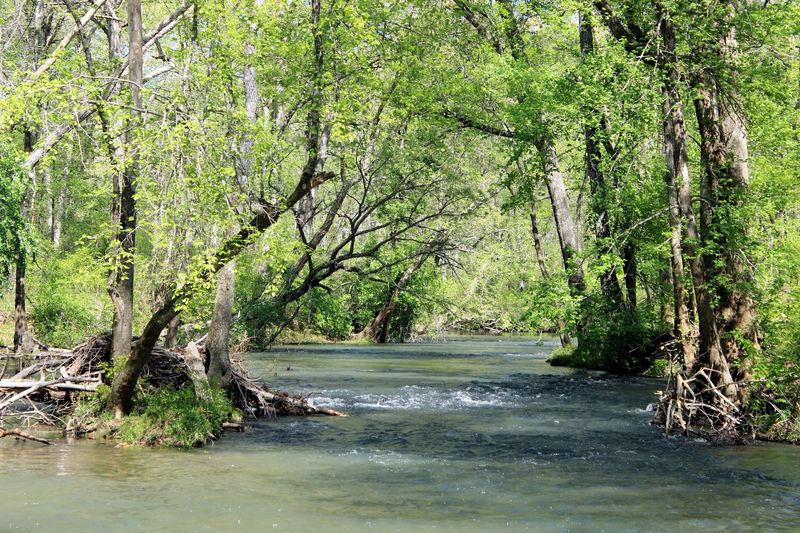
If the waterfalls are the headliners of this hike, then Big Creek is absolutely the opening act that steals the show. The trail runs alongside and across this creek multiple times throughout the roughly 2-mile one-way journey, and each crossing felt like a small ceremony.
The water is clear, cold, and moves with a confidence that made me want to follow it wherever it was going.
I stopped at one particularly wide, shallow section and just sat on a rock for a few minutes, watching the water move around my boots.
There were tiny fish darting between the stones, and the creek bed was a mosaic of grays, greens, and rusted oranges that looked almost too beautiful to be accidental. It’s the kind of scene that makes you understand why artists move to the middle of nowhere.
The creek crossings themselves range from easy stepping-stone hops to slightly more committed splashes, depending on recent rainfall. When I visited after a few dry days, most crossings were manageable with careful foot placement.
After heavy rain, the water level rises considerably, so checking conditions before heading out is genuinely smart planning rather than optional advice. Big Creek isn’t just a geographic feature of this hike.
It’s the pulse of the whole experience, setting the tempo and the mood for everything that follows.
Every bend in the trail revealed another stretch of it, and every stretch made me happier than the last.
The Forest Itself Deserves Its Own Fan Club
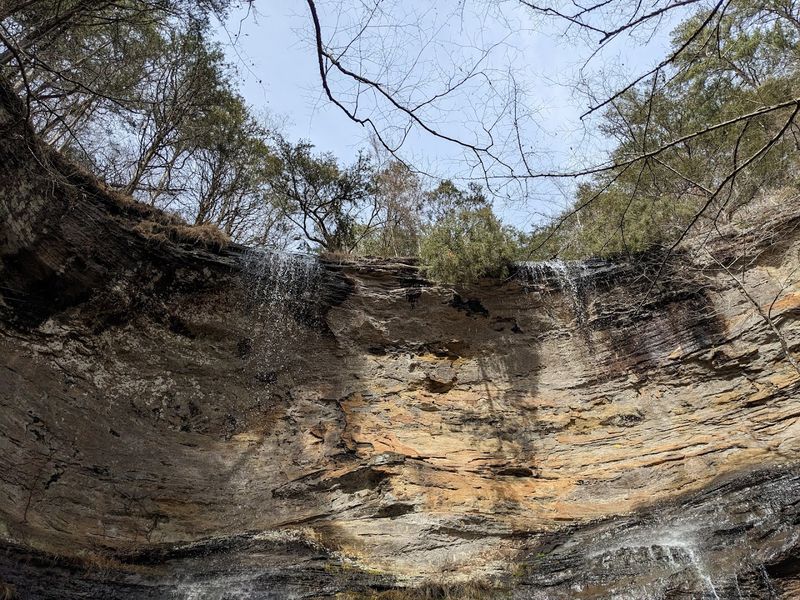
At some point during this hike, I stopped thinking about the destination and started being completely absorbed by the journey itself. The forest surrounding the High Bank Twin Falls trail is a mix of hardwoods and conifers that creates this layered, textured environment where something interesting is happening at every elevation.
Above you, the canopy filters light like stained glass.
At eye level, ferns and wildflowers compete for attention. Down at your feet, the forest floor is a soft carpet of decomposing leaves and moss.
I noticed massive sandstone bluffs beginning to appear along the trail around the halfway point, rising from the creek banks and streaked with mineral deposits in shades of orange, red, and cream.
These formations are part of what makes the Boston Mountains so geologically fascinating. They’ve been shaped over millions of years, and standing next to them made me feel approximately the size of a breadcrumb.
The biodiversity in this stretch of the Ozark National Forest is genuinely impressive. I spotted a pileated woodpecker hammering away at an oak, heard what I’m pretty sure was a barred owl even though it was midday, and watched a box turtle make a very deliberate crossing of the trail ahead of me.
The forest felt alive in a way that went beyond just trees and plants. It had personality, presence, and the kind of quiet confidence that comes from being undisturbed for a very long time.
Hearing The Falls Before Seeing Them
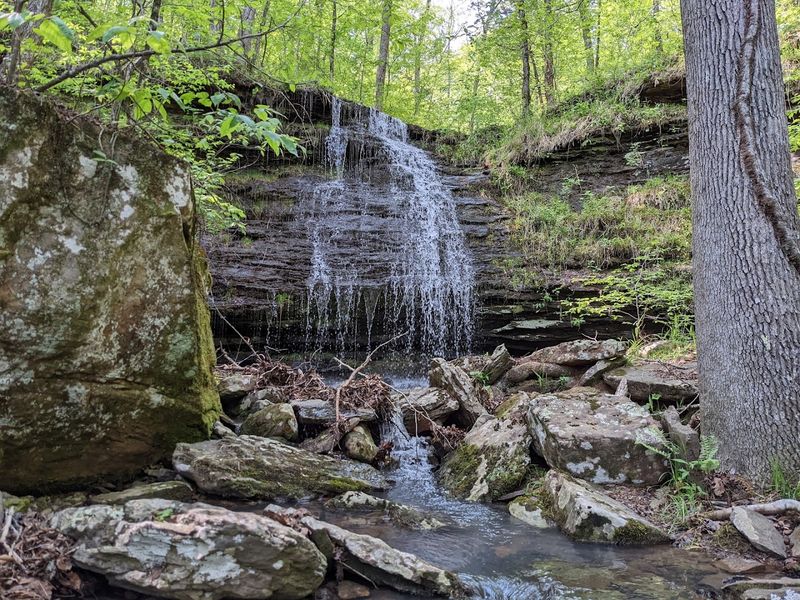
There’s a specific moment on this trail that I had been warned about by a forum post and still was completely unprepared for: you hear High Bank Twin Falls before you see them, and that sound alone is enough to make your pace quicken embarrassingly.
It starts as a low hum threading through the trees, then builds into a full, layered roar that bounces off the surrounding bluffs and fills the air like surround sound.
I rounded a bend in the trail and the sound hit me like a wall, rich and resonant and thrilling in the way that only moving water can be.
My brain immediately started doing that thing where it tries to process what it’s about to see before the eyes have caught up. I was half-jogging at that point, completely abandoning any pretense of a leisurely stroll.
The trail descends more steeply in the final approach, and the vegetation changes noticeably as the moisture from the falls starts influencing the microclimate.
Everything gets greener, wetter, and more dramatic. The rocks along the path are slick with spray, and the air carries that clean, electric freshness that only exists near moving water.
I’ve hiked to a lot of waterfalls over the years, and that moment of auditory anticipation before the visual reveal is genuinely one of my favorite experiences in the natural world. High Bank Twin Falls delivered that moment with an enthusiasm I did not see coming.
First Look At High Bank Twin Falls
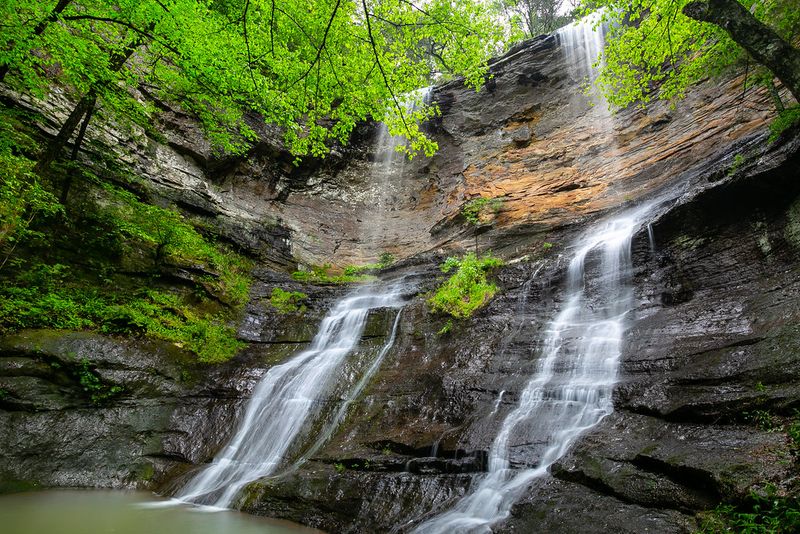
Nothing could have fully prepared me for the actual first sight of High Bank Twin Falls, and I say that as someone who looked up every photo available online before making the trip.
The real thing has a dimension and a presence that no image captures. Two separate falls drop in parallel lines down a high sandstone bluff, their streams merging at the base into a shared plunge pool that churns with white water and mist.
The bluff itself is enormous, easily over 50 feet tall in sections, and streaked with dark mineral staining that contrasts dramatically against the pale sandstone.
Ferns and mosses cling to every available ledge and crevice, creating a vertical garden that softens the hard rock into something almost painterly. I stood at the base for a long time, just rotating slowly and trying to absorb all of it at once, which is impossible but deeply satisfying to attempt.
The pool at the base is shallow enough to wade in, and the water is bracingly cold even in summer, fed by springs and shaded by the bluff above. I took off my boots and waded in up to my knees, which was simultaneously the coldest and best decision of my entire day.
The sound at the base is immersive in a way that feels almost meditative, a constant, enveloping rush that drowns out every thought except the immediate, uncomplicated joy of being exactly where you are.
Double The Waterfalls, Double The Wow
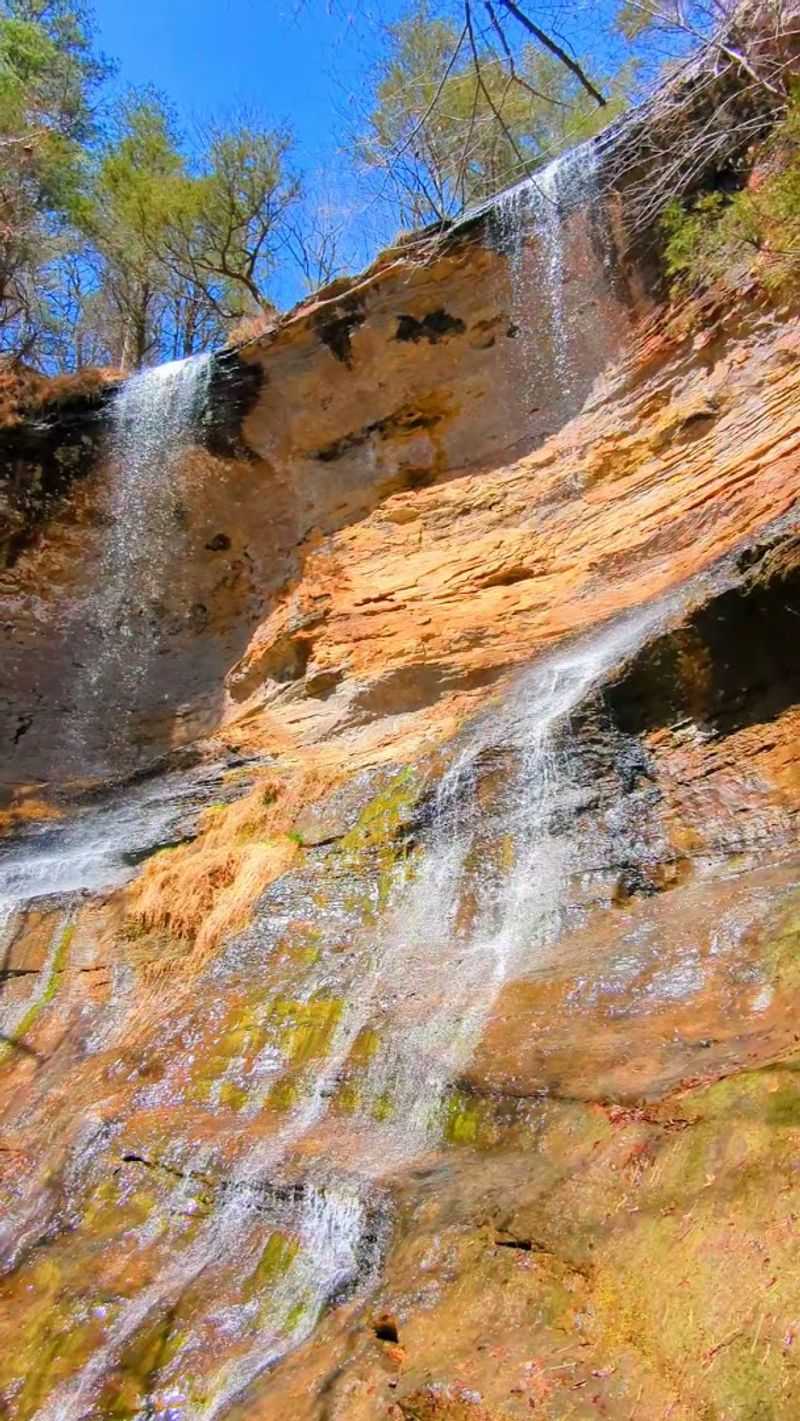
By the time I started the hike back out, I was already planning my return trip. That’s the clearest sign I know that a place has genuinely gotten under my skin.
High Bank Twin Falls isn’t the most famous waterfall in Arkansas, it doesn’t have a gift shop or a parking lot the size of a stadium, and there’s no Instagram-famous viewing platform with a queue of people waiting for their turn. That’s precisely what makes it extraordinary.
The relative obscurity of this place means you can stand at the base of two dramatic waterfalls in a cathedral of ancient forest and feel like you discovered something.
That feeling is increasingly rare and increasingly valuable in a world where every scenic spot has been photographed, hashtagged, and reviewed into familiarity. High Bank Twin Falls still has that wild, unscripted quality that reminds you what nature actually feels like without the packaging.
The hike out felt shorter than the hike in, the way return journeys always do when your mind has been thoroughly reset and your body is pleasantly tired in the best possible way.
I got back to my car, sat in the driver’s seat for a few minutes with the door open, listening to the distant sound of Big Creek, and felt something I can only describe as genuinely restored.
Arkansas has been hiding this gem in plain sight, and the only question worth asking is: when are you going?