
This Might Be The Strangest Art Town In The U.S. (And It’s In Texas)
Some places feel like they were built for a film set, and then forgot to stop rolling. Out in the desert of Texas sits one of those places, where silence stretches longer than the roads and art doesn’t just hang on walls.
It takes over entire landscapes. Welcome to Marfa, a town that behaves like a living installation piece. This is where Hollywood once wandered into film Giant, and where James Dean shot his final screen scenes before he turned into legend.
Coincidence? The town doesn’t really do coincidences. It also happens to be home to desert mysteries like the unexplained Marfa Lights and minimalist art that looks like it was dropped from another planet by Chinati Foundation.
Marfa doesn’t try to impress. It just exists.
Quiet, strange, magnetic. And somehow, that’s exactly the point.
Where Art Lives In The Desert
Some museums ask you to admire art from a distance. Chinati asks you to live inside it.
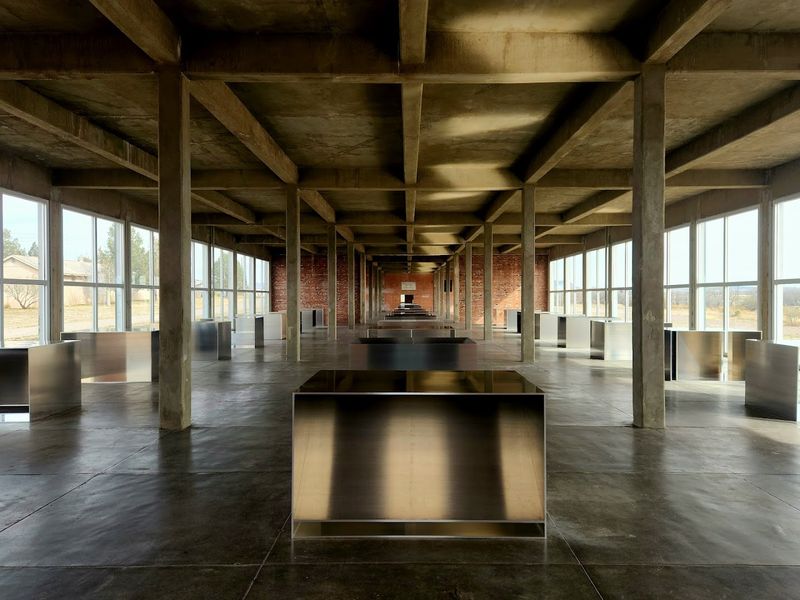
Founded by Donald Judd in 1979, the Chinati Foundation is built on a former U.S. Army base called Fort D.A.
Russell. The sprawling 340-acre campus is home to massive permanent installations that blur the line between art and architecture.
Judd believed that art needed permanent, dedicated space to truly be understood. So he created exactly that.
His famous 100 aluminum boxes are housed in two converted artillery sheds, each piece catching light differently depending on the time of day. It’s the kind of thing you stare at and suddenly understand why people fly across the world for this.
The foundation also houses works by Dan Flavin, whose fluorescent light installations glow with an almost spiritual intensity. John Chamberlain’s crushed automobile sculptures add a raw, industrial energy to the mix.
Walking through Chinati feels less like a museum visit and more like a slow, meditative conversation with space itself.
Tours run on specific days and last several hours, which honestly feels appropriate. Rushing through Chinati would be like skimming a great novel.
You need to sit with it, breathe with it, and let the desert light do its thing. Chinati is not just a destination; it is the entire reason Marfa exists as a cultural force today.
The World’s Most Famous Store You Can’t Shop In
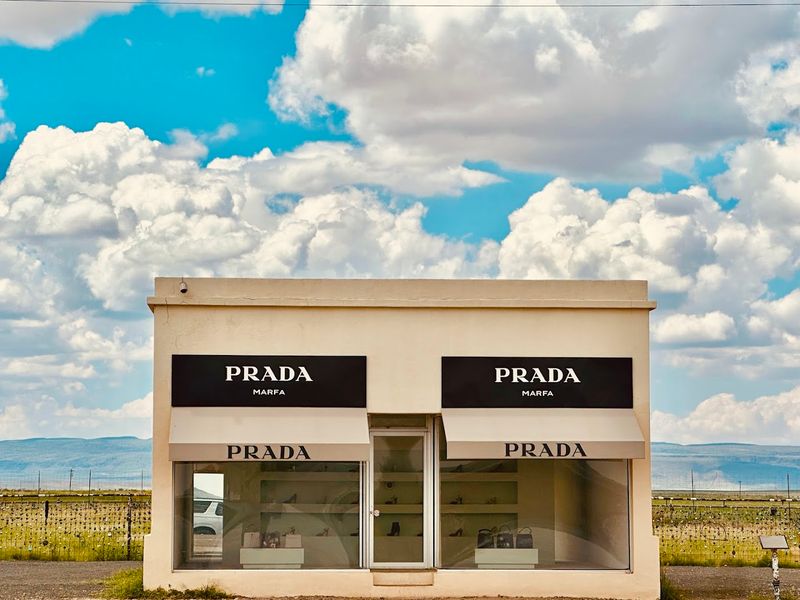
Standing alone on Highway 90, about 37 miles northwest of Marfa, is a perfect replica of a Prada boutique. It has real Prada bags in the windows.
It has real Prada shoes on display. But the door?
Permanently sealed. Welcome to Prada Marfa, one of the most photographed art installations in the world.
Created in 2005 by artists Elmgreen and Dragset, the piece was designed to slowly deteriorate and be reclaimed by the desert.
That plan changed when it became a viral sensation before social media was even really a thing. It’s been vandalized, repaired, and photographed by everyone from tourists to fashion magazines to pop stars.
Beyonce has been photographed here. So has pretty much every cool person who has passed through West Texas in the last two decades.
The installation comments on consumerism, luxury, and the absurdity of placing high fashion in the middle of absolute nowhere. It works on every level.
Visiting feels oddly surreal, like stumbling onto a movie set that nobody bothered to dismantle.
The contrast between the sleek, minimalist storefront and the rugged, empty landscape around it is genuinely striking.
You’ll take approximately forty photos and still not feel like you’ve captured it properly. Prada Marfa is the kind of art that makes you laugh, think, and reach for your camera all at once.
It earns its legendary status every single day.
A Mystery Nobody Has Solved Yet
Every town has its legends. Marfa’s happens to be a genuine, documented, totally unexplained phenomenon that has been baffling people since the 1800s.
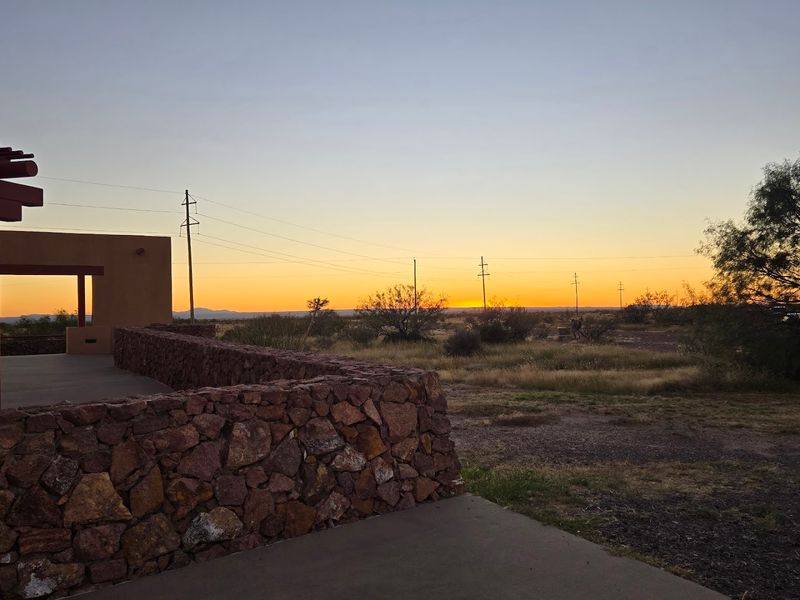
The Marfa Lights are mysterious glowing orbs that appear near Mitchell Flat, east of town, and nobody has ever fully figured out where they come from.
Theories range from swamp gas to reflections of car headlights to, naturally, aliens. Scientists have studied them.
Journalists have written about them.
Curious visitors camp out at the official Marfa Lights Viewing Area on Highway 90, hoping for a glimpse. Some nights they appear.
Some nights they don’t. That unpredictability is part of the whole mystique.
The lights were first officially documented by rancher Robert Ellison in 1883, long before cars existed to explain them away. They’ve been described as basketball-sized glowing spheres that hover, split, merge, and dart across the horizon.
The viewing area even has interpretive displays explaining the various theories, which somehow makes the whole experience feel even more wonderfully strange.
Going to see the Marfa Lights feels like being part of a long, ongoing story that has no ending yet. You sit in the dark, stare at the horizon, and feel genuinely connected to every other curious human who has done the same thing for over a century.
Whether you see them or not, the act of watching for something mysterious under a vast Texas sky is unforgettable all on its own.
Where Culture Gets A Little Unexpected
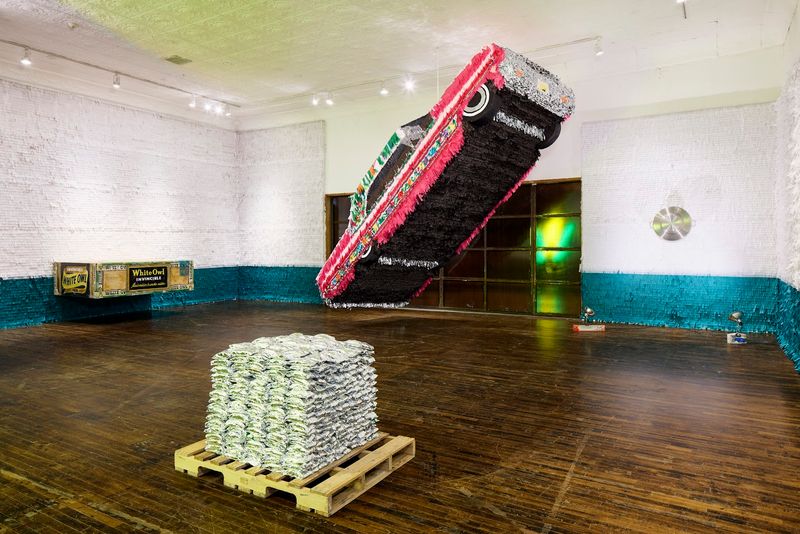
Not everything in Marfa is about minimalism and quiet contemplation. Ballroom Marfa brings noise, color, energy, and genuine community spirit to the cultural mix.
Founded in 2003, this nonprofit arts space hosts exhibitions, film screenings, live performances, and public programs that keep the town’s creative pulse beating strong.
The building itself has a fascinating history. It started as a Masonic lodge, then became a skating rink, and eventually transformed into one of the most exciting contemporary art spaces in Texas.
That layered history gives Ballroom Marfa a warmth and personality that feels distinct from the more austere minimalist institutions nearby.
Ballroom is known for championing emerging artists and experimental work that might not fit neatly into a traditional gallery context. They’ve collaborated with musicians, filmmakers, architects, and performance artists.
The programming is consistently surprising and refreshingly unpredictable, which fits Marfa’s overall energy perfectly.
Outside the main space, there’s a striking mural by artist Remed that covers the building’s exterior. It’s become a landmark in its own right, adding a burst of visual energy to the otherwise understated streetscape.
Ballroom Marfa reminds you that art doesn’t have to be serious or intimidating to be meaningful. Sometimes it’s loud, colorful, and completely joyful.
In a town full of big ideas, Ballroom keeps the conversation lively and the doors genuinely open to everyone who wanders through.
Living Inside A Work Of Art
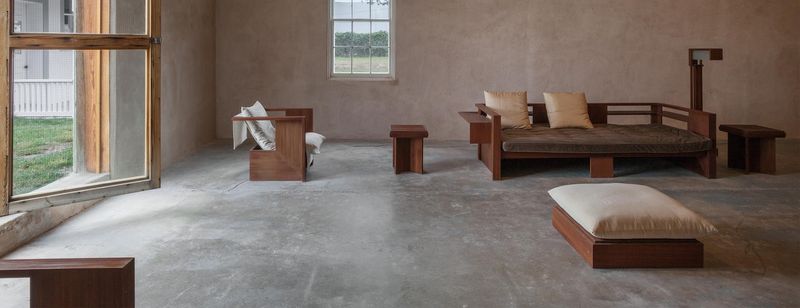
If Chinati is Donald Judd’s grand public statement, the Judd Foundation is where things get personal. The foundation manages two properties in Marfa that Judd lived and worked in: the Block, a former grocery and dry goods store, and the Studios, a collection of buildings where his personal art collection and library are preserved exactly as he left them.
Visiting feels like stepping into the mind of someone who thought about space, light, and objects with extraordinary precision.
Every room is arranged with careful intention. Books, furniture, art pieces, and tools are placed exactly where Judd wanted them.
Nothing has been moved. It’s less a museum and more a preserved way of thinking.
Judd designed and built much of the furniture himself, believing that everyday objects should be made with the same rigor as fine art.
Walking through his spaces, that philosophy makes total sense. A simple wooden table becomes a meditation on proportion.
A shelf of books becomes a portrait of a mind.
Tours are available and genuinely illuminating, offering context that makes the spaces even richer. The Judd Foundation is also deeply committed to preserving Marfa’s broader architectural and cultural heritage.
For anyone interested in how creative people actually live and work, this is one of the most fascinating stops in all of Texas.
It answers the question: what does it look like when an artist builds their entire world around their vision?
Celebrating Marfa’s Hollywood Past
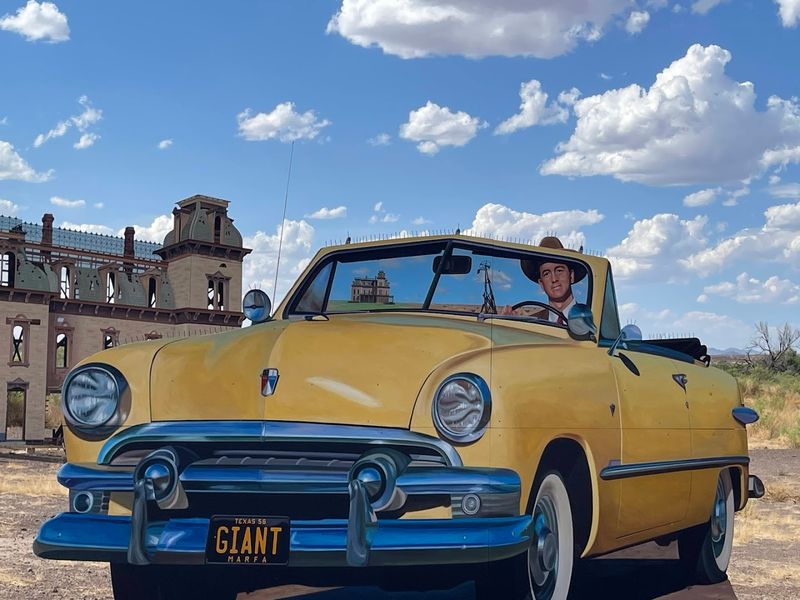
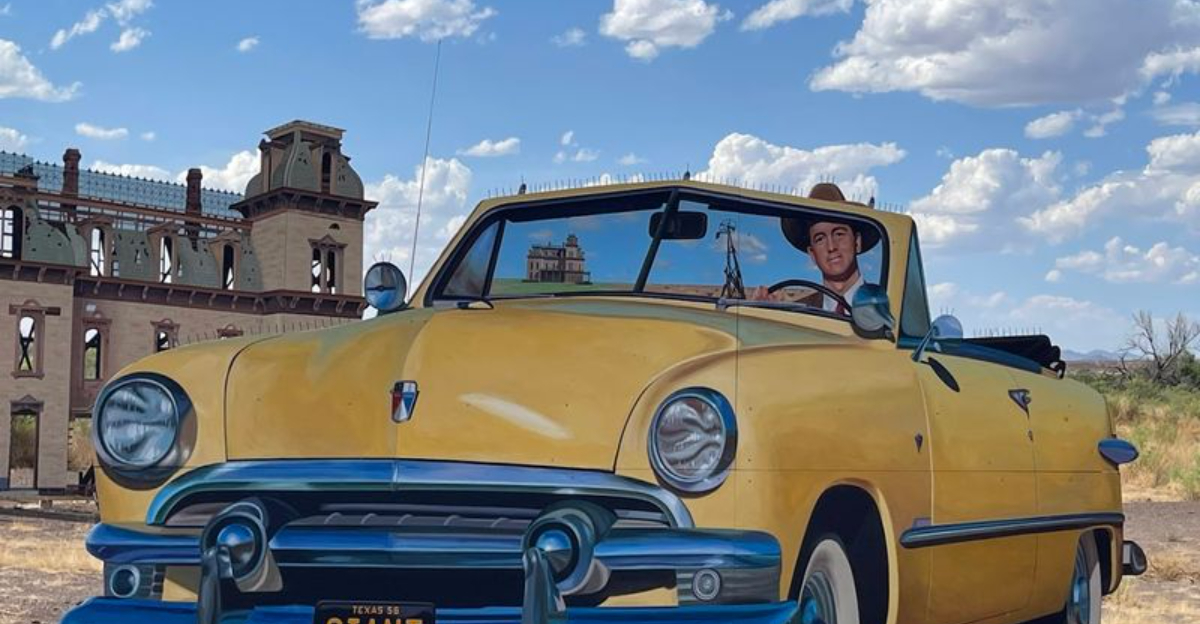
Before Marfa was an art destination, it was a movie set. The classic 1956 film Giant, starring Rock Hudson, Elizabeth Taylor, and James Dean, was filmed in the area around Marfa.
The town has never forgotten that moment of Hollywood glory, and artist John Cerney made sure of it.
Cerney created a series of large-scale flat metal figures placed in the landscape near Marfa, depicting scenes and characters from the film.
These life-size cutouts stand in the open desert, catching the wind and casting long shadows across the scrubby ground. They’re playful, nostalgic, and genuinely striking against the wide West Texas horizon.
The mural and figures celebrate the area’s cinematic history while also functioning as a kind of outdoor public art installation.
They remind visitors that Marfa’s relationship with creativity, storytelling, and spectacle goes back much further than Donald Judd’s arrival in the 1970s.
Stopping to see the Giant tribute is a lovely detour that adds texture to the Marfa story. It connects the town’s art world identity with its ranching and Hollywood past in a way that feels organic and genuinely fun.
James Dean filmed some of his final scenes here, which gives the whole thing an extra layer of emotional weight.
Marfa has always attracted people with vision. The Giant mural is proof that some stories deserve to be told in the biggest possible way.
Marfa As Your Desert Base Camp
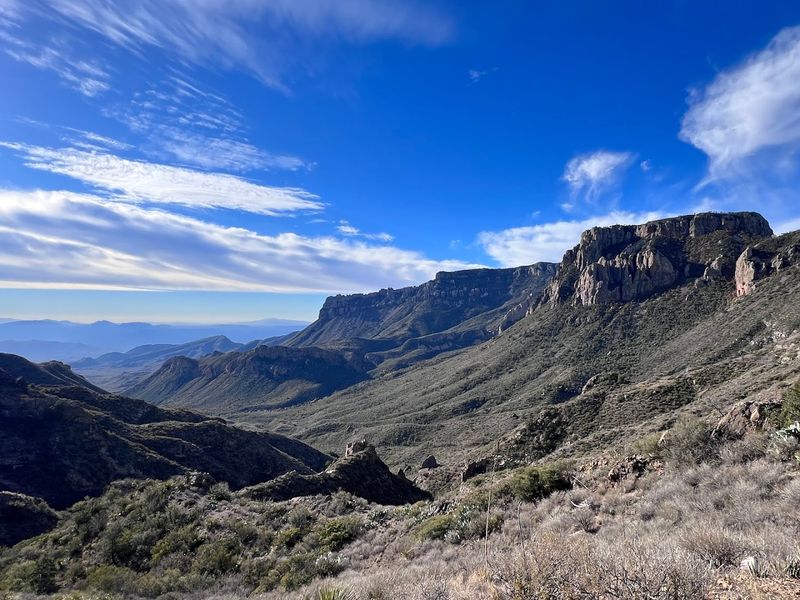
Marfa doesn’t exist in isolation. One of the smartest things about using it as a home base is its proximity to some of the most jaw-dropping natural scenery in the entire country.
Big Bend National Park sits about two hours south, and the drive there is an experience all by itself.
Big Bend covers over 800,000 acres of Chihuahuan Desert, mountains, and Rio Grande river canyons. It’s one of the least-visited national parks in the lower 48 states, which means you can experience genuine wilderness without fighting crowds.
The contrast between Marfa’s art world energy and Big Bend’s raw, ancient landscape is genuinely thrilling.
The Chisos Mountains rise dramatically from the desert floor inside the park, offering hiking trails with views that feel almost impossible.
The Santa Elena Canyon, where the Rio Grande cuts between sheer 1,500-foot limestone walls, is one of those sights that makes you feel very small in the best possible way.
Marfa also sits close to Presidio, Fort Davis, and the McDonald Observatory, where the dark sky conditions are among the best in North America for stargazing.
The region as a whole offers a layered experience that combines culture, wilderness, history, and science in a way few places in America can match. Marfa is the perfect anchor for exploring all of it.
Could there be a better reason to finally book that West Texas road trip you’ve been putting off?