
10 Kansas Places That Look Nothing Like The Kansas People Expect
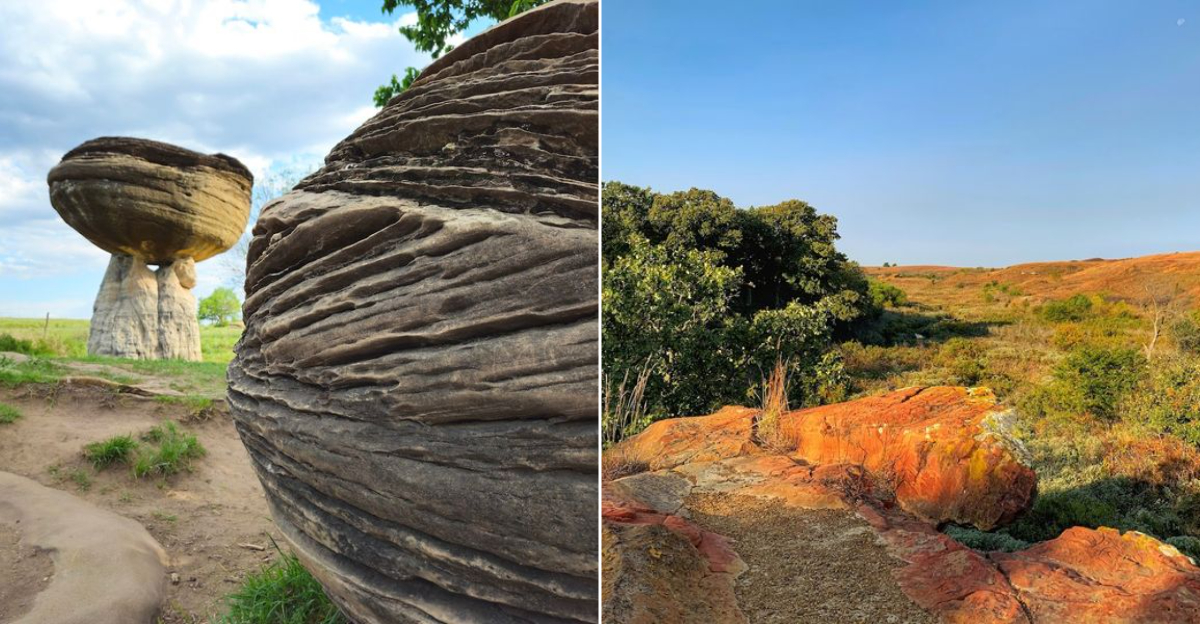
Most people picture Kansas and immediately think of Dorothy Gale spinning through a tornado over flat golden wheat fields. Thanks, The Wizard of Oz, for setting the bar so low!
But here is the truth that surprises nearly every visitor who looks around.
Kansas is secretly one of the most geologically dramatic states in the country, hiding chalk pyramids, underground salt museums, canyon trails, and badlands that make travelers do a double take.
Across 82,000 square miles, tucked inside that wide open space are landscapes that feel borrowed from Utah, New Mexico, and even the moon. Ancient seabeds left behind towering white formations.
Wind and water carved mushroom-shaped rocks out of sandstone. Underground salt mines became jaw-dropping museums.
The variety is stunning, and most people have no idea any of it exists. Whether you love road trips, nature, or being dramatically proven wrong, Kansas is ready to flip the script.
Pack your curiosity, leave your assumptions at the state line, and discover a Kansas nothing like the one Hollywood sold you.
1. Little Jerusalem Badlands State Park
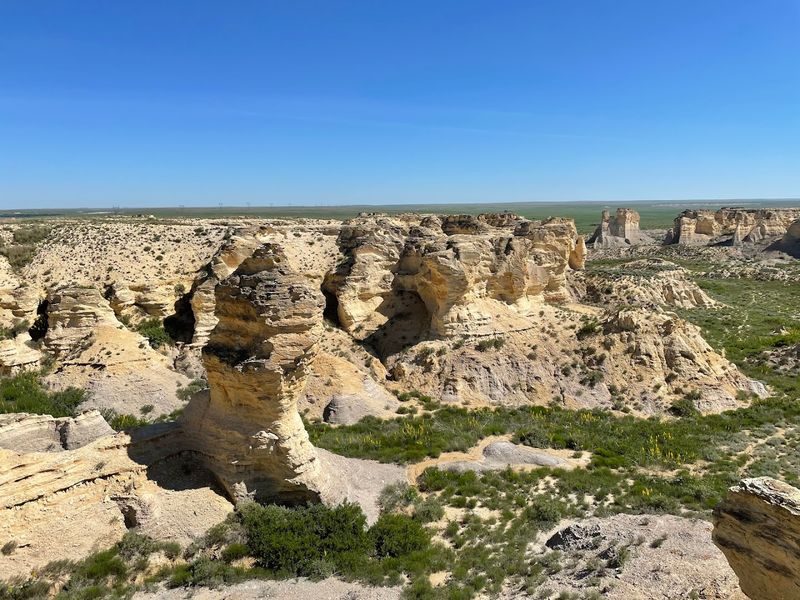
Nobody expects to find something that looks like a miniature Jerusalem rising out of the Kansas prairie, but here we are. Situated along County Road 400 and Gold Road near Oakley, Kansas 67748, Little Jerusalem Badlands State Park is one of the most visually striking places in the entire Midwest.
The chalk formations here rise up to 100 feet tall, carved slowly by wind and water over millions of years into jagged spires and dramatic cliffs.
The park protects the largest remaining Niobrara chalk formation in the state. Walking the trails feels genuinely surreal, like someone quietly relocated a piece of the American Southwest into the middle of the Great Plains without telling anyone.
The landscape shifts from golden prairie grass to stark white rock walls within just a few steps.
The park opened to the public in 2019 after a partnership between The Nature Conservancy and Kansas State Parks. There are two trails available, including a longer route that brings you right up to the base of the formations.
Sunrise and sunset visits reward you with colors that seem almost too good to be real. Kansas just quietly keeps winning when nobody is watching.
2. Monument Rocks National Natural Landmark
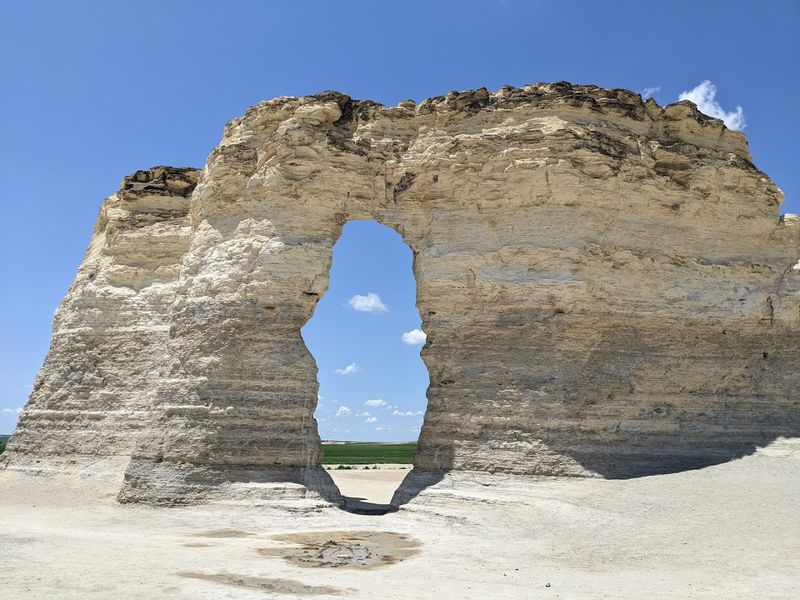
Standing in front of Monument Rocks for the first time genuinely stops you in your tracks.
Located along Monument Rocks Road south of Oakley, Kansas 67748, these chalk formations are the first National Natural Landmark ever designated in the entire United States, earning that honor back in 1968.
They rise up to 70 feet tall and look like something that belongs on another planet entirely.
About 80 million years ago, this whole region sat beneath a vast inland sea called the Western Interior Seaway.
When that sea retreated, it left behind thick layers of chalk that erosion slowly sculpted into the towering pyramids and arches you see today.
Fossils of prehistoric sea creatures have been found throughout the surrounding area, which adds a genuinely wild layer to the whole experience.
The best part? Monument Rocks sits on private land that is freely accessible to visitors, so there are no entrance fees and no crowds fighting for the best photo angle.
You can walk right up to the formations and feel the chalky texture with your own hands. Visiting at golden hour turns the white rock into warm amber tones that feel almost cinematic.
This is the Kansas that needs to be on every bucket list.
3. Castle Rock Badlands
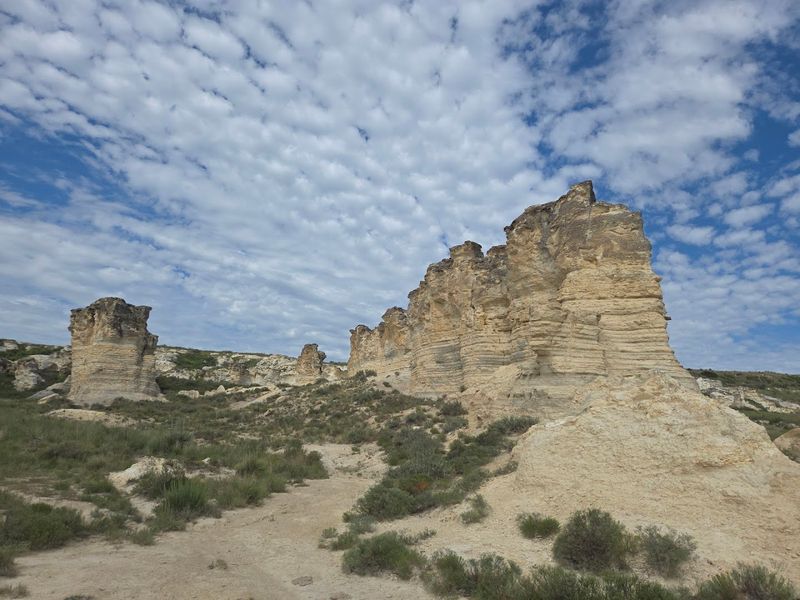
Castle Rock does not ease you in gently. It just hits you all at once, standing there like a cathedral built by geology itself, completely unannounced in the middle of the Kansas plains.
Located about 15 miles south and 4 miles east of Quinter near Collyer, Kansas 67631, this site features limestone and shale formations that jut dramatically out of the surrounding flatlands.
Hoodoos, steep crevices, and a massive central ridge define the landscape in ways that feel genuinely cinematic.
The formations here are remnants of the same ancient seabed that created Monument Rocks. Erosion worked differently here though, producing sharper edges and more dramatic vertical drops.
The tallest spire, known simply as Castle Rock, soars about 70 feet into the air and is visible from quite a distance across the open plains.
Castle Rock also sits on privately owned land, freely open to visitors who want to explore. There are no formal trails, which means the experience feels wonderfully raw and unfiltered.
You pick your path, scramble around the formations, and take in a view that genuinely makes you question whether you are still in Kansas at all.
Bring sturdy shoes, good sunscreen, and the willingness to be completely surprised. Kansas geology has been quietly flexing this whole time.
4. Mushroom Rock State Park
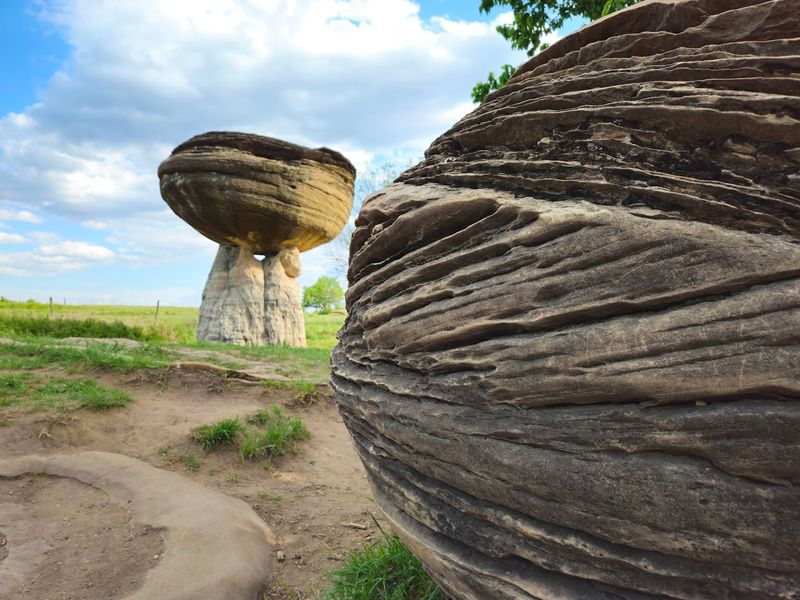
Mushroom Rock State Park is Kansas pulling off a magic trick in plain sight. Found along Avenue K near Brookville, Kansas 67425, this tiny park holds one of the most unusual collections of naturally shaped rocks anywhere in the central United States.
The formations look exactly like giant stone mushrooms, with wide rounded caps balanced on narrower bases, all carved patiently by wind and water over thousands of years.
The rocks are made of Dakota sandstone, a material that erodes at different rates depending on its hardness.
The softer layers wear away faster, leaving the harder capstone behind to overhang in that signature mushroom shape. The largest formation here weighs an estimated 200 tons, which makes its delicate-looking balance even more impressive in person.
At just two acres, Mushroom Rock holds the title of Kansas’s smallest state park, but what it lacks in size it absolutely makes up for in character.
The site has been a recognized landmark since the 1800s, when travelers along the Santa Fe Trail used these distinctive rocks as a navigation point.
Standing beside one of these formations, you get a strong sense of just how long the earth has been quietly sculpting things without needing anyone’s approval. Small park, massive personality.
5. Rock City Park
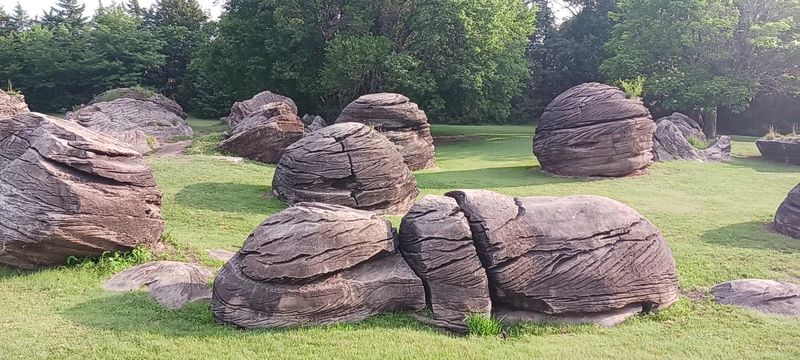
Rock City Park looks like a giant left a bag of marbles scattered across a Kansas hillside and just never came back for them.
Located at 1051 Ivy Road near Minneapolis, Kansas 67467, this privately owned park features over 200 massive spherical Dakota sandstone concretions, many of them measuring up to 27 feet in diameter. That makes them among the largest natural sandstone concretions found anywhere on Earth.
Concretions form when minerals gradually cement sediment particles together around a central nucleus, growing outward over millions of years like a geological snowball.
The ones at Rock City are strikingly round and densely clustered, which gives the whole place a prehistoric playground energy that is hard to describe without just standing there gaping at it.
The park has been welcoming curious visitors since the 1940s and still operates as a charming, low-key attraction with a small entrance fee.
You can walk freely among the boulders, climb some of them, and spend a surprisingly long time just circling the formations trying to process what you are actually looking at.
Rock City was designated a National Natural Landmark in 1976, cementing its status as one of the genuinely remarkable geological sites in the entire country. Kansas keeps its best secrets just off the main highway.
6. Kansas Underground Salt Museum
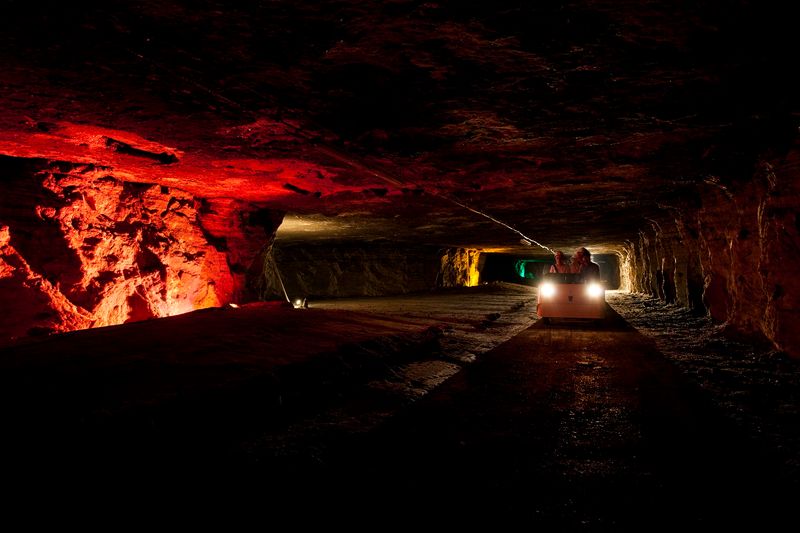
Going underground in Kansas sounds like the setup to a quirky road trip story, and honestly, it delivers. Strataca, the Kansas Underground Salt Museum, sits 650 feet below street level at 3650 East Avenue G in Hutchinson, Kansas 67501.
Visitors descend by mine elevator into a working salt mine that has been operating since 1923, and what greets them down there is genuinely breathtaking in the most unexpected way.
The underground chambers stretch for miles, with salt walls that shimmer under the museum lighting in shades of white, gray, and pale amber.
The mine sits within the Hutchinson Salt Member, a massive underground salt deposit that stretches across much of central Kansas.
The temperature underground stays a constant 68 degrees year round, which is its own kind of magic on a sweltering Kansas summer day.
Strataca offers several tour options, including a tram ride through the mine tunnels and a dark ride experience that turns out the lights completely so you can feel true underground darkness.
The museum also houses an extraordinary archive of film reels and historical documents stored underground because the stable conditions preserve materials better than almost anywhere on the surface.
This is not just a museum, it is a whole other world hiding directly beneath your feet.
7. Kanopolis State Park
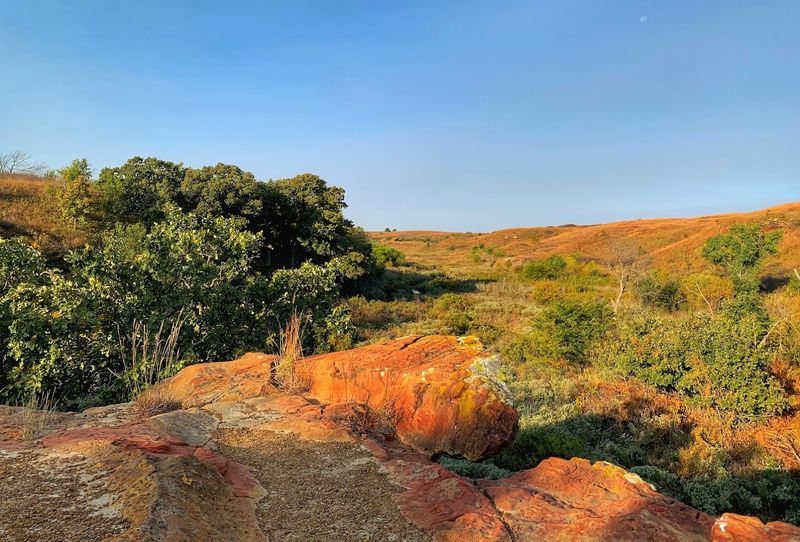
Kanopolis State Park carries a quiet confidence that hits differently once you actually arrive and see what it is hiding.
Located at 200 Horsethief Road near Marquette, Kansas 67464, this park holds the title of Kansas’s very first state park, established in 1956.
But the real draw is not the history, it is the terrain, which feels absolutely nothing like what most people picture when they think Kansas.
The Buffalo Track Canyon Nature Trail winds through a landscape of sandstone bluffs, hidden caves, and dense shrubby ravines that create a tunnel-like experience along certain stretches.
The canyon walls glow orange and amber in the afternoon light, and the contrast between the rugged rock faces and the lush green vegetation below is genuinely striking. Over 27 miles of trails cover prairie, riverbed, bluffs, and canyon terrain.
Horsethief Canyon, one of the park’s most dramatic areas, earned its name from a time when horse thieves used the hidden ravines to conceal stolen animals.
That history adds a layer of gritty character to an already compelling landscape. Kanopolis also borders Kanopolis Lake, which adds water recreation to the mix.
The variety packed into one park is impressive, and the canyon terrain alone is worth the drive from anywhere in the state.
8. Historic Lake Scott State Park
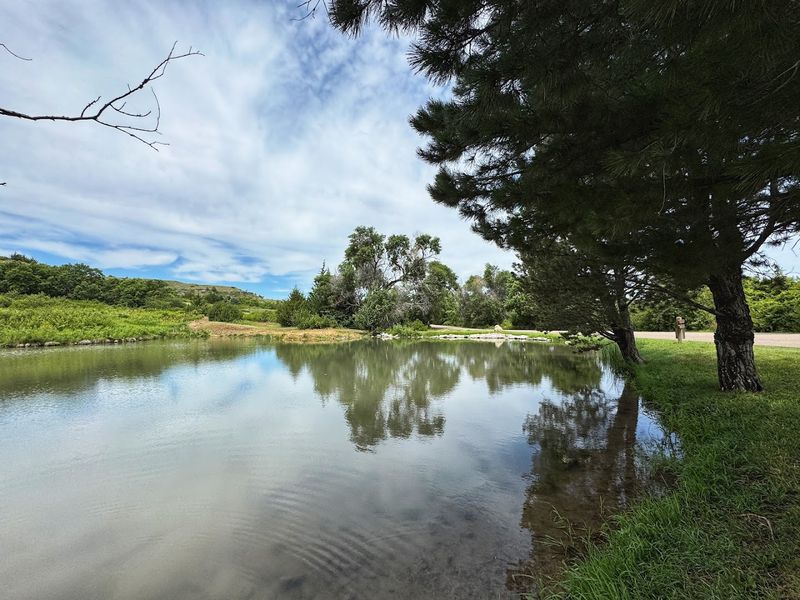
Historic Lake Scott State Park is the kind of place that makes you stop mid-sentence and just stare.
Situated at 101 West Scott Lake Drive near Scott City, Kansas 67871, this park sits in a spring-fed canyon that feels almost tropical compared to the surrounding high plains landscape.
Limestone bluffs rise sharply around a clear, calm lake, creating a scene that belongs on a postcard from somewhere far more famous.
The park draws its name from a series of historically significant events that took place in this canyon. The area contains the ruins of El Cuartelejo, the northernmost known pueblo ruin in the United States, built by Taos Pueblo people who fled to Kansas in the late 1600s.
That alone gives the park a depth that goes well beyond its scenic beauty.
Spring-fed streams keep the canyon lush and green even during dry summers, which creates a striking visual contrast with the open plains just outside the park boundary.
Bison once roamed this canyon in enormous numbers, and the landscape still carries that wild, unhurried energy. Hiking, fishing, and camping are all popular here, but honestly, simply standing at the lake and taking in the bluffs is reward enough.
Scott City just became a destination worth circling on the map.
9. Cedar Bluff State Park
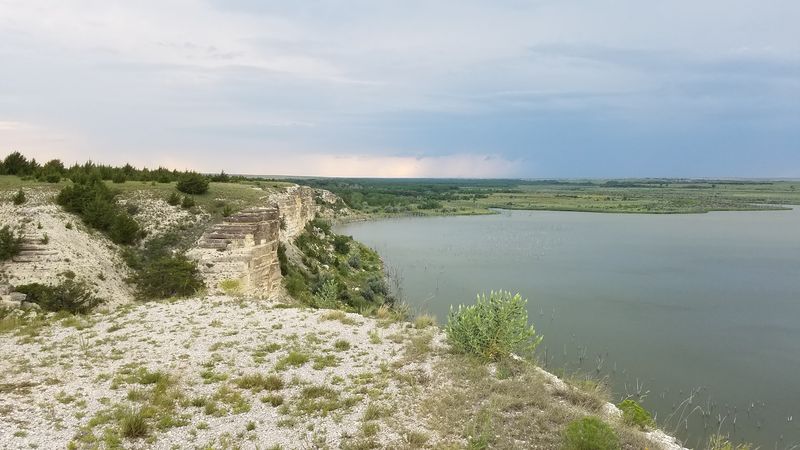
Cedar Bluff State Park plays the long game, revealing its best features slowly as you wind through the terrain and realize the landscape keeps changing around you.
Located at 32001 Kansas Highway 147 near Ellis, Kansas 67637, this park sits along the shores of Cedar Bluff Reservoir, where dramatic white chalk and limestone bluffs drop straight down to the water’s edge.
The contrast between the pale rock and the blue-green water is genuinely stunning.
The bluffs here are part of the same Niobrara chalk formation that created Monument Rocks and Little Jerusalem, but the setting along the reservoir gives Cedar Bluff a completely different character.
Erosion has sculpted the shoreline into a series of dramatic outcroppings and coves that reward exploration by both land and water.
The park covers over 1,700 acres and includes trails that wind along the bluff edges with panoramic views stretching across the reservoir.
Wildlife is abundant here, with deer, wild turkey, and a wide variety of bird species making regular appearances along the trails.
The park also offers some of the best fishing in western Kansas, with the reservoir stocked regularly with walleye and bass.
Cedar Bluff tends to fly under the radar even among Kansans, which means the trails stay refreshingly quiet. Quiet, dramatic, and completely underrated is a rare combination worth seeking out.
10. Elk City State Park
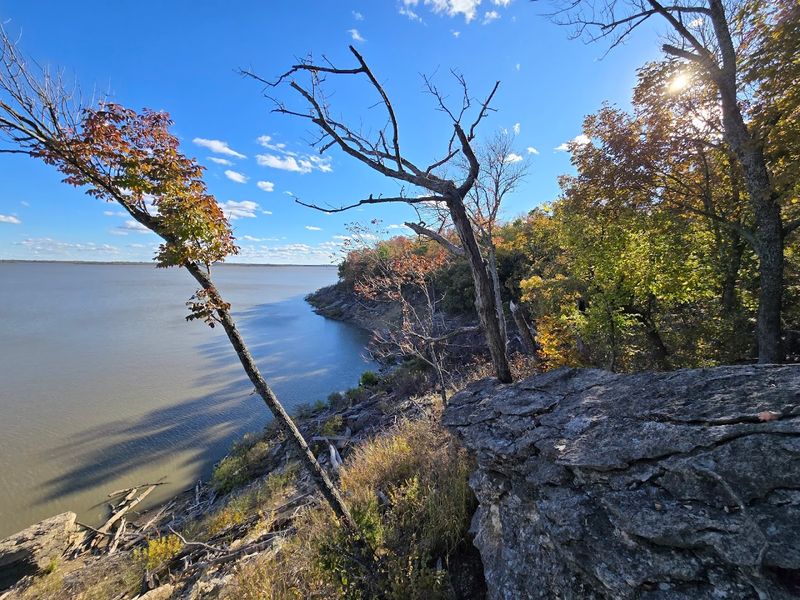
Elk City State Park is the plot twist at the end of the Kansas road trip that nobody saw coming.
Nestled at 4825 Squaw Creek Road near Independence, Kansas 67301 in the southeastern corner of the state, this park delivers a densely forested, creek-lined landscape that looks nothing like the Kansas most people picture.
Tall hardwood trees create a full canopy overhead, and the Elk City Lake shoreline winds through terrain that feels genuinely lush and wild.
The park sits within the Ozark Plateau transition zone, which explains why the vegetation here is dramatically different from the western Kansas plains.
Oak, hickory, and walnut trees dominate the forest, and the understory is thick with wildflowers during spring. The Table Mound Trail system offers over 15 miles of hiking through terrain that rolls and dips in ways that feel surprising for Kansas.
Elk City Lake itself stretches across 4,500 acres and offers excellent fishing, paddling, and shoreline exploration. The combination of forest, water, and rolling terrain creates an almost Appalachian atmosphere that consistently catches visitors off guard.
Birding is exceptional here, with more than 200 species recorded in the park over the years. Elk City is the kind of place that resets your entire understanding of what Kansas actually looks like, and that reset feels pretty great.
Have you been underestimating Kansas this whole time?