
Take A 2026 Road Trip And See The 10 Most Fascinatingly Weird Attractions In All South Carolina
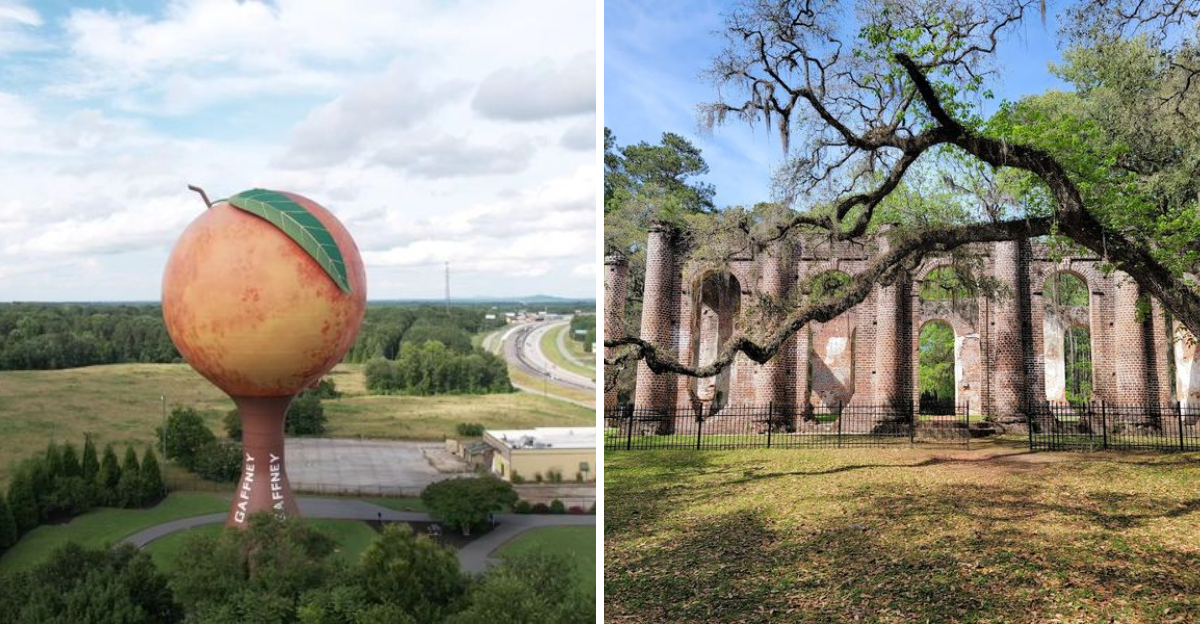
South Carolina is famous for many things.
Pristine beaches.
Historic towns.
World-class barbecue.
Giant peaches?
Mysterious UFO sites?
Roadside attractions that leave you wondering what on earth you just saw?
Not so much.
Yet that unexpected side of South Carolina is exactly what makes exploring the state so much fun. Beyond the postcard-perfect destinations and well-known tourist attractions lies a collection of wonderfully strange landmarks, bizarre creations, and unforgettable roadside oddities that turn ordinary road trips into unforgettable adventures.
These are the places that make you pull over without hesitation.
The places that fill your camera roll.
The places that spark conversations long after the trip is over.
And perhaps best of all, they remind you that travel is often at its most memorable when it is a little weird.
South Carolina has plenty of famous attractions.
But these are the ones you’ll be talking about for years.
1. Lee State Park Artifacts And Lizard Man Exhibit, Bishopville
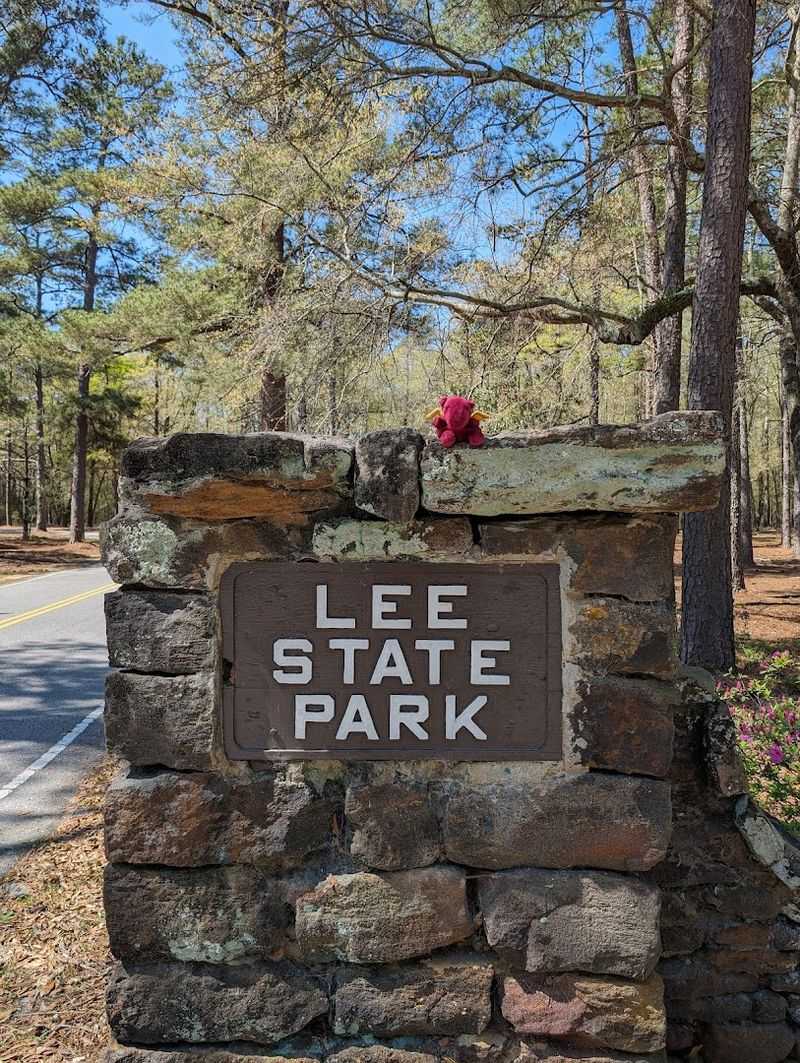
In the summer of 1988, a teenager named Christopher Davis reported being attacked near Scape Ore Swamp by a seven-foot, red-eyed, scaly humanoid creature, and Bishopville, South Carolina, has never been quite the same since.
The Lizard Man became a national media sensation, inspiring a flood of sightings, merchandise, and one very entertaining local legend that Lee State Park at 487 Loop Road in Bishopville has wisely chosen to celebrate.
The exhibit inside the park collects newspaper clippings, photographs, and artifacts tied to the Lizard Man craze, giving the whole story a surprisingly well-documented presentation.
Rangers and staff are often happy to share their own takes on the legend, which adds a fun, conversational layer to the visit.
The park itself is beautiful, with equestrian trails, a river, and artesian wells, so there is plenty to enjoy beyond the cryptid corner.
Visiting Lee State Park means you get nature, history, and the faint, thrilling possibility that something scaly is watching from the swamp.
2. South Of The Border, Hamer
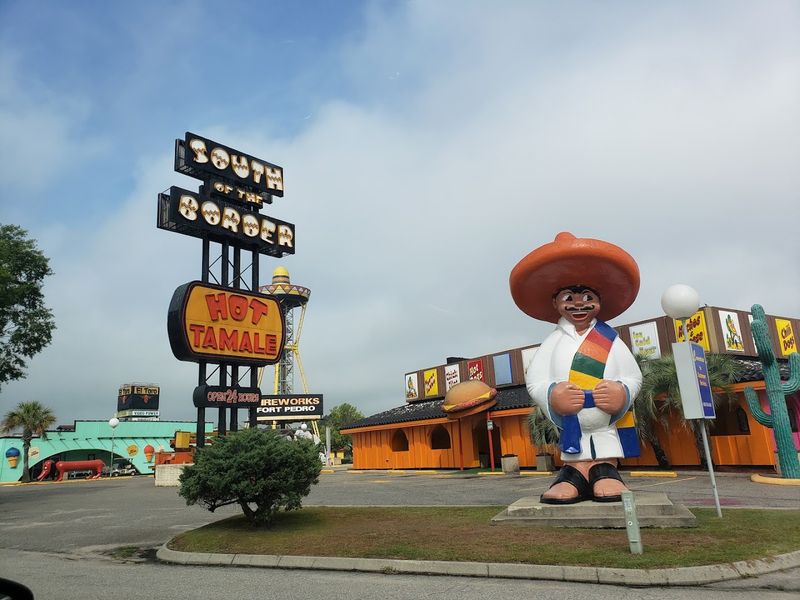
Long before you actually reach South of the Border on US-301 in Hamer, South Carolina, the billboards start teasing you from miles away, each one funnier and more outrageous than the last.
This sprawling roadside complex has been luring travelers since 1950, and it shows absolutely no interest in being subtle about it.
The towering Sombrero Tower shoots up over 200 feet into the sky and offers a ride-up elevator for panoramic views of the surrounding flatlands.
Pedro, the mustachioed mascot, appears on signs, statues, and storefronts across the property, giving the whole place a delightfully over-the-top theme park energy.
There are gift shops, restaurants, a motel, an amusement area, and enough neon signage to light up a small city.
Kids absolutely love running between the giant statues while adults tend to get lost in the souvenir shops for longer than they planned.
South of the Border is kitsch elevated to an art form, and I mean that as the highest possible compliment.
3. The Peachoid Giant Peach Water Tower, Gaffney
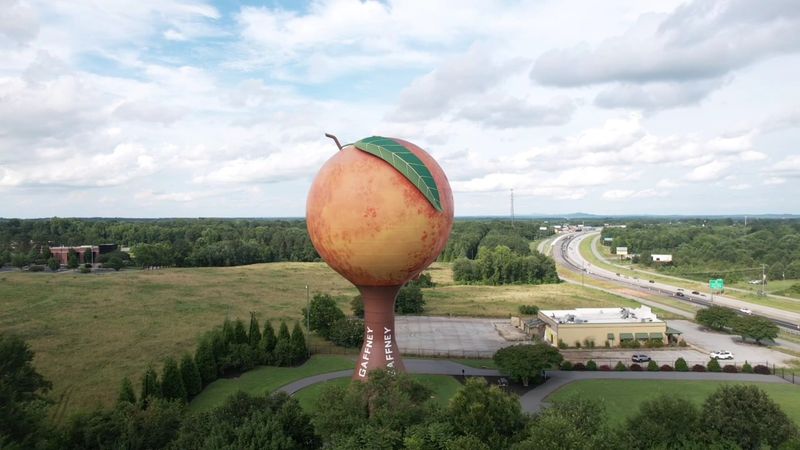
Spotted from Interstate 85 near Gaffney, South Carolina, the Peachoid stops drivers in their tracks every single day, which is exactly what it was designed to do.
Built in 1981 and sitting at 1 Peachoid Road, this 135-foot-tall water tower holds one million gallons of water and is painted to look exactly like a ripe, sun-kissed peach, right down to the crease.
South Carolina is one of the top peach-producing states in the country, so the locals wear this giant fruit landmark with serious hometown pride.
The tower earned a new wave of national fame after appearing in the Netflix series “House of Cards,” which sent curious fans on road trips to snap photos.
You can pull into a small viewing area near the base to get your best camera angle without risking your bumper on the highway shoulder.
Standing beneath something this enormous and this peachy is a genuinely surreal experience that no photograph fully captures.
4. Pearl Fryar’s Topiary Garden, Bishopville
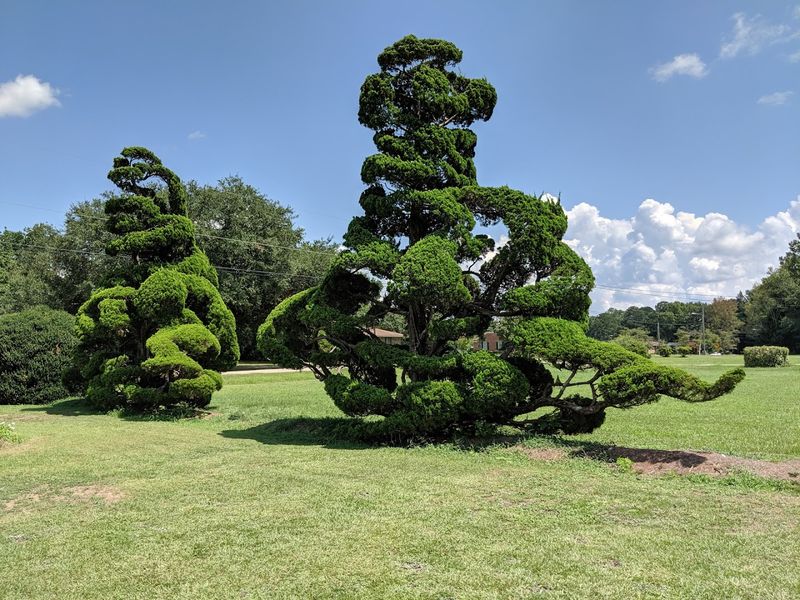
What started as one man’s desire to win a yard-of-the-month award has grown into one of the most extraordinary folk art environments in the entire American South.
Pearl Fryar’s Topiary Garden at 145 Broad Acres Road in Bishopville, South Carolina, features more than 300 sculpted trees and shrubs, all shaped by Fryar himself using techniques he taught himself from library books and sheer determination.
The shapes range from elegant spirals to wild abstract forms that look like something between a dream and a geometry textbook.
Fryar, who began the garden in the 1980s, has become a celebrated figure in the folk art world and was the subject of a well-received documentary called “A Man Named Pearl.”
The garden is open to visitors and feels like stepping into a quiet, living sculpture park where every corner reveals something new and unexpected.
Spending an hour here resets your sense of what one person with a pair of shears and a clear vision can actually accomplish.
5. Button King Museum, Bishopville
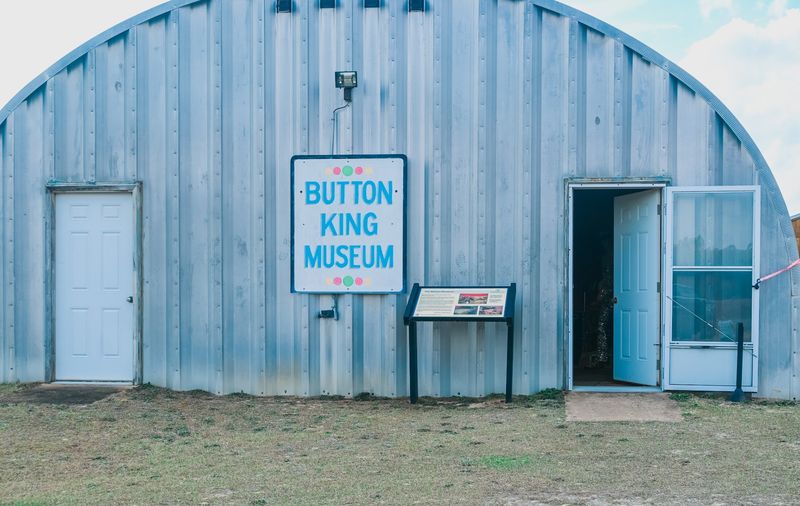
Dalton Stevens earned the title of Button King the old-fashioned way: by sewing over 600,000 buttons onto everything he owned, including his clothes, his car, his coffin, and eventually the walls of his museum at 52 S Main Street in Bishopville, South Carolina.
The story goes that Stevens suffered from insomnia in the late 1980s and started sewing buttons to pass the sleepless hours, a hobby that quietly spiraled into one of the most committed artistic obsessions in South Carolina history.
Walking through the museum feels like entering a room where every surface has been given a bedazzled, button-covered personality.
Stevens appeared on national television programs and late-night shows, turning his quirky compulsion into a celebrated piece of American outsider art history.
The museum preserves his legacy and gives visitors a chance to see the full scope of his button-covered world up close.
Bishopville turns out to be quite the hub of wonderfully strange creativity, and the Button King Museum is proof that sometimes the most unusual hobbies leave the biggest marks.
6. The World’s Smallest Police Station, Ridgeway
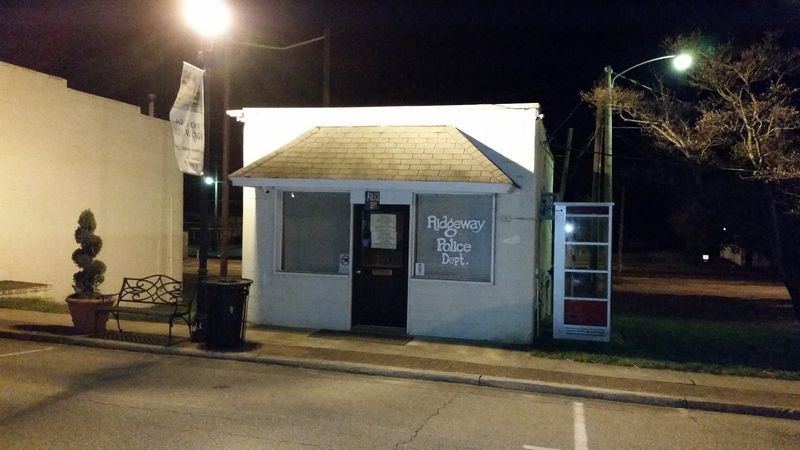
Tucked along 141 N Main Street in the charming small town of Ridgeway, South Carolina, sits a structure so compact it makes a phone booth look spacious: the self-proclaimed World’s Smallest Police Station.
The little wooden building dates back to around 1940 and was originally used as a working police outpost, reportedly staffed by a single officer who managed calls and kept watch over the quiet downtown area.
Ridgeway, with a population that hovers around 300 people, clearly did not need a precinct the size of a city block, and the town leans into that fact with genuine good humor.
A sign proudly declares its record-holding status, and visitors routinely stop to take photos beside the door, which barely fits one adult standing straight.
The surrounding Main Street has a sweet, unhurried quality that makes the whole stop feel like a step back into a simpler era of small-town American life.
Ridgeway proves that the best roadside bragging rights sometimes come in the smallest possible packages.
7. Old Sheldon Church Ruins, Yemassee
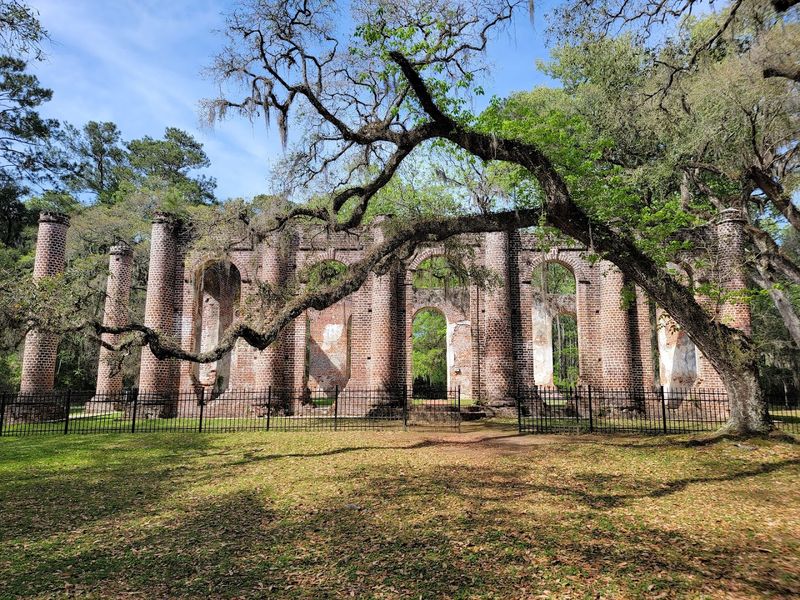
Standing in the middle of a moss-draped forest off Old Sheldon Church Road near Yemassee, South Carolina, these brick columns and crumbling walls carry more than two centuries of dramatic history in every weathered stone.
Prince William’s Parish Church, as it was originally known, was built around 1745 and burned by British troops during the Revolutionary War, then rebuilt, then burned again by General Sherman’s forces during the Civil War, leaving the haunting skeleton that stands today.
The ruins are surrounded by an old cemetery where Spanish moss hangs from nearby oaks, creating an atmosphere that feels genuinely cinematic without any artificial help.
Photographers and history lovers make regular pilgrimages here, particularly in the early morning when soft light filters through the open arches in a way that feels almost theatrical.
There is no admission fee, and the site is maintained with respectful care that honors both the architecture and the stories buried in the surrounding grounds.
Old Sheldon Church is the kind of place that stays with you long after the drive home.
8. Stumphouse Tunnel, Walhalla
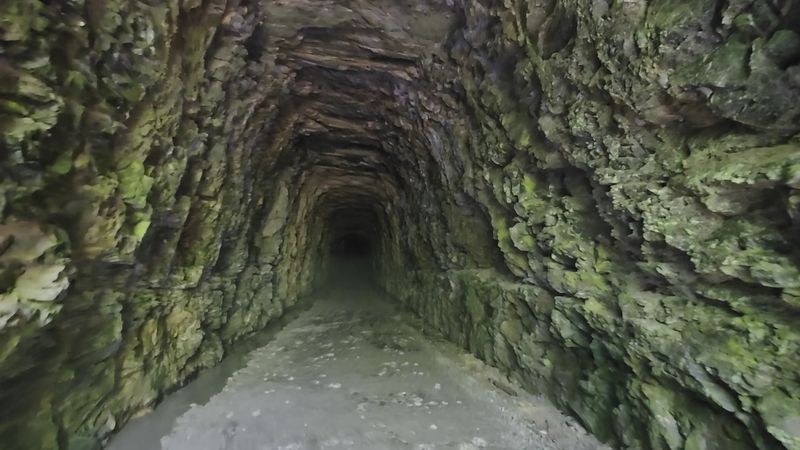
Carved through the Blue Ridge Mountains near Walhalla, South Carolina, Stumphouse Tunnel at 109 Tunnel Lane is a 1,600-foot unfinished railroad passage that has been fascinating curious visitors for well over a century.
Construction began in the 1850s as part of an ambitious plan to connect Charleston to the Midwest by rail, but funding ran out before the tunnel could be completed, and the mountain simply kept the hole.
Walking inside feels immediately dramatic: the temperature drops sharply, the walls glisten with seeping groundwater, and the distant circle of light at the far end creates a perspective that photographers absolutely love.
Clemson University actually used the tunnel in the 1940s and 1950s to age blue cheese, taking advantage of its cool, consistently humid interior in a wonderfully practical piece of repurposing history.
The surrounding Stumphouse Mountain Heritage Preserve offers hiking trails and a picnic area, making the stop feel complete rather than just a quick look-and-leave.
Stumphouse Tunnel rewards the curious with a cool, quiet, genuinely otherworldly experience tucked into the South Carolina upstate.
9. God’s Acre Healing Springs, Kershaw
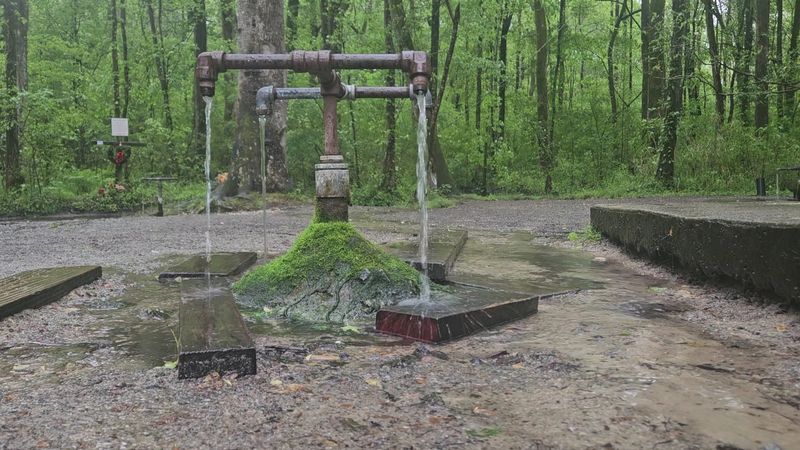
Alongside Kershaw Camden Highway in Kershaw, South Carolina, a small roadside spring quietly draws a steady stream of visitors who arrive with empty jugs and a strong belief in the water’s restorative powers.
God’s Acre Healing Springs has been a local landmark for generations, with stories dating back to the 1700s claiming that the mineral-rich water healed soldiers and settlers of various ailments.
The land was eventually deeded to God in 1944 by a man named Lute Boylston, who believed the spring was too sacred to be owned by any individual person, making it one of the more unusual property arrangements in South Carolina’s legal history.
Simple spigots allow visitors to fill containers directly from the spring, and the surrounding area has a calm, almost reverent atmosphere that makes the stop feel meaningful regardless of your personal beliefs.
Locals and out-of-towners alike make regular return trips, treating the visit as part practical errand and part quiet ritual.
There is something genuinely touching about a place so simple that has held people’s trust for so long.
10. The Kazoo Museum, Beaufort
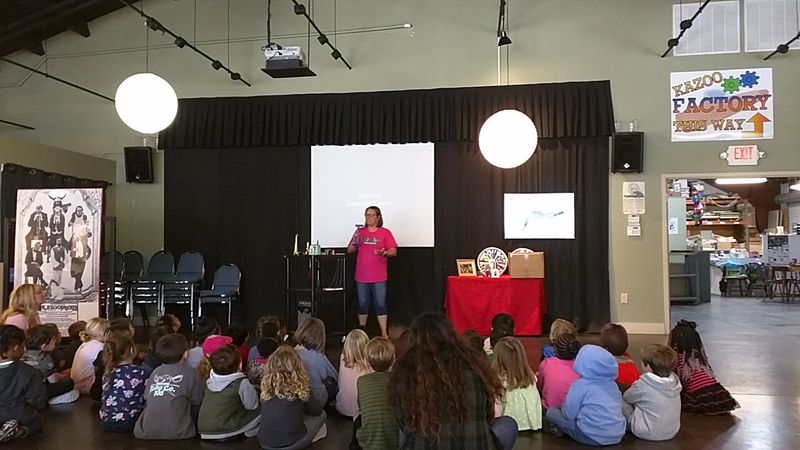
Somewhere in Beaufort, South Carolina, there is a museum entirely devoted to the kazoo, and it is far more interesting than you might expect from a sentence that contains both the words “museum” and “kazoo.”
Located at 15 Magnolia Street, the Kazoo Museum celebrates the surprisingly rich history of this humble instrument, tracing its origins back to the 1840s and showcasing hundreds of kazoos made from materials ranging from metal and plastic to wood and even gold.
The collection includes rare and vintage models that serious music historians actually get excited about, which adds an unexpected layer of depth to what could have been a purely novelty attraction.
Visitors can learn how kazoos are made, explore their cultural history, and yes, actually play a few, which turns the visit into a participatory experience rather than a passive one.
Beaufort itself is a gorgeous coastal city worth exploring before or after your kazoo education, with antebellum architecture and waterfront views that pair nicely with a humming good time.
The Kazoo Museum is proof that the most joyful stops are often the ones you never saw coming.