
The Most Mysterious Place In New Mexico You Can Still Explore Today
Some mysteries don’t need locked doors or hidden treasure maps. They’re waiting out in the open, carved into stone and left behind by people who lived thousands of years ago.
Deep in New Mexico’s desert landscape, there’s a place where ancient symbols, unanswered questions, and stunning scenery come together to create an experience unlike any other. Who made these markings?
What stories were they trying to tell? The answers may never be completely known, and that’s exactly what makes this destination so fascinating.
Walking among these ancient carvings feels like stepping into a conversation with the past, where every symbol holds a little piece of a forgotten story.
Equal parts mysterious, beautiful, and unforgettable, this hidden New Mexico wonder proves that history’s greatest secrets are sometimes hiding right in front of us.
Step Into The World’s Most Ancient Outdoor Art Gallery
Forget everything you think you know about art museums. This place rewrites the rules entirely, and it does so across more than 50 acres of rugged New Mexico desert.
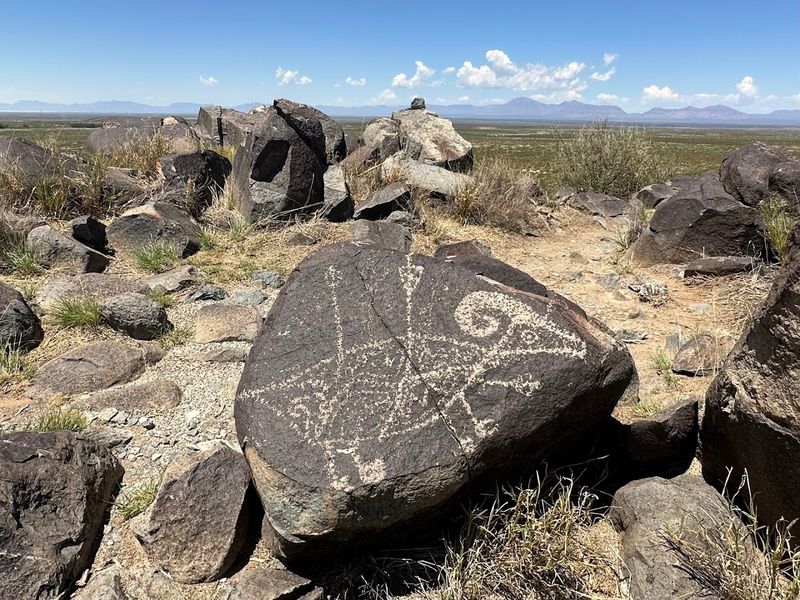
The Three Rivers Petroglyph Site holds one of the densest concentrations of prehistoric rock art anywhere in the entire Western Hemisphere, with over 21,000 individual carvings spread across a dramatic basaltic ridge.
Walking the trail feels less like a hike and more like flipping through an ancient sketchbook that never ends. Every rock face you pass has something new to offer.
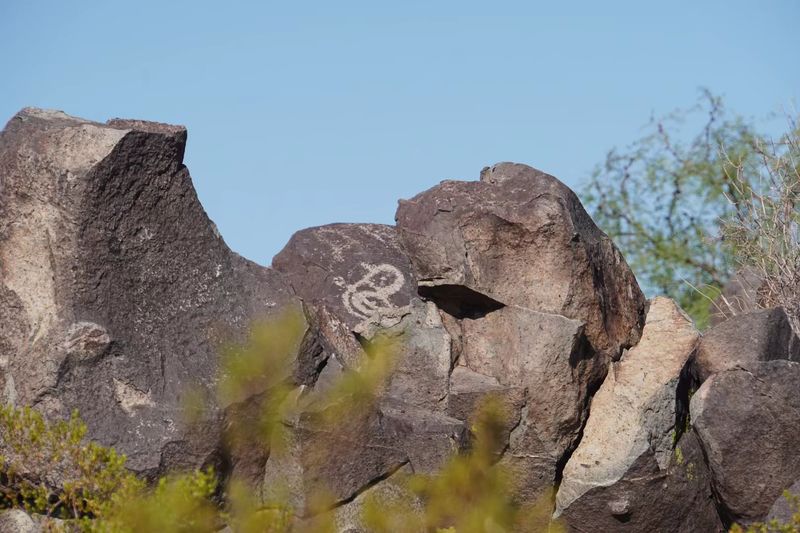
Sunbursts, masks, spirals, animals, and geometric patterns appear one after another in a visual sequence that somehow feels both chaotic and intentional at the same time.
The sheer scale of this place is genuinely hard to wrap your head around until you are actually standing in it. No single visit covers everything, which is exactly why so many people end up planning a second trip before they have even finished the first one.
This is outdoor art at its most primal and most powerful.
Uncover The Story Behind The Jornada Mogollon People
Long before anyone mapped this stretch of desert, a remarkably creative culture was already leaving their mark on it.
The Jornada Mogollon people inhabited this region from around 200 AD all the way through approximately 1450 AD, and they chose this basaltic ridge along County Road B30 in Tularosa, New Mexico 88352, as one of their most expressive creative spaces.
Their artwork is not random scribbling. Researchers believe these carvings reflect spiritual ceremonies, cosmological beliefs, and everyday observations about the natural world around them.
The images range from deeply symbolic to almost playfully literal, which tells you something interesting about the range of human expression across any era.
What makes their story especially compelling is the mystery surrounding their eventual departure from this region.
Scholars continue to investigate what caused this thriving culture to move on, and the petroglyphs themselves are considered one of the most important keys to understanding who these people truly were. Every carving is essentially a sentence in a language we are still learning to read.
Watch Ancient Technique Come Alive In Stone
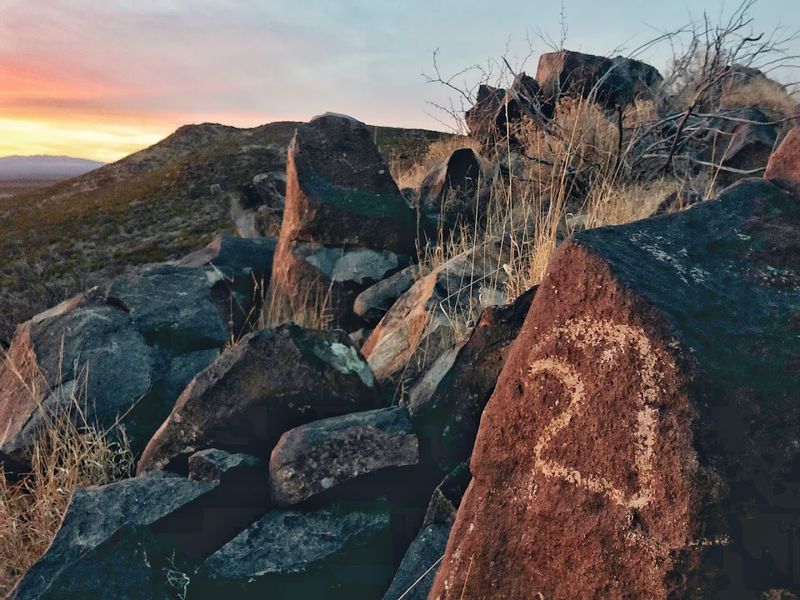
There is something almost meditative about imagining the process behind these carvings. Ancient artists worked by removing the dark desert varnish coating the surface of volcanic basalt, revealing the lighter rock underneath to create their images.
No paint, no brushes, just stone tools and extraordinary patience.
Some designs were scratched lightly into the surface. Others were carefully pecked, using a harder stone against the rock face in a rhythm that must have echoed across the desert for hours at a time.
The contrast between the dark outer layer and the lighter interior stone is what gives these images their striking visibility even after centuries of exposure to wind and sun.
What is wild is how durable this technique turned out to be. Many of the carvings look almost freshly made when you catch them in the right angle of afternoon light.
The artists had no way of knowing their work would outlast entire civilizations, but somehow it did, which might be the most quietly profound thing about this entire site.
Feast Your Eyes On An Astonishing Variety Of Images
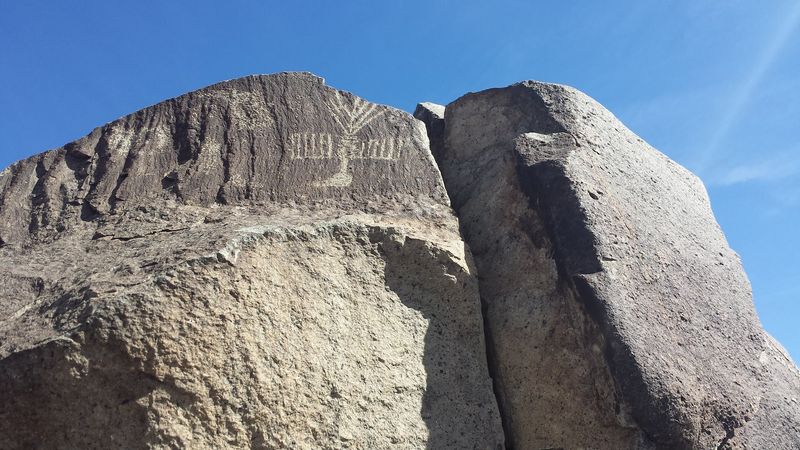
If variety is the spice of life, then this trail is basically a full spice rack. The images at Three Rivers cover an extraordinary range of subjects, from wildlife to abstract symbols to human figures that seem to be mid-dance or mid-ceremony depending on how you look at them.
Bighorn sheep appear frequently, often depicted with incredible anatomical detail.
Birds, fish, insects, and reptiles show up alongside handprints and masked figures that carry an almost theatrical energy.
One standout carving shows a bighorn sheep filled with intricate Mimbres-style interior designs and pierced by three arrows, a composition so sophisticated it genuinely stops you in your tracks.
The geometric patterns are their own category entirely.
Spirals, grids, zigzags, and dot clusters repeat across the rocks in ways that feel almost mathematical. Some researchers connect these patterns to astronomical observations or seasonal calendars, while others see them as purely ceremonial.
Either way, you will spend way more time staring at rocks than you ever expected, and you will enjoy every single second of it.
Wrestle With Meanings That Nobody Can Fully Explain
Here is the thing about mysteries: the good ones stay mysterious. The petroglyphs at Three Rivers are a perfect example of that principle in action.
Scholars have studied these carvings for decades, and while certain images have plausible interpretations, a significant portion of the designs remain genuinely unexplained.
Some carvings are believed to represent prayers for rain, requests for successful hunts, or depictions of spiritual beings from Jornada Mogollon cosmology.
Others may have served as trail markers or territorial indicators for traveling groups. A few designs show clear connections to Mesoamerican iconography, hinting at trade networks and cultural exchanges that stretched far beyond this desert ridge.
Standing in front of a carving and genuinely not knowing what it means is a surprisingly humbling experience in the best way.
We live in an era where answers are one search away, so encountering something that resists easy explanation feels almost radical. The ambiguity is not a flaw in the experience.
It is the whole point, and it is what keeps curious visitors coming back year after year.
Explore The Ruins Of An Ancient Village Nearby
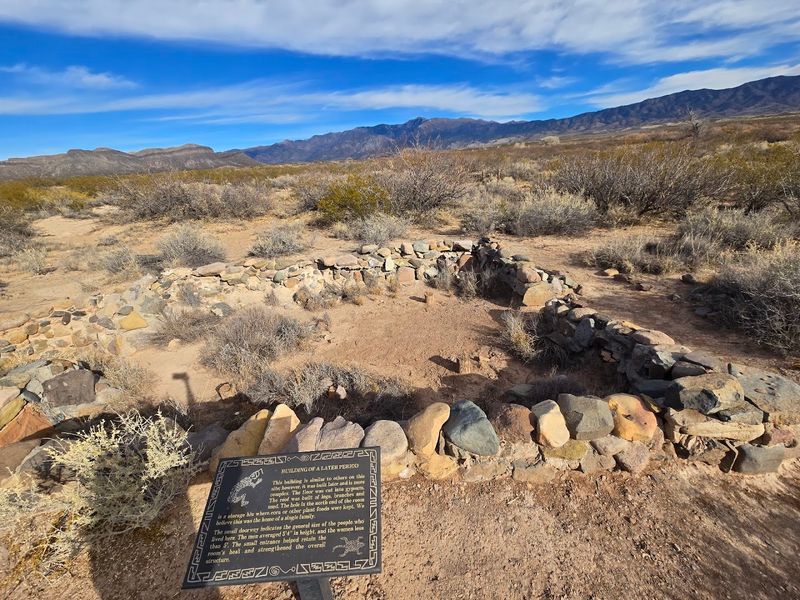
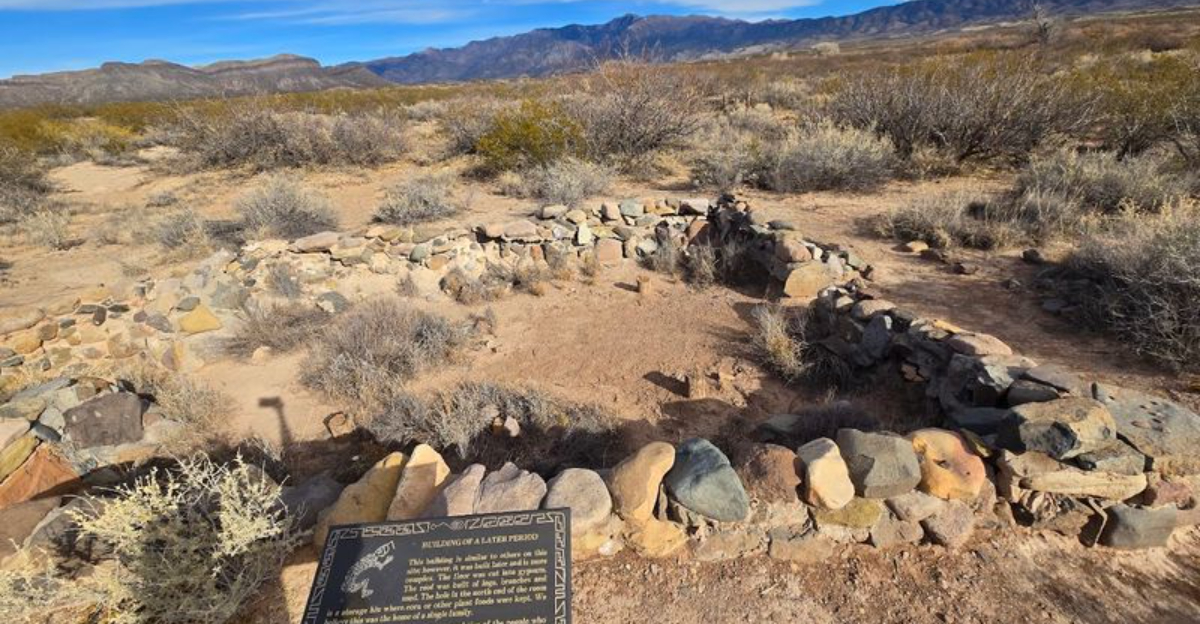
The petroglyphs get all the glory, but just across the road from the main trail sits something equally fascinating.
A partially excavated ancient village offers a rare glimpse into the daily lives of the people who created all that rock art. The foundations of prehistoric structures are still visible, quietly outlining rooms where real human lives unfolded centuries ago.
This village site adds a grounding dimension to the whole experience. Suddenly the carvings are not just abstract ancient art.
They belong to people who woke up every morning in this desert, prepared food, raised families, and gathered together for ceremonies. The physical evidence of their homes makes that connection feel immediate and real in a way that purely visual art sometimes cannot.
The short walk to the village site is easy and well worth the extra few minutes. Interpretive markers help explain what you are looking at, which is genuinely helpful since prehistoric architecture does not always announce itself loudly.
Pairing the village visit with the petroglyph trail gives you a far more complete picture of this ancient community than either experience alone could provide.
Soak In Jaw-Dropping Desert Views From The Ridge
Not everything at Three Rivers is carved into a rock. Some of the most memorable moments here happen when you pause, look up, and realize the landscape itself is putting on a show.
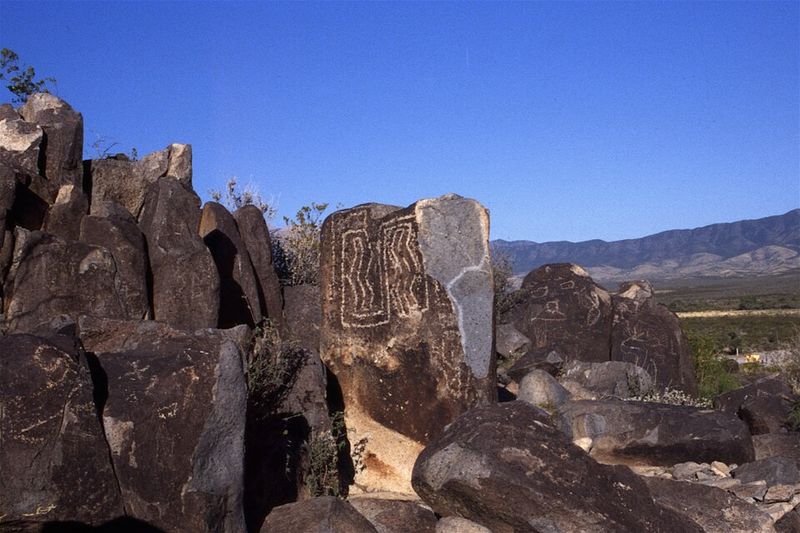
The basaltic ridge where the petroglyphs are located offers sweeping panoramic views that stretch for miles in every direction.
To the east, Sierra Blanca Peak dominates the horizon with the kind of quiet authority that only genuinely tall mountains can pull off.
To the west, the brilliant white expanse of White Sands National Park shimmers in the distance, with the San Andres Mountains forming a jagged backdrop behind it.
The Valley of Fire is also visible from certain points along the trail, adding another layer of geological drama to an already cinematic scene.
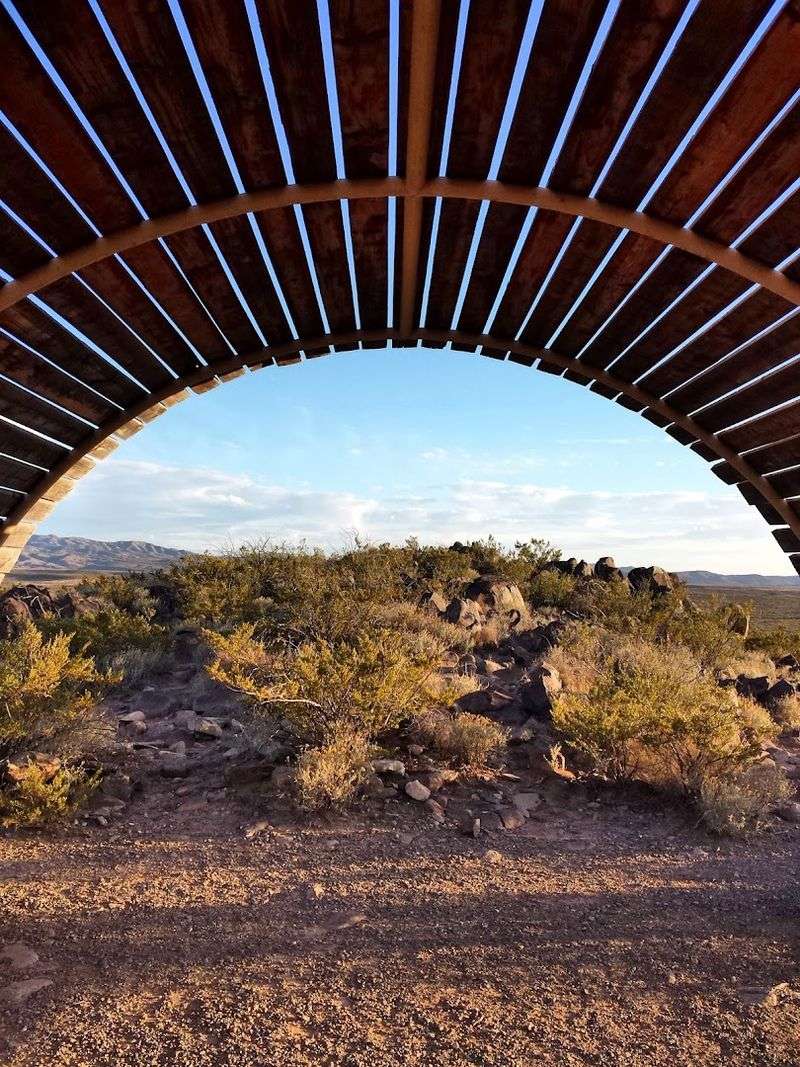
There is a covered rest area roughly halfway along the trail where you can sit, catch your breath, and just take it all in.
This is a good moment to drink some water and appreciate the fact that you are standing in a landscape that has looked essentially the same for thousands of years. That kind of perspective is genuinely hard to find anywhere else.
Decode The Curious Circle And Dot Mystery
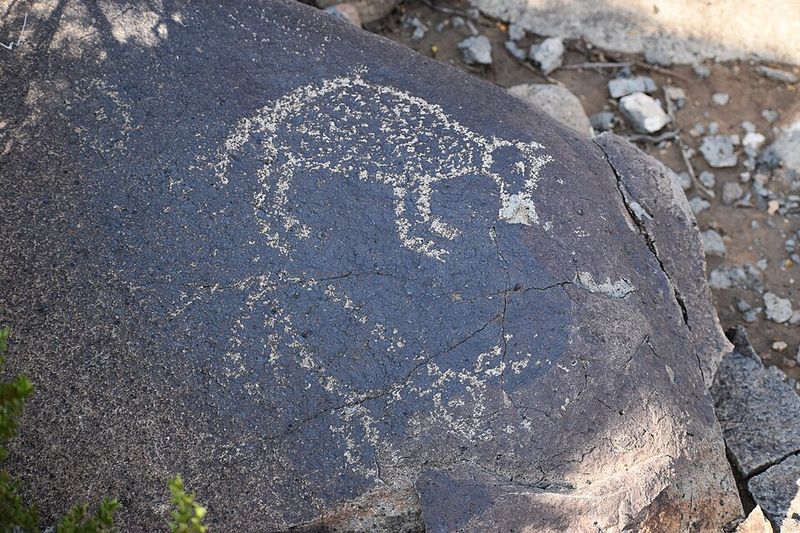
Among the thousands of images at Three Rivers, one symbol shows up with striking regularity: a simple circle with a dot at its center. It sounds almost too basic to be interesting, but this particular motif appears in more than ten percent of all the carvings at the site, making it statistically significant in a way that demands attention.
What makes this even more intriguing is that the circle and dot design appears far less frequently at other Jornada Mogollon sites across the region.
Three Rivers seems to have had a special relationship with this symbol, though exactly what that relationship meant remains an open question.
Some researchers connect it to representations of corn, which was a deeply important crop in this culture. Others link it to Mesoamerican deities like Quetzalcoatl, suggesting long-distance cultural influence.
Keep your eyes open for this one as you walk the trail because once you start noticing it, you genuinely cannot stop.
It pops up in clusters, in isolation, and sometimes tucked into corners of larger compositions as if it were a signature. Ancient punctuation, maybe, or perhaps something far more sacred than we currently understand.
Help Protect This Irreplaceable Piece Of Human History
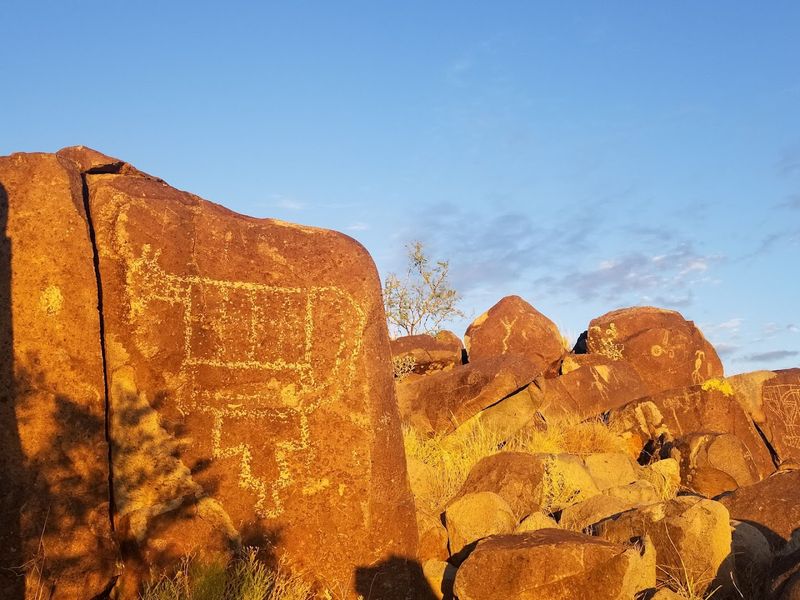
Everything about Three Rivers feels ancient and enduring, but that does not mean it is invincible. The petroglyphs have survived for hundreds of years through wind, rain, and extreme desert temperatures, yet they remain genuinely vulnerable to something much smaller: human contact.
The natural oils from our hands can accelerate the deterioration of rock surfaces in ways that are not immediately visible but are very real over time.
Staying on the designated trail is not just a rule posted on a sign. It is the single most effective thing a visitor can do to ensure these carvings survive for future generations.
The Bureau of Land Management maintains the site carefully, and the entry fee, a modest amount that also accepts the America the Beautiful Pass, goes directly toward preservation and upkeep.
Visiting responsibly is its own kind of tribute to the people who made this place.
They created something meant to last, and we have the opportunity to honor that intention simply by being thoughtful.
So look closely, photograph freely, and let yourself be genuinely moved by what you see. What story do you think the ancient artists most wanted the world to remember?