
This Tiny Texas Town Is At The Center Of One Of America’s Strangest Legends
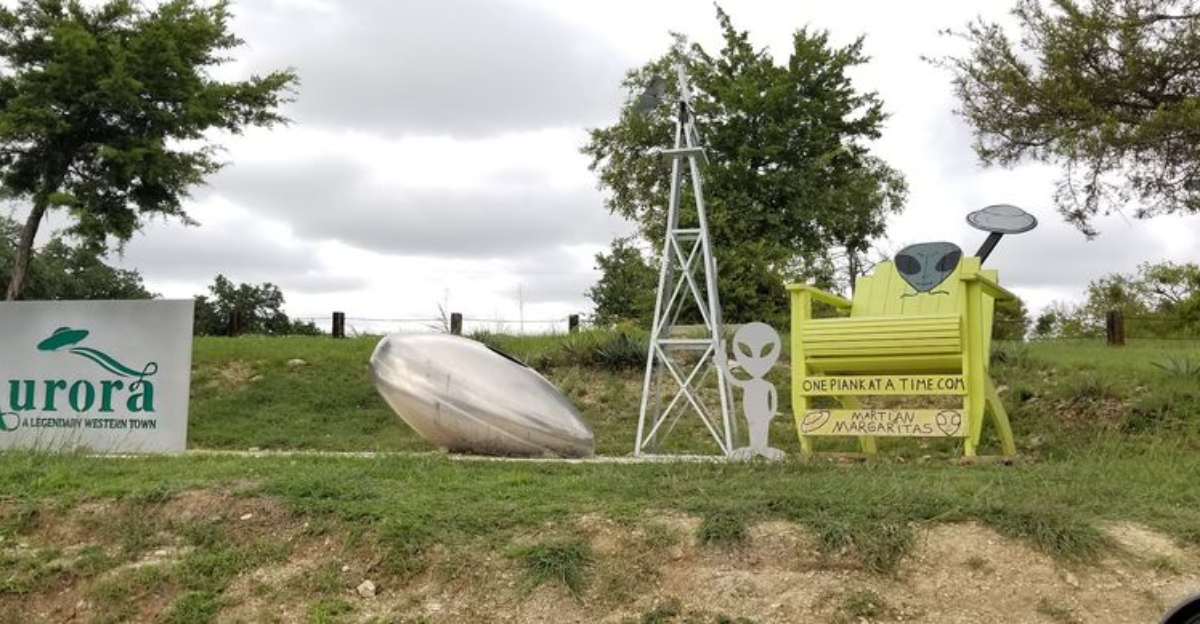
Every small town has that one story people swear is true. This one just happens to involve an alien.
Long before UFO documentaries, conspiracy podcasts, or The X-Files convinced everyone to “trust no one,” this tiny Texas town became the center of one of America’s strangest legends.
According to local lore, something mysterious fell from the sky in 1897, crashed into a windmill, and left behind a story that refuses to fade away.
Some call it the first UFO crash in U.S. history. Others insist it was nothing more than an elaborate tale dreamed up to put a struggling town on the map. The funniest part?
More than a century later, nobody has managed to settle the argument. Whether you’re a skeptic, a believer, or just here for the weird roadside history, this place proves that the best travel stories don’t always come with clear answers.
The Morning Everything Changed
April 17, 1897 started like any other quiet Tuesday in Aurora, Texas. The roosters crowed, the coffee brewed, and nobody expected their morning to become part of American folklore forever.
Then something appeared in the sky. Witnesses described a slow-moving, airship drifting northward at roughly ten to twelve miles per hour.
It was clearly struggling, as if whatever was powering it had simply given up on the journey.
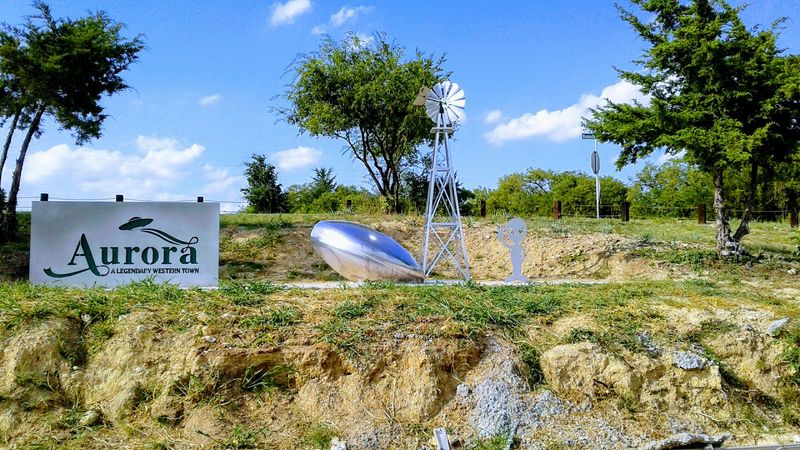
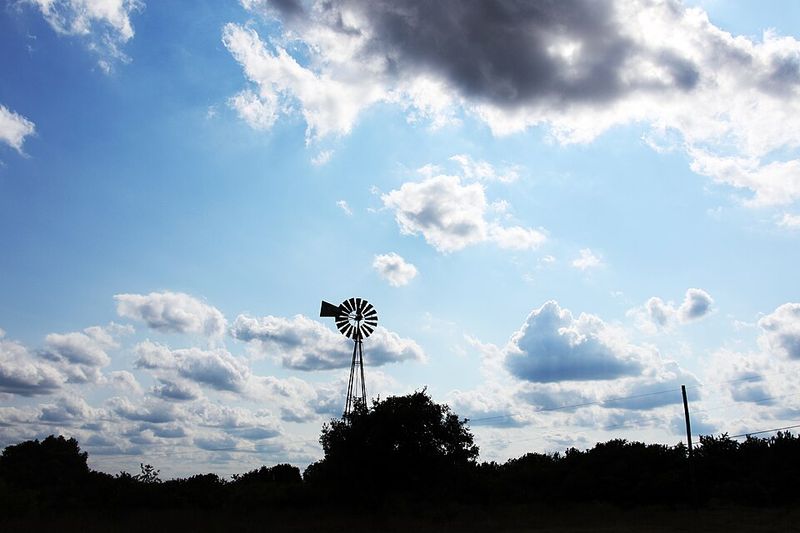
The craft gradually lost altitude as it crossed over the town square. Then, with a thunderous explosion, it slammed directly into a windmill belonging to a local judge.
The impact was massive, scattering wreckage across several acres of land.
The windmill, the water tank, and even a nearby flower garden were completely destroyed.
What made this moment so unforgettable was not just the crash itself. It was what came after, the discovery waiting in the rubble that would send shockwaves far beyond Wise County.
Aurora had just become the center of something nobody had a proper word for yet. Some mornings really do change everything, and this one changed everything twice over.
The Pilot Nobody Could Explain
Finding wreckage from an unknown flying craft was already astonishing enough. But what Aurora residents discovered inside that wreckage pushed the story into completely uncharted territory.
Among the scattered debris lay a pilot.
The body was described as badly disfigured from the impact, yet enough remained for witnesses to form a very clear and very unsettling opinion. This was not a person anyone recognized as human.
Descriptions used phrases like “not of this world” to capture what they saw.
An Army Signal Service officer who reportedly examined the remains went even further. He speculated the pilot was a “native of Mars,” which was the 1897 way of saying absolutely nothing about this makes sense.
The figure was described as petite, with a small frame unlike anything seen before.
People stood in that wrecked flower garden, staring at something that rewrote their understanding of what was possible.
There were no cameras rolling, no breaking news alerts, just a stunned community face to face with the genuinely inexplicable.
Whatever that pilot was, it traveled an unimaginable distance and landed in the most unexpected place imaginable. Aurora, Texas was nobody’s first guess for a cosmic destination.
A Burial Unlike Any Other
Here is where the story takes a turn that is equal parts tender and bizarre. When a community in 1897 Texas did not know what to make of something, they fell back on what they did know: kindness and ceremony.
The mysterious pilot received a proper Christian burial.
A traveling pastor reportedly conducted the rites, and the being was laid to rest in Aurora Cemetery alongside the town’s other residents. It was a remarkably gracious response to an utterly confusing situation.
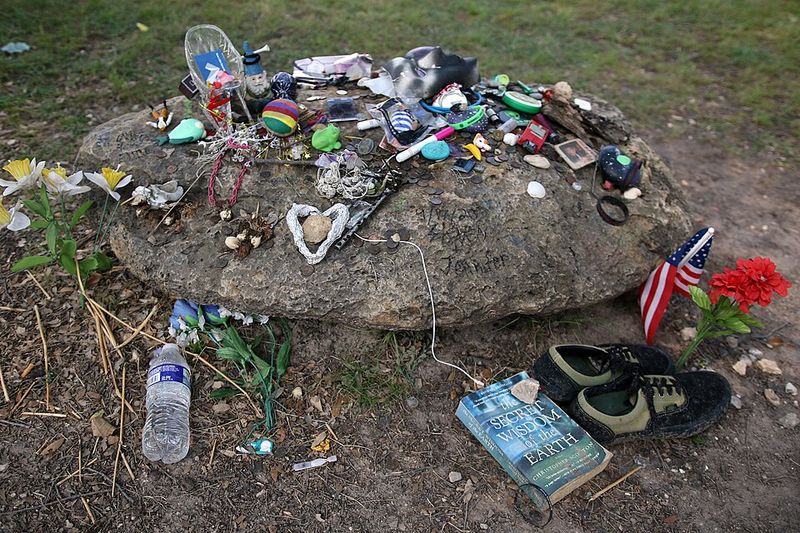
For years, a stone marker sat at the grave. It reportedly bore a crude carving of a spacecraft, making it perhaps the strangest headstone in Texas history.
Visitors began calling the pilot “Ned” or “Little Traveler,” names that carried an unexpected warmth for someone so far from home.
The Texas Historical Commission eventually placed an official marker at the cemetery acknowledging the legend. It does not confirm the story, but it does not dismiss it either.
That careful, diplomatic phrasing is doing a lot of heavy lifting on a small metal sign.
The burial itself remains one of the most human moments in the entire Aurora story, proof that even the unexplainable deserves a little dignity.
The Newspaper Story That Started It All
Every great mystery needs its origin document, and Aurora’s came courtesy of the Dallas Morning News on April 19, 1897.
Two days after the crash, the story hit print and immediately took on a life of its own.
The article was written by S.E. Haydon, a cotton buyer who lived in Aurora.
His report was detailed, earnest, and written with the kind of matter-of-fact confidence that made readers sit up straight.
He described the airship, the crash, the wreckage, and the discovery of the pilot with calm, methodical precision.
Haydon noted that papers found among the wreckage were covered in strange hieroglyphic writing. He described the craft as being made of an unknown metal, resembling a mix of aluminum and silver.
These details transformed a local oddity into a national conversation almost overnight.
The article became the primary source that researchers, journalists, and enthusiasts have returned to for over a hundred years. It is the cornerstone of the entire Aurora legend.
Whether Haydon was reporting facts or crafting something more creative, he wrote a piece that outlasted him by generations. Not bad for a cotton buyer with a story to tell and a newspaper willing to print it.
The Well That Swallowed The Evidence
Any good mystery worth its salt has a moment where the evidence goes sideways, and Aurora delivers that moment with theatrical flair.
After the crash, much of the wreckage was reportedly dumped into the water well located directly beneath the destroyed windmill.
Some accounts even suggest pieces of the craft were buried alongside the pilot. It is the kind of detail that makes historians simultaneously frustrated and fascinated.
Years later, a man who purchased the property decided to clean out the well for practical use.
Shortly after using the water, he developed severe arthritis and reportedly blamed the well’s contents. He then sealed the well permanently with a concrete slab.
Make of that what you will.
In later decades, investigators used ground-penetrating radar around the well site. Researchers reportedly recovered metal fragments nearby that tested with unusually high aluminum content.
The results were intriguing without being conclusive, which is basically Aurora’s signature move.
The well itself still sits on private property, sealed and silent, holding whatever secrets it swallowed more than a century ago. It is the kind of plot twist that no screenwriter would dare submit, because nobody would believe it was real.
Was The Whole Thing A Texas-Sized Tall Tale?
Okay, let’s talk about the elephant in the room, or rather, the alien in the flower garden. Not everyone believes the Aurora story, and their skepticism comes with some genuinely compelling arguments worth hearing out.
At the time of the crash, Aurora was struggling. A severe illness, likely meningitis, had swept through the community and significantly reduced the population.
To make things worse, the railroad chose a neighboring town over Aurora, essentially cutting it off from economic growth.
Some researchers believe S.E. Haydon’s vivid newspaper article was less journalism and more creative strategy.
The thinking goes that a sensational story might attract attention, visitors, and perhaps a second look from investors. An 86-year-old resident interviewed in 1979 reportedly claimed the whole thing was meant as a joke.
Still, the hoax theory has its own holes. The level of detail in Haydon’s account, the physical evidence explored decades later, and the sheer consistency of local oral history make it hard to simply laugh off.
Aurora sits in that delicious gray zone where neither believers nor skeptics can claim total victory.
And honestly, that ambiguity is exactly what keeps people coming back. A mystery with a clean answer is just a trivia question.
The Investigators Who Could Not Let It Go
Once a story like Aurora gets loose in the world, it attracts a very specific kind of person: the kind who owns their own radar equipment and has opinions about soil composition. Over the decades, Aurora has drawn investigators from every corner of the curious universe.
Television programs dedicated entire episodes to the mystery. “UFO Files” and “UFO Hunters” both turned their cameras toward Wise County in search of answers.
Researchers used ground-penetrating radar in the cemetery, scanning beneath the surface for anything unusual near the reported grave site.
The Aurora Cemetery Association has remained remarkably firm throughout all of this attention. Every request to exhume the remains has been denied.
A 1972 court injunction made the process even more difficult by requiring notification of next of kin. Finding the next of kin for a possible Martian pilot is, to put it gently, a logistical challenge.
The legal and institutional barriers around the grave have created an almost perfect preservation of the mystery.
Nobody can prove or disprove what lies beneath because nobody is allowed to look. It is the world’s most politely enforced unsolved case.
Every investigator who leaves Aurora empty-handed somehow makes the legend stronger, not weaker.
Small Town, Enormous Legend
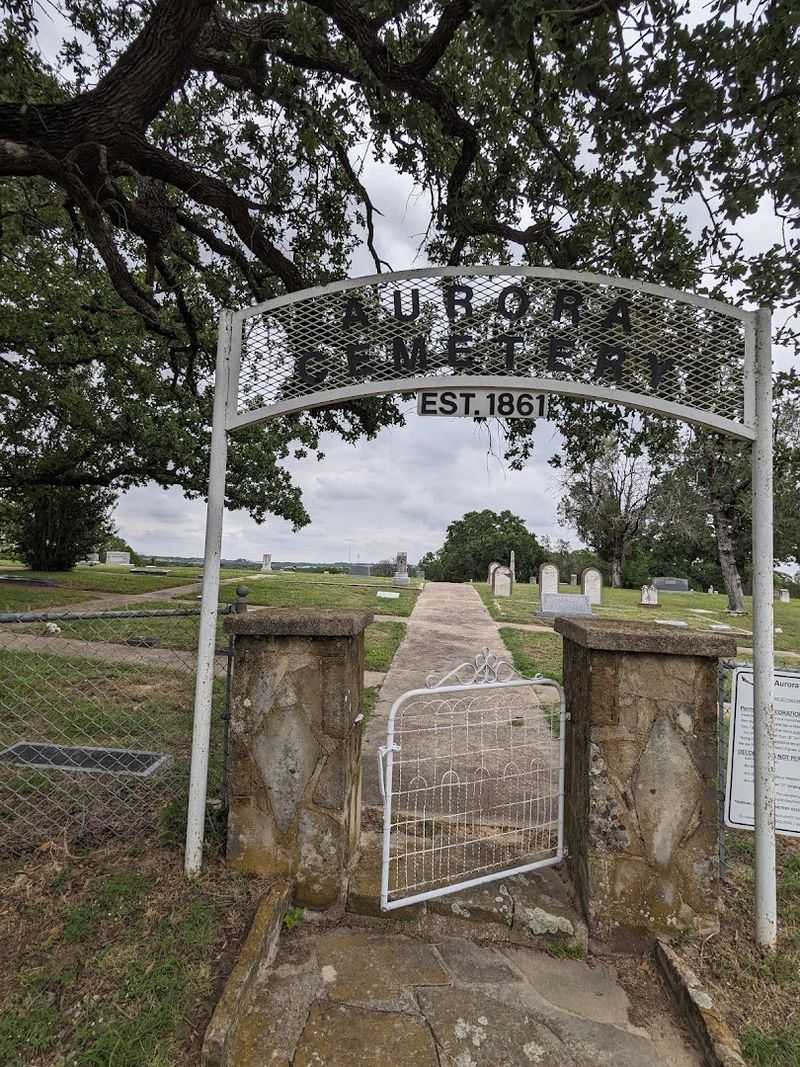
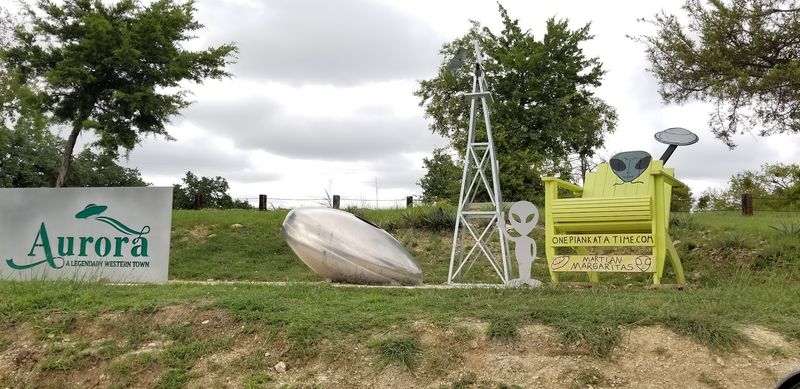
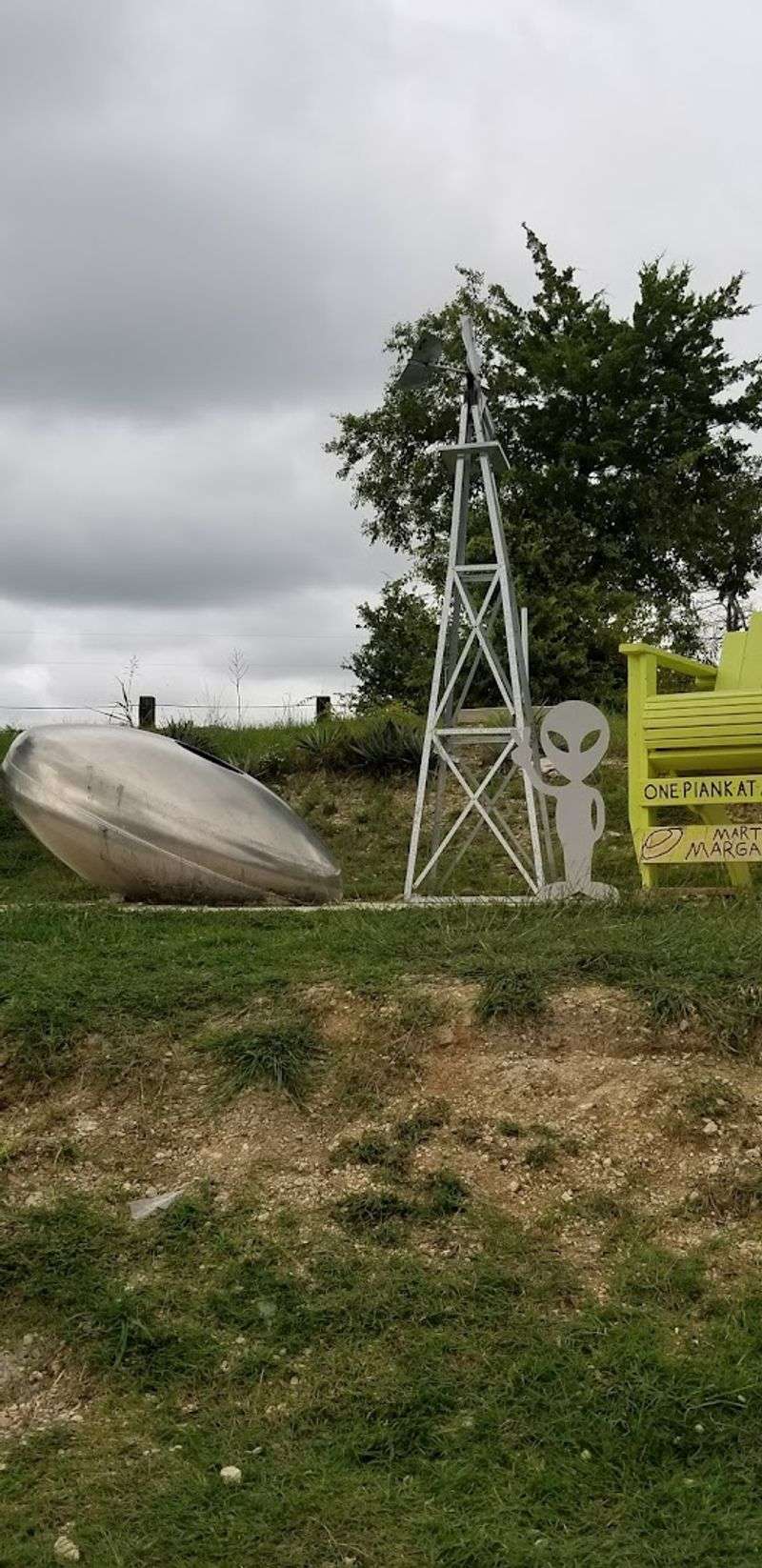
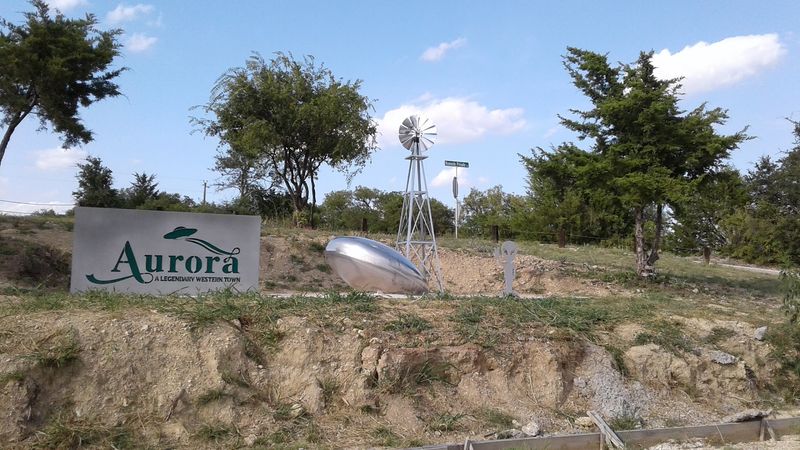
Pull up to Aurora today and you will not find a theme park or a gift shop stocked with alien plushies. What you will find is a genuinely quiet, unpretentious community that happens to carry one of the most extraordinary stories in American history.
The town sits on Highway 114, roughly thirty miles north of Fort Worth in Wise County. With a population of around 1,390 as of 2020, Aurora is the definition of small-town Texas.
The pace is slow, the sky is wide, and the locals seem perfectly comfortable with their unusual claim to fame.
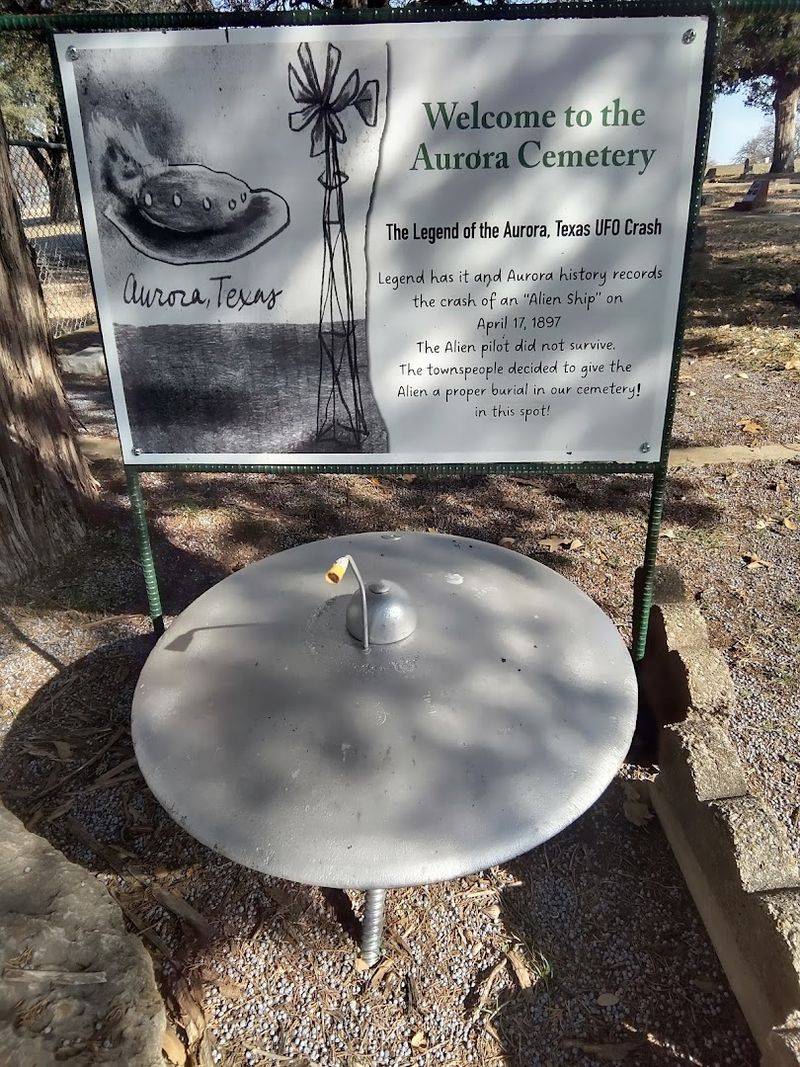
Aurora Cemetery remains the top destination for visitors. The Texas Historical Commission marker there acknowledges the legend in careful, measured language, neither confirming nor denying what happened that April morning in 1897.
People still come to stand beside it, read it slowly, and feel that particular chill that only a genuinely unresolved mystery can produce.
The grave site itself has shifted over the years. The original stone marker disappeared long ago, and even a replacement boulder was eventually removed by local decision.
A bare patch of earth now marks the spot, which somehow feels more powerful than any monument could.
So what do you think really happened in Aurora that morning? The town is not saying, and maybe that is the whole point.