
Oregon’s Most Colorful Natural Wonder Isn’t A National Park
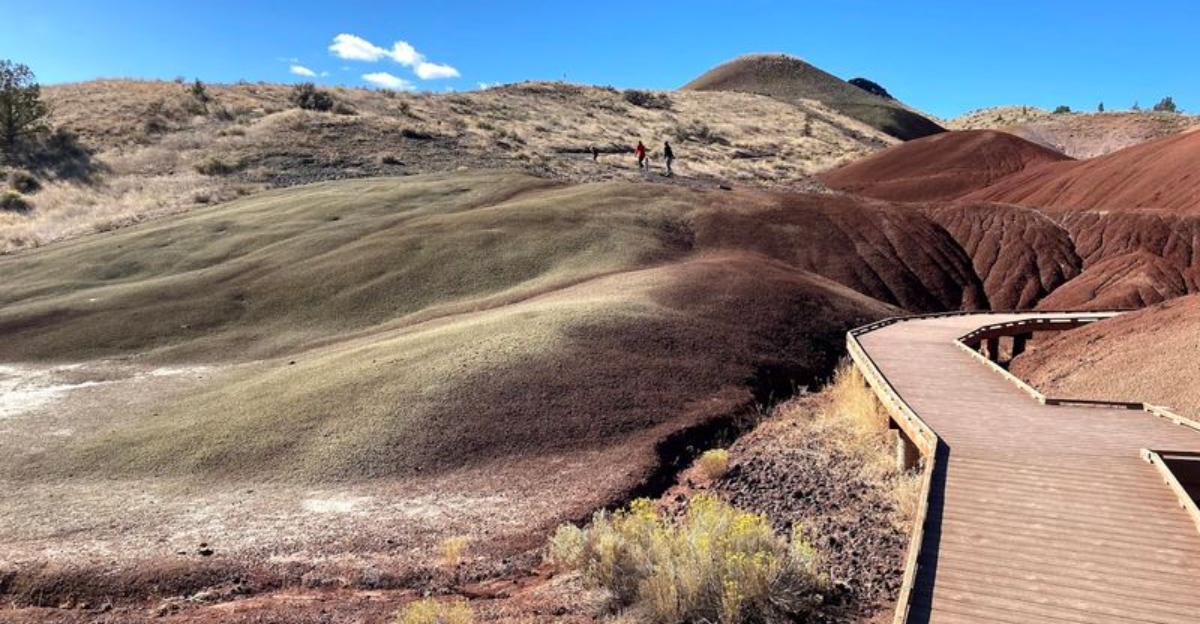
What if nature decided to pick up a paintbrush? Sounds impossible, right?
Yet in the middle of Oregon, the landscape looks like someone turned up the saturation on Earth itself. Layers of red, gold, black, and orange stretch across the hills like a giant work of art, but no artist was involved.
No filters. No special effects. Just millions of years of nature doing what it does best: creating something that looks almost unreal.
The surprising part? This isn’t a famous national park packed with visitors.
It’s a quieter corner of Oregon hiding one of the most colorful geological wonders in America. Every curve, stripe, and shade tells a story written in rock and time.
It’s the kind of place that makes you check your camera settings… only to realize the view really is that incredible.
A Palette So Rich, It Looks Almost Unreal
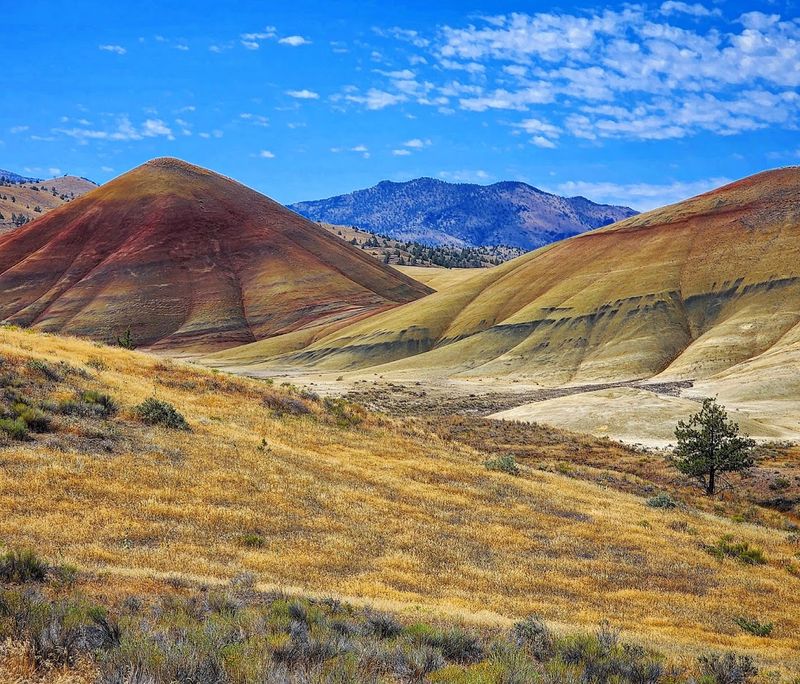
Nobody warns you how theatrical the first glimpse actually is. You round a bend on the gravel road, and suddenly the earth just erupts in color.
Reds, golds, blacks, and soft tans roll across the hills in bold horizontal bands that look hand-painted rather than geological.
Each hue tells a precise chemical story. The fiery reds and oranges come from iron-rich laterite soils formed during ancient warm, wet seasons.
The golden yellows reflect drier periods infused with iron and magnesium oxides. Even the muted greens have a starring role, representing celadonite, a mineral formed under specific volcanic conditions.
What makes this place genuinely wild is how the colors shift depending on the time of day and season. Morning light softens everything into pastels.
Late afternoon sun cranks up the saturation until the hills look almost neon against the high desert sky. After a rain, the pigments deepen dramatically, making wet visits surprisingly spectacular.
The Painted Hills Unit has earned its spot among the Seven Wonders of Oregon, and standing in front of those vivid stripes, you completely understand why. This is geology showing off, and it is doing a spectacular job of it.
The Address That Changed My Definition Of Remote
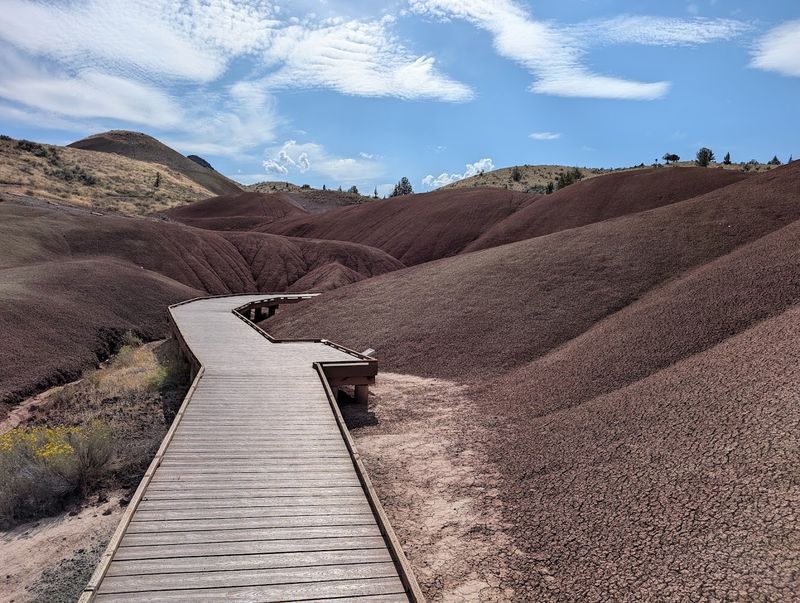
Getting to 37375 Bear Creek Road, Mitchell, Oregon is part of the whole experience, and honestly, the drive sets the mood perfectly.
Mitchell itself is a tiny high desert town, and the nine-mile stretch from town to the unit rolls through open rangeland that feels wonderfully far from everything.
The access road inside the unit is gravel with some washboard stretches, so a vehicle with decent clearance genuinely helps. Cell service disappears well before you arrive, which means navigation needs to happen before you leave town.
Download your maps, charge your devices, and embrace the offline adventure.
The remoteness is actually a feature, not a flaw. There is no commercial noise here, no gift shops crowding the view, no food trucks competing with the scenery.
Just you, the hills, and a silence so complete it almost rings in your ears.
That quiet amplifies everything you see.
The monument is open 24 hours every day of the year, which means sunrise and sunset visits are entirely possible. Those golden-hour windows are genuinely the best times to visit, when the light hits the mineral layers at a low angle and the colors become almost impossibly vivid.
Thirty-Five Million Years Of Geological Storytelling
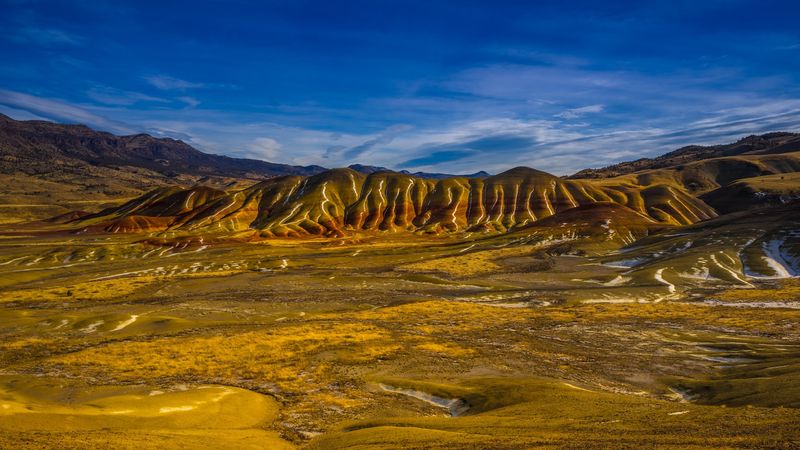
Thirty-five million years is a number so large it barely registers, yet every single stripe on these hills represents a chapter of that enormous timeline.
Ancient volcanic eruptions from the distant Cascade Range repeatedly blanketed this region in ash and pumice. Over time, those deposits compacted, mineralized, and transformed into the vivid claystone layers visible today.
Climate shifts wrote themselves directly into the geology. Warm, humid periods created thick red laterite layers as iron oxidized in the wet soil.
Cooler, drier eras left behind golden and tan bands rich in different mineral compounds. The jet-black streaks are lignite, the compressed remains of ancient plant material from long-vanished floodplains.
Reading these layers feels like flipping through an ancient journal. Each band is a climate entry, a record of temperatures, rainfall patterns, and ecological conditions that no human ever witnessed firsthand.
Scientists use this record to understand how environments shift across geological timescales.
The Painted Hills Unit essentially functions as an open-air laboratory, offering a compressed visual summary of Earth’s mood swings over tens of millions of years.
That kind of deep time perspective has a way of making everyday stress feel refreshingly small.
Fossils Hiding In Plain Sight
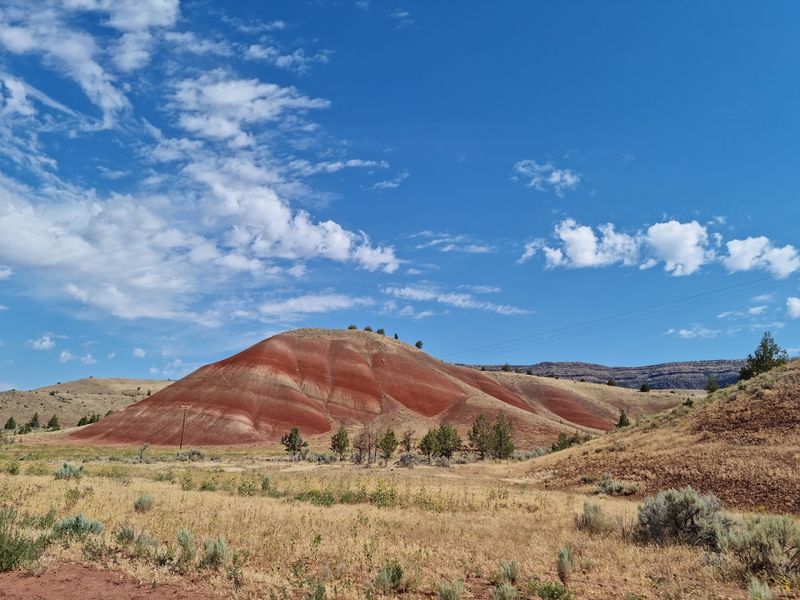
The colors grab all the attention, but the Painted Hills Unit has a rich fossil story running quietly underneath that visual spectacle.
As part of the John Day Fossil Beds National Monument, this unit preserves one of the most significant fossil records in North America, spanning roughly 40 million years of prehistoric life.
The Bridge Creek Flora, a collection of leaf fossils dating between 39 and 30 million years old, represents a lush, almost tropical forest that once covered this now-arid landscape.
Ferns, broad-leafed trees, and subtropical plants thrived here before the climate gradually dried and cooled. Finding their impressions preserved in stone feels like catching a whisper from a vanished world.
Animal fossils from 30 to 27 million years ago add another dimension to the story.
Ancestral horses, early camels, ancient rhinoceroses, and primitive dogs all left their bones in these sediments. Paleontologists have used discoveries from this region to trace critical evolutionary milestones in several beloved modern species.
Fossil collecting is strictly prohibited, which is exactly as it should be. These remains belong to the scientific record, not a souvenir shelf.
Knowing they stay protected means future generations get to experience the same sense of wonder you feel standing here today.
Short Trails, Maximum Payoff
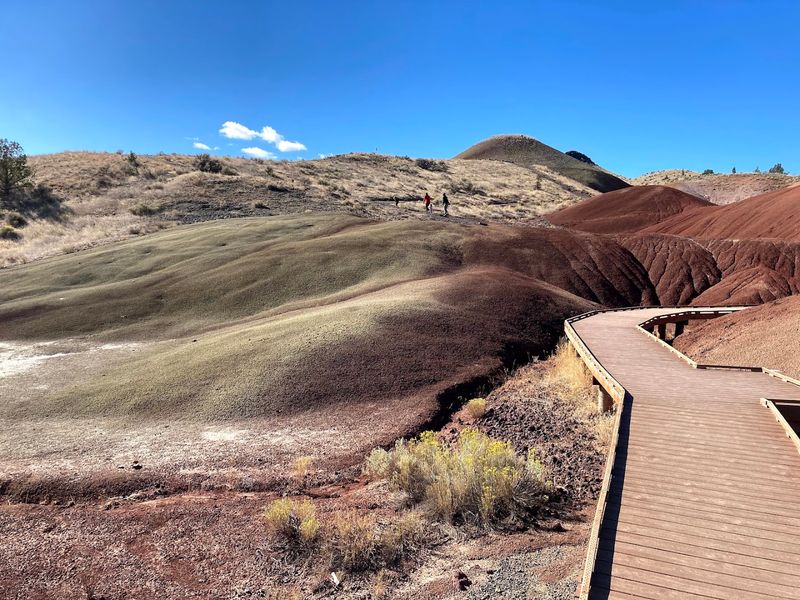
The trail system here is refreshingly approachable, which means you do not need to be a seasoned hiker to have a genuinely memorable experience.
Most routes are short, well-marked, and designed to get you face-to-face with the most dramatic formations without requiring a full day of effort.
The Carroll Rim Trail is the crown jewel at 1.6 miles roundtrip. It gains about 400 feet in elevation and delivers sweeping panoramic views across the entire unit.
The effort is real but completely worth it, especially in the late afternoon when the light turns golden and every color on those hills intensifies dramatically.
The Painted Hills Overlook Trail covers just 0.5 miles and rewards minimal effort with maximum visual drama.
The Painted Cove Trail winds through intensely red clay formations for only 0.25 miles, sometimes on a boardwalk that keeps delicate surfaces protected. The Leaf Hill Trail offers a fossil-focused quarter-mile walk, while the Red Scar Knoll Trail brings you close to distinctively colored mounds.
Staying on designated paths is genuinely critical here. The claystone formations are fragile and easily damaged by foot traffic.
The National Park Service uses the memorable phrase “Don’t Hurt the Dirt” for good reason, and respecting it ensures this place stays stunning for everyone who follows.
Light, Rain, And The Art Of Timing Your Visit
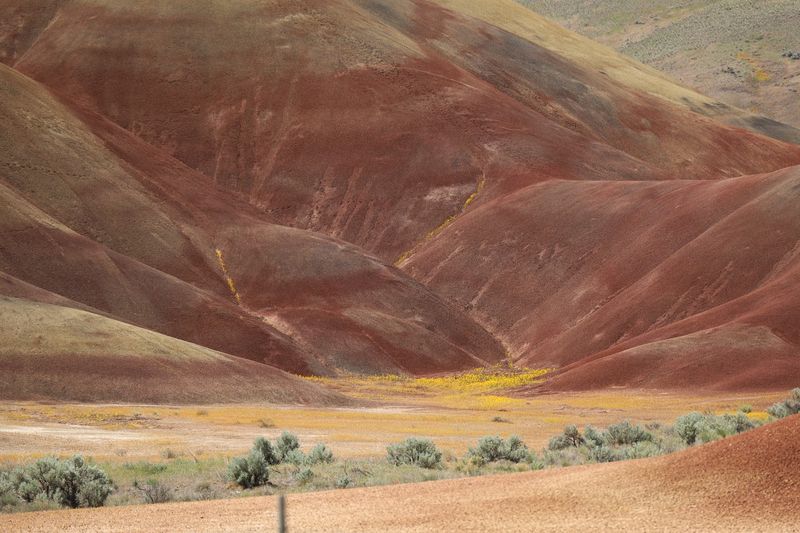
Timing a visit to the Painted Hills Unit is almost like planning a great meal. The ingredients are always there, but the right conditions make everything taste infinitely better.
Light and moisture are the two variables that transform a good visit into an unforgettable one.
Golden hour, roughly the last ninety minutes before sunset, is widely considered the best window. Low-angle sunlight rakes across the textured surface of the hills, creating dramatic shadows that emphasize every ridge and ripple.
The reds deepen toward burgundy, the golds warm into amber, and the whole scene takes on a cinematic quality that feels almost staged.
Rain works its own kind of magic on the colors. Moisture activates the mineral pigments in the claystone, intensifying every hue significantly.
Visiting shortly after a rain event can produce the most saturated, vivid colors the hills are capable of showing. Just be aware that the clay becomes extremely slippery when wet, so appropriate footwear is non-negotiable on those days.
Early morning visits have their own quiet charm. Soft diffused light and cooler temperatures make the experience more contemplative.
Summer afternoons, by contrast, bring intense heat and flatter light, which tends to mute the colors somewhat. Planning around these rhythms turns a good trip into a genuinely great one.
One Of Oregon’s Seven Wonders, And It Earns The Title
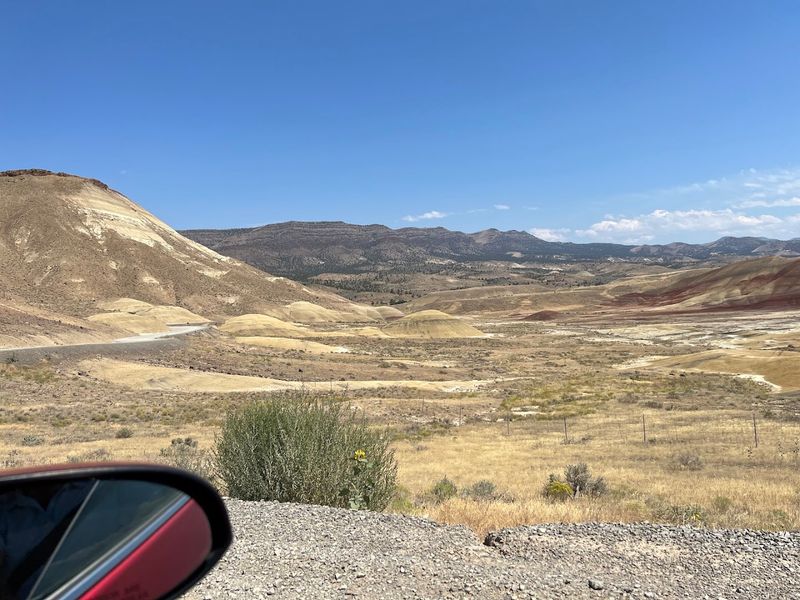
Being named one of the Seven Wonders of Oregon is not a participation trophy. The Painted Hills Unit earned that designation by offering something genuinely singular, a landscape that exists nowhere else on Earth in quite this form.
Millions of years of specific volcanic, climatic, and chemical conditions converged to create this exact visual result.
What distinguishes it from other natural wonders is the intimacy of the experience. There are no towering peaks demanding you crane your neck.
No roaring waterfalls competing for your attention. The Painted Hills present themselves at eye level, rolling gently across the terrain in a way that feels almost conversational, like the earth is telling you something directly.
The site also holds serious scientific prestige. Researchers from institutions worldwide have studied these formations to better understand paleoclimatology, evolutionary biology, and sedimentary geology.
The Painted Hills Unit contributes to knowledge that extends far beyond Oregon’s borders, making it significant on a genuinely global scale.
Visitors consistently describe a feeling of quiet awe here, something different from the rush of excitement at more dramatic landscapes.
The Painted Hills ask you to slow down, look carefully, and appreciate the extraordinary patience behind their creation. That kind of wonder is rare, and finding it in the Oregon high desert feels like the best kind of surprise.
Practical Magic
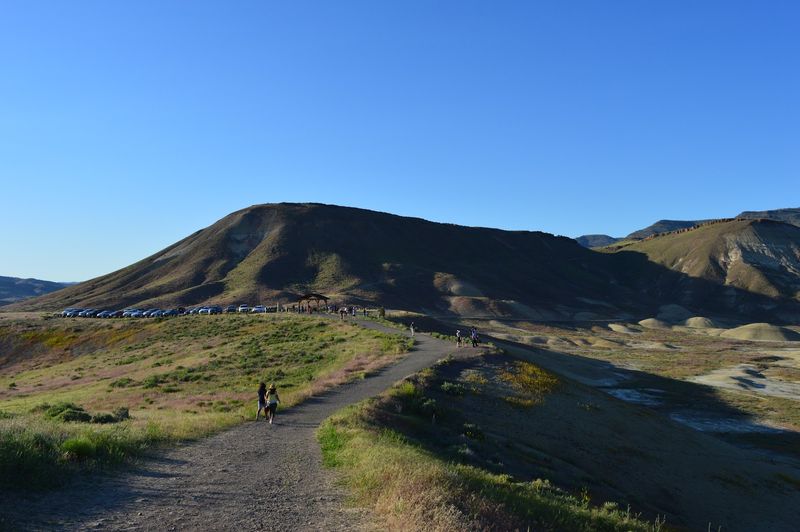
The Painted Hills Unit is open 24 hours a day, every single day of the year, and there is no entry fee, which makes it one of the most accessible natural wonders anywhere in the country.
That said, a little preparation goes a long way toward making the visit genuinely comfortable rather than just survivable.
Water is the most important thing to bring. There is no drinking water available on site, and the high desert climate can be surprisingly demanding, especially during summer months when temperatures climb quickly.
Sunscreen, a hat, and layers for cooler mornings are all practical additions to the packing list.
Restroom facilities are available at the main areas, though they are vault toilets rather than full facilities.
The main road through the unit is unpaved gravel with some washboard sections. A standard passenger car can manage it in dry conditions, but a vehicle with higher clearance handles it more comfortably.
Cell service is essentially nonexistent once you leave Mitchell, so downloading offline maps before departure is genuinely smart planning.
The picnic area near the visitor center offers shaded tables and green grass, a surprisingly lush oasis in the middle of the arid landscape.
It is a perfect spot to decompress after the trails. Have you ever found a place that exceeded every expectation before you even finished the first trail?
The Painted Hills has that effect, every single time.