
Ariston Café: The 1935 Route 66 Restaurant Still Serving From Its Original Booths in Litchfield, Illinois
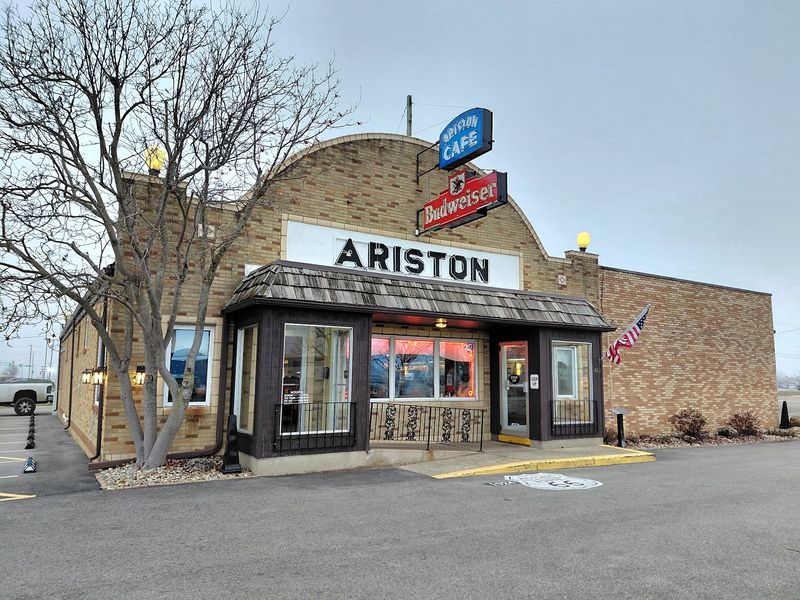
Tucked along Old Route 66 in Litchfield, Illinois, the Ariston Café has been feeding highway travelers and local regulars from the same building since July 5, 1935. Nearly nine decades of road-trippers, truck drivers, and Sunday families have passed through its doors, and much of what they walked into still stands today.
The original booths, the counter, and other historic fixtures remain in place, making this one of the most genuinely preserved roadside restaurants anywhere on Route 66. Getting the full story means separating the well-documented history from the claims that still need confirmation.
Ariston Café is the historic Route 66 restaurant behind the premise
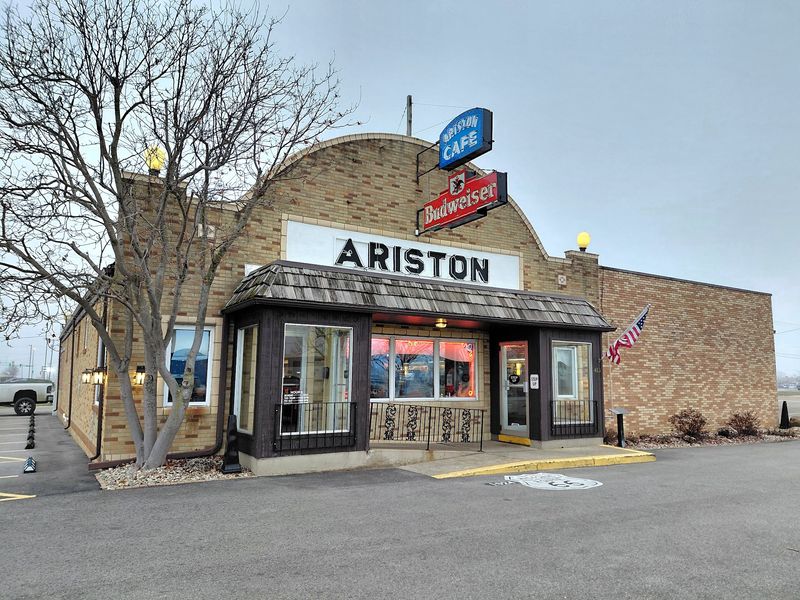
The restaurant behind the time-capsule premise is the Ariston Café, located at 413 Old Route 66 N in Litchfield, Illinois. According to the National Park Service’s profile of the café, Pete Adam founded the Ariston business in Carlinville in 1924, moved it to Litchfield in 1929, and then opened the present Route 66 building on July 5, 1935.
That date matters: the current structure opened in 1935, not 1936, even though the headline premise uses the later year.
The defensible version of the time-capsule story is this: Ariston Café continues to operate in a largely preserved 1935 building that retains original booths and other historic interior features. The Illinois historic-preservation condition assessment confirms that the original booths, counter, dining area, and kitchen remain in the structure.
That is a meaningful and well-documented achievement for any commercial building approaching its ninth decade of continuous restaurant use.
What the authoritative historical sources do not establish is equally worth stating plainly. The premise’s references to bottomless coffee, vinyl booths, and recipes unchanged since the 1930s are not verified by the National Park Service record, the Illinois preservation assessment, or the café’s official website.
Those details may reflect current practice or local reputation, but they require direct confirmation from the restaurant before being treated as established fact. The article that follows presents what the evidence actually supports and flags where the record runs out.
A 1935 café was built for the Route 66 traffic stream
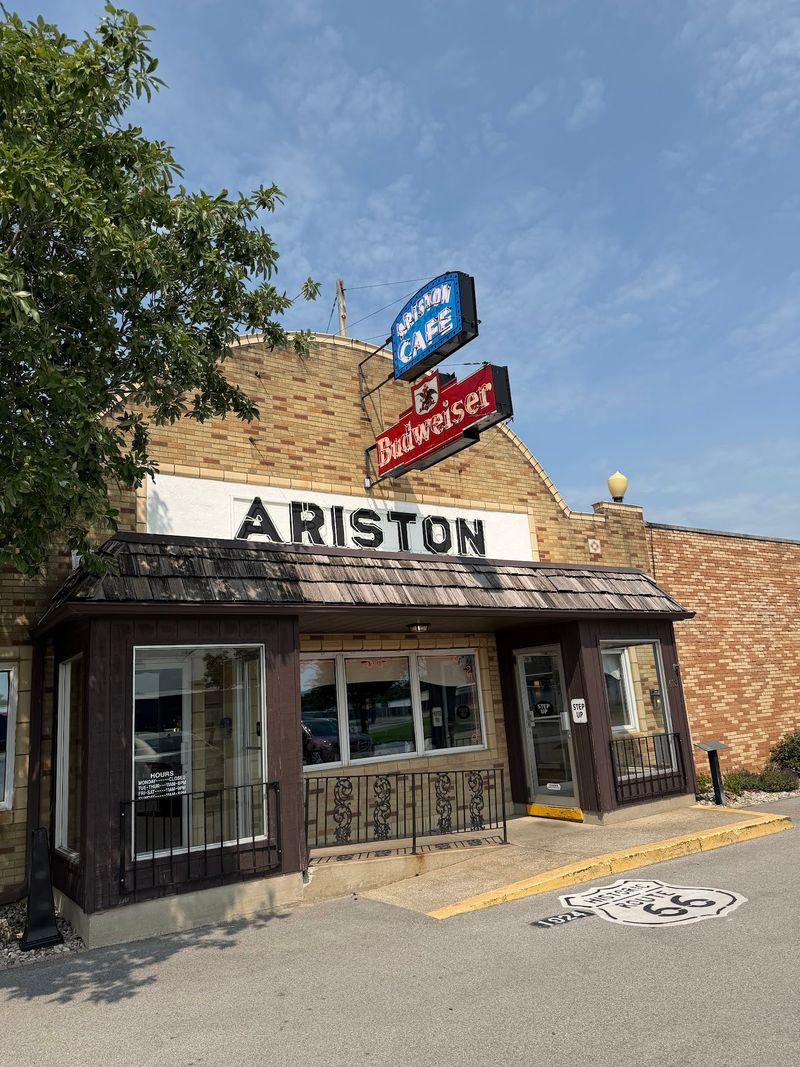
When Pete Adam opened the Litchfield building on July 5, 1935, Route 66 was already the primary road connecting Chicago to St. Louis and, beyond that, to the American Southwest. Motorists did not have the option of an interstate bypass; the highway ran directly past the café’s front door, making a well-placed roadside restaurant a practical necessity rather than a novelty.
The building was designed to handle that steady flow of passing trade.
According to the Illinois IDNR condition assessment report, the original structure measured approximately 40 by 60 feet and contained 15 tables and six booths, with a total capacity of up to 100 diners. That scale was substantial for a roadside stop in 1935, reflecting Pete Adam’s confidence in the traffic volume the new highway corridor would deliver.
The layout combined counter seating with booth and table seating, giving the café flexibility to serve quick-stop travelers and longer-stay groups at the same time.
The Route 66 context shaped every decision about the building’s purpose. Travelers heading between Chicago and St. Louis needed fuel, food, and a brief rest, and a café positioned on the main highway corridor could serve all three functions at once.
Gas pumps originally stood outside the café, turning the property into a fuller roadside service point. The physical scale, the booth-and-counter layout, and the highway-facing design were all calibrated for the motorist market that Route 66 was delivering through Litchfield every day of the week.
Original booths and fixtures still anchor the dining room
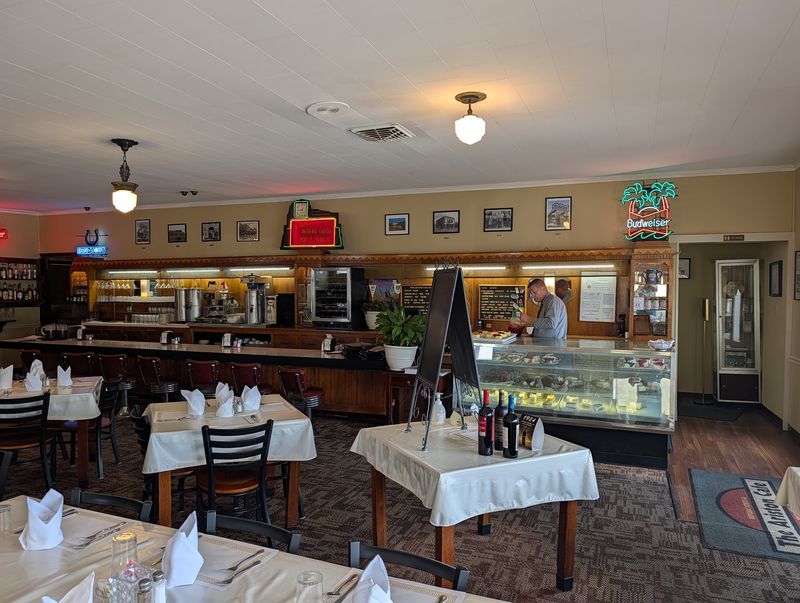
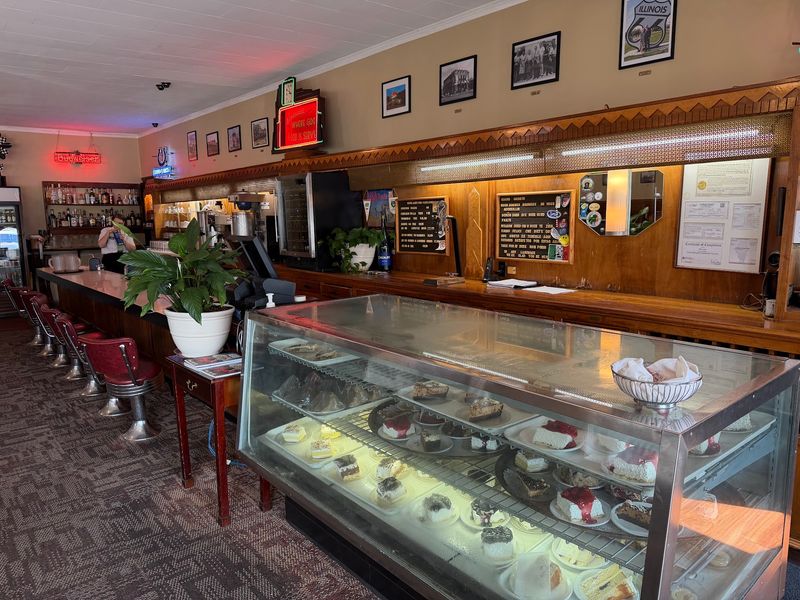
Walking into the Ariston Café today means stepping into a dining room where substantial portions of the 1935 original remain visible and in use. The Illinois IDNR assessment confirms that the original booths, counter, dining area, and kitchen are still present in the building.
That kind of material continuity is rare in American commercial architecture, where restaurant interiors are typically gutted and redesigned every decade or two to follow changing tastes.
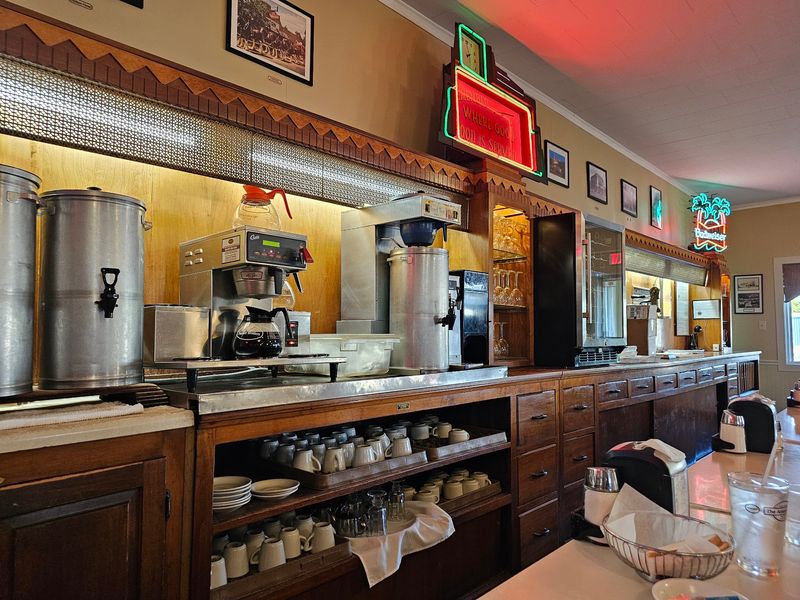
The National Park Service documentation adds detail to the picture. The National Register photo continuation sheet references surviving chrome stools, light fixtures, an Art Deco wall cabinet, and the original acoustical-tile ceiling.
Those elements give the dining room a layered quality: the bones of a 1935 roadside café are still readable beneath whatever updates have been made over the years. Chrome stools at a counter and an Art Deco cabinet are not decorative reproductions installed for nostalgia; they are documented survivors from the building’s first decade.
Precision matters here, though. Saying the café retains original features is accurate and supported.
Saying that every booth is unchanged, that every surface is untouched, or that the upholstery is the same material used in 1935 goes further than the authoritative sources allow. The sources confirm that original booths exist; they do not specify that the booths are vinyl or that each one has never been reupholstered or repaired.
A building that has operated continuously for nearly 90 years will have seen maintenance, and the honest description is one of substantial preservation rather than a frozen, museum-quality interior. What survives is genuinely impressive without requiring exaggeration.
Bypasses and interstates tested the café’s staying power
Roadside restaurants on Route 66 faced a recurring threat throughout the mid-twentieth century: highway engineers kept moving the road. For the Ariston Café, the first major test came in 1940, just five years after the current building opened.
According to the National Park Service’s Ariston Café page, a four-lane bypass was constructed behind the café that year because traffic on the original alignment had grown too congested to handle safely. Overnight, the building’s front-door relationship with the highway changed, and the owners had to adapt quickly.
Their response was practical: they added signage to the rear of the building to catch the attention of drivers on the new bypass route. That kind of operational flexibility, adjusting to a changed physical reality without abandoning the location, would prove to be a recurring theme in the café’s history.
The bypass did not shut the café down; it forced a reconfiguration that kept customers coming.
The larger challenge arrived decades later when Interstate 55 was built and Route 66 lost its status as the main Chicago-to-St. Louis corridor. Highways that had once guaranteed a steady stream of passing trade became quieter roads traveled mostly by locals and nostalgic Route 66 enthusiasts.
The Illinois preservation assessment attributes the café’s survival to a combination of factors: the quality of its food and service, its location near several busy roads and the interstate, and a loyal base of local and regional customers who kept returning regardless of what the highway maps showed. No single romantic explanation captures the full picture; it was a mix of geography, reputation, and consistent hospitality that kept the doors open.
The place endured even as ownership and food evolved
Pete Adam ran the Ariston Café from its 1924 founding until his death in 1966. After that, his son Nick took over and operated the restaurant for nearly 50 years, maintaining the family connection that had defined the business from the beginning.
That unbroken Adam family involvement across multiple generations gave the café a continuity of character that went beyond the physical building.
The ownership story changed in July 2018, when new local owners purchased the business. According to the National Park Service record, the sale ended the Adam family’s direct involvement.
Describing the Ariston Café as family-owned for nearly a century is no longer accurate without that qualification: the Adam family’s era ended in 2018, and the current owners are a separate group with their own investment in the restaurant’s future.
The food has also evolved over the decades. The café’s current menu spans American, Southern, Italian, and Greek dishes, a range that reflects both the restaurant’s long history and the tastes of successive generations of customers and owners.
A 1938 menu does exist in the historical record, establishing that the café had a food identity early on, but the sources reviewed do not show that specific recipes remained identical from the 1930s to today. What the evidence supports is a long-running restaurant tradition, not a frozen time capsule of Depression-era cooking.
The current menu is worth exploring on its own terms rather than as a replica of something older.
What visitors can verify before they make the drive
Planning a visit to the Ariston Café starts with the basics. The official address is 413 Old Route 66 N, Litchfield, Illinois 62056, and the phone number listed on the café’s official website is 217-324-2023.
Current posted hours run Tuesday through Thursday and Sunday from 11 a.m. to 8 p.m., and Friday and Saturday from 11 a.m. to 9 p.m. Monday hours are not listed on the official site, so calling ahead before a Monday trip is a sensible precaution.
The café operates as a lunch and dinner restaurant, not as a 24-hour or all-day-breakfast diner. Visitors expecting a traditional roadside diner that opens at dawn and closes late should check the hours before making the drive.
Restaurant schedules can shift with the seasons, staffing, or ownership decisions, so a quick phone call before traveling from a distance is worth the two minutes it takes.
One detail that often appears in descriptions of the Ariston Café is bottomless coffee or endless refills. The authoritative sources reviewed for this article, including the National Park Service record, the Illinois preservation assessment, and the café’s official website, do not confirm that policy.
It may well be a current practice, but it should be verified directly with the restaurant rather than assumed. If coffee is a priority for your visit, ask when you call.
The café’s historic status and surviving interior features are well-documented and worth the trip regardless of what the coffee policy turns out to be. The National Register listing, awarded in May 2006, recognizes the building’s significance to Route 66 transportation history, and that recognition stands on its own.
The documented time capsule is preserved, not frozen
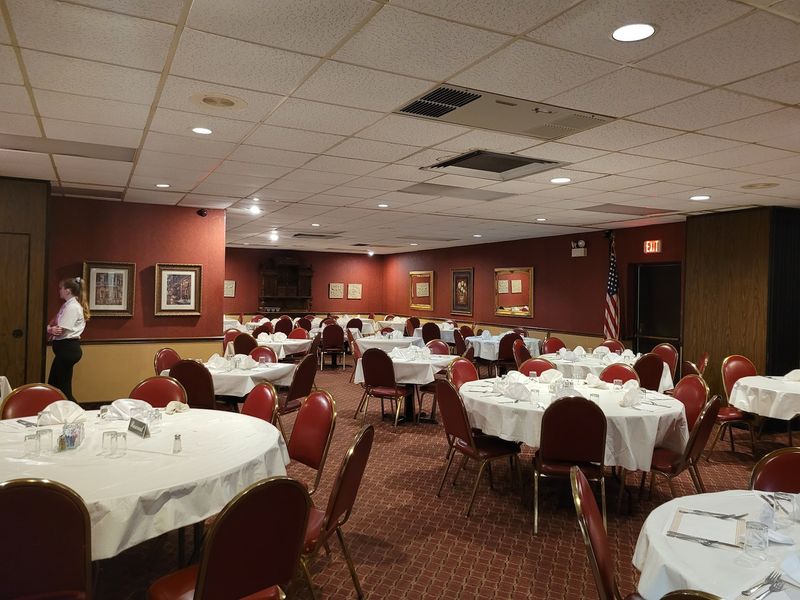
The Ariston Café’s real significance comes from something more nuanced than a simple claim that nothing has changed since 1935. The National Park Service documentation and the Illinois preservation assessment both record a building that has been modified, expanded, and restored over time: a 1974 expansion added a banquet wing, gas pumps were removed, new front doors and awnings were installed, and restoration work was carried out at various points.
An ownership change in 2018 brought a new chapter entirely. None of that diminishes the café’s historic value; it simply means the story is richer than a frozen snapshot.
What makes the Ariston Café genuinely remarkable is that continued operation in a recognizably preserved 1935 building is itself an uncommon achievement. Original booths, a historic counter, chrome stools, Art Deco fixtures, and an acoustical-tile ceiling from the building’s early years still greet visitors.
That combination of physical survival and unbroken restaurant use across nearly nine decades of highway history is not something that can be replicated or easily found elsewhere on Route 66.
Visitors who make the drive to Litchfield with accurate expectations will find a roadside café that preserves a genuine piece of American highway culture, not a theme-park recreation of one. Check the official website or call ahead to confirm current hours and any service details before you go.
The building has outlasted two bypasses, an interstate, and multiple ownership eras; the least a traveler can do is make sure the kitchen is open when they arrive. Some places earn their reputation one honest meal at a time, and the Ariston Café has had nearly 90 years of practice.