
Missouri Gave 10 Hard-Working Places A Second Career As Surprisingly Good Day Trips
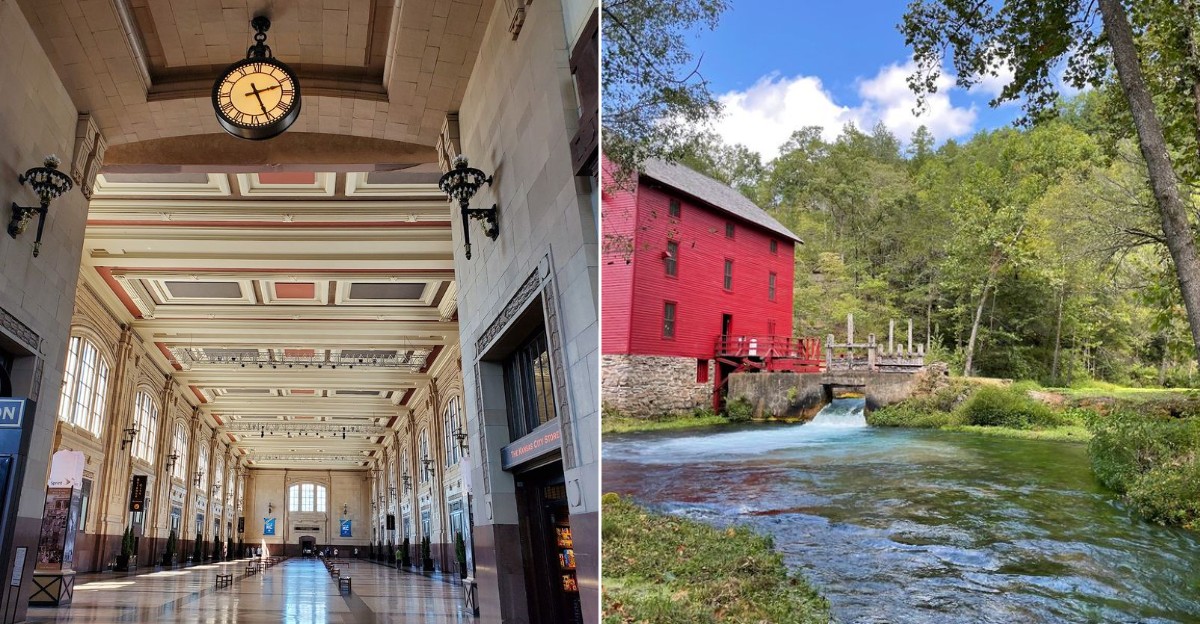
What do you do when a mine, a factory, a grand old house, or some other place that spent decades doing actual work suddenly gets a second career? You could tear it down.
Missouri apparently said, “Nah, let’s make it interesting.” And honestly, some of these places have no business being this fun.
One minute, you’re looking at a building that seems like it should come with a hard hat and a union card.
The next, there’s art on the walls, history under your feet, or some bizarre little story that makes you wonder why nobody told you about this sooner.
So, how did these former workhorses end up becoming places worth driving across town, or across the state, to see?
Let’s take a look at Missouri places that changed jobs without losing their personalities.
1. City Museum, St. Louis
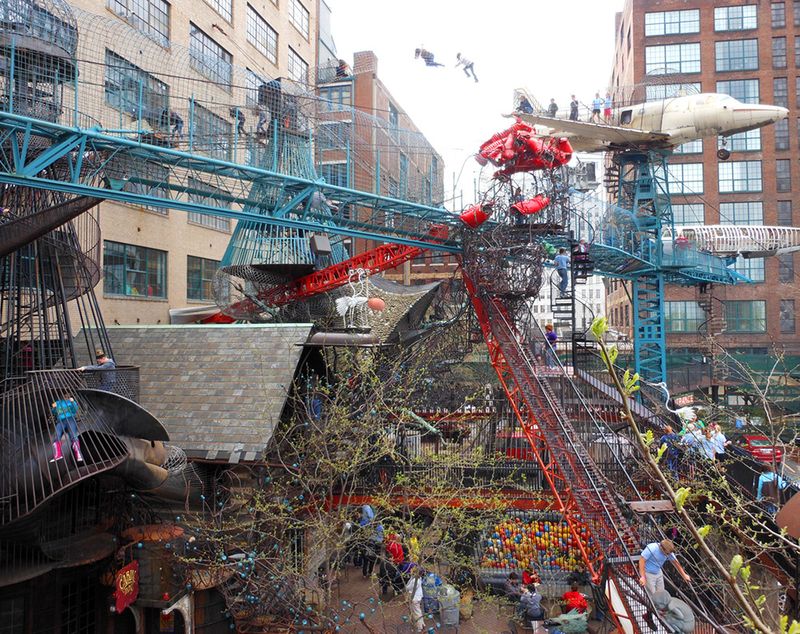
Nobody in the world looked at a 600,000-square-foot shoe factory and thought “playground,” but somebody in St. Louis absolutely did.
City Museum, tucked at 750 N 16th St, St. Louis, MO 63103, is the kind of place that makes you question every boring building you have ever walked past. What was once a sprawling industrial warehouse is now an architectural fever dream that has to be seen to be believed.
Climb through wire tunnels suspended several stories above the ground. Ride a 10-story spiral slide that deposits you somewhere unexpected.
Scale the outdoor MonstroCity structure, which is built from airplane fuselages, a real fire engine, and other salvaged industrial pieces welded into something truly magnificent. The rooftop Ferris wheel alone is worth the trip up.
Inside, you will find a vintage pinball hall, an antique carousel, and an aquarium showcasing Missouri’s native aquatic life.
The Enchanted Caves wind through the lower levels like something from a fantasy novel. City Museum does not just preserve history; it physically transforms it into something you can touch, climb, and slide through.
This is not a museum in any traditional sense, and that is exactly the point.
2. Foundry Art Centre, St. Charles
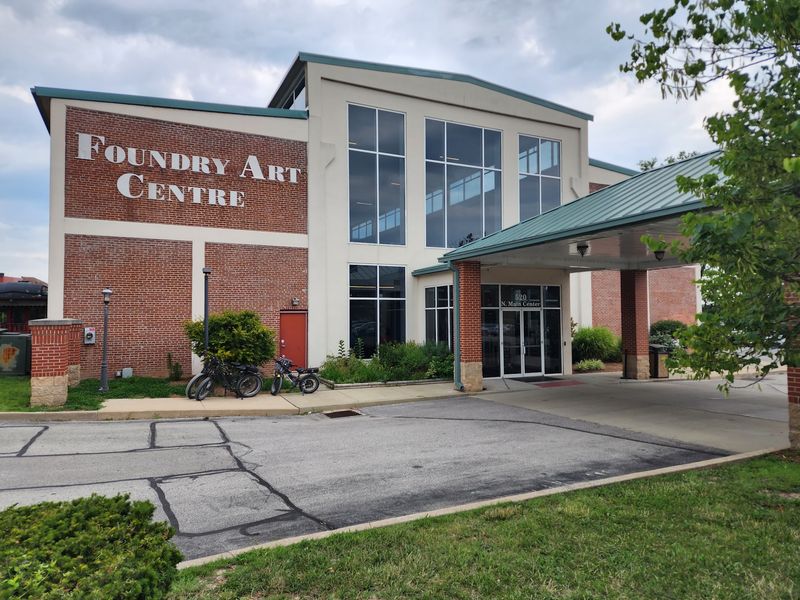
A 1920s train car factory sounds like the last place you would expect to find a gallery showcasing international contemporary art. But that is exactly what happened in St. Charles, and honestly, the contrast makes the whole experience even better.
The Foundry Art Centre at 520 N Main Center, St. Charles, MO 63301 sits right along the Missouri River and carries that quiet, industrial cool that newer buildings simply cannot fake.
American Car and Foundry originally built this 36,800-square-foot space to manufacture train cars. When that chapter closed, the building could have been forgotten.
Instead, a thoughtful renovation brought it back to life in 2004 as a fully functioning art center, complete with main galleries, an East Gallery dedicated to emerging artists, and a children’s gallery that makes creativity feel genuinely accessible.
Artist studios are open for visitors to peek inside, which gives the whole place a living, working energy rather than a static display. Rotating exhibitions, performances, and educational programs keep the calendar full year-round.
The building’s bones, exposed brick, soaring ceilings, and industrial framing, do all the atmospheric heavy lifting. Great art looks even better when the walls have their own story to tell.
3. Missouri Mines State Historic Site, Park Hills
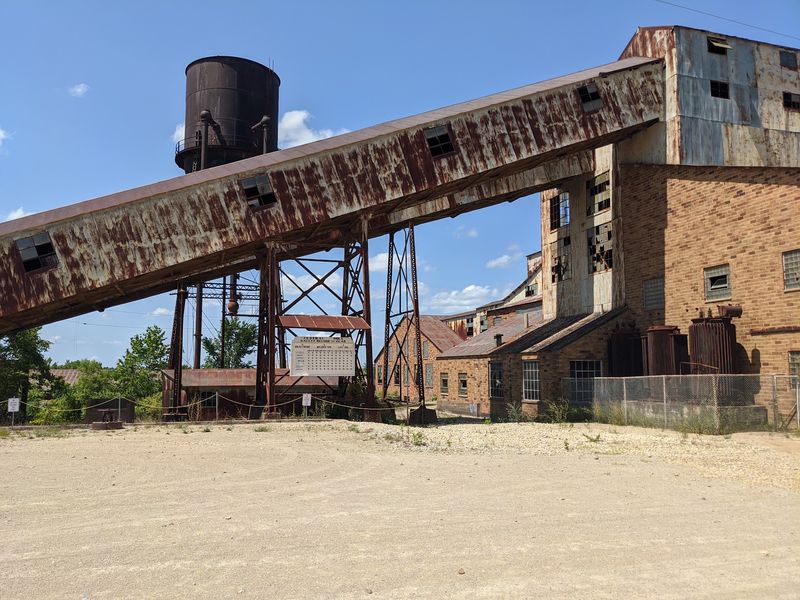
Lead mining shaped southeastern Missouri in ways that are still visible today, and nowhere tells that story more powerfully than this place.
The Missouri Mines State Historic Site at 4000 State Highway 32, Park Hills, MO 63601 sits in the heart of what was once called the Old Lead Belt, a region that fueled American industry for generations.
The St. Joe Lead Co. ran operations here starting in the early 1700s, making this one of the longest-running mining legacies in the country.
The former powerhouse building has been converted into a genuinely impressive museum. Inside, massive restored underground mining equipment fills the floor space in a way that makes you feel small in the best possible sense.
Mineral specimen collections, geology exhibits, and interpretive videos round out the experience with real educational depth.
What makes this site special is the preservation of the original mill buildings and towering industrial structures outside.
You are not looking at reproductions or scaled-down models. You are standing next to the actual machinery that once processed millions of tons of ore.
The weight of that history is palpable in every rusted beam and weathered wall. Missouri’s mining past is not just remembered here; it is preserved in full scale.
4. Bonne Terre Mine, Bonne Terre
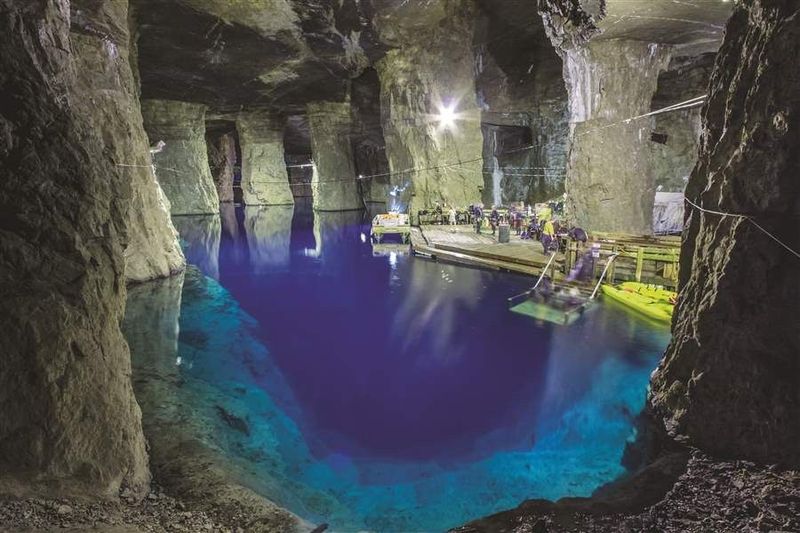
Somewhere beneath a quiet Missouri town, there is a lake the size of several football fields that almost nobody outside the state knows about.
The Bonne Terre Mine at 185 Park Ave, Bonne Terre, MO 63628 operated as a lead mine from 1862 to 1963, and the St. Joe Lead Company spent a century carving out one of the most extraordinary underground spaces in North America.
When mining operations ended, groundwater gradually filled the lower levels. What was left behind is the world’s largest subterranean lake, a genuinely jaw-dropping natural wonder sitting 200 feet below the surface.
Guided walking tours take you through the upper levels, past enormous carved-out chambers supported by thick mineral pillars. Boat tours glide across the crystal-clear flooded lower levels, where the water visibility stretches dozens of feet down.
The Bonne Terre Mine has also earned a global reputation as a premier destination for scuba enthusiasts, who travel from around the world to explore its underwater passages. Even if you keep your feet dry, the experience of standing inside this former industrial giant is unforgettable.
This National Historic Site is a reminder that the most surprising wonders are sometimes the ones hiding directly beneath your feet.
5. Union Station Kansas City, Kansas City
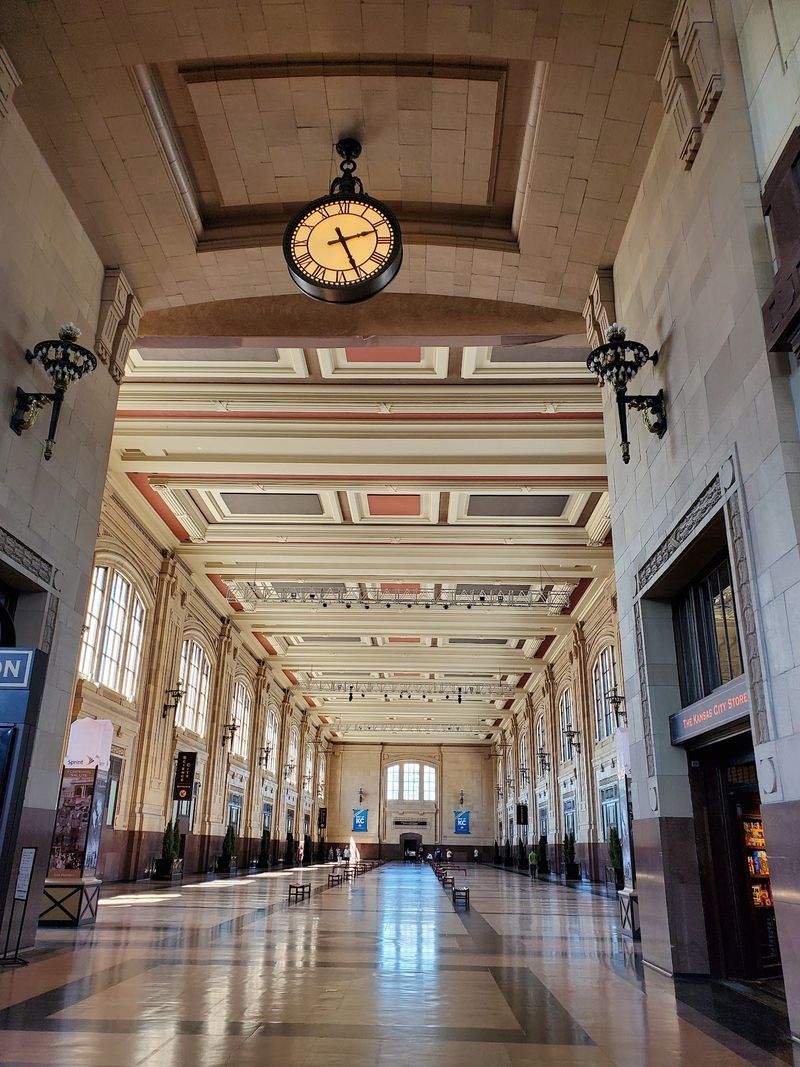
When Union Station opened in 1914, it was one of the grandest train depots in the entire country. Kansas City knew how to make an entrance, and this building was proof.
Located at 30 W Pershing Rd, Kansas City, MO 64108, the station processed millions of passengers over the decades before rail travel declined and the building fell into a long, quiet chapter of uncertainty.
The comeback story here is genuinely impressive. Rather than demolishing or abandoning the structure, Kansas City transformed it into a civic landmark that now draws visitors for entirely different reasons.
Science City, one of the most acclaimed science centers in the region, fills a large portion of the space with hands-on exhibits that make learning feel like play.
The Arvin Gottlieb Planetarium and the Regnier Extreme Screen Theatre add to the entertainment lineup in a big way.
The Model Railroad Experience, City Stage performances, and rotating world-class traveling exhibitions give the station a packed calendar throughout the year. The architecture itself remains a showstopper, with its soaring ceilings and grand proportions reminding every visitor what ambition looked like in 1914.
Union Station did not just survive its transition; it absolutely thrived through it.
6. St. Louis Union Station, St. Louis
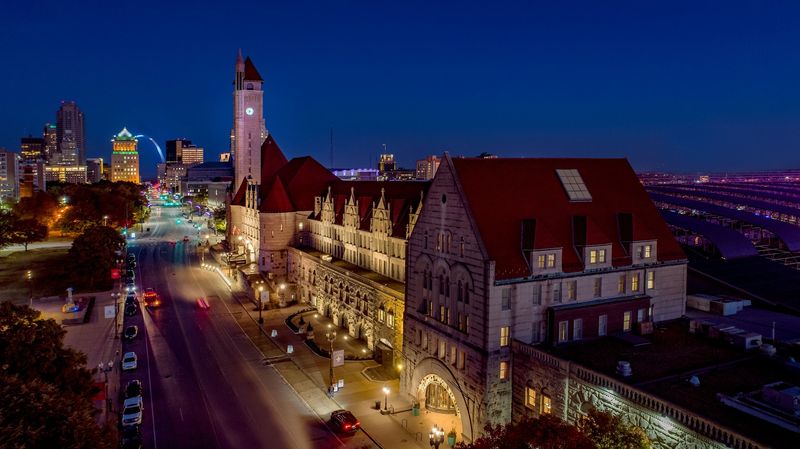
Once upon a time, St. Louis Union Station was one of the busiest passenger rail terminals on the entire planet. That is not an exaggeration.
When it opened in 1894 at 1820 Market St, St. Louis, MO 63103, it set the standard for what a train station could be. The Grand Hall alone, with its terrazzo floors, intricate wooden details, and jaw-dropping stained glass windows, was enough to make travelers stop mid-stride.
The station’s second life is just as ambitious as its first.
A 200-foot observation wheel called The St. Louis Wheel now spins inside the complex, offering views that the original rail passengers could never have imagined. The St. Louis Aquarium brings marine life to a landlocked city in spectacular fashion.
A carousel, mini-golf course, mirror maze, and ropes course fill in the gaps for anyone looking to keep busy.
Every evening, the Grand Hall becomes a canvas for a mesmerizing light show projected across those same vaulted ceilings that have stood since the Victorian era. The contrast of historic architecture and modern entertainment creates something genuinely unique.
St. Louis Union Station is living proof that the best old buildings do not need to be replaced; they just need a bold new vision and the courage to execute it.
7. Sikeston Depot Museum And Cultural Center, Sikeston
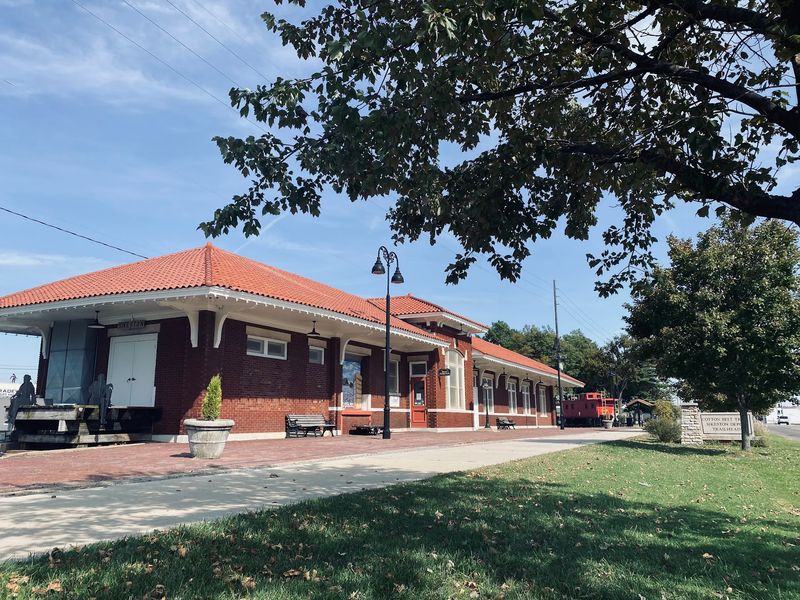
A railroad depot that survived the Civil War, served as a regional supply hub, and then quietly closed its doors in 1985 deserves a better ending than simply fading away.
The Sikeston Depot Museum and Cultural Center at 116 W Malone Ave, Sikeston, MO 63801 got exactly that. Built in 1916 by the Iron Mountain Railroad, this depot has layers of history stacked on top of each other like a very well-organized archive.
Today, the building functions as a lively museum and cultural space that covers an impressive range of stories. Permanent exhibits explore the Mississippian Indian tribe, the distinctive heritage of what locals call Swampeast Missouri, and the region’s deep roots in cotton farming.
A display dedicated to Parks Air Force Base adds a different dimension to the historical narrative.
Perhaps the most unexpected exhibit involves the invention of the mechanical horse, a quirky piece of regional history that catches most visitors completely off guard.
An art gallery featuring local and regional artists rounds out the experience with a creative energy that keeps the space feeling current.
The Sikeston Depot Museum is the kind of place that surprises you with how much story one small building can hold. Small town history, it turns out, is rarely actually small.
8. Patee House Museum, St. Joseph
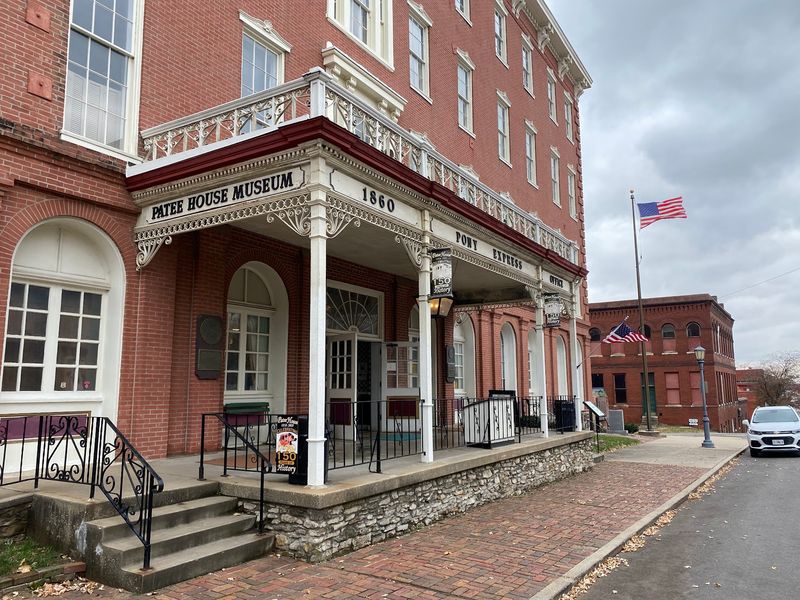
Built in 1858 as the most luxurious hotel west of the Mississippi River, the Patee House had ambitions that matched the frontier era it was born into.
Located at 1202 Penn St, St. Joseph, MO 64503, this grand building became the eastern terminus of the Pony Express Trail in 1860, making it one of the most historically loaded addresses in the entire American West. That is a remarkable resume for a single building.
Over the following decades, it adapted constantly, serving as a Civil War headquarters, hosting women’s colleges, and even operating as a shirt factory at one point. Each chapter added another layer to its already remarkable story.
Today, as a National Historic Landmark, the Patee House functions as a history museum that does not shy away from the full complexity of its past.
Visitors can walk through the original Pony Express headquarters, explore recreated Streets of Old St. Joseph, and examine an impressive collection of historic transportation artifacts.
An 1860 locomotive, stagecoaches, vintage vehicles, and an indoor carousel make the exhibits feel tangible rather than theoretical.
The nearby Jesse James Home on the museum grounds adds another unexpected dimension. Patee House is not just a museum; it is a layered, living document of American westward ambition.
9. Watkins Woolen Mill State Historic Site, Lawson
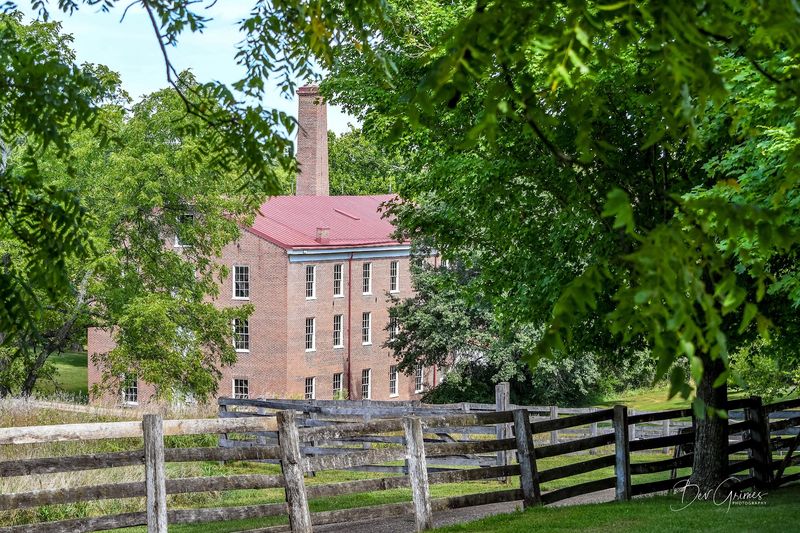
There is only one 19th-century woolen mill in all of North America that still contains its original machinery, and it happens to be sitting quietly in Lawson, Missouri.
The Watkins Woolen Mill State Historic Site at 26600 Park Rd N, Lawson, MO 64062 is the kind of place that history enthusiasts dream about finding.
The mill itself is extraordinary, but the surrounding site adds even more context to the story.
Beyond the mill, you can tour the Watkins family home and a collection of original farm buildings, including a gristmill and sawmills that speak to the self-sufficient ambition of 19th-century rural life.
The visitor center provides well-organized exhibits that explain early industrial processes in genuinely accessible language. The history here is not locked behind glass; it is preserved in working machinery and original structures.
The surrounding state park softens the experience beautifully. Hiking trails wind through the property, a lake offers swimming and fishing, and wildlife viewing opportunities are plentiful along the way.
The restored 1871 Mt. Vernon Church and the 1856 Franklin School Octagonal Schoolhouse add two more remarkable stops within the same visit.
Watkins Woolen Mill is the rare historic site where the landscape and the history feel equally worth your time.
10. Alley Mill, Eminence
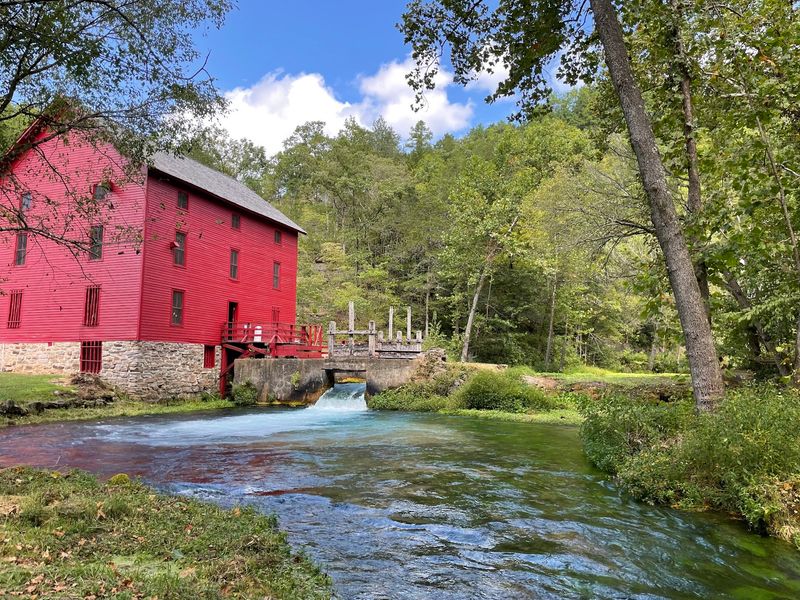
Missouri’s most photographed building is not a skyscraper or a famous landmark in a major city. It is a small red mill tucked deep in the Ozarks, and once you see it in person, the title makes complete sense.
Alley Mill at 12185 Alley Hollow Rd, Eminence, MO 65466 sits within the Ozark National Scenic Riverways, surrounded by the kind of green, unhurried beauty that makes you immediately forget whatever was stressing you out before you arrived.
Built in 1894 to replace an earlier mill from 1868, Alley Mill was actually ahead of its time. It used a water turbine instead of a traditional water wheel and employed rollers for grinding grain, making it a genuinely modern merchant mill by the standards of its era.
The building also housed a post office in its earlier days, serving as a small but vital community hub for the surrounding Ozark settlements.
Today, the mill opens seasonally for tours and operates as a museum and gift shop inside its original walls. The real showstopper, though, is Alley Spring directly beside it, one of Missouri’s largest freshwater springs, pumping 81 million gallons of vivid turquoise water daily into the Jacks Fork River.
A one-room schoolhouse nearby completes the scene. Has a day trip ever looked this effortlessly perfect?