
How You’re Supposed To Eat These 20 Foods
You’ve been eating them your whole life, but have you ever stopped to wonder if you’re doing it right?
From sneaky snack hacks to little-known tricks that actually make a difference, some foods come with their own set of secret rules.
Whether it’s peeling, dipping, or slicing, a few small tweaks can totally change the game.
Get ready to rethink your routine and find out what the food pros have been keeping to themselves all along.
1. Sushi: One Bite Wonders

Forget cutting sushi in half! Traditional etiquette calls for eating each piece in a single bite.
Pick it up with chopsticks, flip it upside down, and dip only the fish side lightly in soy sauce. The rice would soak up too much sauce and fall apart if dipped.
Between different types, cleanse your palate with pickled ginger, but never put ginger on top of the sushi itself. That’s a major faux pas!
2. Oysters: Slurp Don’t Chew

Rookie mistake: chewing oysters like regular food. Pros know to hold the shell with your non-dominant hand, making sure the wide end faces your mouth.
Add a drop of mignonette or lemon, then tilt and slurp the entire contents in one go. Swallow immediately or give just one gentle chew to release flavors.
The entire experience should capture that perfect briny essence of the sea. No need for forks or excessive chewing!
3. Pizza: Fold It Like A New Yorker

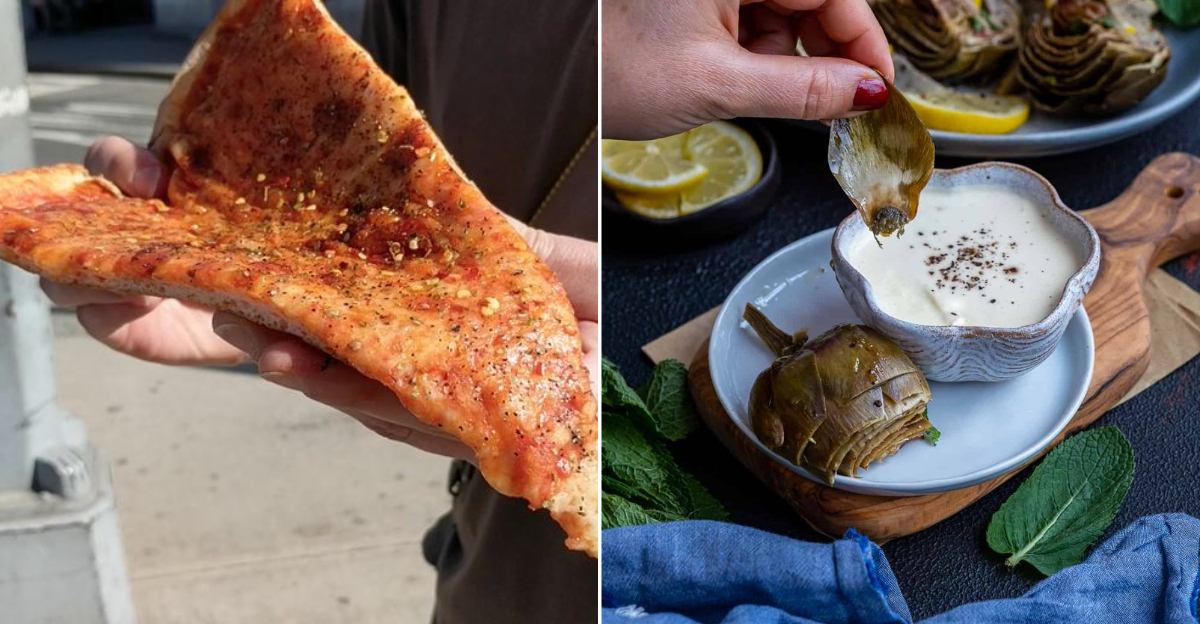
Authentic New York pizza demands the fold. Grab a slice by the crust, fold it lengthwise to create a U-shape, and take a bite from the pointed end.
This technique prevents toppings from sliding off and contains the delicious oil that might otherwise drip down your arm.
Chicago deep dish requires a different approach altogether. Fork and knife are not only acceptable but necessary for navigating those thick, layered slices. No judgment either way!
4. Ribs: Embrace The Mess
Attempting to eat ribs with utensils is like swimming with an umbrella. Grab them with your hands, holding each rib by the exposed bone ends.
Start from one end and work your way across, pulling the meat away with your teeth. Sauce on your face? Badge of honor!
Professional rib-eaters know to twist the bones slightly to separate meat from cartilage. Keep napkins handy, but remember that spotless hands after ribs means you’ve missed the whole experience.
5. Lobster: Strategic Dismantling
Tackling lobster requires methodical destruction. Start by twisting off the claws, then crack them with the provided tool.
Extract tail meat by breaking the connection between body and tail, then pushing from the small end. Don’t overlook the knuckles! These hidden pockets contain some of the sweetest meat.
Many skip the green tomalley and red roe, but culinary adventurers consider them delicacies. Remember: the tiny fork is for picking, not stabbing.
6. Artichoke: Leaf by Leaf
Attacking an artichoke requires patience. Pull off outer leaves one by one, dip the fleshy base in butter or sauce, then scrape the soft part off with your teeth while holding the pointed end.
Discard the scraped leaves on a separate plate. Once you’ve worked through all leaves, you’ll reach the fuzzy choke.
Scoop this out with a spoon and discard it to reveal your prize: the tender heart beneath, which you can cut and enjoy in blissful bites.
7. Pomegranate: The Underwater Method
Stained countertops and splattered shirts are pomegranate rookies’ calling cards. Smart eaters cut the fruit in half, then submerge each half in a bowl of cold water.
While underwater, gently break apart and push the seeds out with your fingers. The magic? Seeds sink while the bitter white membrane floats!
Skim off the floating bits, drain the water, and enjoy your perfectly clean ruby jewels. Bonus points for using this method without a single red splash on your clothing.
8. Mango: The Hedgehog Hack
Battling mango juice running down to your elbows? Try the hedgehog method! Slice off one side of the mango just past the flat seed, then score the flesh in a grid pattern without cutting through the skin.
Push the skin side up to invert the cubes outward. Now you can slice the cubes off with a knife or eat them directly.
For wild mango enthusiasts, sucking the seed clean afterward is perfectly acceptable and deliciously rewarding.
9. Watermelon: Triangles With Purpose
Watermelon triangles aren’t just randomly cut shapes. Their design offers the perfect eating strategy: hold the rind as a handle and bite from the pointed end inward. This contains the dripping juice and gives you something clean to hold.
Salt sprinklers know a tiny pinch enhances sweetness dramatically. Competitive eaters employ the curved slice technique to maximize flesh and minimize rind contact.
Remember to save the triangular pieces for picnics and serve cubed watermelon for indoor, fork-friendly situations.
10. Corn on the Cob: The Typewriter
Corn connoisseurs use the typewriter method: eat in straight rows from left to right, then rotate slightly and repeat. This systematic approach ensures you get every kernel without awkward patches.
Butter application matters too! Instead of struggling with a knife, use a piece of bread as your butter applicator.
Simply spread butter on bread, then use the bread to rub butter evenly across the corn. Season after buttering so spices stick properly to the surface.
11. Peaches: The Napkin Necessity
Biting directly into a ripe peach guarantees juice cascading down your chin. Smart peach eaters lean forward slightly over their plate or napkin before taking that first juicy bite.
Alternatively, slice the peach along its natural seam, twist the halves in opposite directions to separate, and remove the pit.
This method gives you manageable, less drippy portions. Summer peach veterans know to keep a dedicated peach-eating shirt in their wardrobe for those inevitable stains!
12. Grapes: Stem Strategy
Sophisticated grape eating isn’t about popping them individually. Leave grapes attached to their small stem sections when serving, providing a natural handle for guests to hold while plucking off individual grapes.
Freezing grapes transforms them into nature’s sorbet. For wine accompaniment, try the one-by-one method: take a small sip of wine, then eat a single grape to experience how the flavors interact.
Seed-spitters have perfected the subtle art of collecting seeds in cheeks before discreetly removing them.
13. Dates: Mind The Pit
Casual date munchers risk dental disaster! First, determine if your date is pitted. If not, take a small bite and eat around the large seed in the center, discarding it discreetly.
For stuffed dates, the one-bite approach works best. Cream cheese or almond-filled varieties should be consumed whole to prevent filling spillage.
Date veterans know to check for tiny stem pieces at the end that can be woody and unpleasant if accidentally chewed.
14. Chestnuts: Score Before Roasting
Exploding chestnuts ruin holiday gatherings! Always score an X on the flat side before roasting to allow steam to escape.
Once roasted, peel them while still warm when the shells come off most easily. Hold the chestnut in a cloth napkin to protect fingers from heat.
Crack open along the scored lines and enjoy the buttery interior. True chestnut aficionados know to remove not just the hard outer shell but also the bitter inner skin that clings to the nut meat.
15. Soup: Spoon Away From You
Contrary to instinct, proper soup eating involves dipping the spoon away from you, then bringing it to your mouth. This prevents drips on your clothing and cools the liquid slightly before it reaches your lips.
Never blow on hot soup in formal settings! Instead, wait patiently for it to cool. For chunky soups, it’s acceptable to tilt the bowl slightly away from you to gather the last spoonfuls.
Remember the old saying: “As the ship sails out to sea, I spoon my soup away from me.”
16. Falafel: Pita Pocket Protection
Falafel balls crumble with abandon if mishandled! Nestle them properly inside pita bread with the opening at the top, not the side. This creates a secure pocket that catches falling pieces and sauce.
Apply tahini or tzatziki to the inside walls of the pita first, before adding falafel. Take smaller bites from the top down, maintaining the structural integrity of your pocket.
Street food experts wrap the bottom half in paper for extra protection against the inevitable sauce cascade.
17. Edamame: Squeeze and Pop
Watching someone chew edamame pods whole is painful! Proper technique: hold the pod between fingers, put one end in your mouth, and gently squeeze or bite to pop the beans into your mouth.
Discard the inedible pod in a separate bowl. Salt clings best to slightly damp pods, so don’t dry them completely after boiling.
Edamame experts know to hold the pod horizontally rather than vertically for maximum bean extraction with minimal effort.
18. Peanuts: Shell Game Strategies
Stadium peanut pros crack shells with precision! Hold the peanut between thumb and forefinger, applying pressure at the seam until it splits.
Extract nuts with fingers, not teeth, to avoid shell fragments. Never shell an entire handful at once. Instead, maintain a steady rhythm: shell, eat, discard, repeat.
This method keeps the freshness intact. In-shell peanuts actually stay fresher longer than pre-shelled varieties, making the extra effort worthwhile for maximum flavor.
19. Mussels: Empty Shell Strategy
Mussel masters use an empty shell as natural tongs! After eating your first mussel with a fork, save the empty shell. Pinch it between fingers and use it to pluck the meat from subsequent shells.
Never eat closed mussels that didn’t open during cooking. For the sauce-obsessed, tilt each shell slightly to capture the flavorful broth inside.
Belgian mussel connoisseurs alternate: one mussel, one fry, creating the perfect rhythm of seafood and potato.
20. Croissants: Layer Preservation
Squishing a croissant destroys its flaky architecture! Instead, tear small pieces horizontally along the natural layers rather than crushing the entire pastry. This maintains the delicate honeycomb structure inside.
French pastry chefs insist croissants should never be sliced with a knife. For butter application, add a small amount to each torn piece rather than pre-buttering the entire croissant.
True croissant aficionados know to save the pointed ends for last as they contain the most concentrated buttery flavor.