
6 Small-Town Southern Comfort Food Dishes In North Carolina
Down here in North Carolina, we take our comfort food seriously.
I’ve spent years roaming the backroads of small towns across our beautiful state, sampling the most soul-satisfying dishes that have been passed down through generations.
These six southern classics aren’t just meals – they’re edible history, representing traditions and techniques that tell the story of our state’s rich culinary heritage.
1. Golden-Crisp Fried Green Tomatoes
Last summer, I stumbled upon the most perfect fried green tomatoes at a roadside diner in Rutherfordton. The elderly cook, Ms. Beatrice, had hands that moved with the confidence of someone who’d been making this dish since before I was born. She shared her secret: cornmeal mixed with just a pinch of sugar to balance the tomatoes’ tartness. These unripe tomatoes transform into something magical when sliced thick, dredged in seasoned cornmeal, and fried until golden.
The exterior develops a satisfying crunch while the inside softens just enough, maintaining a pleasant firmness that gives way with each bite. Many North Carolina grandmothers insist on using cast iron skillets that have been seasoned for decades, claiming they impart a flavor no new pan could match. Traditionally served with a dollop of pimento cheese or herb-flecked buttermilk dressing, this dish makes use of garden tomatoes that haven’t yet ripened – true Southern resourcefulness at its finest.
What began as a practical solution for using unripe tomatoes has become a beloved staple. In small towns like Shelby and Lincolnton, you’ll find local variations where some folks add a sprinkle of bacon bits or a dash of hot sauce for extra zing. The beauty of this humble dish lies in its simplicity – just a few ingredients coming together to create something far greater than the sum of its parts.
2. Hearty Chicken And Pastry
My grandmother’s chicken and pastry could cure anything from a common cold to a broken heart – at least that’s what she always claimed. Unlike its cousin chicken and dumplings, our North Carolina version features flat, rectangular strips of pastry rather than puffy dumplings, creating a texture that’s uniquely comforting. The magic begins with a whole chicken simmered slowly until the meat falls off the bone, creating a rich broth that forms the dish’s foundation.
Meanwhile, the pastry – made from just flour, salt, and chicken broth – is rolled thin and cut into strips before being dropped into the bubbling pot. Some local cooks in towns like Smithfield and Wilson have closely guarded family recipes, with variations that might include a splash of evaporated milk for richness or a hint of sage that elevates the entire dish. Watching the pastry strips cook is mesmerizing – they start firm but gradually absorb the savory broth, becoming tender while still maintaining their distinct texture. The finished dish should be neither soup nor stew but something wonderfully in-between.
On chilly evenings in small towns across eastern North Carolina, this dish appears on dinner tables as reliably as the sun sets. Churches throughout Johnston County are famous for their chicken and pastry fundraisers, where massive pots feed entire communities. One bite transports you instantly to simpler times – it’s comfort in its purest form, unpretentious and deeply satisfying.
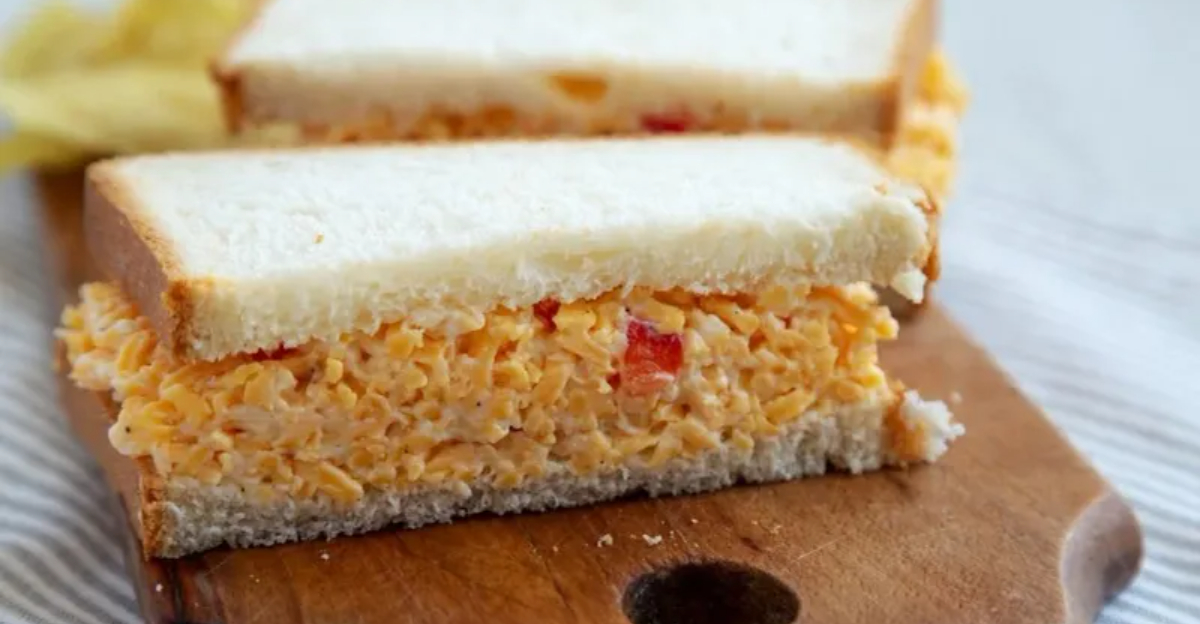
3. Creamy Pimento Cheese Sandwich
The first time I tasted proper pimento cheese was at my aunt’s kitchen table in Davidson. She laughed at my wide-eyed reaction, saying, “Honey, that store-bought stuff isn’t even in the same universe.” She was right – the homemade version is an entirely different experience, creamy yet textured, sharp yet mellow, with bright pops of pimento peppers throughout. Known affectionately as “Southern pâté” or “Carolina caviar,” this spread combines sharp cheddar cheese, mayonnaise (Duke’s only, according to purists), and those signature pimentos.
Some small-town recipes add secret ingredients – a dash of hot sauce in Brevard, a splash of pickle juice in Edenton, or a hint of grated onion in Southern Pines. The cheese must be hand-grated – never pre-shredded – to achieve that perfect texture that spreads beautifully across soft white bread. While fancy restaurants across the country now serve artisanal versions with additions like bacon or jalapeños, the traditional sandwich remains the ultimate comfort food.
At family gatherings and church socials across small North Carolina towns, you’ll find these sandwiches cut into triangles on serving platters, disappearing faster than any other offering. The sandwich reaches perfection when the bread is lightly toasted and the pimento cheese is at room temperature, allowing all the flavors to shine. Nothing beats sitting on a wraparound porch with this simple sandwich and a glass of sweet tea, watching the world go by in true Southern style.
4. Smoky Collard Greens With Ham Hock
“You can judge a Southern cook by their collards,” my neighbor Mr. Johnson once told me as he stirred a massive pot in his Tarboro backyard. The aroma wafting from that pot was intoxicating – smoky, savory, and deeply complex from hours of patient simmering with a ham hock nestled among the greens. Collards aren’t just food in North Carolina – they’re cultural touchstones that connect us to our agricultural roots. These hearty greens require proper preparation, beginning with the ritual washing and “de-ribbing” – removing the tough central stem before chopping the leaves into manageable pieces.
The cooking liquid, affectionately called “pot likker,” becomes almost as treasured as the greens themselves. This nutrient-rich broth is often sopped up with cornbread, with some folks even drinking it straight from a cup as a tonic. The true secret lies in the balance – enough ham hock to infuse smoky depth without overpowering the earthy flavor of the greens themselves. In small towns like Plymouth and Windsor, families pass down specific techniques like adding a splash of vinegar or a pinch of red pepper flakes at just the right moment.
Collards are particularly revered around New Year’s Day, when eating them supposedly brings financial prosperity in the coming year. Whether that’s true or not, I can attest that a plate of perfectly cooked collards, glistening with pot likker and served alongside cornbread, makes you feel rich in all the ways that truly matter.
5. Crispy-Outside Hush Puppies
The best hush puppies I’ve ever tasted came from a tiny seafood shack in Calabash, where the cook tossed them straight from the fryer into a paper-lined basket. These golden nuggets of cornmeal joy had a crackling exterior that gave way to a tender, steamy interior – the textural contrast that makes a truly exceptional hush puppy. Legend has it that these bite-sized delights got their name when cooks would toss fried cornmeal batter to barking dogs, telling them to “hush, puppy!” Whether that’s true or just a good story, these simple fritters have become essential companions to fried seafood across North Carolina’s small towns.
The basic recipe calls for cornmeal, flour, eggs, and buttermilk, but local variations abound – adding minced onion in Morehead City, incorporating crab meat in Southport, or mixing in jalapeños in Lexington for a spicy kick. The technique matters tremendously. The oil must be the perfect temperature – too cool and they absorb grease, too hot and they burn before cooking through.
When done right, they emerge with that characteristic oblong shape, created by dropping the batter from a spoon into shimmering oil. In fishing communities along our coast, hush puppies were originally a practical way to use leftover fish-fry batter, but they’ve evolved into beloved stars of the plate rather than afterthoughts. Nowadays, no fish camp or seafood shack menu would be complete without them, served piping hot with a side of honey butter or just as they are – perfectly crisp, golden, and irresistible.
6. Velvety Banana Pudding
My first memory of banana pudding involves sneaking an extra serving at a family reunion in Wadesboro when I was seven. The dessert had barely hit the picnic table before it was surrounded by eager relatives wielding serving spoons. That’s the power of proper banana pudding in North Carolina – it creates a magnetic pull that’s impossible to resist. Unlike fancy desserts that rely on exotic ingredients, banana pudding celebrates simplicity: layers of vanilla wafer cookies, sliced bananas, homemade custard, and billowy meringue.
The magic happens as the components meld together – the cookies softening as they absorb moisture from the custard, the bananas contributing their sweet perfume. In small towns like Mount Olive and Whiteville, local variations might include a splash of banana extract in the custard or a sprinkle of cinnamon atop the meringue. The debate between meringue-topped versus whipped cream-topped versions can spark friendly arguments at church socials across the state. Traditionalists insist on meringue, baked until the peaks turn golden brown, while modernists prefer the convenience and richness of whipped cream.
What everyone agrees on is that banana pudding should be made in advance, allowing time for the flavors to harmonize. The perfect spoonful should contain all elements – the silky custard, tender cookie, soft banana, and either fluffy meringue or cream – creating a symphony of textures and flavors that represents the culmination of generations of Southern dessert wisdom. It’s comfort in a bowl, the sweet finale to any proper Southern meal.