
18 Foods You’ll Only Find In New York (And Why They Matter)
New York isn’t only about glittering towers and dazzling theater lights – it’s a city where every bite carries a story.
Street carts sizzling on busy corners, delis that have survived generations, and hole-in-the-wall gems all serve up dishes that exist nowhere else on earth.
Each plate is more than just a treat for your taste buds – it’s a snapshot of history, culture, and the communities that give the city its unmistakable character.
1. The Legendary New York Slice
Nothing says New York like folding a giant triangle of thin-crust pizza and watching the orange oil drip down your wrist.
Born from Italian immigrant traditions, the New York slice became the city’s great equalizer – affordable, portable, and available on virtually every corner. The magic lies in that perfectly balanced dough, which somehow stays crisp yet foldable.
I still remember my first authentic slice on a snowy Manhattan day, when the steam rising from that perfect cheese-to-sauce ratio warmed not just my hands but my soul.
2. Grandma Slice: Long Island’s Secret Weapon
While tourists chase the famous triangle slice, locals know the square Grandma slice is where culinary magic happens. This thin, pan-baked treasure features a light coating of tangy sauce and plenty of garlic, typically baked in a home-style fashion.
Popularized on Long Island in the late 1980s and early 1990s, especially at Umberto’s/King Umberto in New Hyde Park, the Grandma slice honors the homemade pizzas Italian grandmothers created before commercial pizza ovens existed.
The slightly charred bottom and concentrated flavors make every bite a nostalgic journey to someone’s nonna’s kitchen.
3. Bagel with Lox & Schmear: The Sunday Ritual
Hand-rolled, boiled, then baked – a proper New York bagel needs no toasting when fresh. Layered with silky cream cheese, delicate slices of cured salmon, perhaps some red onion, capers, and tomato, it becomes an edible masterpiece.
The combination emerged from Jewish appetizing shops on the Lower East Side, places like Russ & Daughters that have served generations.
Back in college, my Sunday morning ritual involved joining the line at Ess-a-Bagel, watching skilled hands assemble these works of art while neighbors debated everything from politics to baseball scores.
4. The Humble Bialy: Bagel’s Forgotten Cousin
Flatter than a bagel with a depression instead of a hole, the bialy comes filled with caramelized onions and sometimes poppy seeds. Unlike its famous cousin, it’s baked rather than boiled, creating a different texture altogether.
This bread treasure arrived from Białystok, Poland, preserved by Jewish bakers like those at Kossar’s, which has been making them since 1936.
While bagels became international stars, bialys remained a local secret – a chewy, oniony delight that separates true New Yorkers from the tourists.
5. Knish: The Original Handheld Comfort
Square or round, this doughy pouch filled with seasoned potato or kasha (buckwheat groats) is the original grab-and-go comfort food.
The knish arrived with Eastern European Jewish immigrants who sold them from pushcarts on the bustling Lower East Side.
Yonah Schimmel’s Knishery has been serving these starchy delights since 1910, becoming a living museum of old New York.
My grandmother would tell stories of buying hot knishes wrapped in wax paper for a nickel, the steam warming her hands during harsh winters as she walked to school.
6. Pastrami on Rye: The Sandwich That Built New York
Mountains of warm, peppery pastrami piled impossibly high between slices of seeded rye bread, with nothing but mustard to dress it.
This sandwich isn’t just food but a performance art, especially at institutions like Katz’s Delicatessen, where countermen slice each order by hand.
The creation dates back to 1888, when Sussman Volk first combined Romanian cured meat techniques with German bread traditions.
The resulting sandwich became the cornerstone of Jewish deli culture and a taste of New York that tourists and locals alike still line up for.
7. Egg Cream: The Misleading Marvel
Despite containing neither eggs nor cream, this frothy fountain drink captures the playful spirit of old Brooklyn.
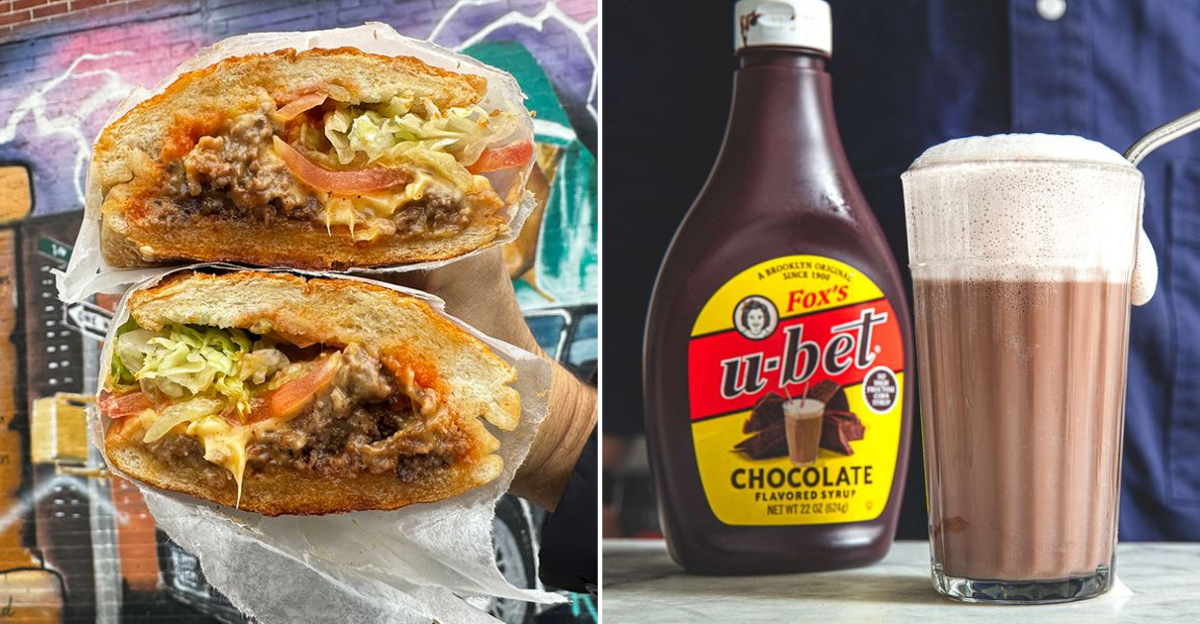
The magical combination of milk, seltzer, and chocolate syrup (preferably Fox’s U-bet) creates a fizzy, creamy treat that once flowed from soda fountains citywide.
Born in immigrant neighborhoods as an affordable luxury, the egg cream represents a time when corner candy stores were community hubs.
I’ll never forget my grandfather teaching me the proper technique – syrup first, then milk, stir vigorously, and add seltzer last while stirring to create that perfect foamy head.
8. Black-and-White Cookie: The Edible Yin-Yang
Half vanilla, half chocolate – this oversized, cake-like cookie with fondant icing represents New York’s dual nature. Flat and round, it differs from upstate’s domed “half-moon” cookies, which feature buttercream frosting instead.
These cookies have been staples in New York bakeries for generations, with institutions like Glaser’s (now closed) helping cement their iconic status.
The black-and-white isn’t just a sweet treat – it’s a cultural touchstone that even featured in a famous “Seinfeld” episode as a metaphor for racial harmony.
9. Halal Cart Chicken and Rice: Midtown’s Midnight Feast
Yellow rice topped with chopped marinated chicken, sliced lettuce, tomato, and that mysterious white sauce that New Yorkers would probably bathe in if they could. This street food phenomenon redefined Manhattan’s late-night dining scene.
Popularized by vendors like The Halal Guys (who started at 53rd and 6th in 1990), these plates represent New York’s newest food tradition.
The combination of Middle Eastern flavors adapted for American palates creates lines that stretch around blocks at all hours, proving that the city’s immigrant food story continues to evolve.
10. Chopped Cheese: The Bodega Masterpiece
Ground beef chopped on the grill with onions, melted cheese, lettuce, tomato, and condiments on a hero roll – this bodega creation is Harlem and the Bronx’s gift to sandwich culture. Often credited to Blue Sky Deli (aka Hajji’s), it represents corner-store culinary innovation at its finest.
The chopped cheese remained a neighborhood secret until recent years, when food explorers and social media brought it mainstream attention.
I first tried one after a late concert uptown, watching the bodega worker’s practiced moves as he transformed simple ingredients into something transcendent on the flattop grill.
11. Dirty-Water Dogs: Street Cart Royalty
There’s something magical about a hot dog from a Manhattan street cart – simmered in that mysterious seasoned water, topped with the bright red onion sauce that NYC carts made famous, and a squiggle of mustard. No fancy artisanal toppings needed.
German immigrants introduced frankfurters to the city, but the iconic metal pushcarts with their blue and yellow Sabrett umbrellas made them a quintessential New York experience.
The perfect dirty-water dog offers a snap when you bite, followed by juicy flavor that somehow tastes better when eaten while walking past Central Park.
12. New York Cheesecake: Dense, Dreamy Decadence
Unlike its fluffier cousins from other regions, New York cheesecake stands tall, proud, and dense. The secret lies in the heavy cream cheese base and slow baking that creates that distinctive, rich texture that doesn’t so much melt in your mouth as command it.
Brooklyn’s Junior’s has been setting the gold standard since 1950, though the style predates the restaurant.
The classic version needs no fancy toppings or swirls – just a pure, creamy canvas that showcases the simple luxury of transforming humble ingredients into something extraordinary.
13. Buffalo Wings: Upstate’s Fiery Gift
Crispy fried chicken wings tossed in a buttery hot sauce, served alongside cooling blue cheese and celery sticks – this combination ignited America’s obsession with spicy bar food.
The creation story is well-documented: Teressa Bellissimo at Buffalo’s Anchor Bar invented them in 1964 as a late-night snack.
While now found nationwide, authentic Buffalo wings maintain a specific preparation method and sauce-to-butter ratio that out-of-state versions rarely capture.
The wings represent upstate New York’s contribution to the national food conversation, proof that culinary innovation happens far beyond Manhattan’s borders.
14. Beef on Weck: Buffalo’s Other Claim to Fame
Thinly sliced roast beef piled on a kummelweck roll – a Kaiser roll topped with coarse salt and caraway seeds – then dipped in au jus and slathered with horseradish. This Buffalo specialty delivers a flavor explosion that puts ordinary roast beef sandwiches to shame.
German immigrants brought the concept to Western New York, where institutions like Schwabl’s and Charlie the Butcher perfected it.
The contrast between the tender meat, crusty salted roll, spicy horseradish, and rich jus creates a harmony of flavors that locals fiercely defend as superior to the more famous Buffalo wing.
15. The Garbage Plate: Rochester’s Beautiful Mess
Imagine a foundation of home fries and macaroni salad topped with hamburger patties or hot dogs, smothered in meat sauce, mustard, and onions. This glorious mess represents Rochester’s contribution to late-night cuisine.
Nick Tahou Hots created this feast in the early 20th century, though the name “Garbage Plate” came later.
As a college student in Rochester, I witnessed the plate’s magical powers firsthand – it’s simultaneously a hangover cure, a celebration meal, and an endurance challenge.
The way locals debate the best plate in town reveals how deeply this dish is woven into Rochester’s identity.
16. White Hots: The Pale Mystery Dogs
These uncured, unsmoked pale sausages look like regular hot dogs that forgot to put on their makeup. Made from a blend of pork, beef, and veal, white hots offer a distinct flavor profile that’s milder yet somehow more complex than their red counterparts.
Zweigle’s has been producing these Rochester specialties since the 1920s, born from German-American butchering traditions.
While visitors might be initially put off by their ghostly appearance, locals know that grilled white hots, especially at a Red Wings baseball game, deliver a subtle spiced flavor that red hots can’t match.
17. Spiedies: Binghamton’s Marinated Marvel
Cubes of meat (traditionally lamb, now often chicken) marinated for days in a tangy herb-vinegar sauce, then skewered and charcoal-grilled to perfection. The final touch? Sliding the meat off the skewer directly onto a slice of soft Italian bread.
This Southern Tier specialty traces back to Italian immigrant workers in the early 20th century. The annual Spiedie Fest and Balloon Rally draws thousands to celebrate this local treasure.
The magic lies in that marinade – every family has their secret recipe, passed down through generations and guarded more carefully than family heirlooms.
18. Salt Potatoes: Syracuse’s Simple Perfection
Small potatoes boiled in heavily salted water until tender, then drenched in melted butter. The salt creates a distinctive crust while the insides become uniquely creamy. Sometimes the simplest foods tell the most interesting stories.
Irish salt miners working around Syracuse’s Onondaga Lake in the 1800s created this dish, cooking potatoes in the extremely briny water.
What began as worker sustenance became central to Central New York’s summer food identity, especially at clambakes and lakeside gatherings where the small potatoes are served by the bowlful.