
A Unique Alabama Tunnel That Reveals A Surprising Historical Story
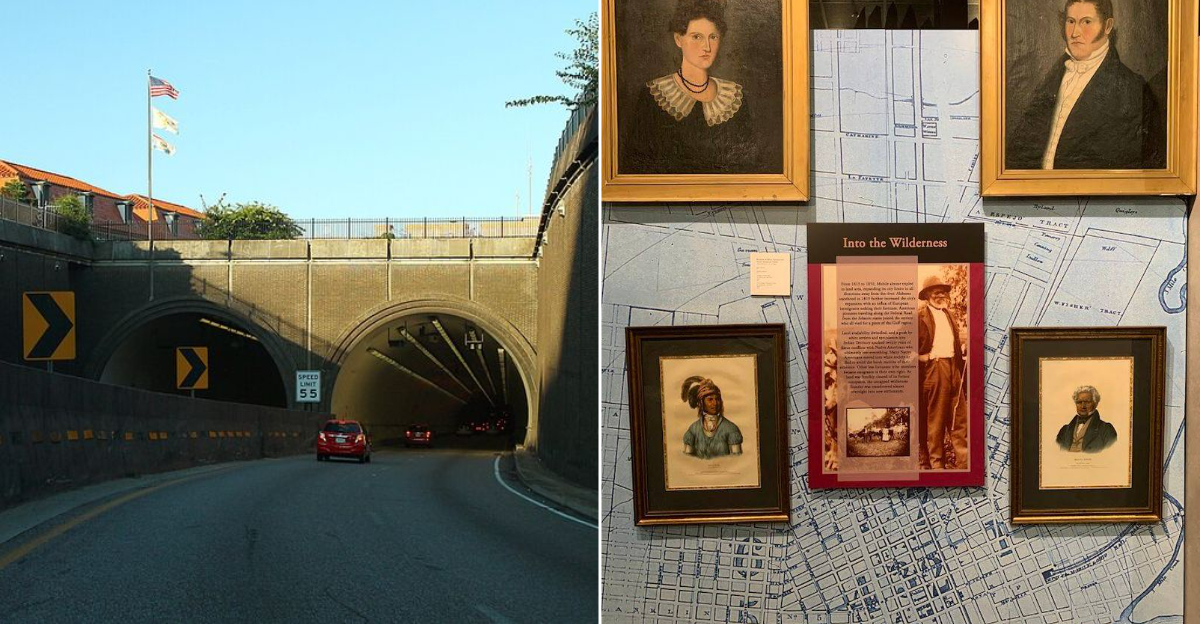
There’s a stretch of road where everything above you feels suddenly distant. Just the hum of tires, the cool shade of concrete, and the strange thrill of knowing you’re sliding beneath a river that glints in the sun.
Legends around Alabama say every local has their own ritual for it, like a secret handshake, but you just hold your breath all the way through and wonder what story lies hidden in that slippery silence.
What really surprised me wasn’t just that this passage runs under the water, but how it turns an ordinary drive into a moment where the ordinary feels like a bridge into something deeper.
An unexpected chapter of history you don’t see on postcards. This is one of those places where you arrive just to pass through, yet somehow you leave with a story you didn’t even know you were looking for.
An Engineering Marvel Built Differently Than You’d Expect
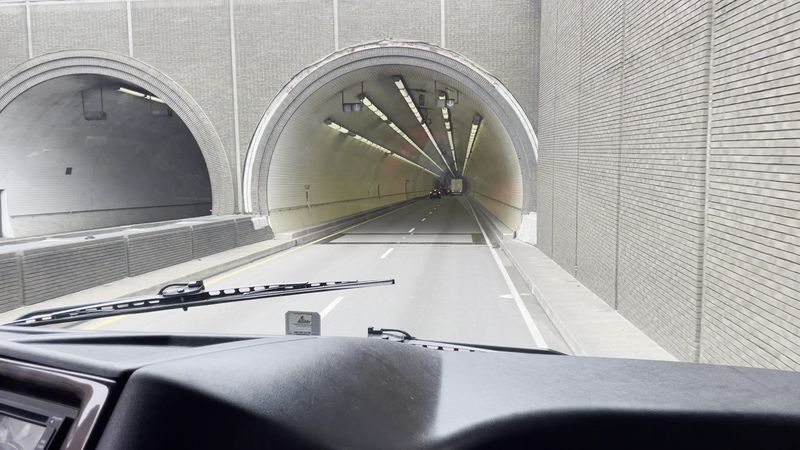
Most tunnels are bored through rock or earth, but this tunnel was built in a completely different way, almost like something out of science fiction. Engineers constructed massive concrete sections on land, floated them down the river, and carefully sank them into a prepared trench at the bottom.
The precision required still impresses civil engineers today.
The tunnel has two separate two-lane tubes, one for eastbound and one for westbound traffic. Each stretches about 3,000 feet, giving drivers a surprisingly long ride under a live river.
Clearance beneath the water reaches roughly 40 feet, creating a slightly surreal feeling of being submerged beneath something enormous.
Construction took place between 1969 and 1973, long before modern technology like GPS or computer modeling. Engineers relied on physics, math, and sheer determination to line up each section with millimeter accuracy.
Driving through for the first time, I thought about the workers guiding those massive concrete tubes into place beneath the river. The tiles lining the walls now have a vintage mid-century look, but they remain intact, and the grout lines are surprisingly clean.
The tunnel feels both old and indestructible. It is more than infrastructure, it is a quiet legacy, a remarkable achievement that continues to impress decades later.
Driving Under The Mobile River On I-10
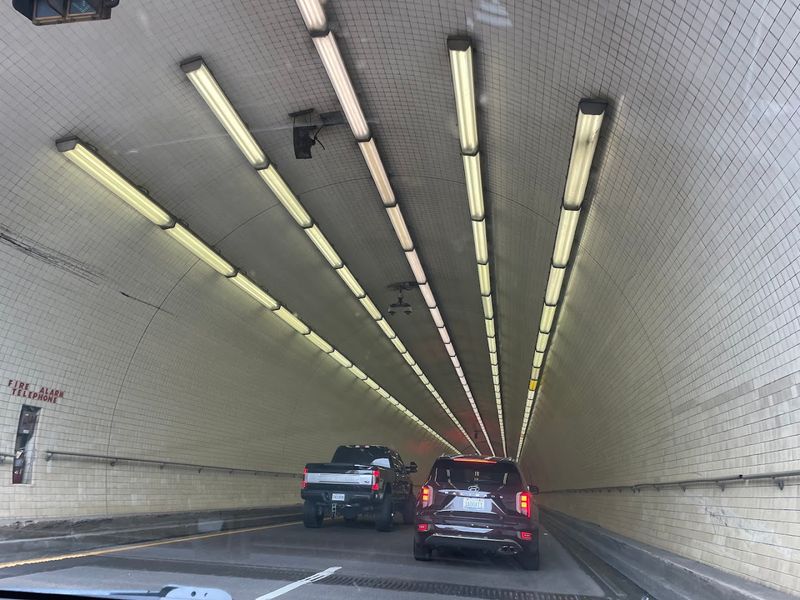
There is something disorienting about dipping below the road and realizing the Mobile River is directly overhead. I’d driven through plenty of underpasses, but this felt completely different.
The road slopes downward enough that you actually feel it in your stomach, like the opening drop of a roller coaster. Then the tiles close in, and suddenly you’re in a completely different world.
The tunnel runs along Interstate 10, connecting downtown Mobile to Blakeley Island. As soon as you enter, all signals vanish, no radio, no streaming, no navigation voice.
Just the sound of your engine bouncing off tiled walls and the glow of fluorescent lights stretching into a gentle curve.
That curve is part of the westbound tube, necessary to align with the road on the other side. It slows traffic for regular commuters, but for a first-timer, it adds to the drama, keeping the destination a secret until the last second.
Brake lights from cars ahead reflect across the cream-colored tiles in a way that is strangely beautiful. Red light dances along the underwater corridor while the world above continues unaware.
I even honked my horn once, just to hear the echo, it was magnificent. Driving under a river has never felt this cinematic.
Ten out of ten, I would do it again without hesitation.
The Controversial Name Behind The Tunnel
This is where the road trip took a sharp turn into uncomfortable historical territory. After leaving the tunnel and regaining my signal, I pulled over and spent twenty minutes researching the name stamped on the structure.
It’s named for George C. Wallace, the 45th Governor of Alabama, who served four terms and was in office when the tunnel was completed in the early 1970s.
Wallace is one of the most polarizing figures in American history. He is perhaps best remembered for his 1963 inaugural address, declaring his commitment to segregation.
The tunnel has not been renamed, and for locals who commute through it daily, the name carries weight a casual road tripper can only begin to understand.
What struck me most was the contrast: an impressive engineering achievement connecting communities, yet tied to a figure whose legacy is rooted in division. The structure itself is neutral, useful, even beautiful, but the history attached is anything but simple.
Sometimes infrastructure tells more about its era than any textbook, and this tunnel is a clear, uncomfortable example.
The Moment Your Radio Dies And Everything Goes Quiet
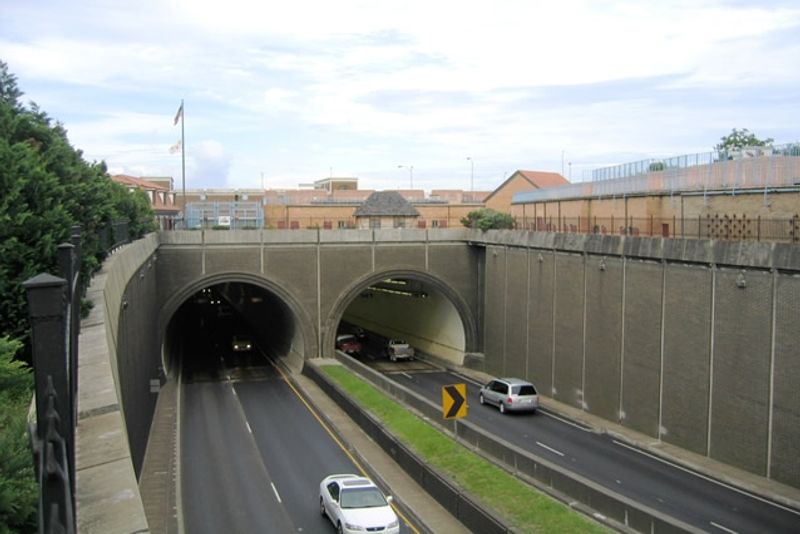
Nobody really warned me about the silence. One review I skimmed mentioned it, but I didn’t grasp what it meant until I experienced it.
One moment I was mid-song in a playlist I’d been building for weeks, and the next, everything stopped.
The radio cut to static, my phone lost signal, and navigation froze. Suddenly, I was completely alone with only the sound of my car moving through a tiled tube beneath a river.
It lasted maybe two to three minutes, short in clock time but long when you’re used to constant digital noise. No notifications, no podcasts, no GPS recalculating, just engine buzz, tire noise, and faint echoes of other cars in the same corridor.
I found myself paying attention to the drive in a way I rarely do on a highway.
The tiles caught the light cinematically, and the fluorescent strips had a cool, institutional glow, slightly eerie but dramatic with a river overhead. A few lights were out, making the lit ones feel warmer.
Emergency doors and phones along the walls added a mix of reassurance and tension.
Open 24/7, the tunnel creates a rare stretch of enforced quiet, a small, accidental mindfulness in a world where silence has almost disappeared.
Why Traffic Backs Up And What The Future Holds
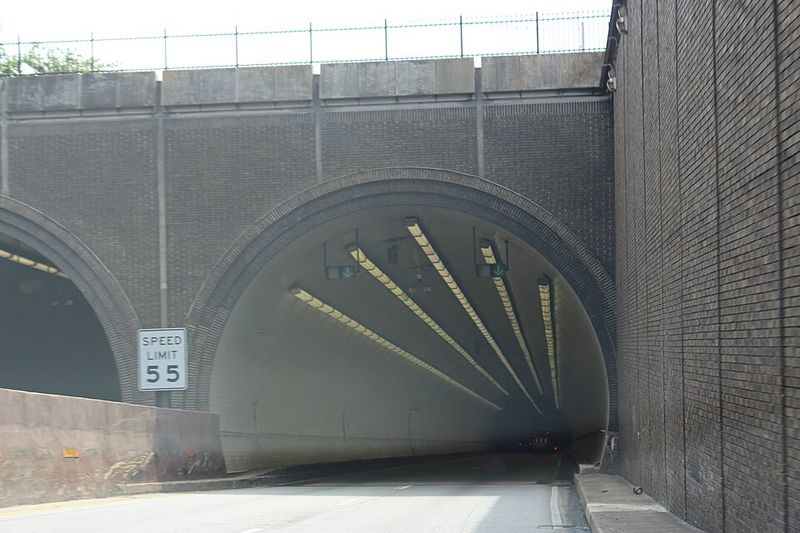
Let me be honest: the traffic at the tunnel can test your patience on a bad day. The westbound tube has a noticeable curve designed to align the exit with downtown Mobile, forcing drivers to slow down.
During peak hours, that slowdown can turn a quick two-minute drive into a twenty-minute crawl.
The tunnel carries massive daily traffic, serving local commuters and long-distance travelers on one of the busiest interstates in the Southeast.
The backup has prompted discussions about the tunnel’s future. Engineers have studied replacing the aging twin tubes with a wider crossing to meet modern traffic demands.
The constraints of the 1970s design, including the westbound curve, make expanding the existing structure nearly impossible without a full rebuild.
What struck me is how the tunnel’s limitations feel like a personality quirk. Locals have a complicated affection for it, like an old car that runs fine but won’t exceed sixty miles per hour.
It’s inconvenient, sometimes frustrating, yet oddly charming. Infrastructure that has been part of daily life for decades becomes part of a city’s identity, and this tunnel has achieved that in Mobile.
Whatever happens next, replacing it will be about more than just building a road. It will be rewriting a small piece of the city’s story.
The USS Alabama And What Waits On The Other Side
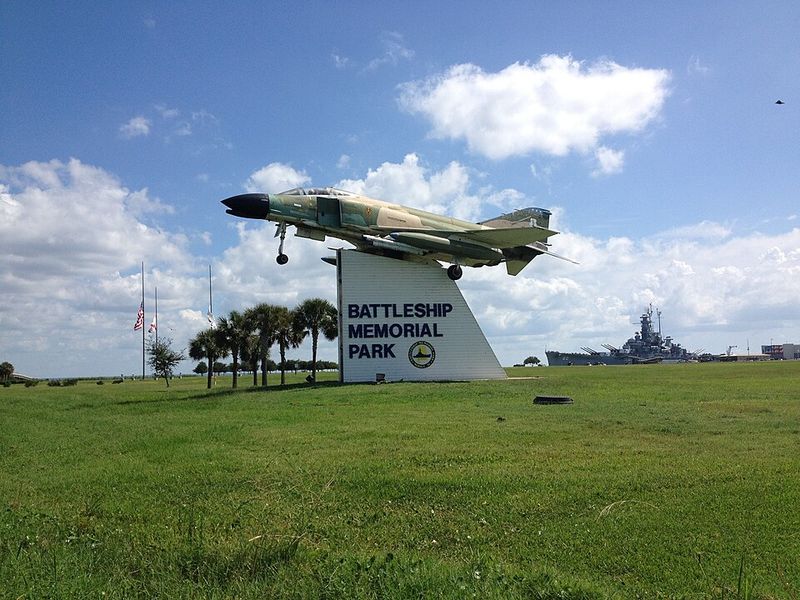
Coming out of the eastbound side of the tunnel into daylight felt like a movie reveal. The sky opened, the radio came back to life, and right there in the distance sat the USS Alabama, a massive World War II battleship now docked at Battleship Memorial Park.
The ship served in both the Atlantic and Pacific theaters before being decommissioned, and local residents raised funds to bring it to Mobile in 1964.
The park also includes the USS Drum, a World War II submarine that visitors can tour. Crawling through its cramped corridors gives a vivid sense of what life at sea was really like for the sailors who served aboard.
I hadn’t planned to stop, but emerging from the underwater tunnel with the battleship in sight made it feel like the road itself was recommending a visit.
I pulled off, spent a couple of hours exploring the park, and even bought a book about the ship’s history.
The tunnel’s proximity to Battleship Memorial Park is one of those happy geographic accidents that makes a road trip feel curated. You drive under a river, emerge blinking into daylight, and find a 35,000-ton battleship ready to share stories.
Mobile has a way of stacking its history deep, and this corner of the city stacks it especially high.
Why This Tunnel Deserves A Slow-Down Moment
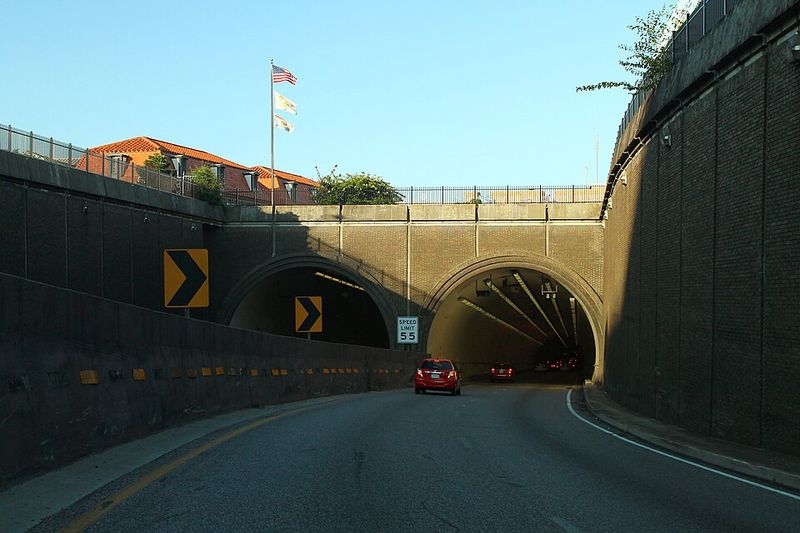
Road trips often turn into highlight reels of the obvious: big national parks, famous landmarks with gift shops, or Instagram-perfect overlooks packed with people doing the same thing you are.
The tunnel is none of those things, which is exactly why it’s worth slowing down for. It asks for nothing, has no visitor center, no selfie spot.
It just quietly carries thousands of cars under a river every day.
In those 3,000 feet of underwater highway, there is more history, engineering ambition, and complicated American story than many tourist attractions can claim.
The construction alone, sinking pre-built sections into a river trench with 1970s technology, is remarkable. The name on the tunnel sparks questions about how communities remember the past and whether everyday infrastructure should carry contested legacies.
The silence when the radio cuts out, the echo of a horn, the way brake lights turn the tiles red in slow traffic. Small details that add up to something memorable.
I’ve driven countless highways and remembered almost none, but this one stuck.
If you’re on I-10 in Alabama, don’t treat the tunnel as just another stretch of road. Notice the tiles, feel the silence, think about the name and what it means.
Some of America’s most interesting places don’t come with signs. This one stopped me cold, and it might do the same for you.