
10 Abandoned Factories In Michigan That Nature Is Slowly Reclaiming
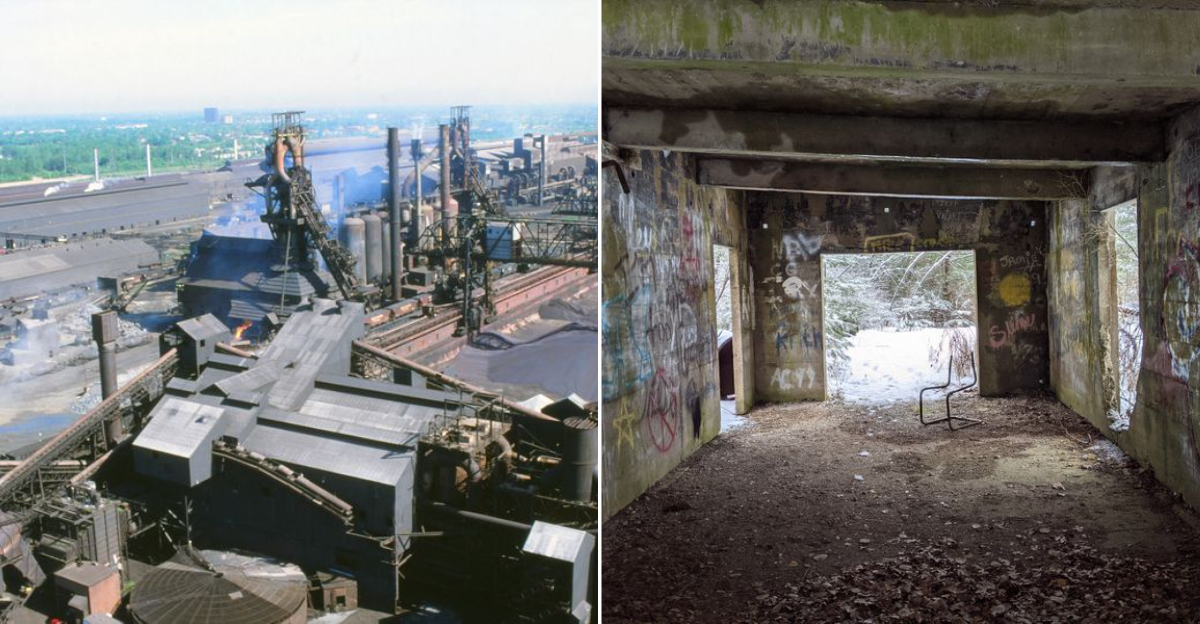
Michigan’s factories once roared with the sounds of progress, shaping cars, steel, and cement for a growing nation.
Today, many of those same industrial giants sit silent, their walls cracked and machinery rusted, as nature slowly takes back the spaces people abandoned.
Walking through these forgotten sites feels like stepping into another world—trees pierce factory floors, vines climb smokestacks, and wildlife moves in where workers once labored.
These ten abandoned factories tell a hauntingly beautiful story of resilience, where industry fades but nature never stops.
1. Packard Automotive Plant: Detroit’s Weathered Giant
Last summer, I wandered through the Packard Plant’s labyrinthine remains and nearly jumped out of my skin when a falcon swooped from a collapsed ceiling beam! Built in 1903, this 3.5-million-square-foot behemoth once churned out luxury automobiles but has spent more years abandoned than operational.
Maple saplings now punch through the factory floor like determined fists, while birch trees sway from rooftop soil deposits. The concrete walls, cracked by decades of Michigan freeze-thaw cycles, provide perfect homes for colonies of bats and nesting birds.
Moss carpets spread across the factory floor, creating an oddly peaceful atmosphere in this industrial graveyard. Mother Nature doesn’t waste time with demolition permits—she simply sends her green army to reclaim what was briefly borrowed from her domain.
2. Marlborough Cement Factory: The Forgotten Silent Giant
Stumbling upon the Marlborough Cement Factory feels like discovering a lost civilization. I remember my boots crunching through a carpet of autumn leaves that completely obscured what was once a spotless factory floor. This massive complex, abandoned since the 1960s, has surrendered to an army of determined plant life.
Towering silos now serve as vertical gardens where ivy climbs relentlessly toward the sky. The old kiln building houses a surprising array of wildlife—I counted three deer families making their home among the rusted equipment during my visit!
What struck me most was how the limestone dust, once considered an industrial nuisance, now forms a unique alkaline soil that supports rare wildflower varieties found nowhere else in the region. Nature doesn’t just reclaim—she improves and innovates.
3. Fisher Body Plant 21: Where Nature Covers An Auto Legacy
“Holy smokes!” I gasped when I first glimpsed the six-story Fisher Body Plant through a curtain of virginia creeper. This automotive giant once produced bodies for Cadillacs and Buicks before closing in the 1990s. Now it’s nature’s playground!
The assembly line where workers once installed dashboards has become a linear forest of birch trees, their white bark gleaming against the factory’s dark interior. Rainwater pools in the basement have created miniature ecosystems complete with frogs and insects that echo throughout the cavernous space.
My favorite spot is the old paint room where multicolored wildflowers now grow in bizarre patterns, seemingly influenced by chemicals that leached into the soil. Talk about turning pollution into beauty! The factory’s broken windows function as perfect frames for photographing the contrast between industrial decay and natural rebirth.
4. McLouth Steel: A Legacy Of Steel And Rust
Venturing into McLouth Steel feels like stepping onto another planet where rust is the primary color. Boy, did I underestimate the power of Michigan’s persistent rain when I visited! Once employing thousands and producing steel for America’s automotive industry, this massive complex now hosts nature’s most determined cleanup crew.
Rust-colored water trickles from abandoned machinery, creating surreal orange streams where specialized algae thrive. The strangest sight? A family of foxes has dug a den beneath an overturned smelting pot, turning industrial waste into cozy real estate!
Throughout the complex, metal structures bend under the weight of climbing vines that seem to possess supernatural strength. The administration building’s roof has collapsed, allowing a perfect circle of sunlight to nurture a thriving garden of volunteer maple trees in what was once the main office. Nature’s boardroom takeover is complete!
5. Ardis Furnace: Abandoned Industrial Site
Snowshoeing through Michigan’s Upper Peninsula last winter led me to the haunting remains of Ardis Furnace. The iron-processing facility’s stone walls peeked through snowdrifts like the spine of some prehistoric creature. Abandoned in 1911 after a brief operational life, this remote site has spent over a century returning to the wilderness.
Massive pine trees now grow directly through what remains of the furnace structure, their roots wrapping around century-old bricks like octopus tentacles. During spring thaws, the old cooling channels become streams that host native trout, creating an accidental conservation area.
The furnace’s chimney has become home to several generations of peregrine falcons who hunt in the surrounding forest. Iron oxide from the facility has stained nearby soil a deep red, creating a striking backdrop for the vibrant green moss that blankets every surface like nature’s version of industrial carpeting.
6. Carp River Forge: Wilderness Swallows The Ironworks
“You’ve got to be kidding me!” I exclaimed when my GPS insisted I’d reached Carp River Forge. What historical records described as a major 19th-century ironworks appeared to be nothing more than a peaceful forest glade. This early Michigan industrial site, abandoned before the Civil War, demonstrates nature’s complete victory over human enterprise.
Only by crouching down could I spot the foundation stones, now serving as anchors for towering maple trees whose roots have shattered and rearranged the original layout. The river that once powered the forge has reclaimed its natural course, erasing the man-made channel that diverted its waters.
Wildflowers carpet the former industrial yard in spectacular seasonal displays, completely unaware of the site’s smoky past. The only hint of human presence is an occasional square-cut stone peeking through leaf litter—silent witnesses to Michigan’s earliest industrial ambitions, now just footnotes in the forest’s story.
7. Schoolcraft Furnace: The Forest’s Industrial Artifact
My hiking buddy bet me five bucks I couldn’t find the Schoolcraft Furnace without a guide. He lost that bet, but just barely! This 1840s iron-smelting operation in Michigan’s western forests lasted barely two decades before economic troubles shut it down. Now it’s a mysterious ruin that makes you question whether industry ever existed here at all.
The main furnace stack remains surprisingly intact, though completely engulfed by a curtain of trumpet vine whose orange flowers attract hummingbirds by the dozen. Black bears regularly den in the collapsed ore storage buildings during winter months, leaving behind distinctive claw marks on the remaining timbers.
What fascinates me most is how the forest floor has risen nearly two feet since abandonment, partially burying the lower sections of the furnace. Each year, another layer of leaves decomposes, slowly entombing this industrial relic under nature’s patient burial process—archaeology happening in real time.
8. J.J. Deal & Son Carriage Factory: Jonesville’s Verdant Time Capsule
Getting permission to photograph inside the J.J. Deal Factory felt like winning the lottery! This carriage manufacturer, which later attempted to transition to automobile production, stands as a red-brick monument to early transportation manufacturing in Jonesville. The moment I stepped inside, I was greeted by a startling carpet of ferns that have colonized the wooden floors.
Sunlight streams through broken windows, creating perfect growing conditions for the indoor forest that now occupies what was once an assembly area. Squirrels have established elaborate nests in the rafters, using scraps of century-old upholstery materials still present from the factory’s operational days.
The most magical element is the old elevator shaft, now functioning as a natural chimney that draws seeds upward on air currents. This has created a vertical garden of plant life growing from each landing, with different species thriving at different heights based on available light. Mother Nature: the world’s most innovative architect!
9. Lansing Metal Center: Auto Parts Buried Under Prairie Rebirth
The sprawling Lansing Metal Center parking lot gave me a serious case of the willies as dusk approached. Closed in 2006 after 65 years stamping out auto parts, this General Motors facility represents a more recent industrial abandonment. Unlike century-old ruins, this modern factory demonstrates how quickly nature begins reclamation when humans step away.
The massive parking lot, once home to hundreds of employee vehicles, now features an impressive collection of cracks where determined grasses push skyward. These fractures form a fascinating spiderweb pattern visible from above—nature’s artistic statement about impermanence.
Inside the partially collapsed structure, rainwater has created seasonal ponds that attract migratory birds who seem completely unbothered by the building’s industrial past. The loading dock areas have become perfect deer bedding grounds, protected from predators and weather by the remaining roof sections. Even recent ruins become wildlife sanctuaries with remarkable speed!
10. Henry Rowe Manufacturing Company: Textile Mill Turned Woodland Cathedral
Discovering the Henry Rowe textile mill required serious detective work and a willingness to wade through knee-high undergrowth. Established in 1880 and abandoned during the Great Depression, this once-bustling factory produced work clothes for Michigan’s industrial workforce. Now it produces nothing but wonder for explorers like me!
The mill’s distinctive sawtooth roof has partially collapsed, creating alternating patches of sunlight and shadow that fall across the production floor like a natural light show. These varied lighting conditions have created distinct microhabitats—sun-loving sumac thrives in bright spots while mushrooms form fairy rings in perpetually shaded corners.
Water damage has caused the wooden floors to warp dramatically, creating an undulating landscape that resembles natural topography rather than human construction. The loveliest surprise? A family of barn owls nesting in the old clock tower, their ghostly white forms visible at dusk as they prepare for nightly hunts through the property’s thriving meadow ecosystem.