
11 Abandoned Ghost Towns In Kansas That Still Hold Stories Of The Past
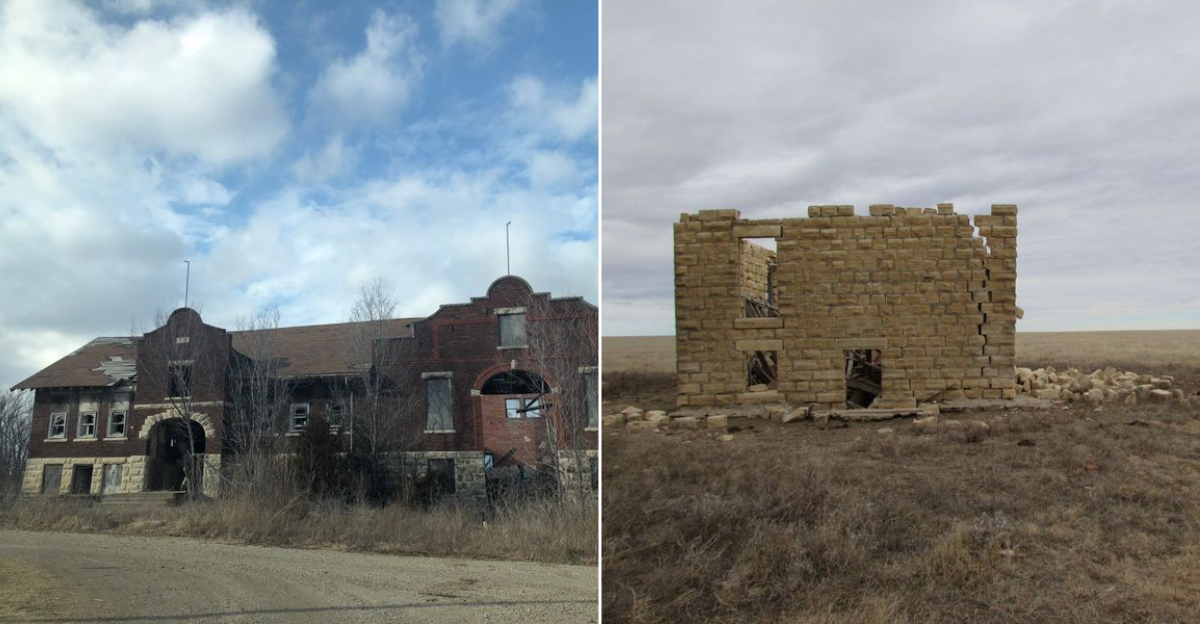
I remember driving through Kansas on a cross-country trip, the horizon stretching endlessly in every direction, golden fields shimmering under the sun. I couldn’t help but wonder what stories hid beneath all that open land—what pieces of history time had quietly covered up.
As it turns out, Kansas is scattered with ghost towns, haunting reminders of ambition and loss.
Once-bustling communities built on dreams of railroads, farming, and fortune now sit silent, their wooden structures weathered by wind and memory. Each one has a tale to tell. So buckle up—we’re heading into twelve forgotten corners of the Sunflower State.
1. Sibley, Kansas (Cloud County)
Founded back in 1869, Sibley had big dreams of becoming the county seat.
Imagine the excitement when settlers arrived, building homes and businesses with high hopes for the future. But when the county seat competition went to another town, Sibley’s fate was sealed.
The residents slowly drifted away, chasing opportunities elsewhere. Today, the land serves as private farmland, and you won’t find much evidence that a bustling town once stood there. It’s a powerful reminder that sometimes one decision can determine whether a community thrives or vanishes into history.
2. Le Hunt, Kansas (Montgomery County)
Le Hunt sprang to life in 1905 as a company town surrounding the United Kansas Portland Cement Company.
Workers and their families moved in, building a community around the promise of steady industrial work. But the cement venture failed within a decade, leaving everyone scrambling for new livelihoods.
Walking through Le Hunt today feels like stepping onto a movie set. The old smokestack still reaches toward the sky, surrounded by crumbling factory walls, empty houses, and a quiet cemetery. It’s a striking example of how industry could create entire towns—and just as quickly abandon them when profits dried up.
3. Vine Creek, Kansas (Ottawa County)
Vine Creek earned its place on the map when the railroad came through and a post office opened in 1879.
For decades, it served as a vital stop where trains brought mail, supplies, and news from the outside world. Residents built their lives around that railroad connection.
But when the trains stopped coming regularly and the post office closed in 1932, Vine Creek’s purpose evaporated. Today, barely anything marks where the town once stood. It’s a textbook case of how railroad routes determined which Kansas towns survived and which became whispers on the wind, forgotten except by historians and curious explorers.
4. Cofachique, Kansas (Allen County)
Cofachique holds a special place in Kansas history as the original county seat of Allen County, founded way back in 1855.
Settlers built stores, established a sawmill, and created what looked like a permanent community. For a brief moment, Cofachique was the center of local government and commerce.
Then everything changed almost overnight. By 1859, the post office relocated, residents packed up, and the town essentially vanished like morning mist. It’s wild to think an entire county seat could disappear so quickly, but Cofachique proves that frontier towns lived or died by the thinnest margins.
5. Chicago, Kansas (Sheridan County)
Yes, Kansas had its own Chicago, though this version was considerably smaller than its Illinois namesake! Established around 1880, this Chicago served as a post office, stage stop, and general store for travelers crossing the plains. Life here revolved around serving people passing through rather than permanent settlement.
The post office shut down in 1887, barely seven years after opening. Today, you’ll find an abandoned schoolhouse standing sentinel over the prairie, plus a rusty sign and home foundation. Chicago, Kansas reminds us that some towns existed for incredibly brief moments, serving specific purposes before fading when those needs disappeared.
6. Diamond Springs, Kansas (Morris County)
Diamond Springs started as an oasis along the famous Santa Fe Trail back in 1825, offering weary travelers fresh water and rest. Wagon trains would stop here, grateful for the natural spring that gave the place its name. For years, it thrived as a crucial waypoint on the journey west.
But when trail traffic slowed and a stage station suffered a violent robbery, Diamond Springs lost its purpose.
Today, only a monument and scattered remnants mark where countless pioneers once rested. Standing there, you can almost hear the creaking wagon wheels and imagine the relief travelers felt upon reaching this vital stop.
7. Bushong, Kansas (Lyon County)
Bushong managed to hang on longer than most ghost towns, maintaining a post office from 1887 all the way to 1976.
But recent years have seen dramatic decline, with an enormous empty high school building and collapsed gymnasium standing as monuments to better days. The scale of abandonment is genuinely haunting.
While a few hardy souls still remain, Bushong exemplifies how modern economic shifts can drain even long-established communities. Walking past that massive, empty school building—once filled with children’s laughter and Friday night basketball games—hits differently than exploring a town that died a century ago. Progress doesn’t always move forward for everyone.
8. Silkville, Kansas (Franklin County)
Ever heard of a utopian silk-farming commune in Kansas? Silkville was exactly that—a collective settlement founded in 1870 by French immigrant Ernest Valeton de Boissiere. He envisioned a perfect society where everyone worked together raising silkworms and producing silk fabric. Members shared labor, profits, and an idealistic vision of communal living.
Spoiler alert: silk farming in Kansas proved challenging, and the commune dissolved after Boissiere’s death. The grand experiment ended, and Silkville became another Kansas ghost town. It’s a fascinating reminder that Kansas attracted all kinds of dreamers, from gold prospectors to utopian philosophers, and the prairie holds their stories still.
9. Richland, Kansas (Chautauqua County)
Richland rode the oil boom wave in the early 1900s when petroleum was discovered in southeastern Kansas. Suddenly, this sleepy area transformed into a bustling town full of roughnecks, businessmen, and families chasing black gold. The population swelled, buildings went up quickly, and money flowed freely through local establishments.
But oil booms eventually bust, and Richland followed the familiar pattern. When the wells dried up and companies moved on, so did the people.
Today, Richland stands mostly empty, a testament to how natural resource extraction can create and destroy communities with equal speed. The buildings remain, but the energy is long gone.
10. Skiddy, Kansas (Morris County)
Skiddy’s story is quieter than gold hoaxes or oil booms—it simply represents hundreds of small Kansas towns that slowly faded as farming mechanized and young people left for cities.
Founded in the late 1800s, Skiddy had the usual small-town amenities: a school, grain elevator, post office, and tight-knit community.
But as agriculture required fewer hands and modern life pulled people toward urban centers, Skiddy’s population dwindled. Buildings deteriorated, businesses closed, and eventually the town crossed that invisible line from struggling to abandoned. Skiddy matters because it represents the slow, quiet death of rural America—less dramatic than a mining hoax, but perhaps more poignant.
11. Hoge, Kansas (Ness County)
Way out in Ness County, Hoge represents the most remote and forgotten type of Kansas ghost town.
Established in the late 1800s during homesteading days, it never grew particularly large. Families claimed their 160 acres, built simple homes, and tried to scratch out livings from the challenging western Kansas soil.
Harsh weather, isolation, and economic hardship eventually drove most settlers away. Today, Hoge is barely a memory—you’d have trouble finding it even with GPS. Yet it matters because countless tiny settlements like Hoge dotted the Kansas landscape, representing ordinary people’s extraordinary courage to build lives in an unforgiving environment.