
8 Abandoned Ghost Towns In Kentucky That Still Hold Echoes Of The Past
I first learned to listen for history on a foggy morning when my granddad parked beside a collapsed foundation and said, “Put your ear to the bricks.” I did, and I swear the past hummed back at me like cicadas tuning up for summer, steady and undeniable.
Since then, I’ve chased that same music across Kentucky, wandering through towns where empty streets still whisper names, errands, and half-forgotten routines.
These quiet places don’t ask for attention—they offer it, gently. Come with me as we explore eight vanished spots that trade stoplights for storylight and leave you grinning at every echo they share.
1. Blue Heron (Mine 18) – McCreary County
Steam seems to linger here even when the air is cool, as if the last shift just clocked out and forgot to turn off the atmosphere. I step onto the steel ghost structures and it feels like tracing constellations with my boots, each frame a star in the old company sky.
The recorded voices crackle with grit and grace, and I catch myself nodding along like a rookie on the line. Walkways pull you through the tipple, store, school, and stories while the river keeps steady time. On select days a heritage train rumbles by like memory on rails and the whole gorge answers.
I always pause to thank the signage for translating the past into present tense. This open air museum is less a replica and more a reunion. Stand here long enough and the rhythm of work turns into a chorus of ordinary courage, ringing clear as coal on metal.
2. Barthell Coal Camp – Near Stearns, McCreary County
The road into Barthell curls like a question mark, and I love the answer it gives. Restored company houses sit shoulder to shoulder, tidy as lunch pails lined on a bench, and suddenly the century between us feels like a quick coffee break.
A guide points out the tipple site and bathhouse while I grin at the museum exhibits that put names to callused hands. Humor sneaks in with a miner’s sign that reads in effect Please return the daylight. Lodging here turns the evening into a living time capsule where crickets handle the soundtrack.
Walk slow and the narrow hollow stretches wider with context. I always imagine kids racing tin can cars along these boards and winning by a nose. Barthell teaches gently that isolation forged community, and that workdays ended not with silence but with supper, stories, and small victories stacked like coal.
3. Paradise – Muhlenberg County
The word Paradise arrives with a wink here, because the town itself pulled a vanishing act that would make a magician jealous. I climb the hilltop cemetery and the view spreads like an old map, streets erased but still stubborn in the mind’s eye.
Stones whisper surnames that used to echo from front porches, and I catch a tune carried by the wind that might just be memory rehearsing. TVA’s buyout swept the buildings away, yet stories root deeper than any foundation.
Locals point to hidden traces and I nod like I can see the sidewalks clicking back into place. The nearby plant hums a present-tense counterpoint, modern and mechanical. I leave a quiet thank you for the folks who documented everything before the curtain fell. Paradise teaches that absence can be articulate, and sometimes the clearest landmark is a lyric that refuses to fade.
4. Golden Pond – Trigg County (Land Between the Lakes)
Sunlight pools on the pavement at Golden Pond Visitor Center like a wink from the old town that once warmed this spot. I read the marker and feel the ground perk up with stories of timber crews, farms, and a certain reputation for crafty ingenuity.
The relocation era left tidy paperwork and untidy hearts, yet the ridge breezes still carry neighborly hellos. Overlooks trace invisible streets while my boots try their best to color inside former lines. I meet a ranger who turns facts into friendly campfire sparks and suddenly the past feels within handshake distance.
The gift shop sells maps that function like treasure for memory hunters. Trails feather out between lakes where roads used to run. Golden Pond proves that a name can outlast a mailbox, and that communities can reassemble themselves in the mind with surprising clarity and a grin.
5. Bells Mines – Crittenden and Union Counties
The forest here wears history like a subtle cologne, and you only notice it when the breeze tilts just right. I follow a faint roadbed through Big Rivers WMA where coal once choreographed a riverfront hustle. The cemetery appears like a chorus waiting in the wings, names arranged with solemn rhythm and generous patience.
Birdsong supplies the soundtrack while my steps tap out a gentle beat. Traces of foundations surface like shy turtles, then slip back into leaf litter. I imagine company whistles swapping shifts with owls at dusk, both punctual and proud.
Hunters pass by with nods that double as museum tickets to the outdoors. The Ohio River glints through the trees, stage light for a quiet encore. Bells Mines applauds softly from the understory, reminding me that towns can retire without retiring their character, and that exploration rewards attention more than speed.
6. Creelsboro – Russell County
A river town knows how to tell a story, and Creelsboro still talks with confident vowels. I roll up to the country store where the porch creaks like a friendly handshake and the coffee smells like continuity.
Once the Cumberland bustled with steamboats, now the highway hums elsewhere, but the past refuses to pack its bags. A few homes and relics keep the beat while Rockhouse Arch turns geology into a marquee. Anglers trade tips that double as history lessons and I scribble notes like a diligent understudy.
The river access feels like a backstage pass to yesterday’s main street. Even the postcards seem eager to gossip. Creelsboro shows how a place can shrink on paper yet expand in personality, with every corner offering a wink and a breadcrumb. Follow both and you will leave smiling at how a port still welcomes without a dock.
7. Airdrie – Muhlenberg County
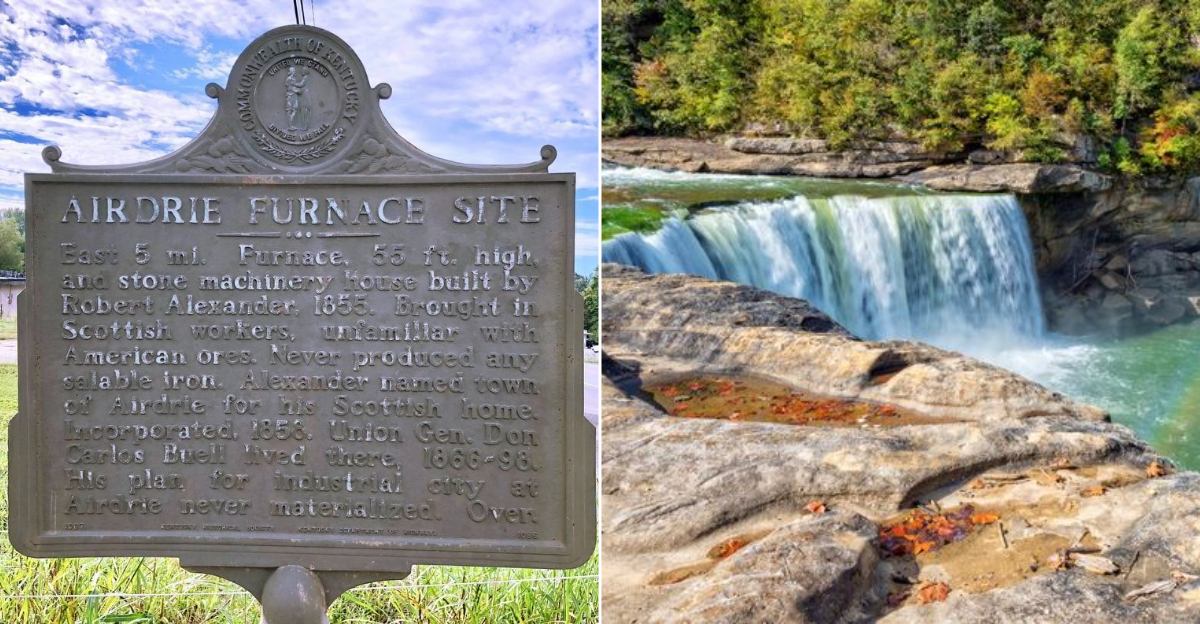
The furnace rises from the woods like a stone sermon, and I find a front row seat made of moss. Airdrie dreamed in iron with Scottish swagger, then woke to the economics of reality, leaving the stack to argue handsomely with time.
I run my fingers along chisel marks and hear a workshop of accents planning a future that arrived unfashionably late. Trails circle the ruins in a respectful hush while birds improvise above the tall arch. A marker fills in the plot points with elegant restraint.
Sunlight paints the masonry in warm notes that feel both earnest and optimistic. I picture wheelbarrows squeaking, sparks juggling, conversations bargaining with stubborn ore. Airdrie teaches that ambition is a great storyteller even when the ledger disagrees. The result is a ruin that stands like a thesis on grit and a quiet invitation to keep imagining.
8. Birmingham – Under Kentucky Lake, Marshall County
The lake looks calm but it is a library, and Birmingham is one of its best kept volumes. I stand at Birmingham Point watching the water flicker like pages, each glint a footstep on a vanished street. When levels drop you can sometimes spy shapes teasing the surface, foundations playing peekaboo with the shoreline.
Locals share photos that act like periscopes into the past, and I nod through every story like an eager diver. Boats drift above former front yards with unhurried grace. I like to imagine mail routes continuing underwater, envelopes addressed to memory.
The dam changed the map, but the town lingers in conversations and family albums. Birmingham proves that a place can move from land to legend without losing its zip code in our hearts, and that quiet water can echo just as loudly as brick.