
8 Deserted Ghost Towns In Virginia That History Buffs Can’t Resist Exploring
I’ve always been fascinated by places where time seems to hold its breath, where the wind carries faint whispers of what once was.
Virginia is full of these echoes—ghost towns that linger like half-remembered stories scattered across hills, forests, and riverbanks. Each one opens a doorway into a forgotten era, from old colonial ports to mining outposts that once pulsed with ambition.
Exploring them feels like paging through a living history book, the kind written in weathered wood and rusted iron, where every creak and crumble reminds you that the past never really disappears—it just waits to be found.
1. Matildaville — Great Falls Park (Fairfax County)
Picture George Washington himself investing in a canal project that would birth an entire town.
Matildaville came to life in the 1790s as headquarters for the Patowmack Company, a bold engineering venture designed to bypass the roaring falls on the Potomac River. Named after the company manager’s wife, Matilda Lee, the settlement housed workers, their families, and the dreamers who believed they could tame the wild river.
Today, you can wander the River Trail inside Great Falls Park and stumble upon stone ruins that tell stories of ambition and heartbreak. The National Park Service maintains the site, making it accessible for anyone curious about early American infrastructure. Foundations peek through the forest floor like secrets waiting to be discovered.
2. Union Level — Mecklenburg County (near South Hill)
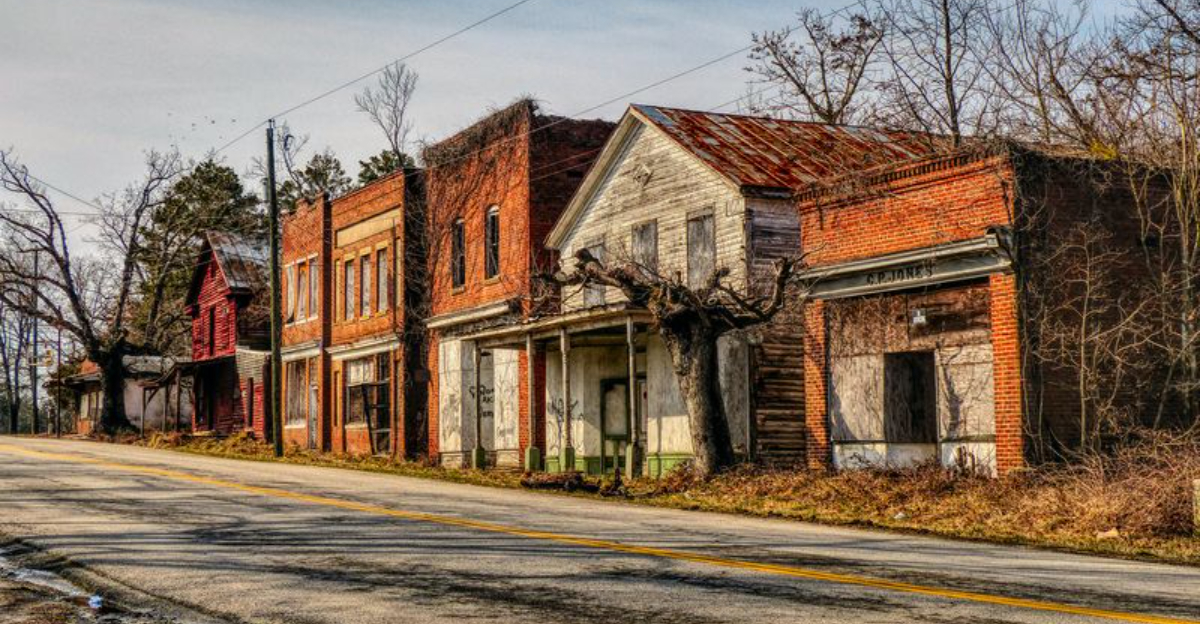
Driving past Union Level feels like flipping through a sepia-toned photo album at highway speed. This authentic main-street ghost town still shows off rows of abandoned storefronts that once bustled with tobacco traders and farmers stocking up on supplies.
Virginia Tourism recognizes it as a visitable historic site, though Mother Nature and time have been less than gentle with some structures.
What makes Union Level particularly haunting is how visible it remains from the road, a stark reminder that prosperity can vanish faster than morning fog. Some buildings have faced demolition, but enough remain to paint a picture of rural Virginia commerce in its heyday. It’s the kind of place that makes you slow down and wonder about the families who called it home.
3. Wash Woods — False Cape State Park (Virginia Beach)
Getting to Wash Woods requires commitment, which somehow makes the journey more rewarding. This coastal ghost hamlet hides within False Cape State Park, accessible only by hiking or biking several miles through stunning maritime wilderness.
Once a thriving fishing and hunting community, Wash Woods eventually surrendered to isolation and the relentless Atlantic storms that reshaped the barrier islands.
The old cemetery still stands as a poignant memorial, with weathered headstones marking lives lived at the edge of land and sea. Church steeple remains pierce the sky like a skeletal finger pointing toward heaven. Virginia’s Department of Conservation and Recreation protects what’s left, ensuring future generations can experience this hauntingly beautiful slice of coastal history.
4. Lignite — Jefferson National Forest (Botetourt County)
Lignite vanished so completely that you might walk right past it without realizing a whole community once existed beneath your boots.
This former mining town sprang up to extract lignite, a low-grade coal that promised fortune but delivered mostly hardship. Company housing, stores, and all the infrastructure of industrial life dotted these Botetourt County woods until the mines closed and everyone scattered.
Now the Jefferson National Forest has reclaimed the land, with only scattered foundations and lonely chimneys marking where families cooked meals and children played. Nature’s takeover feels almost intentional, as if the forest is healing itself after the brief human interruption. Exploring here requires sharp eyes and a good sense of direction, but the solitude rewards those who make the effort.
5. Ca Ira — Cumberland County (Grace Episcopal Church site)
Ca Ira wears its French Revolutionary name like a badge of optimism that never quite paid off. This tobacco-trade village thrived when Virginia’s economy ran on golden leaf and river commerce, but progress chose different routes and left Ca Ira behind. The settlement faded slowly, families moving on as opportunities dried up like tobacco in a curing barn.
Grace Episcopal Church, built in the 1840s, stands as the primary survivor of this lost community. The Virginia Department of Historic Resources lists it officially, recognizing its architectural and cultural significance.
Walking around the church grounds, you can almost see phantom congregations gathering for Sunday services, their voices rising in hymns that once filled these now-silent fields with hope and faith.
6. Colchester / Old Colchester — Mason Neck (Fairfax County)
Colchester once rivaled Alexandria as a bustling colonial port, with ships loading tobacco bound for England and unloading goods that colonists craved.
Founded in the 1750s, the town seemed destined for greatness, positioned perfectly where Occoquan Creek meets the Potomac River. But silting problems and shifting trade routes gradually strangled the port, and by the 1800s, Colchester had slipped into obscurity.
Fairfax County now protects the site through Old Colchester Park and Preserve, where markers guide visitors through the ghostly town layout. Ongoing archaeological digs keep revealing artifacts that connect us to colonial daily life. It’s a place where you can literally stand on history, imagining merchant ships and colonial traders haggling over prices in a world that feels impossibly distant yet surprisingly familiar.
7. Joplin (and nearby vanished communities) — Prince William Forest Park
Joplin didn’t die naturally; it was erased deliberately when the federal government created Prince William Forest Park in the 1930s.
Small settlements like Joplin, Hickory Ridge, and Batestown were home to families who farmed, logged, and lived modestly in these Virginia woods. The Civilian Conservation Corps moved them out, razed their homes, and let the forest reclaim what had been cleared generations before.
Today, the National Park Service acknowledges this complicated history through trails and interpretive materials that highlight what remains. Foundations, old roads, and cemetery plots peek through the undergrowth like memories refusing to fade completely. Walking these trails feels bittersweet, knowing that conservation’s gain was these communities’ loss, a reminder that progress always costs someone something.
8. Falling Creek Ironworks — Chesterfield County (near Richmond)
Falling Creek Ironworks holds the distinction of being the first ironworks in English North America, fired up in 1619 with dreams of industrial might. The settlement promised to make Virginia self-sufficient in iron production, freeing colonists from expensive imports.
But tragedy struck during the 1622 Powhatan uprising, when the works were destroyed and most inhabitants passed away, ending the venture almost before it began.
Now an archaeological park with informative signage marks where this pioneering industrial village once stood. Chesterfield County has preserved the site, allowing visitors to contemplate how a single violent day can erase years of labor and ambition. Standing there, you’re touching the very beginning of American industry, a ghost town that barely got to live before becoming history’s footnote.