
11 Famous Dishes In New York That Started In Surprisingly Small Places
New York has a talent for making food famous before the rest of the world even realizes what happened.
Think about it, some of the state’s most recognizable dishes didn’t come from fancy restaurants, celebrity chefs, or a room full of people debating whether a plate needs “more texture.”
They came from surprisingly small places, and somehow became absolute icons.
A neighborhood pizza shop creates a style, a local kitchen puts together a wildly chaotic pile of comfort food, and suddenly people are willing to cross the state just to get the real thing. How does that happen?
Honestly, we’re not complaining. New York has always been a little allergic to doing things the normal way, and its food is no exception.
So forget the polished culinary fairy tales. These dishes prove that sometimes, all you need is a tiny place, a good idea, and enough New Yorkers willing to say, “No, trust me. You have to try this.”
1. Buffalo Wings

Before Buffalo wings became a Super Bowl staple and a bar menu must-have, they were basically a happy accident inside a small neighborhood bar.
The year was 1964, and the Anchor Bar in Buffalo, New York, was the unlikely birthplace of one of America’s most beloved dishes. Co-owner Teressa Bellissimo had a batch of chicken wings on hand, the kind usually tossed into soup stock without a second thought.
Instead of wasting them, she fried them up and tossed them in a spicy, buttery sauce. Her son Dominic and his friends were hungry, the wings were ready, and the rest is genuinely legendary food history.
They were served alongside blue cheese dressing and celery sticks, a combo that has never changed because it has never needed to.
What started as a late-night snack for a small group of people in a modest Buffalo bar eventually conquered every sports bar, restaurant, and freezer aisle across the country.
The Anchor Bar still stands today and still serves the original recipe. Buffalo wings prove that the best ideas often come from necessity, not planning.
2. Garbage Plate

The name alone stops people in their tracks, and honestly, that is exactly the point. The Garbage Plate is Rochester’s most chaotic, most satisfying, and most misunderstood contribution to American food culture.
It started in 1918 when a Greek immigrant named Alexander Tahou opened a tiny spot called “Hots and Potatoes” in Rochester, New York.
The dish was simple by design: hearty, filling, and built for people who needed real fuel. Over time, his son Nick took over the restaurant, eventually renaming it Nick Tahou Hots.
The now-iconic name “Garbage Plate” reportedly came from college students in the 1970s or 1980s who pointed at the overflowing dish and asked for “a plate with all that garbage on it.” Nick loved it so much he trademarked the name in 1991.
A traditional plate piles your choice of meat over home fries, french fries, baked beans, or macaroni salad, then drowns it all in a spicy meat hot sauce.
It is unapologetically messy and completely wonderful. Rochester residents treat this dish like a rite of passage, and after one bite, you will absolutely understand why.
3. Chicken Riggies
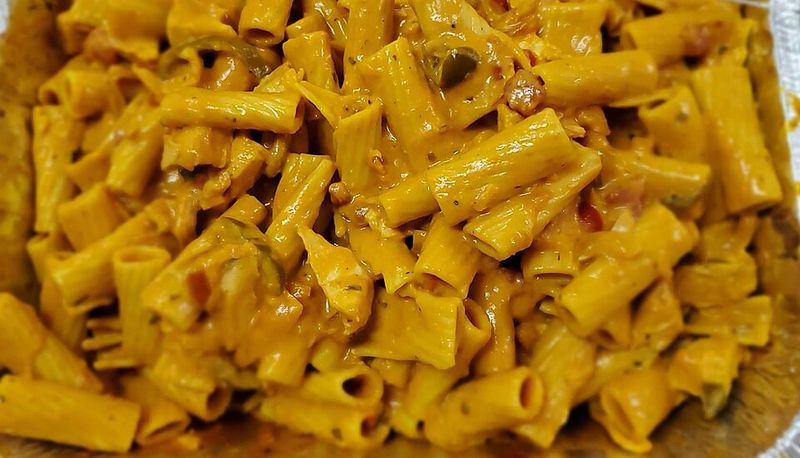
Somewhere between a Sunday gravy and a spicy Italian-American dream, Chicken Riggies was born in the Utica-Rome area of New York in the early 1980s.
The dish brings together rigatoni pasta, juicy chicken, hot or sweet peppers, and a tomato-cream sauce that hits every note at once. “Riggies” is just a playful nickname for rigatoni, which makes the whole thing feel even more charming.
The origin story has a little friendly debate attached to it. Many credit the Chesterfield Restaurant and chef Joe Morelli for making it famous.
Another version points to chef Michael Geno at the Clinton House in 1979, working alongside owners Richie Scamardo and Bobby Hazleton. Wherever it truly started, it spread fast through central New York like a culinary wildfire.
Utica takes this dish seriously enough to host an annual Riggies Fest, where local restaurants compete for the title of best version in the city.
That kind of civic pride around a pasta dish tells you everything. Chicken Riggies is not just regional comfort food.
It is a full-on identity, and Utica wears that identity with complete and total confidence.
4. Utica Greens
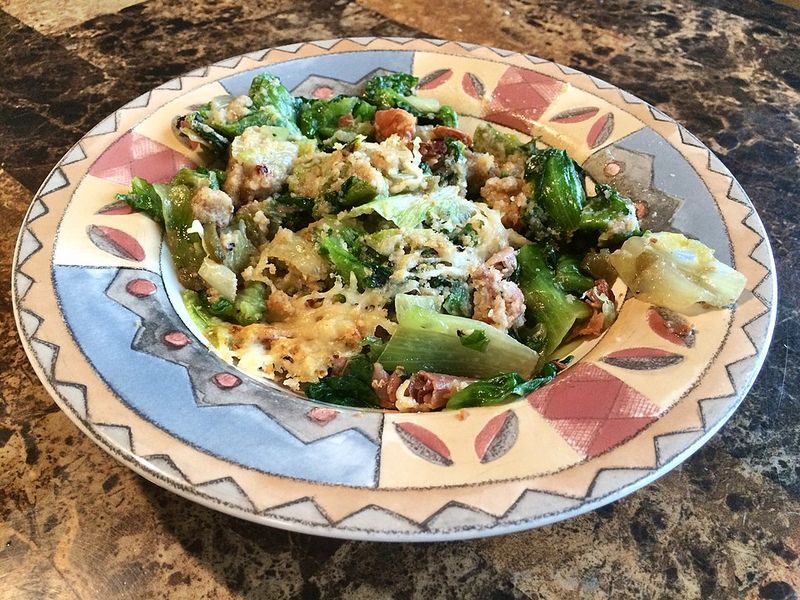
Utica, New York, has a serious talent for turning humble ingredients into something unforgettable. Utica Greens is the perfect example of that.
Built around escarole, a leafy green that most people walk right past in the grocery store, this dish transforms simple produce into something genuinely crave-worthy.
Chef Joe Morelle popularized it at the Chesterfield Restaurant around 1987 or 1988, and the dish quickly earned a devoted following.
Morelle developed his version after encountering an escarole special at Grimaldi’s Restaurant in the early 1980s. He took that inspiration and layered in garlic, olive oil, hot cherry peppers, prosciutto, Pecorino Romano cheese, and breadcrumbs.
The result is bold, savory, and deeply rooted in Sicilian and Southern Italian cooking traditions that immigrants brought to central New York generations ago.
What began as a home-cooked meal, the kind passed down through families without written recipes, eventually became a restaurant staple and a point of regional pride.
You will find Utica Greens on menus across the area, each version slightly different, all of them delicious. This dish is living proof that knowing what to do with a humble green can make you a local legend.
5. Spiedies

If you have never heard of a spiedie, you are not alone, but Binghamton, New York, is ready to change that. Spiedies are marinated cubes of meat, usually lamb, chicken, or pork, grilled on skewers and served on a long bread roll or sliced Italian bread.
The name comes from the Italian word “spiedo,” meaning cooking spit, which tells you exactly where the inspiration originated.
Italian immigrants brought the concept to upstate New York in the early 1900s. Camillo Iacovelli is credited with serving them at his Parkview Restaurant in Endwell in 1938.
His brother Agostino, known as Augie, took the idea further at his Endicott restaurant in 1939. Augie’s original marinade, called “zuzu,” featured wine vinegar, lemon juice, garlic, and fresh mint, a combination that sounds almost too simple to be this good.
Binghamton loves spiedies so much that the city hosts an annual Spiedie Fest and Balloon Rally, drawing huge crowds every year.
The marinade is the real magic here. Families have their own versions, restaurants guard their recipes, and the debate over who makes the best one never really ends.
That is small-town food culture at its absolute finest.
6. Beef On Weck
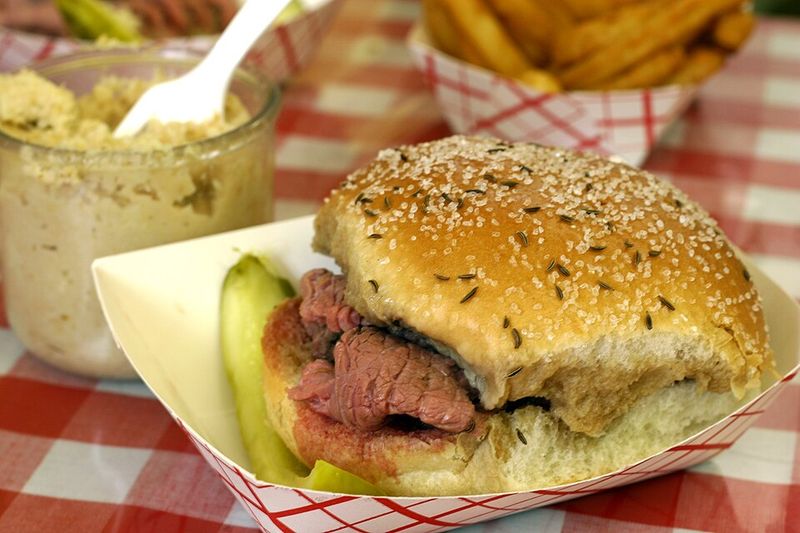
Western New York has a sandwich that outsiders have never heard of and insiders refuse to stop talking about. Beef on Weck is thinly sliced rare roast beef piled onto a kummelweck roll, a soft bun topped with coarse kosher salt and caraway seeds.
The bun often gets dipped in au jus before serving, which turns the whole thing into something close to perfection.
The kummelweck roll itself is believed to have been created by a German baker named William Wahr in Buffalo, possibly inspired by a German roll called Schwabische Seele.
One popular story ties the sandwich’s invention to a saloon owner who used the salty roll to encourage thirsty patrons. Joe Gohn, who ran the Delaware House saloon in Buffalo around 1901, is also credited with popularizing the combination.
Schwabl’s Restaurant in Buffalo, established in 1837, has long been associated with the dish and remains one of the most celebrated spots to try it.
Beef on Weck is served with horseradish on the side, adding a sharp kick that cuts right through the richness of the beef. Buffalo has wings, yes, but locals know this sandwich is just as worthy of the spotlight.
7. Half-Moon Cookies
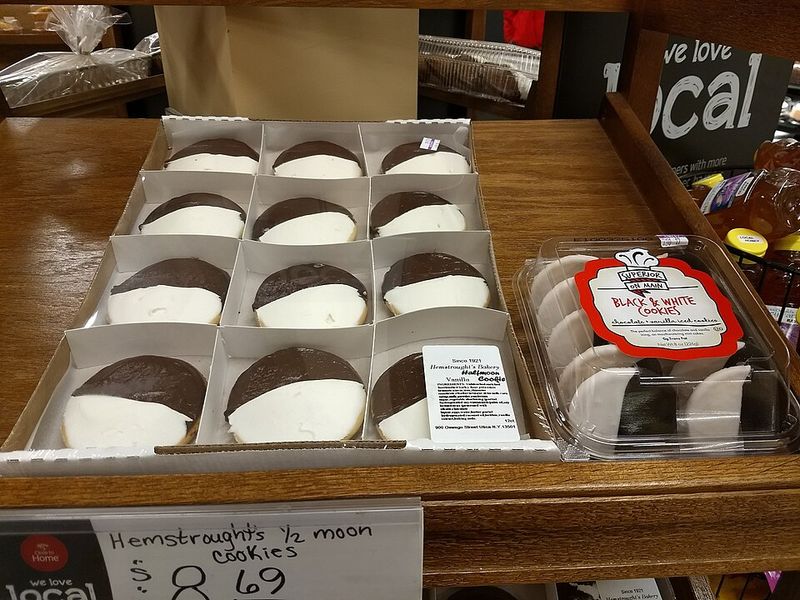
Forget the Black and White cookie for a moment, because Utica has its own version and it is arguably better.
The Half-Moon Cookie was created by Harry B. Hemstrought at his small bakery on Genesee Street in Utica, New York, around 1920 to 1925.
These cookies are soft and fluffy, almost cake-like, and frosted with half vanilla buttercream on one side and half chocolate fudge on the other.
That split frosting is not just a design choice. It is practically a philosophy.
You get two experiences in one bite, and both are excellent. Half-Moon cookies differ from the New York City Black and White cookie, which has a denser base and a glossy fondant-style glaze.
The Utica version is softer, richer, and far more indulgent by comparison.
Hemstrought’s Bakery eventually closed its original location, but the recipe lived on through other Utica bakeries and commercial producers who understood that some things are too good to disappear.
The Half-Moon cookie has become a symbol of Utica’s food identity, the kind of treat that people bring home to family when they visit the city. Once you taste one, you will immediately understand the loyalty.
8. New York-Style Pizza
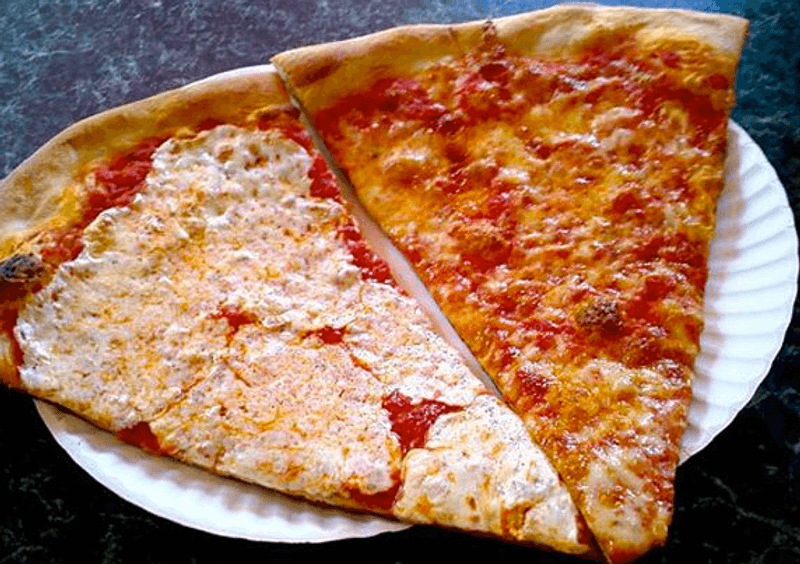
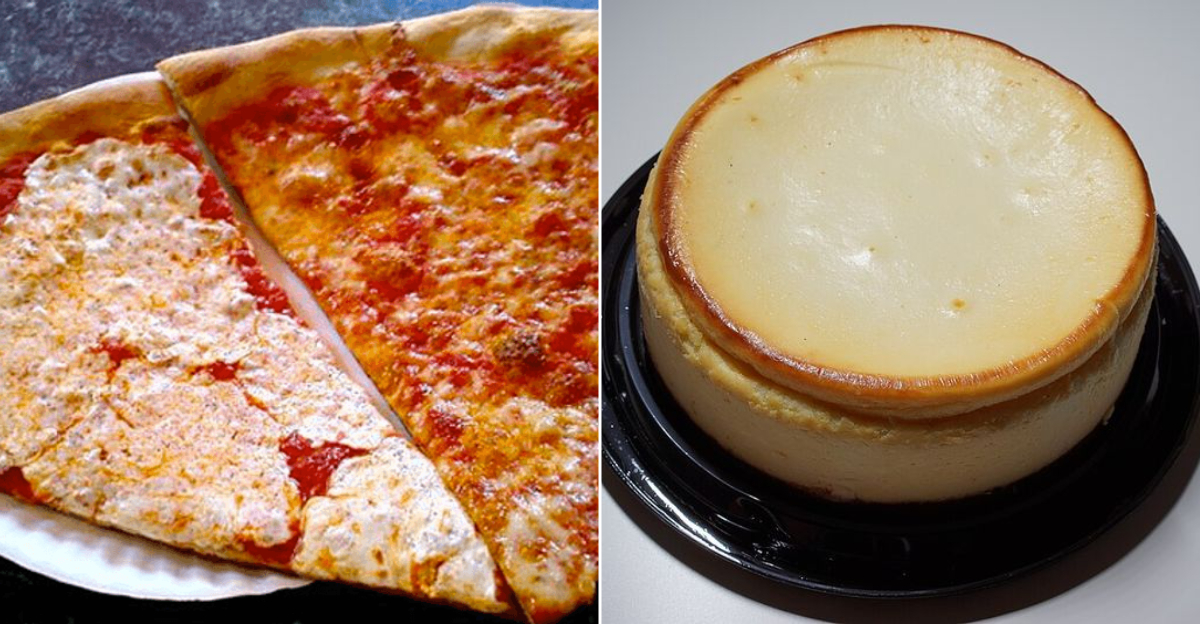
There is a reason people fold their pizza slice in half before taking a bite, and that technique was basically invented on the streets of New York City. New York-style pizza has a large, hand-tossed thin crust that is crispy at the edge but soft and pliable in the middle.
It was built for walking, talking, and eating all at the same time.
The story starts in 1905 when Gennaro Lombardi, a grocer from Naples, opened Lombardi’s in Manhattan’s Little Italy. It is widely recognized as America’s first licensed pizzeria.
Lombardi began selling tomato pies by the slice to local workers, and the style caught on almost immediately. Antonio Totonno Pero, an early Lombardi’s employee, went on to open Totonno’s on Coney Island in 1924, which became the oldest continuously operating pizzeria in the United States.
The use of coal-fired ovens and locally available ingredients helped shape the style into what it is today. Simple toppings, real mozzarella, good sauce, and a crust that holds up under pressure.
New York-style pizza did not need to be complicated. It just needed to be honest, and that honesty is exactly what made it a global icon.
9. Grandma Pizza
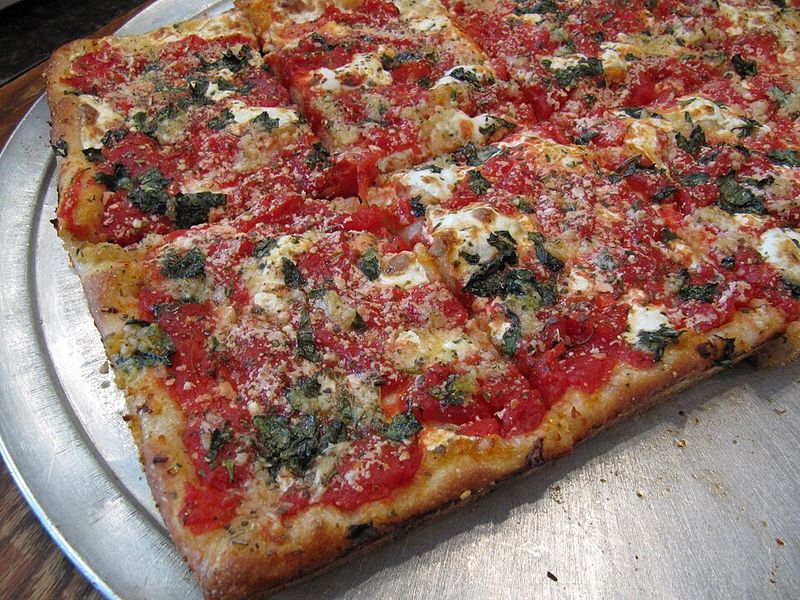
Long Island quietly gave the world one of the most satisfying pizza styles ever made, and it came straight from the home kitchen.
Grandma pizza is a thin, rectangular pizza baked in a sheet pan, with a crispier crust than traditional Sicilian pizza. First-generation Italian-American housewives, immigrants from southern Italy, made these at home using simple ingredients and whatever sheet pans they had on hand.
The homemade origins gave the pizza its name, “grandma pizza” or “pizza alla nonna,” a nod to the women who made it without recipes, without timers, and without any intention of starting a trend.
The style stayed local for years before pizzerias started offering it commercially. Umberto Corteo is credited with introducing Sicilian Grandma pizza at his Long Island pizzerias, Umberto’s in New Hyde Park and King Umberto’s, as early as the late 1970s.
What sets it apart is the cheese-first approach. The mozzarella goes down before the tomato sauce, which creates a uniquely rich, layered flavor.
Garlic, olive oil, and sometimes fresh plum tomatoes finish the whole thing beautifully. Grandma pizza is proof that the most celebrated food traditions often start with someone just trying to feed their family on a regular Tuesday night.
10. Egg Cream
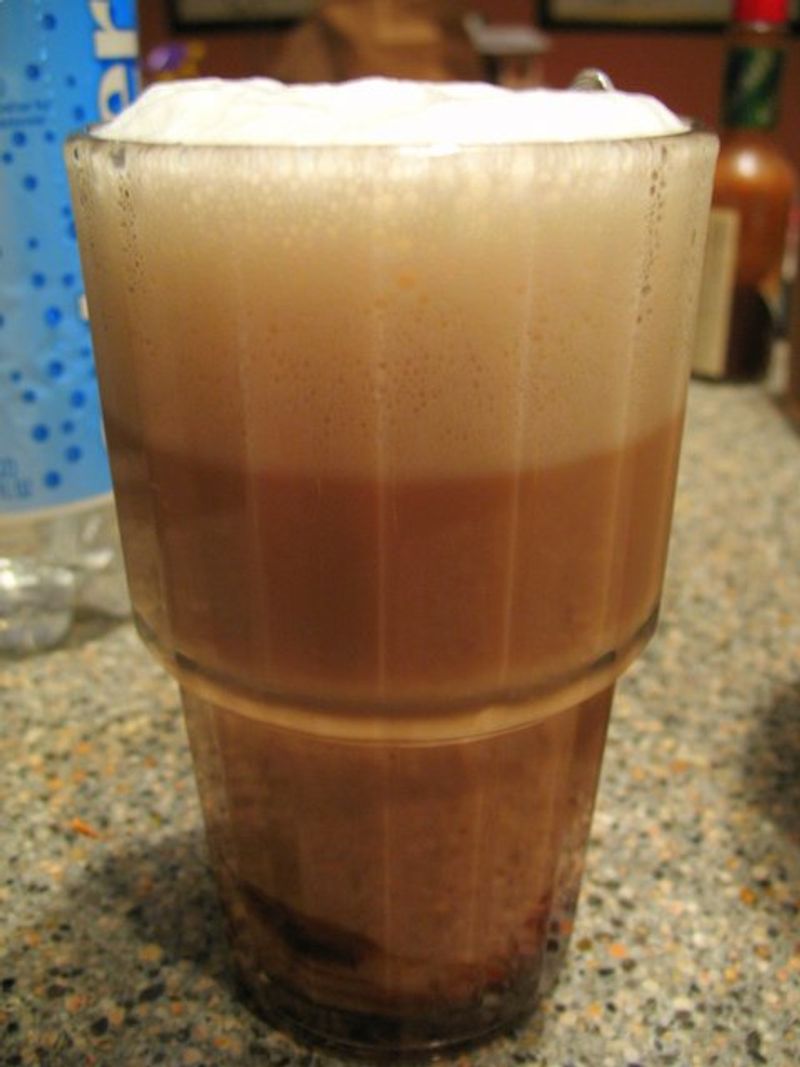
No eggs. No cream.
Just one of the most beloved beverages in New York history. The Egg Cream is a frothy, fizzy drink made from cold milk, Fox’s U-Bet chocolate syrup, and carbonated seltzer water.
The name makes no sense, which somehow makes it even more New York.
The most accepted origin story credits Louis Auster, a Jewish immigrant who ran a candy store in the Lower East Side around the 1890s or early 1900s.
Auster reportedly created the drink as an affordable treat for the immigrant community around him. He developed a secret chocolate syrup recipe that made his version particularly popular.
His stores were reportedly selling thousands of Egg Creams every single day at their peak, which is remarkable for a drink that costs next to nothing to make.
The name itself has a few competing theories. Some say it came from a mispronunciation of the French phrase “chocolat et creme.”
Others suggest it derived from the Yiddish “echt keem,” meaning pure sweetness. Whatever the etymology, the drink endures as a symbol of old New York charm.
Every borough has its loyalists, and the debate over the perfect ratio of syrup to seltzer never truly settles.
That ongoing argument is part of the magic.
11. New York-Style Cheesecake
Rich, dense, and unapologetically indulgent, New York-style cheesecake is in a category entirely its own. The defining feature is the filling: full-fat cream cheese, eggs, and sugar baked into a smooth, velvety texture that holds its shape and melts on contact.
This is not a light dessert. It was never trying to be.
Cream cheese itself was accidentally invented in New York in the late 19th century, when dairyman William Lawrence was attempting to replicate French Neufchatel cheese. That happy accident gave bakers a new ingredient to work with.
Restaurateur Arnold Reuben, known for Reuben’s Restaurant, is widely credited with refining a cheese pie recipe into the baked cream cheese version that became the New York standard, reportedly in the late 1920s or early 1930s.
Lindy’s, a New York restaurant that opened in 1921, became famous for its cheesecake. Junior’s in Brooklyn, established in 1950, cemented the dessert’s legendary status and still draws devoted fans from around the world.
The crust varies, graham cracker, shortbread, sponge cake, but the filling is always the star. So what is your favorite New York dish on this list, and have you tracked down where it actually started?