
9 Forgotten Ghost Towns In Arizona That Are Hauntingly Beautiful
Scattered across the wide Arizona desert, ghost towns lie in quiet ruin, whispering stories of ambition, boom, and inevitable bust from a bygone era. My fascination began years ago on a road trip when I stumbled upon my first abandoned mining settlement.
Weathered wooden storefronts, crumbling saloons, and rusted mining equipment stood frozen in time, offering a haunting glimpse of lives once full of hope.
Ever since, I’ve been captivated by these places where silence speaks louder than words. These nine ghost towns reveal Arizona’s rich mining history while inviting visitors to explore a past that’s eerie, fragile, and strangely beautiful.
1. Vulture City’s Gold Rush Legacy
Gold fever transformed this spot into a bustling hub of 5,000 residents in the 1860s. Walking through Vulture City today feels like stepping into a time machine. The preserved assay office, blacksmith shop, and miners’ quarters stand as silent witnesses to the town’s golden heyday.
I once watched the sunset cast long shadows across these ruins, painting everything in amber hues that mimicked the precious metal that birthed this place. The cemetery on the hill tells stories sadder than fiction.
Despite being abandoned for decades, Vulture City recently reopened for guided tours, allowing visitors to experience the authentic Wild West atmosphere without the Hollywood gloss.
2. Swansea’s Copper Kingdom
Nestled in the foothills of the Buckskin Mountains lies a copper empire’s skeletal remains. My first visit to Swansea left me breathless – not from the hike, but from the unexpected grandeur of these ruins. Stone foundations and crumbling smelter walls create an industrial sculpture garden against the harsh desert landscape.
The town boomed from 1909 until 1924, when plummeting copper prices sealed its fate. Unlike other ghost towns, Swansea sits relatively isolated, requiring a high-clearance vehicle to access.
During spring, wildflowers push through the rubble, creating a poetic contrast between nature’s persistence and human abandonment that photographers will find irresistible.
3. Ruby’s Blood-Red History
Perhaps Arizona’s best-preserved ghost town hides a past as colorful as the gemstone it’s named after. Ruby flourished as a mining camp between 1877 and 1940, producing gold, silver, lead, zinc, and copper. Unlike its abandoned counterparts, Ruby retains over 25 buildings including a schoolhouse and jail that seem frozen in time.
What fascinated me most during my visit was learning about Ruby’s notorious reputation. The town witnessed multiple murders in the 1920s, earning it a spot in Arizona’s darkest chapters.
Today, Ruby sits on private land, requiring an entrance fee that funds preservation efforts – a small price for exploring this remarkably intact piece of mining history.
4. Fairbank’s Railroad Ghost
Unlike towns built on mining dreams, Fairbank owes its existence to the rumbling locomotives that once connected Arizona’s frontier. Founded in 1881 as a railroad stop, this settlement served as the nearest depot to Tombstone during the silver boom years.
The restored schoolhouse now serves as a museum where I spent an afternoon poring over photographs of families who once called this place home. Nearby, the cemetery holds the remains of pioneers who helped shape Arizona’s territorial days.
What makes Fairbank special is its accessibility – part of the San Pedro Riparian National Conservation Area, it offers easy walking paths between buildings and interpretive signs that bring the ghost town’s story to life.
5. Chloride’s Artistic Resurrection
Technically a living ghost town, Chloride refuses to surrender completely to the past. Founded in the 1860s after silver discovery, this mining camp once housed 2,000 souls and 75 mines before declining in the 1940s. Unlike completely abandoned towns, Chloride maintains a small population of eccentric residents who embrace their home’s spectral status.
My favorite discovery here was the outdoor murals painted by Roy Purcell in the nearby canyons. These vibrant works contrast dramatically with the weathered buildings along Tennessee Avenue.
The old train station now serves as a restaurant where locals share tales of Chloride’s heyday with wide-eyed visitors. Don’t miss the mock gunfights sometimes staged on weekends – equal parts cheesy and charming.
6. Oatman’s Wild Burro Wonderland
Burros roam freely through Oatman’s wooden boardwalks, descendants of the pack animals miners abandoned a century ago. This former gold mining boomtown perched along historic Route 66 manages to be both ghost town and tourist attraction simultaneously. The wooden buildings leaning against each other have survived since the early 1900s gold rush days.
I’ll never forget feeding carrots (sold by local shops) to the town’s famous burros who approached my car before I even parked! These gentle beggars are Oatman’s unofficial mayors.
The Oatman Hotel proudly displays thousands of dollar bills signed by visitors and stapled to walls and ceiling – a tradition started by miners who left emergency money behind before venturing into the desert.
7. Jerome’s Billion Dollar Mountaintop
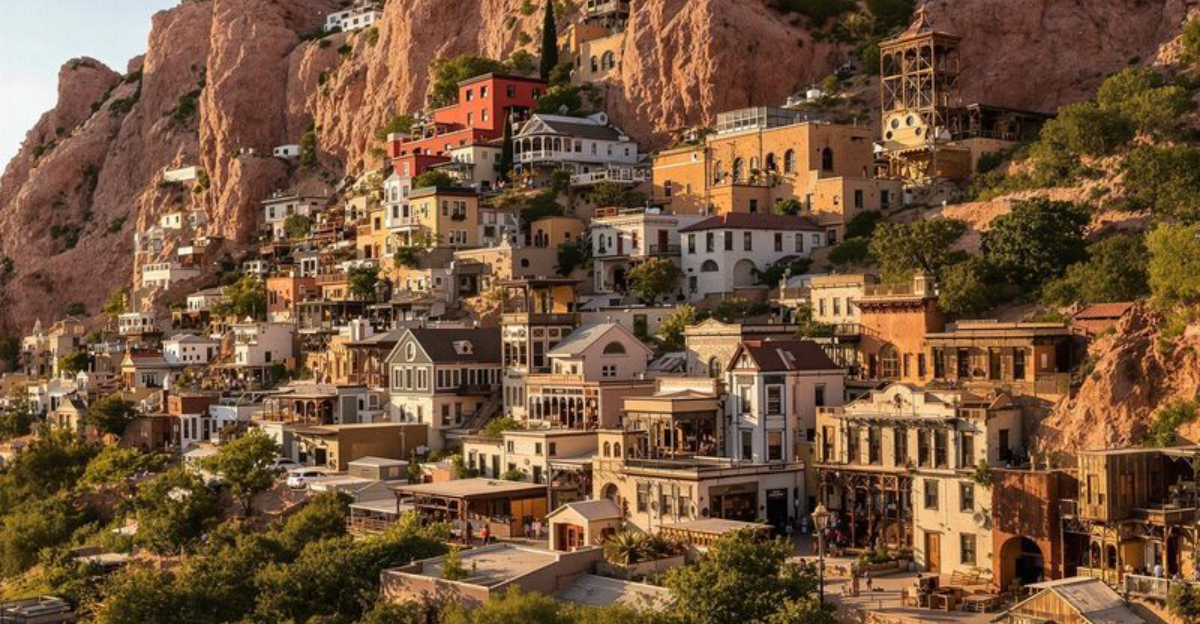
Clinging to Cleopatra Hill at a precarious 5,000 feet elevation, Jerome defies both gravity and extinction. Once called the “wickedest town in the West,” this former copper mining giant produced over a billion dollars in ore before operations ceased in 1953. Buildings slide downhill at glacial pace due to unstable ground, giving Jerome its distinctive tilted appearance.
During my overnight stay at the Jerome Grand Hotel (formerly the town hospital), unexplained footsteps in empty hallways convinced me the ghost town nickname applies literally here. The paranormal reputation attracts ghost hunters year-round.
Unlike truly abandoned towns, Jerome reinvented itself as an artist colony and tourist destination, with galleries and wine tasting rooms occupying buildings where miners once lived.
8. Goldfield’s Second Chance
Rising from its own ashes, Goldfield demonstrates how determined preservation can resurrect the dead. Originally booming between 1893 and 1898, this gold mining town collapsed when ore quality diminished. After decades of abandonment, Goldfield received new life in the 1980s when enthusiasts reconstructed the town as a tourist attraction.
My family loves the underground mine tour where guides demonstrate original mining techniques. The narrow tunnels and cool darkness provide welcome relief from Arizona’s summer heat while offering education disguised as entertainment.
Though technically a reconstruction, Goldfield captures the spirit of the original settlement. Weekend gunfight reenactments, gold panning experiences, and the narrow-gauge railroad make this ghost town particularly family-friendly compared to its more authentically decayed counterparts.
9. Castle Dome Landing’s Museum Time Capsule
Fifty original buildings filled with period-accurate artifacts create the most immersive ghost town experience in Arizona. Castle Dome began as a shipping port along the Colorado River before silver discovery in 1864 transformed it into a mining district. Unlike many ghost towns that feature just a handful of structures, this sprawling site preserves an entire community.
I spent hours exploring the mercantile store where original merchandise still sits on shelves. The saloon, complete with poker tables set mid-game, feels like the players just stepped away momentarily.
What impressed me most was learning that Castle Dome outlasted many better-known mining camps, operating until 1979 when falling silver prices finally closed the mines. Today’s museum complex offers the most comprehensive ghost town experience in the state.