
10 Forgotten Ghost Towns In Washington That Are Both Eerie And Fascinating
Washington State is filled with traces of towns that once held big hopes and busy lives. Scattered across remote forests, mountains, and valleys, these abandoned places were shaped by mining rushes, timber demands, and railroad expansion.
People arrived with plans to build, work, and settle, carving communities into the rugged landscape. As industries faded, so did the towns, leaving behind empty streets, collapsing buildings, and forgotten cemeteries.
Today, their remains offer a quiet look into the past, where stories of labor, loss, and ambition still linger in the silence.
1. Monte Cristo (Snohomish County)
Deep in the Cascade Mountains sits a mining town that promised riches but delivered hardship instead. Monte Cristo sprang up in the 1890s when prospectors discovered silver and gold deposits.
Getting supplies in during brutal winters proved nearly impossible. The remote location and constant avalanches made life miserable for residents who stuck it out.
Today you can hike to the ruins and explore what remains of the old hotel and other structures. The journey takes you through stunning mountain scenery that makes the trek worthwhile even beyond the historical curiosity.
2. Melmont (Pierce County)
Coal brought hundreds of workers to this Pierce County settlement in the early 1900s. Melmont housed families who depended entirely on the mining company for everything from wages to housing.
When the coal ran out, so did the people. The town emptied almost overnight, leaving behind foundations and memories.
Nature has reclaimed most of the site now. Walking through the forest where homes once stood gives you an odd feeling, like stepping through a doorway into the past where ordinary folks lived extraordinary lives.
3. Govan (Lincoln County)
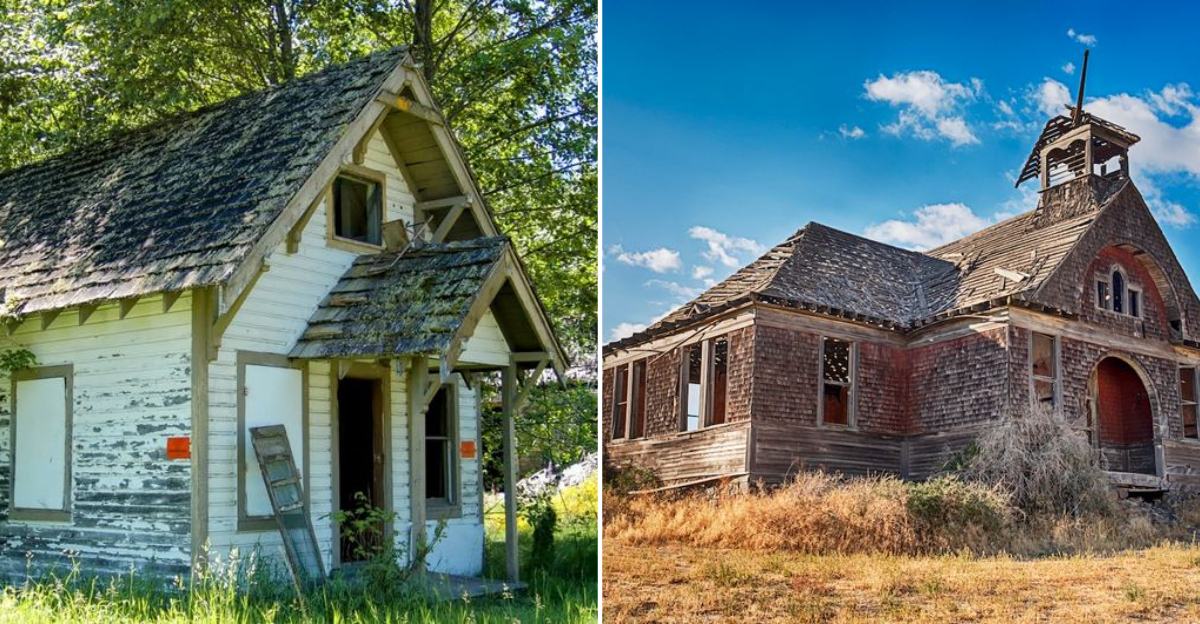
Out on the rolling wheat fields of eastern Washington stands a lonely schoolhouse that once rang with children’s laughter. Govan thrived as a farming community where families worked the land and built a tight community.
Better roads and modern farming equipment meant fewer people needed to live out here. The town slowly faded as families moved to larger towns with more opportunities.
That old schoolhouse remains the main attraction, perfectly preserved and surprisingly photogenic against the endless wheat fields and big sky.
4. Sherman (Lincoln County)
Railroad tracks brought prosperity to Sherman when it became a shipping point for grain in the late 1800s. The massive grain elevator dominated the skyline and represented hope for local farmers.
I visited Sherman on a windy afternoon and felt the loneliness wash over me. Standing beside that towering elevator with tumbleweeds bouncing past creates a mood that photographs can never quite capture.
The town disappeared when the railroad changed routes. Now just a handful of structures remain as monuments to agricultural dreams that flourished briefly then vanished.
5. Claquato (Lewis County)
Before Chehalis existed, Claquato served as the Lewis County seat and seemed destined for greatness. Settlers built homes, businesses, and a beautiful church that still stands today.
Everything changed when railroad officials chose a different route. Towns lived or withered based on railroad decisions, and Claquato got the short end of that stick.
The church remains active and well maintained, hosting occasional services and weddings. Visiting Claquato feels less spooky and more peaceful, like discovering a secret garden that time forgot to bulldoze.
6. Molson (Okanogan County)
Molson rests near the Canadian border and feels like a perfectly preserved piece of Washington’s past. Once a thriving mining town, it now serves as an open-air museum filled with historic structures, machinery, and relics.
Visitors can explore the restored schoolhouse, general store, and blacksmith shop. Informative signs explain how this small community rose and fell during the gold rush era, making Molson one of the most accessible and educational ghost towns in the state.
7. Nighthawk (Okanogan County)
Nighthawk sits quietly along the Similkameen River, where only a handful of old buildings remain from its bustling mining days.
The wooden structures lean against the wind, surrounded by sagebrush and scattered relics of the gold rush. It is a peaceful spot for photographers and history enthusiasts who appreciate authentic ruins.
Early morning or late afternoon light gives the weathered storefronts an otherworldly glow, revealing the character that time has etched into every board.
8. Lester (King County)
Lester once thrived as a bustling railroad and logging town near Stampede Pass, serving Northern Pacific trains passing through the Cascades.
The surrounding forests provided timber and the railroad supplied everything else. Today, concrete foundations, a small cemetery, and rusting equipment mark where hundreds once lived and worked.
The town’s remote mountain location makes it a peaceful stop for history enthusiasts and photographers seeking a quiet glimpse into early 20th-century railway life.
9. Barneston (King County)
Barneston grew out of Washington’s logging boom in the early 1900s, nestled within the Cedar River watershed.
It was once home to lumber workers, their families, and a mill that helped supply Seattle’s building materials. When the area became part of Seattle’s protected watershed, residents relocated and the town disappeared from maps.
Today, traces of Barneston linger in historic photographs, mill foundations, and forest trails that hint at the community that once thrived here.
10. Nagrom (King County)
Nagrom was a company town born in 1911 when the Morgan Lumber Company established a sawmill along the Green River.
The town’s unusual name comes from spelling “Morgan” backward. At its peak, Nagrom had homes, a mill, and a schoolhouse supporting dozens of logging families.
Though little remains today, its story is preserved through historical photos and local archives, making it an intriguing stop for anyone exploring the remnants of Washington’s timber past.