
10 Hidden Ghost Towns In Texas That Are Frozen In Time
There’s a pull to the forgotten corners of Texas that’s hard to explain. Maybe it’s the silence, or the way sunlight clings to old brick and rusted tin. Out along empty highways and dusty trails, whole towns wait, abandoned but not erased.
You’ll find church steeples still standing against the sky, post offices long shut, and storefronts where the wind now does the talking. Some were mining camps swallowed by desert; others drowned beneath man-made lakes or drifted away when the railroad moved on.
Each holds its own strange beauty, a reminder that Texas was built on both ambition and loss. Bring water, patience, and curiosity. These ten ghost towns may be quiet, but they’re still telling their stories to anyone who’ll listen.
1. Terlingua
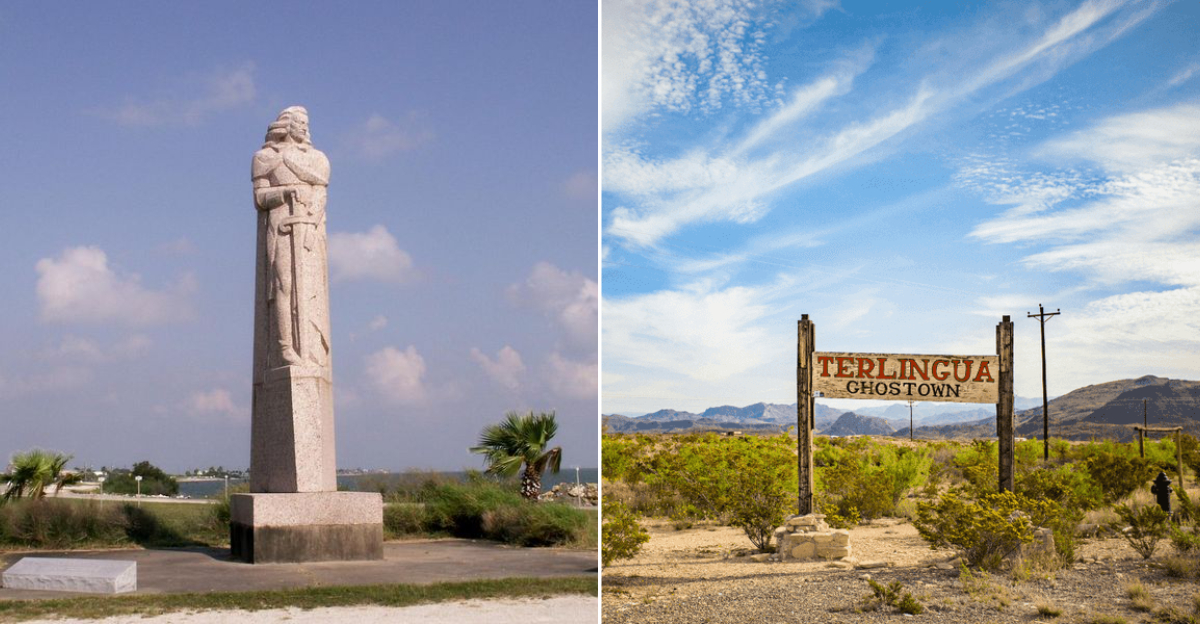
Just outside Big Bend National Park, Terlingua rises from the desert like an unfinished dream. Adobe ruins crumble under a blue sky so wide it feels endless. The silence here has texture, you can almost hear it.
Once a booming mercury mining town, Terlingua fell apart after World War II, but its bones remain: a stone church, the Chisos Mining Company ruins, and a cemetery that glows golden at sunset.
Today, a few artists and wanderers have returned. You can grab chili at the Starlight Theatre and toast to what refuses to die.
2. Indianola
The Gulf whispers around Indianola’s ghost, where salt and wind erased what used to be Texas’ main port. Waves lap at grassy edges where streets once bustled with ships and trade.
Two hurricanes, in 1875 and 1886, wiped it out completely. Now, only a few foundations and a historical marker remain along Matagorda Bay.
Bring your camera and time to think. Standing here feels like looking at an empty stage, the story’s over, but you can still feel the actors’ breath.
3. Glenrio
At the Texas–New Mexico border, Glenrio sits split in two, one side of Route 66 in each state. The motel signs still lean against the sky, advertising rooms that haven’t existed for decades.
This tiny town once fed on highway travelers, diners, gas stations, a post office, until I-40 bypassed it in the 1970s. Then everything stopped.
The neon is gone, but the bones remain. If you pull over at dusk, you’ll see the light bounce off faded lettering, like a movie frozen on its last frame.
4. Shafter
The Chinati Mountains cradle Shafter, a silver mining town where time moves slower than the desert wind. A few dozen residents still call it home, living among stone ruins and mesquite.
Founded in the 1880s, it once pulsed with miners and soldiers before the silver veins ran dry. The mine shut down, reopened, and shut again, like a heart trying to remember how to beat.
Visitors can wander the cemetery, explore old adobe homes, and see the still-standing church, where sun and shadow share the pews.
5. Lobo
Between Van Horn and Valentine, a rusted sign points to Lobo, a ghost town that looks like it’s holding its breath. The desert swallowed it slowly, one sandstorm at a time.
Originally a farming community sustained by groundwater, Lobo collapsed when the wells ran dry in the 1980s. Now, tumbleweeds roll through old gas pumps and hollow houses.
A group of artists bought it recently, hosting pop-up festivals in the ruins. Even ghosts need an audience sometimes, and Lobo seems to like the company.
6. Ben Ficklin
South of San Angelo lies the grave of Ben Ficklin, the town and the man. Established as a mail stop in the 1870s, it was wiped away by a flood in 1882 that left almost nothing standing.
The only survivors moved uphill to create San Angelo proper, leaving this place to the cottonwoods and the river’s hush.
A small cemetery and historical marker still mark the site. It’s haunting in daylight; peaceful, green, and strangely forgiving for what nature once took.
7. Old Bluffton
Hidden under Lake Buchanan for half a century, Old Bluffton resurfaced during droughts, its limestone foundations rising like ghosts from the mud. You can still see old street outlines when the water drops low enough.
Founded in the 1850s, it was a thriving Hill Country settlement until the Buchanan Dam project forced everyone to higher ground in the 1930s.
Standing on the new shoreline, it’s hard not to imagine the past under your feet, a whole town resting quietly beneath the waves.
8. Medicine Mound
Four rocky hills rise near Quanah, once sacred ground to the Comanche and later home to a small, stubborn town. The mounds watch silently over what’s left: a schoolhouse, a few foundations, and a windmill still turning.
Fire destroyed much of Medicine Mound in the 1930s, and the last store closed in 1966. Nature took over what humans abandoned.
Visitors today find quiet beauty in its emptiness. The air hums, the grass ripples, and the past feels close enough to touch.
9. Thurber
Just off I-20, Thurber looks deceptively small, a single smokestack and a few brick ruins hint at what was once the largest coal-mining town in Texas.
Built and owned entirely by the Texas & Pacific Coal Company, Thurber thrived until oil replaced coal in the 1920s. When the company left, the town vanished almost overnight.
The smokestack still stands like a memory you can’t erase. Stop at the small museum nearby, it tells the story better than any ruin could.
10. Toyah
West of Pecos, Toyah is a ghost with good bones: empty storefronts, a silent school, and the echo of trains that no longer stop. The wide streets hint at bigger dreams that dried up with the wells.
It was once a railroad town buzzing with ranchers, travelers, and optimism. Then came drought, depopulation, and time.
Now, photographers and wanderers pass through for the same reason I did, because it feels alive in its stillness, as if waiting for one last arrival.