
12 Hidden Michigan Waterfalls That Are Worth The Hike
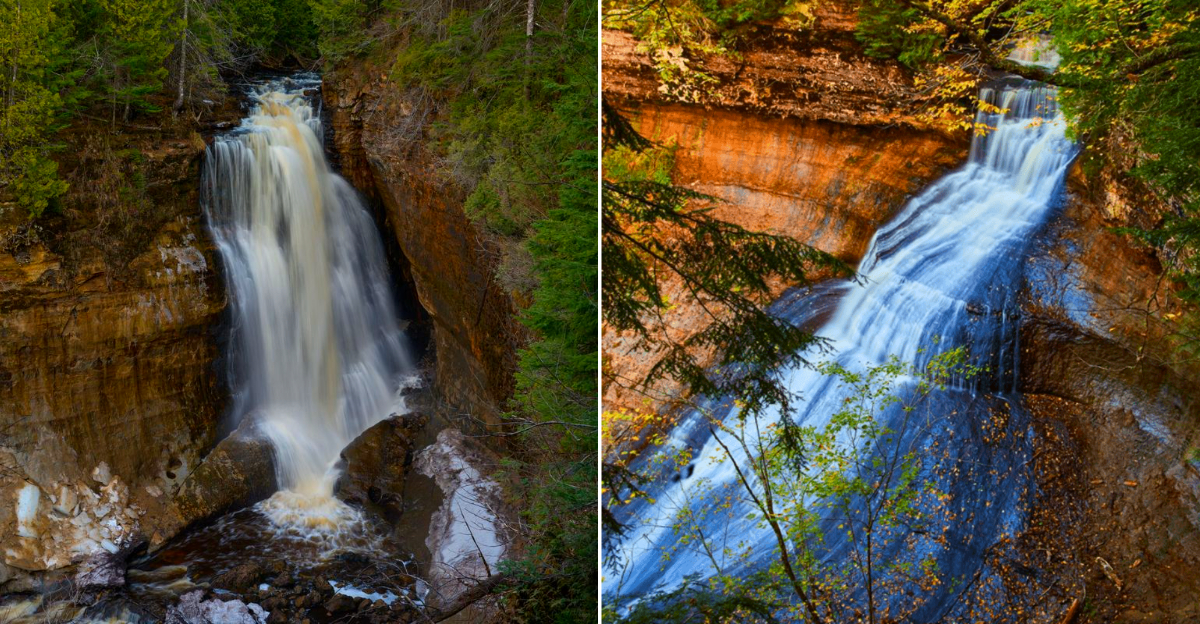
Michigan hides more cascades than most maps admit, tucked behind ancient cedar stands, tamarack bogs, and shifting sandy bluffs. This is a list for the wanderers, those who prefer the smell of balsam and cold, wet rock over paved overlooks.
In the Upper Peninsula (and one special, universally accessible spot below the bridge), the sound of rushing water often finds you long before the view does, a low-frequency hum that vibrates through the soles of your boots.
Each of these stops rewards a steady pace with a scene that feels both intimate and expansive, like a secret the forest has finally decided to share with you.
These are the places where the “root beer” glow of tannin-soaked water meets the emerald moss of untouched gorges, and where the only trail markers are the ones you find in the rhythm of the river itself.
This collection of forest-hidden treasures offers a rare glimpse into the wild, roaring pulse that beats beneath the state’s quietest canopies. Lace up your hikers, pack a spare pair of wool socks, and let these falls stitch together a route through the wilder, quieter corners of the Great Lakes State.
I’ve mapped out the best backcountry paths to help you reach the most secluded drops, from the sandstone canyons of the north to the limestone ledges where you can still feel the spray on your face.
1. Miners Falls (Pictured Rocks National Lakeshore)
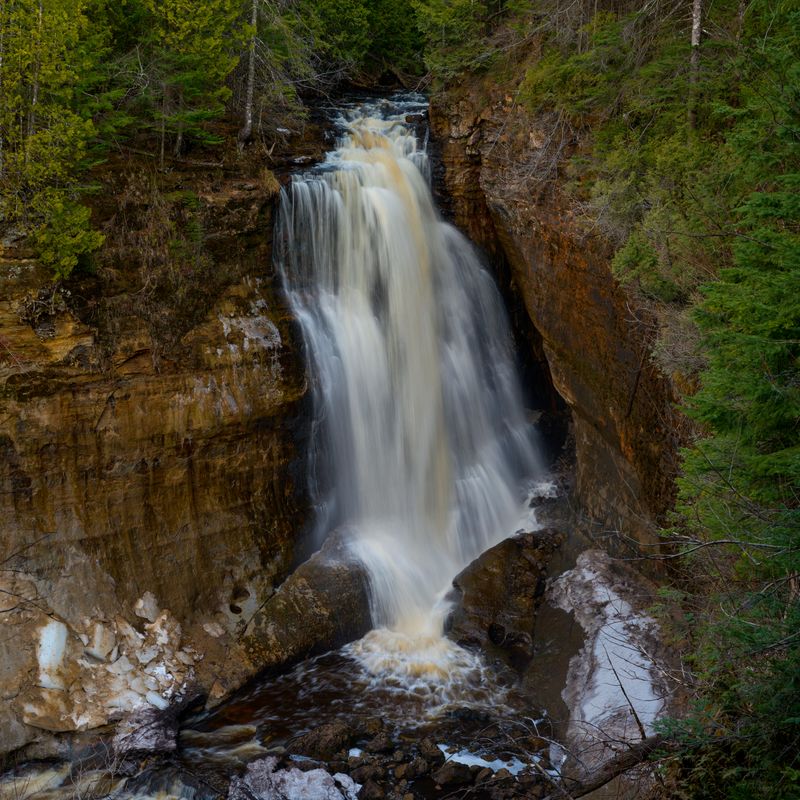
You feel the presence of Miners Falls before you see the white plume, a deep, resonant rush echoing through a cathedral of hemlock and maple. The Miners River drops in a clean, theatrical 50-foot curtain into a dramatic sandstone amphitheater.
Everything here feels grand in scale. After a spring rain, the entire gorge smells like wet stone and leaf loam, a sharp and pleasant forest tonic that clears the head instantly.
The trail here is a legacy of the Civilian Conservation Corps (CCC), whose sturdy handiwork from decades ago still provides the primary access. Their work created a path that respects the topography, winding gently through a dense canopy before revealing the gorge.
While the famous multicolored cliffs of Pictured Rocks draw the kayakers, this inland detour offers a calmer, more grounded connection to the landscape. It is a place where the geological history of the Peninsula is written in the layered sandstone.
Personal Tip: Bring a light jacket even in mid-summer; the mist from the falls creates its own micro-climate that is significantly cooler than the trailhead. I’ve found that the lower platform is the best place to lose track of time.
You’ll find yourself hypnotized by the way the water thunders against the basin, creating a perpetual swirling mist that keeps the surrounding moss a vibrant, neon green.
2. Chapel Falls (Pictured Rocks National Lakeshore)
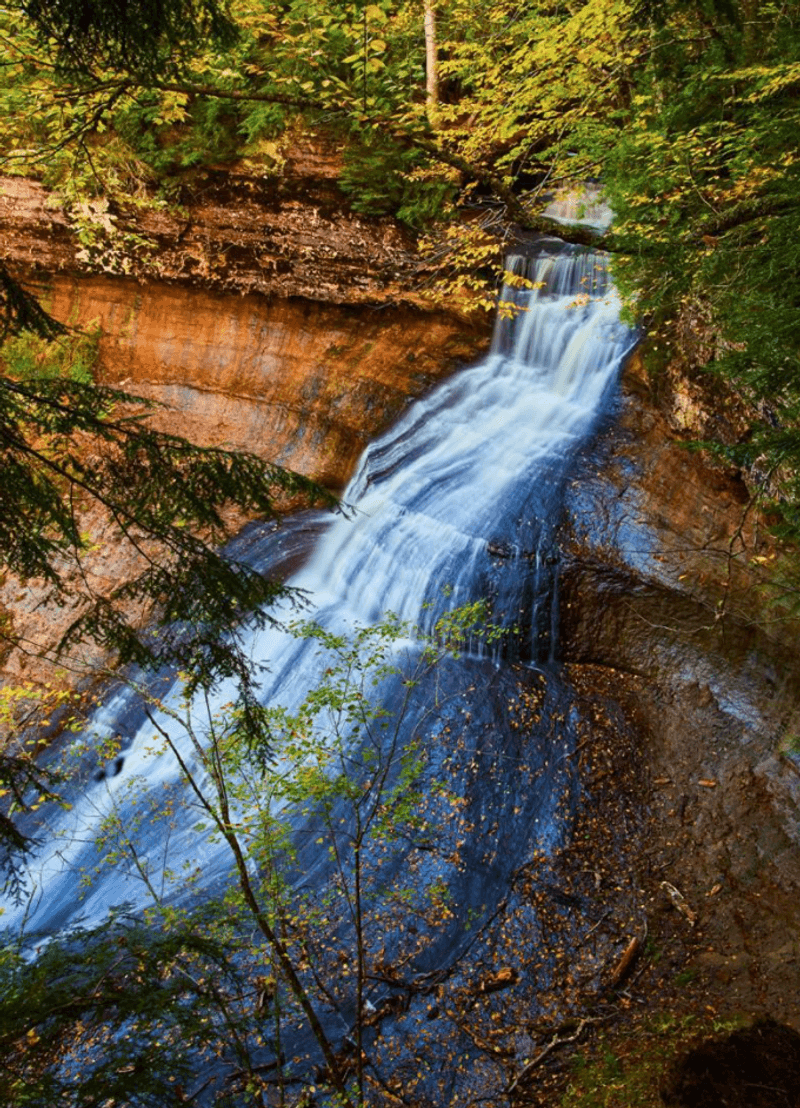
Chapel Falls is the elegant, sophisticated counterpart to the roar of Miners. It is a fine white ribbon that tips off Chapel Creek into a deep, shady gorge.
The hike in is one of my personal favorites, a roughly 1.5-mile wander (one way) through airy hardwoods where the canopy occasionally breaks to reveal the sand plains meeting the forest. The water threads delicately over the edge, sounding more like a graceful whisper than a shout.
Historically, the Chapel area was a favorite haunt for early 20th-century resort visitors who arrived by boat to see the famous Chapel Rock. Today, the park service has carefully rerouted trails to protect the fragile edges of the creek from erosion.
The falls drop about 60 feet, and the viewpoint offers a staggering look across the valley toward the distant blue line of Lake Superior. The forest is slowly reclaiming its rugged, wild posture.
Personal Tip: Parking at the Chapel trailhead is notorious, in 2026, it still fills by 9 or 10 AM on fair-weather weekends. Arrive at dawn for that slanty golden light that makes the falls look like spun silk.
If your legs feel strong, link this with the Chapel Loop trail to see the cathedral rock formations on the coast.
3. Mosquito Falls (Pictured Rocks National Lakeshore)
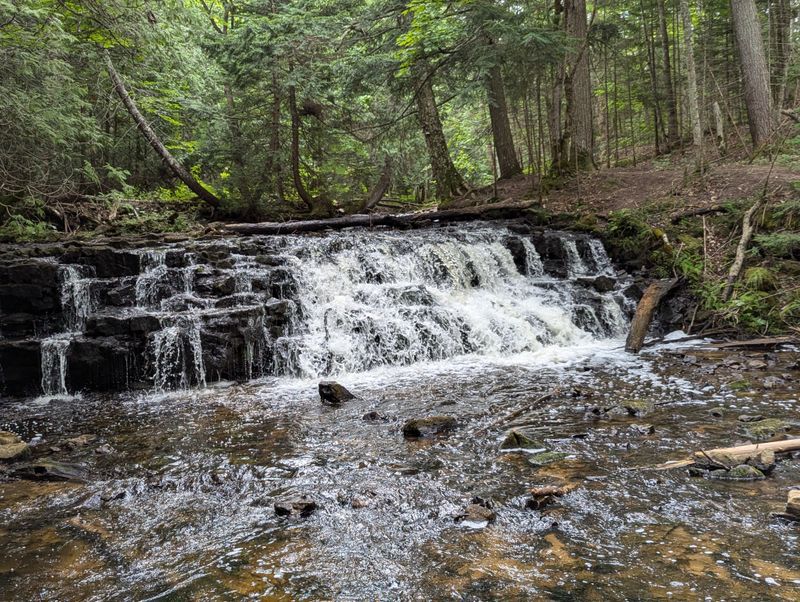
The river at Mosquito Falls fans out over amber-toned rock shelves in a series of playful steps. Roots twist across the path like braided rope, and the cedar shadows turn the pools into the color of over-brewed tea.
It isn’t a fierce waterfall, but a chattering one, full of personality and small, rhythmic splashes. It feels more intimate than the larger plunges, like a secret garden hidden in the brush.
This corner of the park sits near old logging tracts; if you look closely at the forest floor, the straight segments of the trail hint at the rail grades that once cut through these woods. It’s a textured, honest landscape that feels a little more rugged and lived-in than the main overlooks.
The falls only drop about 10 to 15 feet, but the way the river breaks over the rocks makes it one of the most musical spots in the Lakeshore.
Personal Tip: Expect mud. This trail is famous for its muddle, especially after a rain, so waterproof footwear is a non-negotiable.
If you have a thermos, this is the place to use it. Find a flat, mossy rock near the upper steps and watch the light turn honey-colored as it filters through the cedars.
4. Spray Falls (Pictured Rocks National Lakeshore)
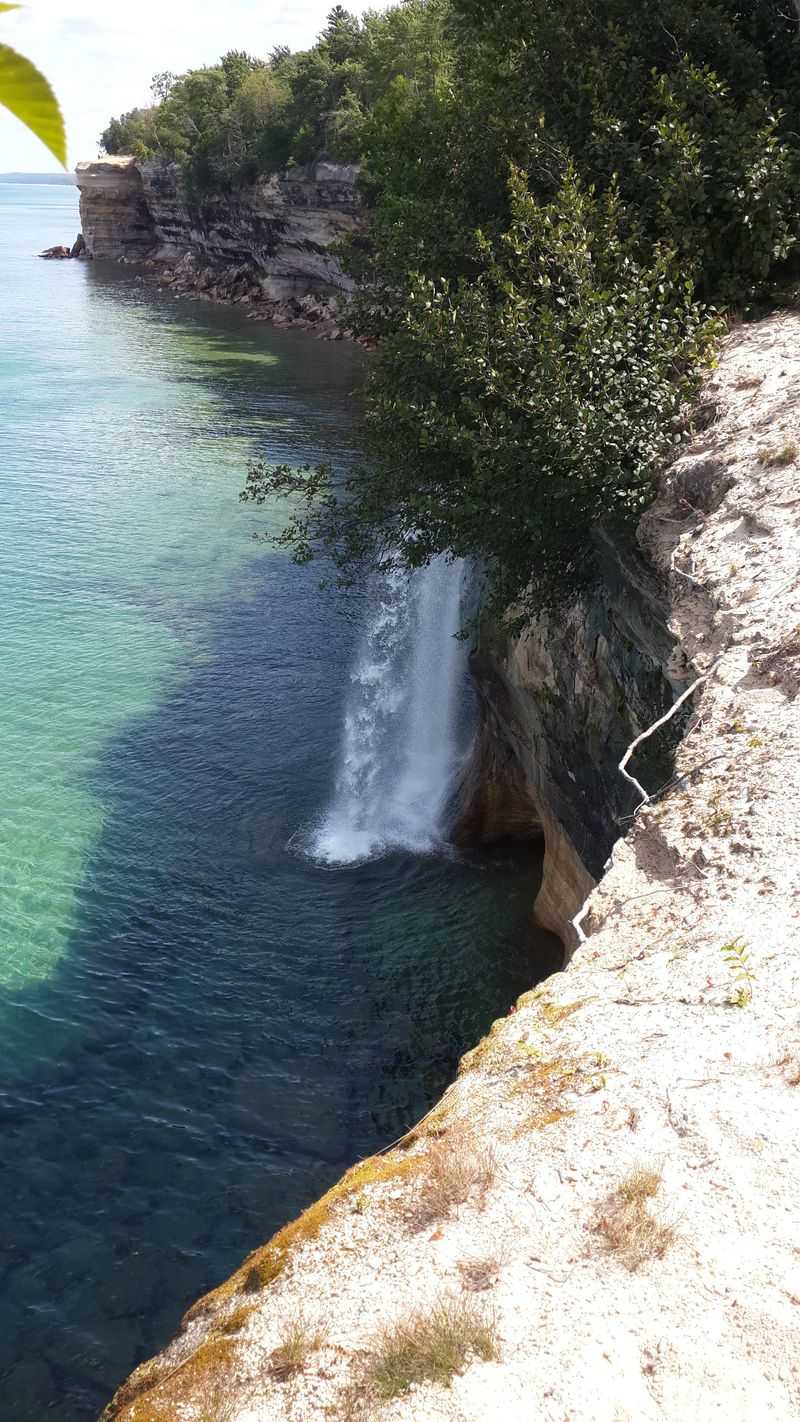
There is a raw, cinematic drama to Spray Falls that is hard to find anywhere else in the Midwest. Here, a white veil of water drops 70 feet directly off a sheer cliff face and into the icy, churning blue of Lake Superior.
Gulls wheel in the updrafts created by the cliff, and when the clouds part, the colors of the Pictured Rocks sharpen into a vivid tapestry. You can feel the pull of the open horizon here, a sense of being at the true edge of the world.
The National Lakeshore protects this rare geological feature where the inland river system meets the Big Sea. Historically, ships hugged this coast for shelter during storms.
On calm days, the water is clear enough to see the rocky bottom, and the falls create a perpetual rainbow in the spray.
Personal Tip: The absolute best land-based view comes from a specific spur on the North Country Trail. If you’re hiking from the Little Beaver Lake trailhead, it’s a roughly 4-mile trek.
Check the marine forecast before you go; on windy afternoons, the Lake Superior spray carries far enough up the cliff to salt your lips.
5. Sable Falls (Pictured Rocks National Lakeshore)
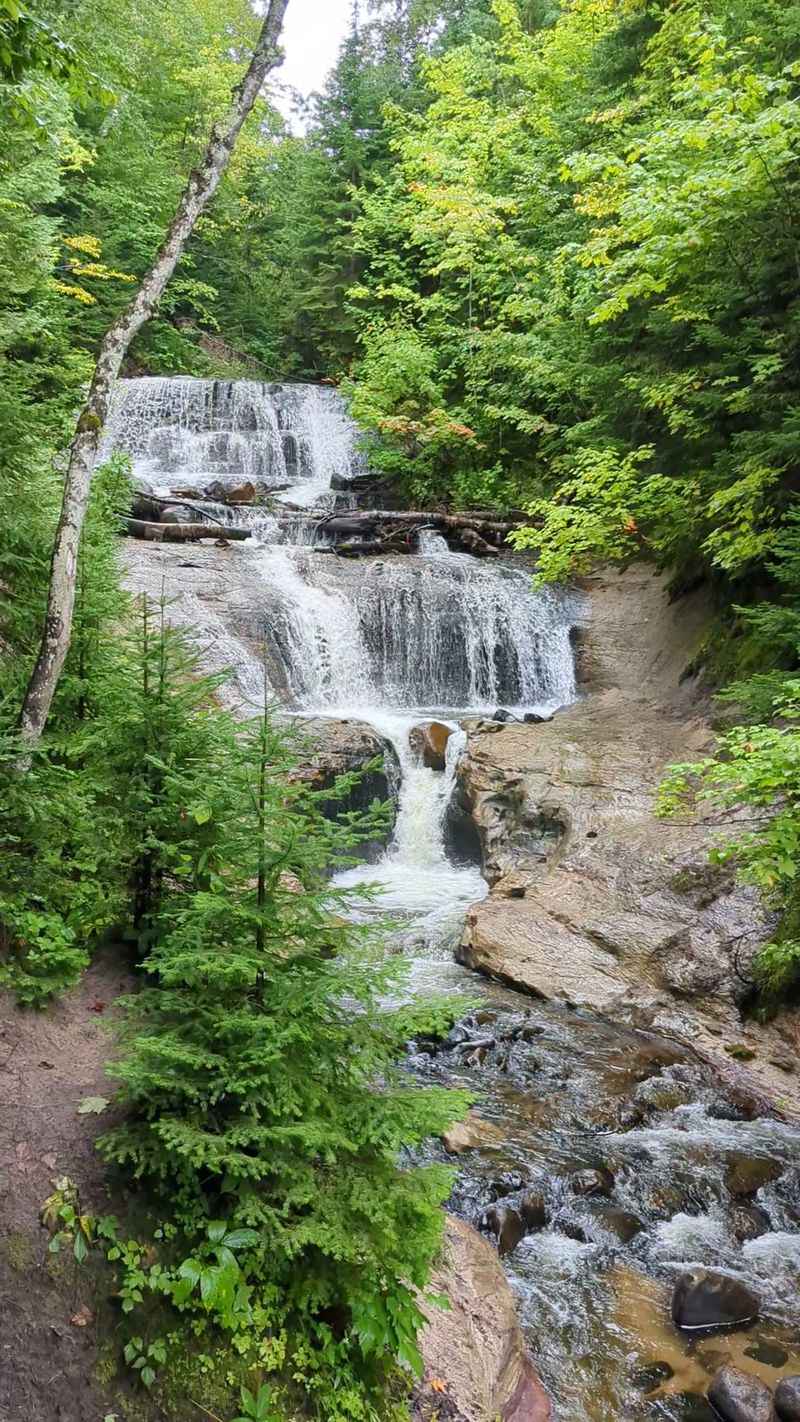
Located at the far eastern end of the Pictured Rocks near Grand Marais, Sable Falls feels like a transition point between the forest and the desert. Wooden stairs drop you into a dune-rimmed valley where Sable Creek spills over layered rock.
The air here changes as you descend. It loses the heavy, damp musk of the deep woods and gains a sandy, bright tang as the wind sighs through the nearby Grand Sable Dunes.
This stretch of water once guided early travelers along the old coast road toward the Au Sable Light. The park’s stabilization of the dune slopes here is a quiet triumph of conservation.
The creek eventually wanders out to a pebbled beach on Lake Superior, a perfect spot for agate hunting.
Personal Tip: Pace yourself on the way back up; it’s about 168 steps, and the elevation change is deceptively steep. I highly recommend following the trail past the falls all the way to the beach.
At sunset, the dunes turn a glowing orange, and the falls take on a mellow, copper tone.
6. Bond Falls (Bond Falls Scenic Site)
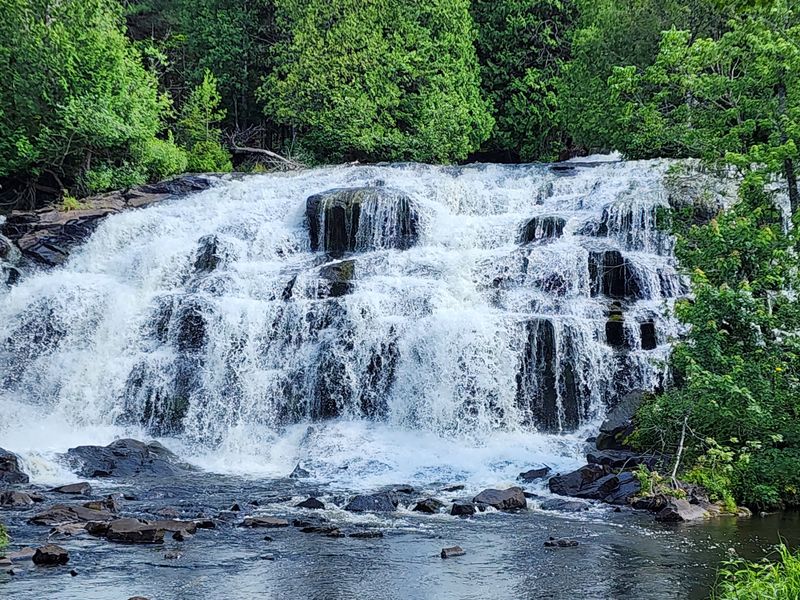
Bond Falls is arguably the most photogenic spot in the entire Upper Peninsula. Located on the Middle Branch of the Ontonagon River, whitewater spreads wide across blocky basalt, creating a massive panorama of foaming tiers.
It isn’t just one drop; it’s a series of cascading curtains that look beautiful from every angle. Mist rises in light, glittering sheets.
The site is managed by the state in a unique partnership with a local utility company. The result is an incredibly well-maintained site with boardwalks that allow for universally accessible views.
Local photographers haunt this spot at sunrise, waiting for the first light to catch the ridges of the foaming water.
Personal Tip: While the main falls are the draw, don’t skip the smaller cascades further up the river. There are several spur paths that lead to quieter, more secluded spots.
Bring a microfiber cloth for your camera lens; the Bond Falls mist will decorate your glass within seconds.
7. Agate Falls (near Trout Creek)
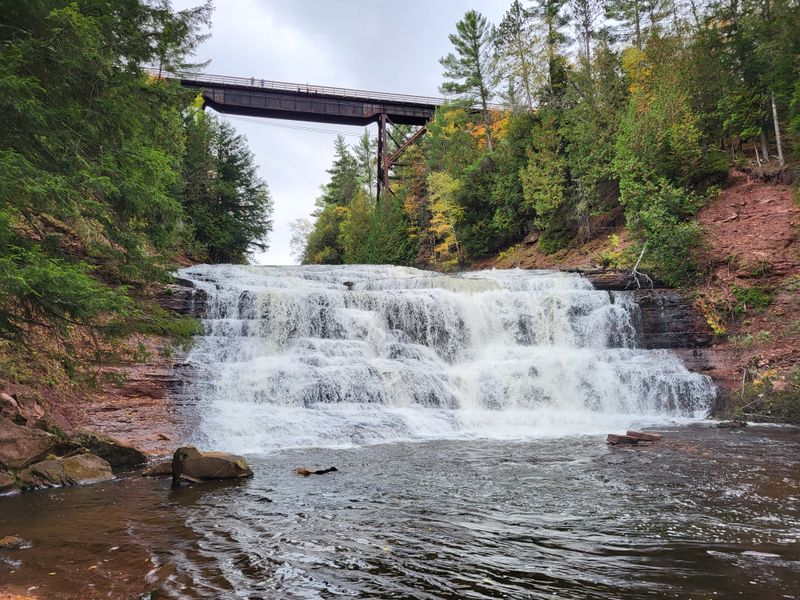
Not far from Bond Falls lies Agate Falls, where the river pours under an old, massive railroad trestle. The falls fan out into smooth, copper-colored slides that hum with a steady, low-frequency vibration.
The water flashes brilliant white over the main lip before settling into deep pools. Once you descend into the gorge, the modern world disappears completely.
The trestle above belongs to a bygone rail era that once fed the timber and ore towns of the interior. Today, it serves as a dramatic frame for the 39-foot falls.
The trail and bridges were upgraded recently to ensure visitors could reach the best viewpoints. It’s a perfect example of hidden in plain sight beauty.
Personal Tip: I like the late afternoon for Agate Falls. The way the sun stripes the river through the ironwork of the trestle creates a cinematic scene. Be sure to use the designated trails; the slopes are made of slippery clay and are much steeper than they look.
8. Wagner Falls (near Munising)
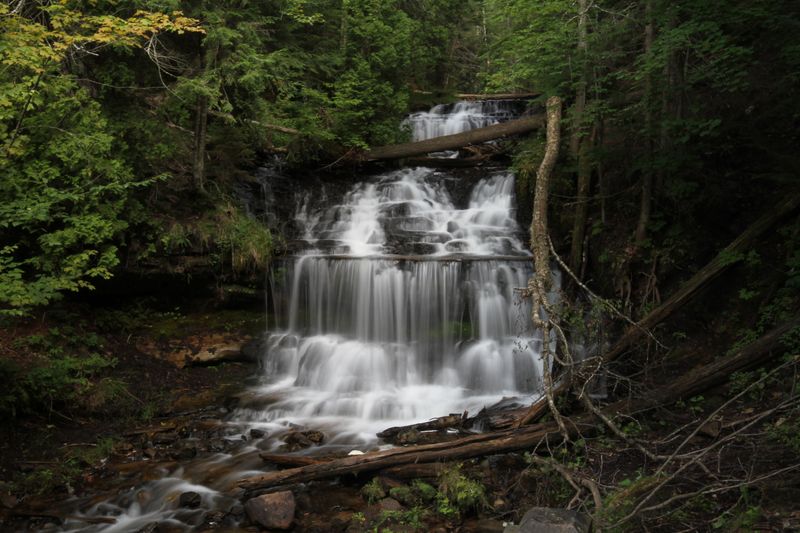
The walk to Wagner Falls is pocket-sized, a short, mossy path through the trees that opens abruptly to a tiered fan of porcelain-white water. It is a boutique waterfall, elegant and perfectly composed.
Hemlocks crowd close to the creek, and the water ribbons through the mossy ledges with a steady, quiet grace. It is the kind of place where voices naturally drop to a whisper.
Designated a state scenic site, Wagner benefits from a less is more approach to management. The parking lot is small, and the walkways are unobtrusive.
The result is a lush, green sanctuary that feels surprisingly remote despite being just minutes from Munising.
Personal Tip: This is the perfect first stop of the day. Visit on a drizzly or overcast morning when the light is flat. After you’ve had your fill of the quiet, head back into Munising for a pasty or a coffee.
9. Laughing Whitefish Falls (Laughing Whitefish Falls State Park)
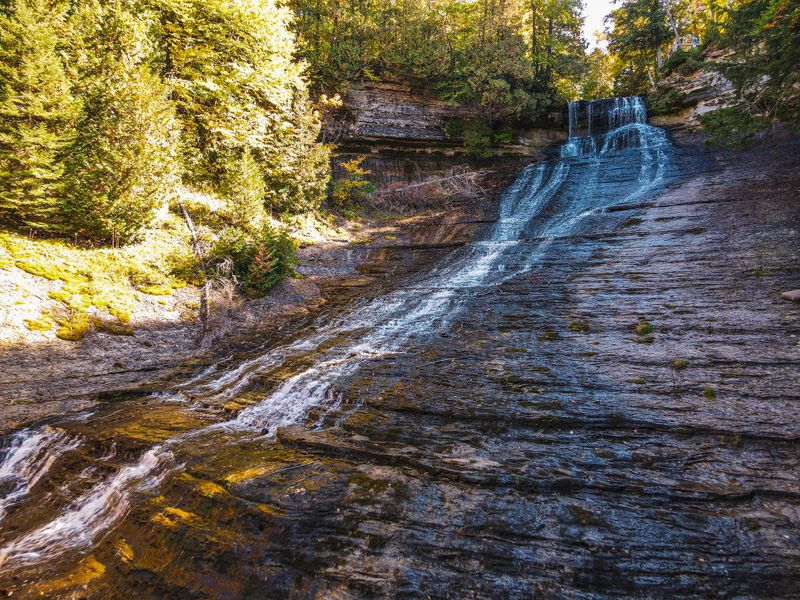
Laughing Whitefish Falls is one of the most unique geological features in Michigan. Rather than a vertical drop, the water whispers down a long, limestone staircase.
It starts as a thin stream at the top and gathers volume as it spreads across the rock’s wide, textured face. The descent is musical and rhythmic.
The park protects a deep ravine shaped by centuries of gentle persistence. It’s a favorite spot for local families to picnic.
The falls are particularly striking in the autumn, when hardwoods frame the limestone staircase in crimson and gold.
Personal Tip: There are several landings on the wooden staircase. Don’t just rush to the bottom.
Each landing offers a different perspective on the way the water braids over the rock.
10. Canyon Falls (Sturgeon River Gorge)
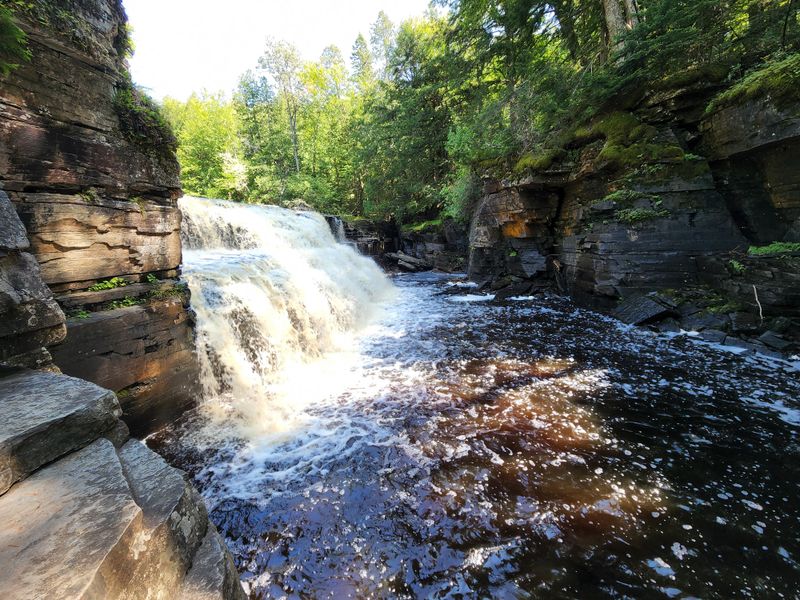
Often called the Grand Canyon of the Upper Peninsula with a wink and a nudge, Canyon Falls nonetheless offers a scale that surprises first-time visitors. The Sturgeon River compresses into a dark, narrow rock hallway.
You feel the vibration in your ribs long before the spray dots your cheeks. The roadside access belies the true wildness of the gorge.
The rock here is ancient and dark, carved with a deliberate, heavy hand. Old quarry stones and remnants hint at the area’s industrial past. The primary feeling is one of raw, untamed nature.
Personal Tip: The footing can be uneven near the edges of the gorge. There are no guardrails in the wilder sections. I always leave Canyon Falls feeling steadied by the river’s heavy, rhythmic pulse.
11. Hungarian Falls (Dover Creek Gorge)
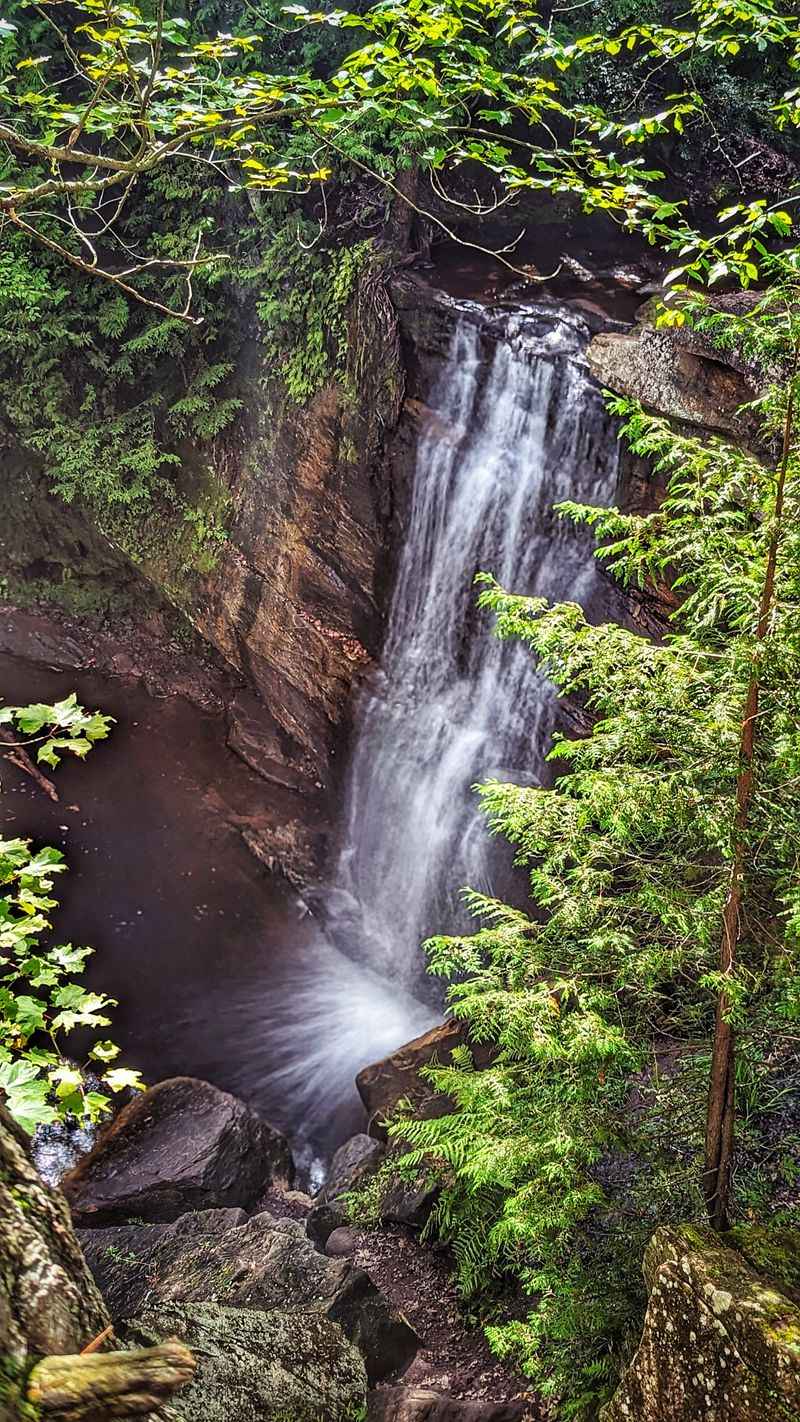
At Hungarian Falls, the landscape is a mix of natural beauty and industrial ghost story. The gorge is littered with rust-colored remnants of the Calumet and Hecla mining era.
Dover Creek steps through multiple drops, upper, middle, and lower, each with a different posture. The main plunge has muscular shoulders.
Local volunteers and conservancies have worked to keep access open to the public. The mix of spruce trees, relics, and rushing water captures the spirit of the Copper Country.
Personal Tip: The parking situation is essentially a pull-off near an old road. The paths can be slick with clay after a rain.
On quiet evenings, you can sometimes hear church bells drifting up through the mist.
12. Ocqueoc Falls (Lower Peninsula)
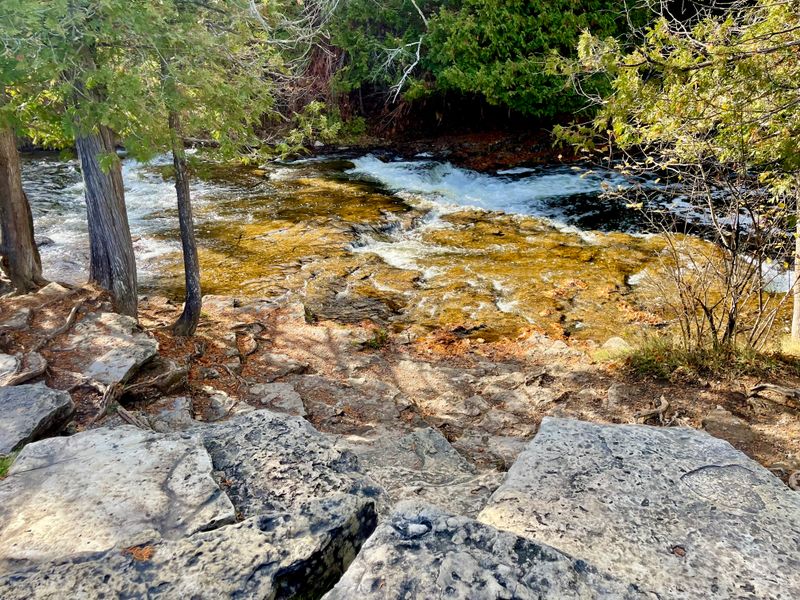
We finish on the other side of the Mackinac Bridge. Ocqueoc Falls is the only major waterfall in Michigan’s Lower Peninsula. The falls are a series of limestone ledges that spread across the river, creating shallow bowls and gentle drops.
This is the only universally accessible waterfall in the United States. Paved ramps allow everyone to reach the water’s edge. On summer days, families wade in the pools and anglers test the current for trout.
Personal Tip: Come early on a weekend if you want solitude. Or embrace the swimming hole vibe and bring your water shoes. Sitting in the limestone shallows, feeling the unhurried current past your ankles, is deeply restorative.