
10 Illinois Amusement Parks From The Past That Locals Still Miss
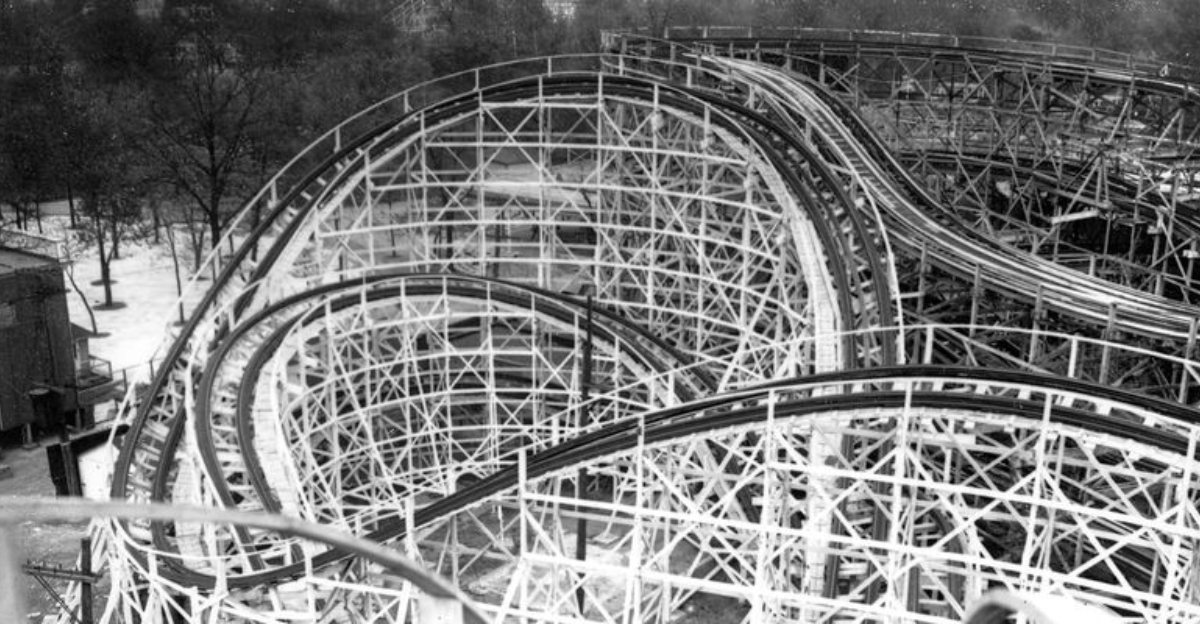
Remember when summer meant thrills and cotton candy at your favorite local amusement park? Illinois once boasted numerous beloved parks that created lifelong memories for generations of families.
While modern mega-parks offer high-tech experiences, there’s something special about those nostalgic attractions that have disappeared from our landscape.
Join me on a sentimental journey through 10 vanished Illinois amusement parks that continue to hold a special place in locals’ hearts.
1. Old Chicago: America’s First Indoor Theme Park
Revolutionary for its time, Old Chicago pioneered the indoor amusement concept in 1975, combining shopping with year-round rides regardless of Midwest weather. The massive dome in Bolingbrook housed roller coasters, a Ferris wheel, and carnival games.
Despite its innovation, financial troubles led to closure after just five years. The building stood abandoned until 1986, when demolition erased this short-lived but fondly remembered experiment in entertainment that was decades ahead of today’s mall entertainment centers.
2. Riverview Park: Chicago’s Legendary Playground
Generations of Chicagoans screamed their lungs out on The Bobs, a wooden roller coaster that defined thrill rides for its era. Riverview operated from 1904 to 1967 in what’s now Roscoe Village.
The park’s 70-acre wonderland featured over 100 attractions, including the terrifying Pair-O-Chutes and mysterious Aladdin’s Castle.
Today, DePaul College Prep and Riverview Plaza shopping center occupy the grounds, but the memories remain vivid in Chicago’s collective consciousness.
3. Kiddieland: Melrose Park’s Family Favorite
Small in size but enormous in impact, Kiddieland delighted youngsters from 1929 until its heartbreaking 2009 closure. The Little Dipper wooden coaster, built in 1950, became the park’s signature attraction.
I still remember my fifth birthday there – sticky fingers from funnel cake and that first magical ride on the Little Dipper.
While a Costco now stands at North and First Avenues, the iconic Little Dipper found a new home at Six Flags Great America, preserving a piece of this beloved family destination.
4. Adventureland: Addison’s Premier Thrill Destination
Once billed as “Chicago’s biggest” amusement center, Adventureland evolved from the earlier Storybook Park into a thrill-seeker’s paradise. From 1961 to 1977, Lake Street in Addison buzzed with excitement around the Italian Bobs coaster.
My grandmother often reminisced about summer evenings spent riding the Scrambler with her high school sweetheart in the mid-60s.
The Western Round-Up’s centrifugal force pinned riders against the wall while the floor dropped away – a sensation impossible to forget even decades after the park’s closure.
5. Dispensa’s Kiddie Kingdom: Oakbrook Terrace’s Toy Wonderland
Dispensa’s combined two childhood dreams – rides and toys – into one magical destination. Operating from 1975 to 1984, this modest park adjacent to the famous Castle of Toys store created a complete family experience.
The park’s modest size belied its outsized impact on local families. Children would enjoy kiddie rides, then beg parents to visit the adjoining toy store, making it a marketing masterpiece.
Today, the 31-story Oakbrook Terrace Tower stands where children once rode carousels and played among colorful attractions.
6. Ebenezer Floppen Slopper’s Wonderful Water Slides: Oakbrook Terrace’s Wild Ride
With possibly the most memorable name in amusement history, these concrete hillside water slides (later renamed Doc River’s Roaring Rapids) provided suburban summer thrills from 1980 to 1989.
Located at Roosevelt Road and Route 83, the park featured wild concrete slides requiring mats or tubes.
Visitors would climb the steep hill, grab their mat, and hurtle down bumpy concrete channels at breakneck speeds.
Today, overgrown remains sit behind fences on private land, a ghostly reminder of simpler summer entertainment before elaborate water parks became the norm.
7. Playland Park: Justice’s Hidden Gem
Tucked between Justice and Willow Springs at 79th Street and LaGrange Road, Playland Park delivered family fun from 1950 to 1979. The park specialized in classic kiddie rides but didn’t skimp on thrills with its Cyclone, Mad Mouse, and infamous Toboggan rides.
I spent countless Saturdays there with my cousins, challenging each other to ride the Toboggan without screaming.
The Sterling Estates Mobile Home Park now occupies the land, with just one former maintenance building as evidence of the laughter and screams that once filled the air.
8. White City: South Side’s Entertainment Palace
Named after the gleaming white buildings of the 1893 World’s Fair, White City illuminated Chicago’s South Side from 1905 to 1933. Located at 63rd and South Park (now King Drive), the park represented the golden age of urban amusement centers.
The sprawling complex featured arcades, thrilling rides, a grand ballroom, and a roller rink that remained open until 1949.
The site’s entertainment legacy ended with the construction of Parkway Gardens housing in the 1950s, erasing physical evidence of this once-magnificent pleasure garden.
9. Watch Tower Park: Rock Island’s Scenic Retreat
Perched dramatically on bluffs above the Rock River, Watch Tower Park offered both natural beauty and manufactured thrills from 1882 to 1927. The site, named for Black Hawk’s historic lookout point, became one of the Midwest’s premier trolley parks.
Visitors flocked to ride early Shoot-the-Chutes water attractions while enjoying spectacular river views.
When the state purchased the land in 1927, the amusement structures were removed by 1928, transforming the area into today’s Black Hawk State Historic Site that preserves the natural beauty without the mechanical amusements.
10. Trout Park: Elgin’s Riverside Escape
Nestled along the Fox River near today’s I-90 and IL-25, Trout Park combined natural beauty with mechanical thrills from approximately 1909 to 1922. The park’s centerpiece “Circle Dip” coaster and classic carousel drew visitors from throughout the region.
Before the amusement era, the site’s springs supported a trout hatchery, and today the area is protected as Trout Park Nature Preserve, though all traces of carousel music and roller coaster screams have long since faded into the quiet forest.