
16 Illinois Small Towns That Go All In On Lights, Parades And Holiday Spirit
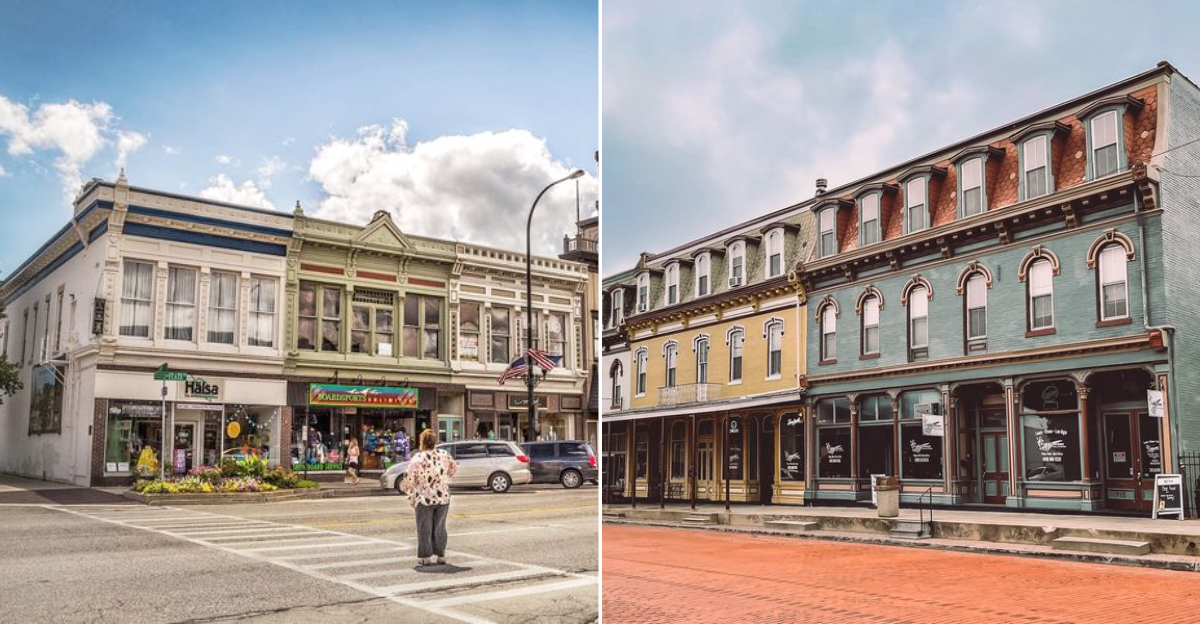
Holiday lights have a way of rearranging a town’s inner logic, and nowhere does that feel truer than in Illinois, where small places often seem to understand instinctively that winter isn’t something to endure quietly, but something to meet together, out in the open, with intention.
I’ve always been struck by how quickly these towns shift once the lights go up, how an ordinary main street becomes a kind of shared living room, with storefronts glowing like hearths and sidewalks slowing people down enough that eye contact and conversation happen naturally again.
What makes these places special isn’t scale or spectacle, but care, the careful looping of lights around courthouse columns, the handmade quality of parades where everyone seems to know at least one person walking past, the tree lightings that feel less like events and more like promises that the season will be faced communally.
You notice it under your boots as much as in the air, that subtle sense of gathering, of being part of something briefly synchronized, even if you’re just passing through.
Locals greet you with the ease of people who assume you’re meant to be there, and that assumption alone does a lot of warming.
This list traces the towns where holiday displays, seasonal rituals, and small but meticulous traditions create an atmosphere you can step into fully, without needing a plan beyond showing up.
Come curious, linger longer than expected, and leave not just with photos, but with the quiet urge to carry one of these traditions back home with you.
1. Galena
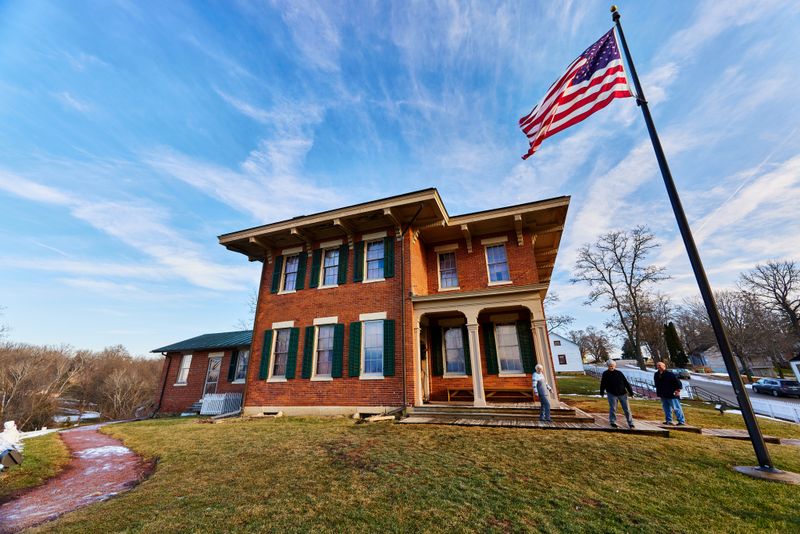
As evening settles in, lantern light reflecting off brick facades along Main Street gives Galena the sensation of slipping gently out of the present and into a slower register of time shaped by continuity rather than nostalgia.
The Helluva Half Mile fills with wreaths, garlands, and carefully trimmed windows that frame horse drawn carriages and steady, unhurried crowds during Candlelight Walks, creating motion that never tips into noise.
Rather than overpowering the historic streetscape, the lighting cooperates with preserved architecture, allowing cast iron details, cornices, and stonework to remain legible and dignified beneath the glow.
Galena’s holiday atmosphere favors restraint, with luminarias lining paths evenly and volunteers quietly maintaining order so nothing competes for attention.
Steep hills and narrow sidewalks naturally slow movement, reinforcing a contemplative pace that aligns with the town’s preservation minded character and physical geography.
Reflections gather in the river once darkness settles fully, extending the town visually without adding new elements.
Standing near the water as the night cools, the lights feel less like decoration and more like the town pausing to collect itself.
2. St. Charles

Cold air rolling off the Fox River sharpens the senses just as the Electric Christmas Parade begins, making the first notes of brass and percussion feel unusually precise.
Illuminated floats move steadily through downtown while bands echo between storefronts, following a sequence that longtime residents anticipate almost instinctively.
The Arcada Theatre marquee anchors the scene with a consistent glow that prevents the parade from feeling scattered despite its length and energy.
Holiday lighting in St. Charles emphasizes movement and continuity, with bridges, trees, and facades lit in ways that guide the eye forward.
The town’s river and mill history remains present but understated, allowing the Fox to serve as a stage rather than a dividing line.
Crowds spread comfortably along the riverwalk, where reflections stretch and fracture beneath passing footsteps.
By the time fireworks arrive overhead, the atmosphere feels settled and cohesive, warmed as much by repetition and familiarity as by spectacle.
3. Geneva

Spiced citrus, clove, and warm sugar drift along Third Street as shop doors open and close during the Christmas Walk, establishing a rhythm that feels both sensory and social.
Carolers gather beneath gas style lamps while merchants pass warm drinks through half open doors, blurring the line between street and interior space.
Geneva’s Swedish heritage surfaces gently through julbock figures, St Lucia crowns, and traditional motifs that feel practiced rather than revived for display.
The preserved Victorian streetscape provides a setting scaled perfectly to the season, avoiding both grandeur and quaintness in favor of balance.
Train arrivals add a ceremonial cadence as visitors step directly into the illuminated center of town, folding movement into the event itself.
The courthouse lawn softens into a communal square under layered strings of light and patient foot traffic.
When the tree lighting begins, the moment lands quietly, as if the town inhales together before releasing the night.
4. Woodstock
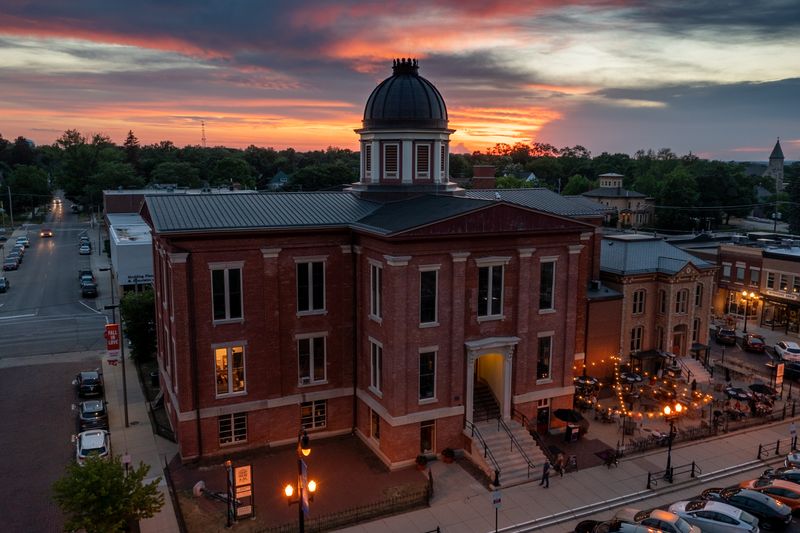
As dusk settles over the square, the lights come on in a way that feels immediately familiar, as if the town has simply returned to a version of itself it knows well.
The Opera House glows softly while the gazebo and surrounding Victorian facades hold layers of light that recall past winters without leaning on them too heavily.
Filming history may draw first time visitors, but the holiday season belongs to locals who know exactly when the square will quiet and when it will hum again.
Rather than pushing density, the lighting respects sightlines, allowing brick, arches, and rooflines to remain readable beneath the glow.
The square naturally gathers people inward, creating a sense of enclosure that makes carols and conversation feel contained rather than scattered.
As the evening deepens, blue hour gives way to warmer tones that flatten shadows and soften edges across the plaza.
Lingering after the ceremony, the lights feel less performative and more like a steady agreement between buildings and people to stay a little longer.
5. Long Grove
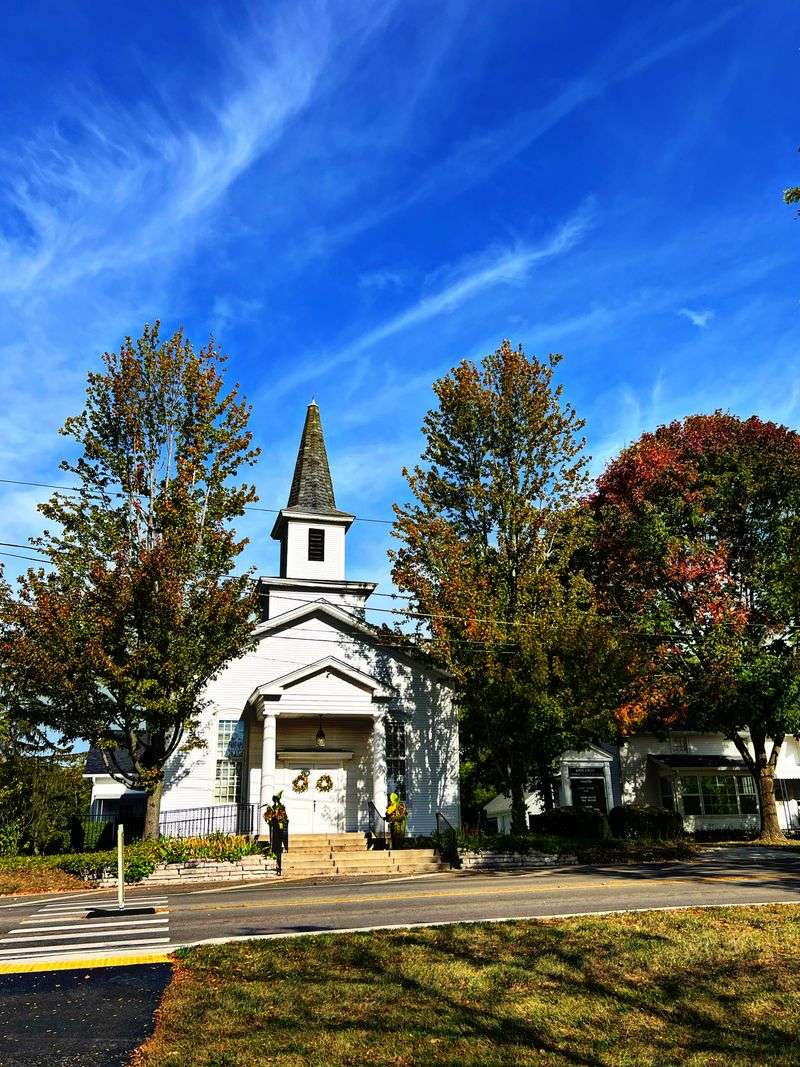
Wooden planks underfoot and the low creak of footbridges set the tone before the lights even come fully into view.
Rather than competing for attention, storefronts accept illumination quietly, letting garlands, pine boughs, and simple bulbs define their outlines.
The covered bridge becomes the emotional center of the season, not through spectacle but through familiarity and careful preservation.
Village scale works in Long Grove’s favor, keeping movement slow and conversations audible without amplification.
The Holiday Walk unfolds more like a shared stroll than an event, with neighbors and visitors folding into the same pace.
Light here behaves horizontally rather than vertically, skimming surfaces instead of announcing itself from above.
As night settles in, the town feels protected rather than enclosed, held together by warmth that never asks to be noticed.
6. Lebanon
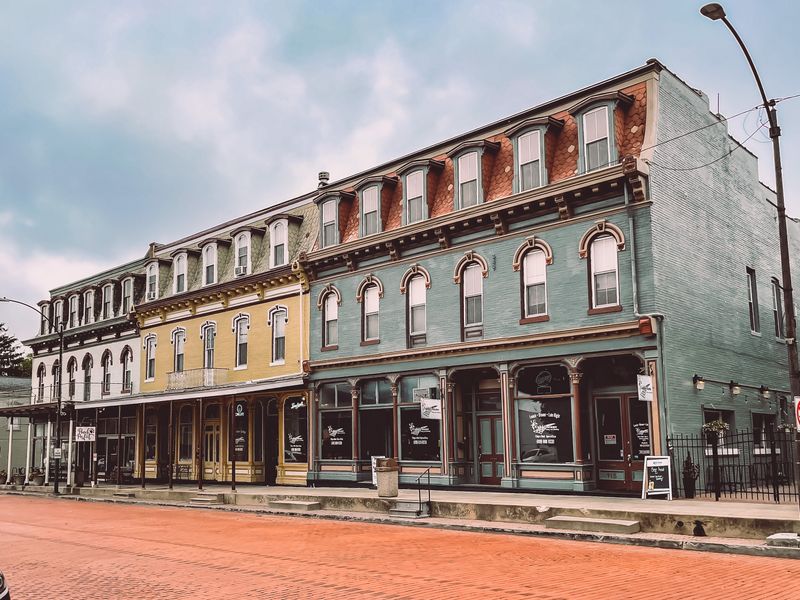
Victorian architecture takes on a new softness once gas style lamps and window lights replace daylight along the main street.
Costumed hosts move gently between buildings, guiding visitors through spaces that feel curated without becoming precious.
The town’s documented Dickens connections surface as atmosphere rather than novelty, grounding the celebration in continuity.
Holiday decorations sit carefully against cornices and brickwork, never overwhelming the lines that give the street its character.
Because parades remain modest in scale, individual details are allowed to breathe and register fully.
As darkness deepens, the street seems to narrow perceptually, drawing people closer together beneath the lights.
By the end of the evening, the glow feels less like an overlay and more like a natural extension of how the town wants to be experienced.
7. Morris
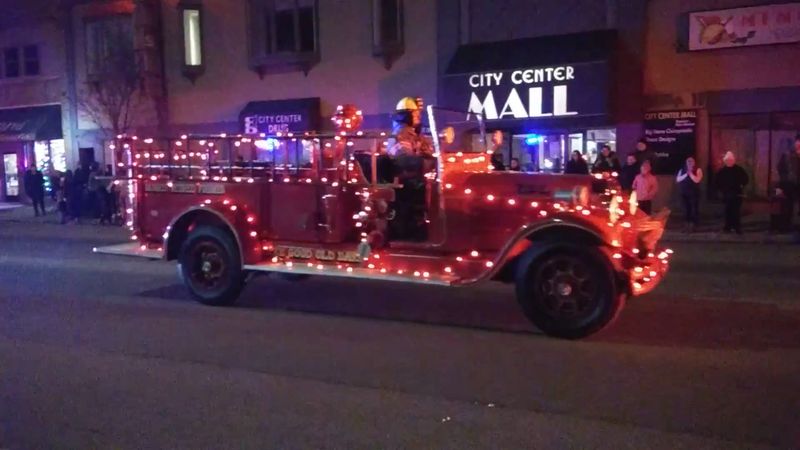
Along Liberty Street, the holiday lights arrive with a practical clarity that mirrors the town itself, outlining storefronts and lampposts in a way that feels deliberate rather than decorative for its own sake.
The Home for the Holidays parade moves with steady confidence, mixing farm equipment, school groups, and small businesses into a procession that reflects how the town actually functions year round.
Morris’s canal history lingers just beneath the surface, shaping a celebration that values punctual starts, clean routes, and displays that respect both spectators and participants.
Instead of compressing the crowd, the street layout allows people to circulate, loop back, and find better sightlines without pressure.
Lighting choices emphasize horizontality, stretching the visual field and encouraging longer glances rather than quick impressions.
As the evening progresses, the courthouse square becomes a slow turning hub rather than a focal point you rush toward and leave.
By night’s end, the lights feel like a continuation of the town’s working rhythm, calm, orderly, and quietly generous.
8. Effingham
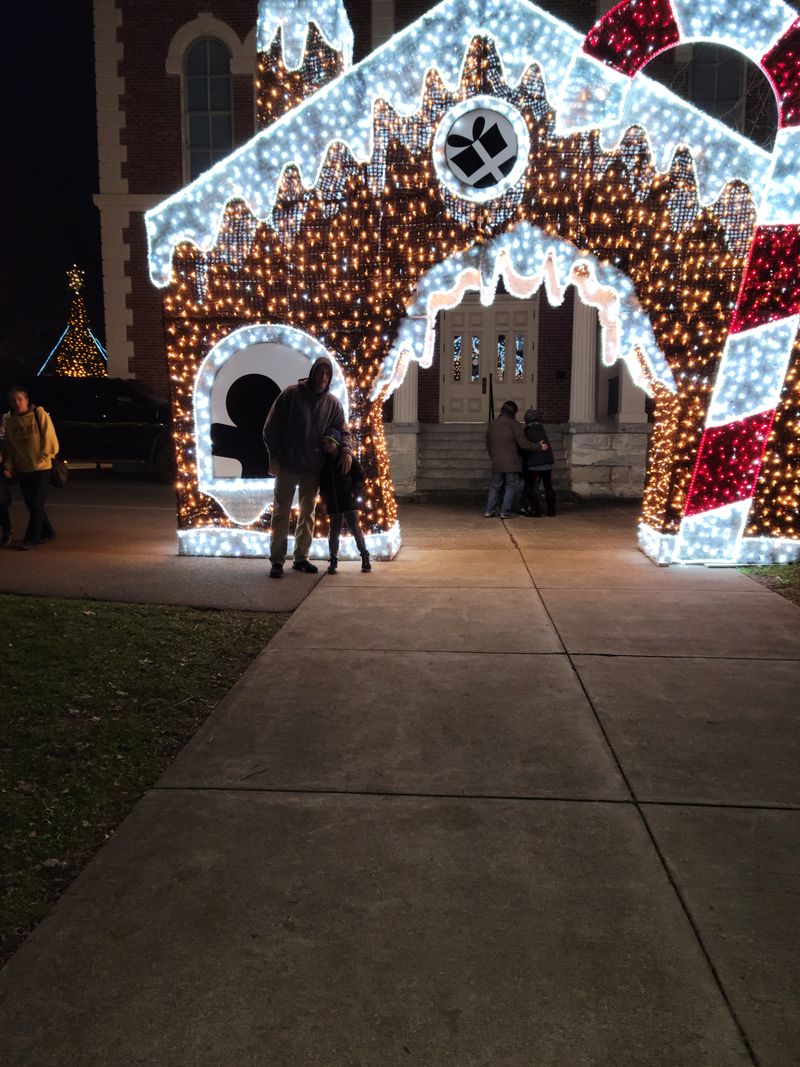
Downtown Effingham presents its holiday lighting with a sense of balance that mirrors its crossroads identity, offering clarity rather than excess.
Clean white lights trace storefronts and civic buildings, creating a visual language that feels intentional and easy to read.
The seasonal displays build on broader revitalization efforts, layering festivity onto spaces already designed for gathering and circulation.
Art installations present throughout the year remain visible beneath the lights, preventing the season from overwhelming the town’s ongoing cultural life.
Movement through downtown feels intuitive, with clear sightlines and evenly spaced points of interest.
As darkness deepens, the glow spreads outward rather than inward, giving the streets an open and welcoming quality.
The experience leaves an impression of steadiness, as though the town is comfortable pausing briefly without losing momentum.
9. Belleville
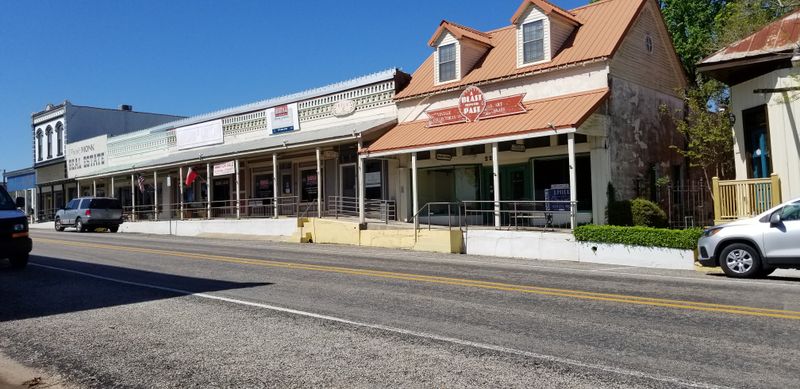
Warm light spills across brick and stone as the holiday market takes shape, transforming downtown into a space that feels both ceremonial and lived in.
German heritage informs the season not as reenactment but as structure, guiding how stalls are arranged and how music and food share space.
The presence of church spires and civic buildings lends the celebration a vertical calm, anchoring activity without dominating it.
Rather than dispersing energy, the layout concentrates movement, keeping conversations and music overlapping in gentle layers.
Lighting here favors warmth and density, allowing faces, textures, and gestures to remain visible even after full dark.
The crowd shifts easily between browsing and watching, never forced into a single mode of participation.
As the evening winds down, the glow feels communal rather than commercial, lingering long after individual stalls begin to close.
10. Sycamore
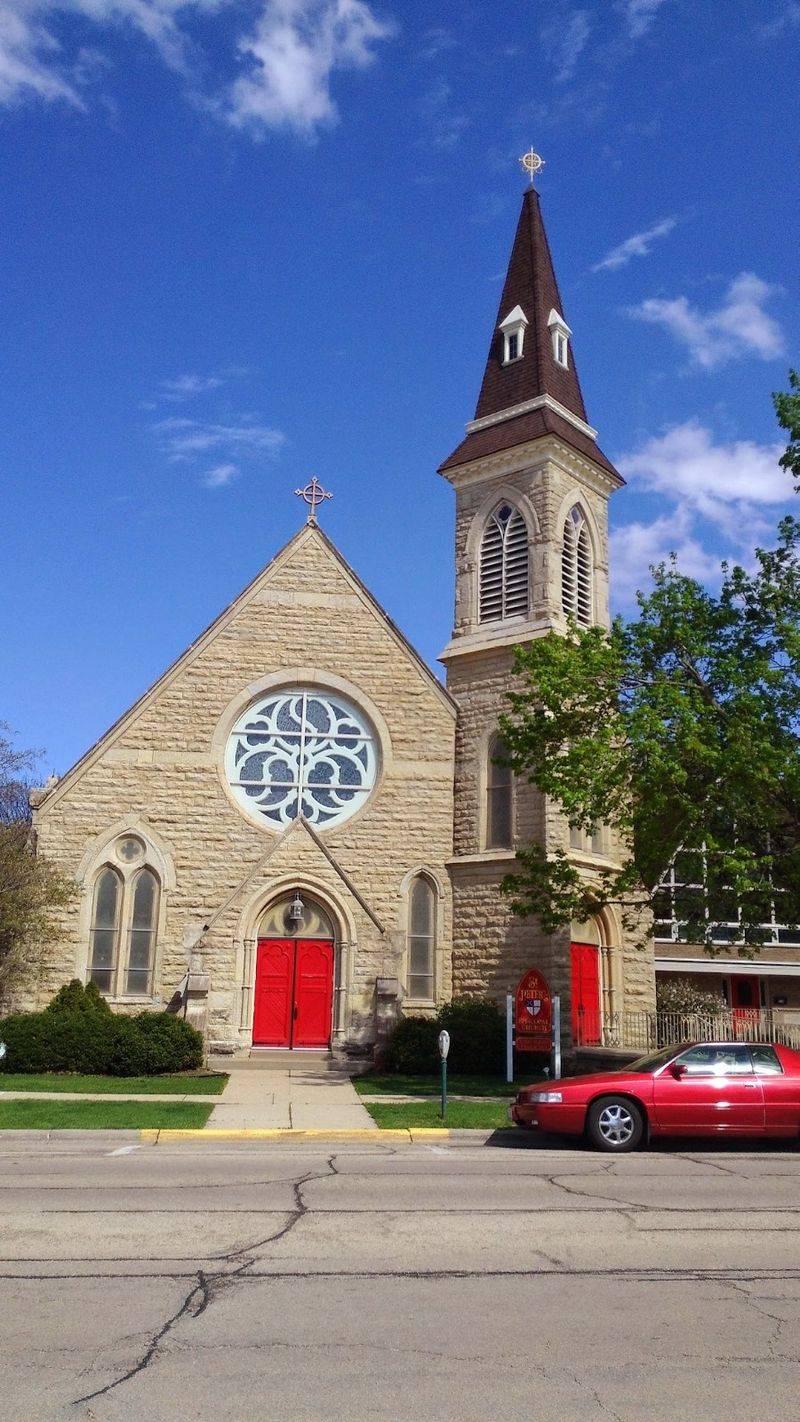
Steam from warm drinks and breath hangs briefly in the air before dissolving beneath the courthouse lights.
The Victorian square holds its symmetry confidently, allowing decorations to accent rather than redefine its geometry.
Holiday traditions here feel inherited rather than invented, carried forward through repetition and shared expectation.
The lighting design respects the courthouse dome as a visual anchor, keeping the square oriented and calm.
Movement remains circular and unhurried, encouraging return passes and second looks.
As the parade concludes, the square settles into a low hum rather than dispersing abruptly.
What remains is a sense of equilibrium, as if the town has found its seasonal center and chosen to stay there awhile.
11. East Peoria

The Festival of Lights transforms driving itself into a communal ritual, where waiting, inching forward, and shared anticipation become part of the experience rather than an inconvenience.
Large illuminated figures rise suddenly from darkness, timed with enough restraint that surprise never tips into chaos.
What began as neighborhood enthusiasm has scaled into a regional tradition while retaining an underlying sense of order.
Logistics and engineering remain largely invisible, allowing motion to feel continuous despite the event’s size.
Children respond instinctively to brightness and repetition, while adults settle into the slow, windshield framed rhythm.
Displays repeat just enough to create familiarity even for first time visitors.
By the final stretch, the lights no longer register as individual scenes but as a continuous narrative unfolding at deliberate, shared speed.
12. Carterville
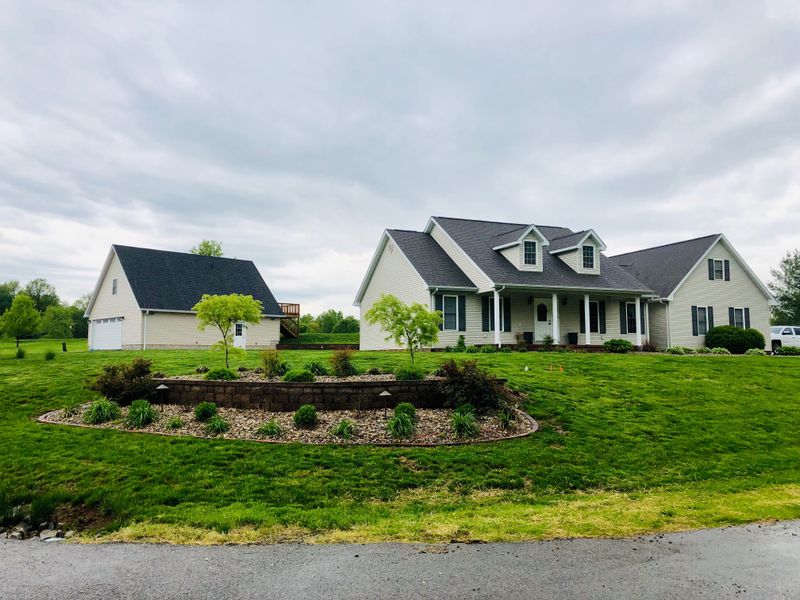
In Carterville, the holiday season announces itself quietly but firmly, as garlands are fastened to lampposts with visible care and the downtown streets take on a softness that feels earned rather than imposed.
The parade route remains compact, which concentrates attention and makes it easy to recognize familiar faces reappearing at different corners of the evening.
Southern Illinois history, shaped by coal, rail, and close knit labor communities, informs a celebration that values reliability, clarity, and shared effort over scale.
Lighting choices favor warmth over brightness, allowing brick, signage, and winter coats to remain readable instead of washed out.
Because everything sits within walking distance, movement becomes conversational rather than directional, with people drifting instead of marching.
The night unfolds without urgency, creating room for pauses, small talk, and repeated encounters.
By the end of the evening, the glow feels inseparable from the town’s everyday rhythm, as if this is simply how Carterville prefers to be seen.
13. Jerseyville
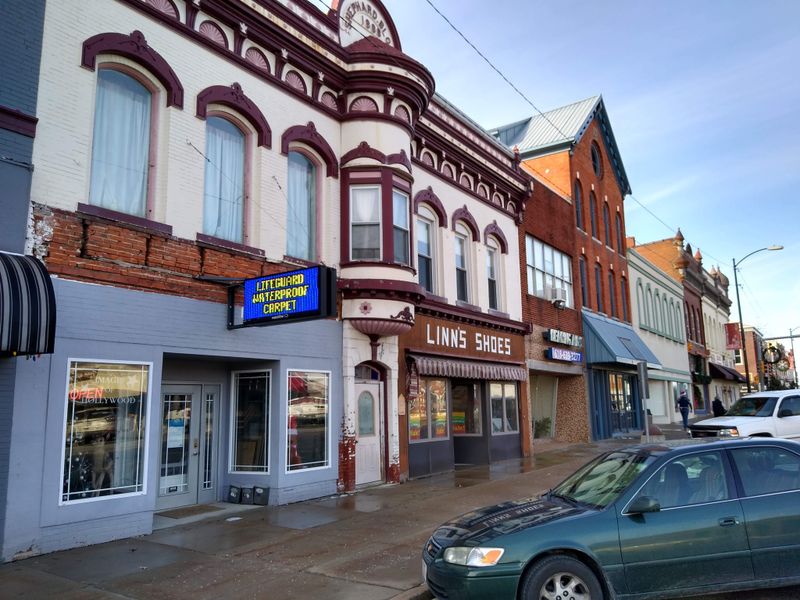
Holiday lights pool gently along the main streets of Jerseyville, outlining historic homes and civic buildings in a way that emphasizes continuity rather than transformation.
The downtown tree establishes a visual tempo that other decorations follow, creating a sense of order without rigidity.
As a county seat with strong agricultural ties, the town brings a grounded energy to its celebrations that resists excess.
Porches and storefronts provide surfaces for light to rest on, rather than compete with, lending the evening a composed appearance.
Routes through residential neighborhoods extend the experience beyond downtown, encouraging slow driving and careful observation.
Conversations drift easily between sidewalks and doorways, reinforcing the sense of shared ownership over the season.
When the evening winds down, the lights remain steady and patient, as if content to be seen without demanding attention.
14. Beardstown
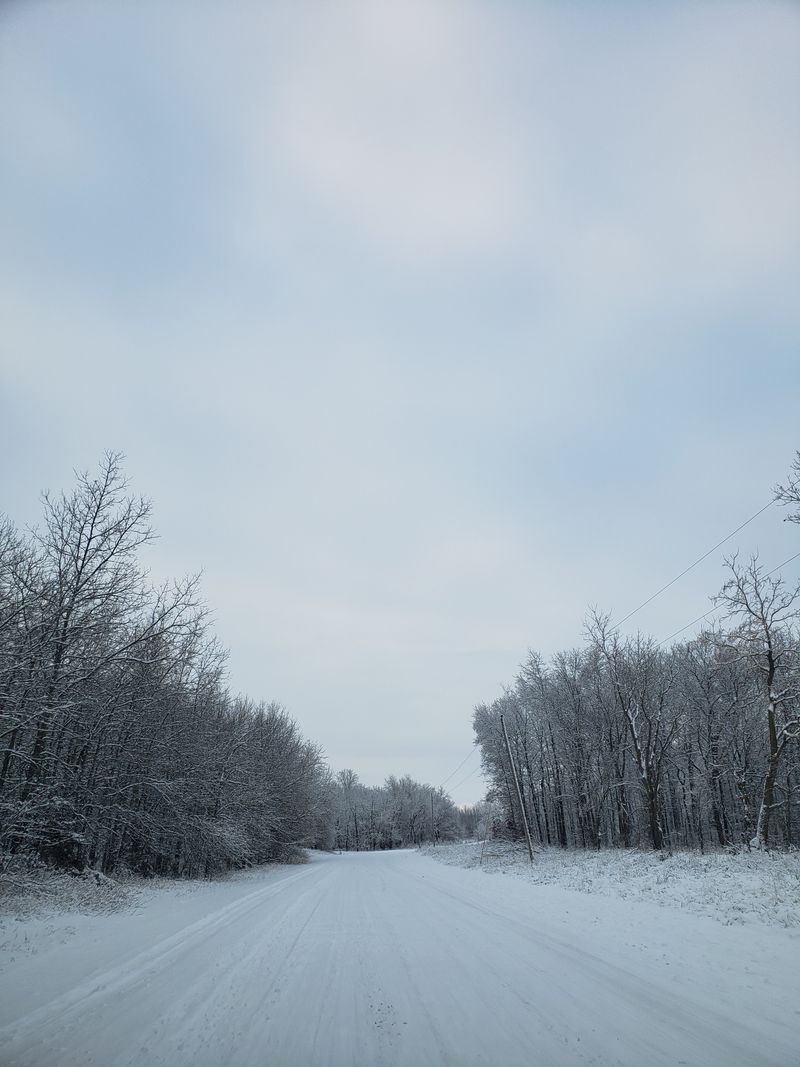
River air sharpens the cold in Beardstown, and the lights respond by feeling warmer, steadier, and more deliberate in contrast.
The square glows with a modest confidence, shaped by civic pride rather than ambition.
Historical awareness, including the town’s legal connections to Abraham Lincoln, anchors the season in something larger than decoration.
Community groups maintain displays with an eye toward longevity, favoring upkeep and timing over novelty.
Movement remains sparse and calm, allowing sound to carry and silence to return quickly.
The proximity of the river adds a subtle undertone of motion even when the town itself grows still.
After the tree lighting ends, the lights seem to settle into place, content to accompany the water’s steady passage.
15. Grafton
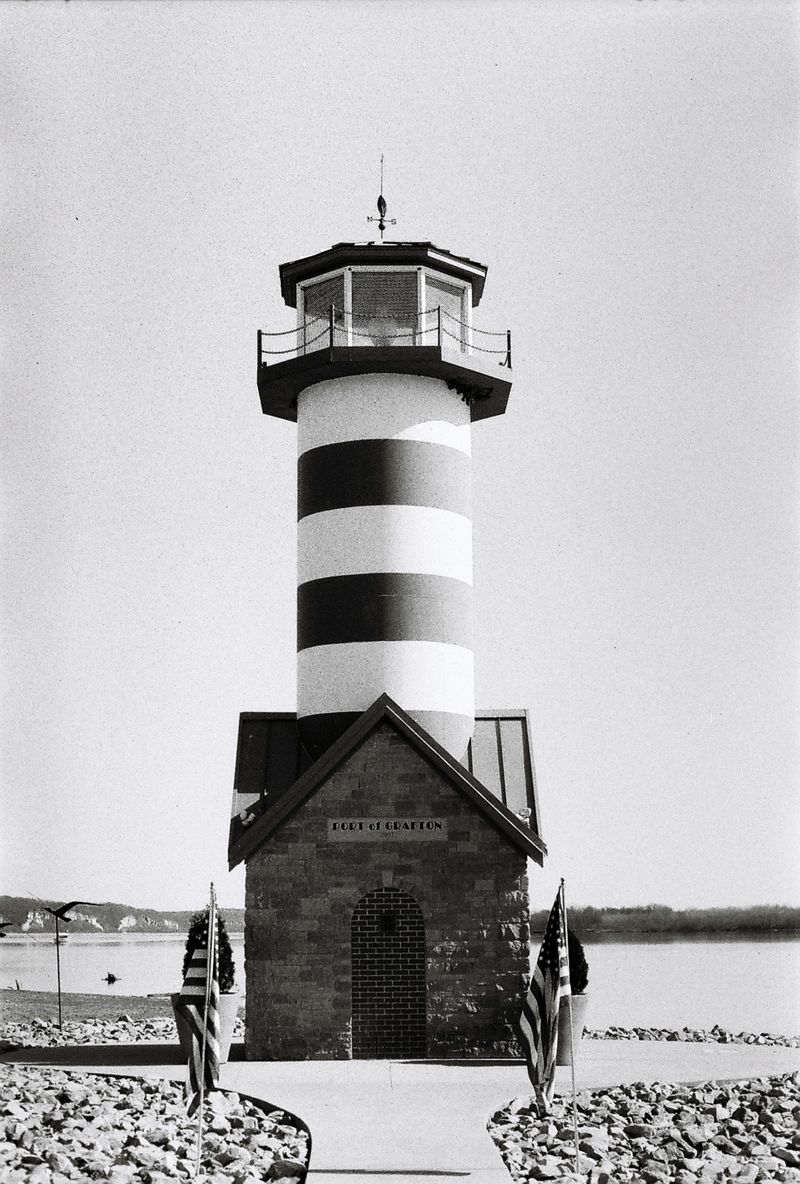
At the point where two rivers meet and winter air moves with unusual force, the holiday lights in Grafton stretch outward and reflect back in ways that make the town feel temporarily suspended between water, bluff, and sky rather than anchored to a single street.
Main Street glows against the dark mass of the surrounding limestone cliffs, creating a layered visual depth where illumination feels earned by contrast rather than amplified by density.
Flood history and repeated rebuilding have shaped a seasonal attitude that values resilience and continuity, so decorations feel purposeful instead of ornamental.
Winter quiet slows foot traffic naturally, allowing each strand of light to register against the movement of the river below.
Reflections from the marina double simple displays into long, wavering ribbons that change with every shift of current.
People pause more than they circulate, choosing vantage points rather than routes.
By the end of the evening, the lights feel neither fixed nor fleeting, but held briefly in balance between land and water.
16. Naperville
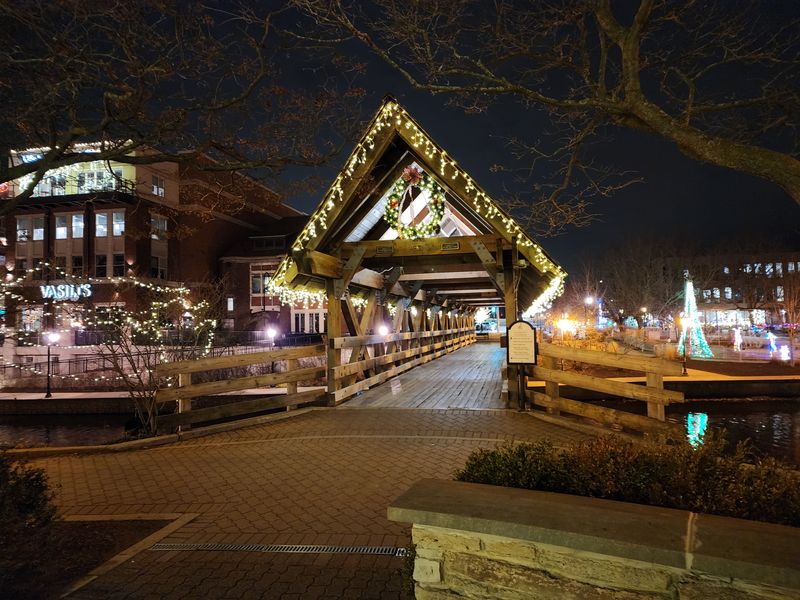
Naperville absorbs the holiday season with practiced ease, as the Riverwalk’s generous paths distribute crowds without compressing them or forcing a single direction of movement.
Covered bridges, public art, and water features catch scattered glints of color, creating layers of light that reward wandering rather than stopping.
The NaperLights display spreads deliberately across space, favoring immersion over focal spectacle.
Living history elements blend into the season without feeling staged, maintaining continuity with everyday use of the area.
Public space here is trusted, allowing visitors to move independently, double back, and linger without guidance.
Reflections along the water soften the pace, encouraging slow loops instead of linear progress.
As the night winds down, the lights feel fully integrated into the city’s infrastructure, suggesting confidence in shared space that extends far beyond the holidays.