
14 Indiana Covered Bridges So Picturesque They Could Double As Postcards
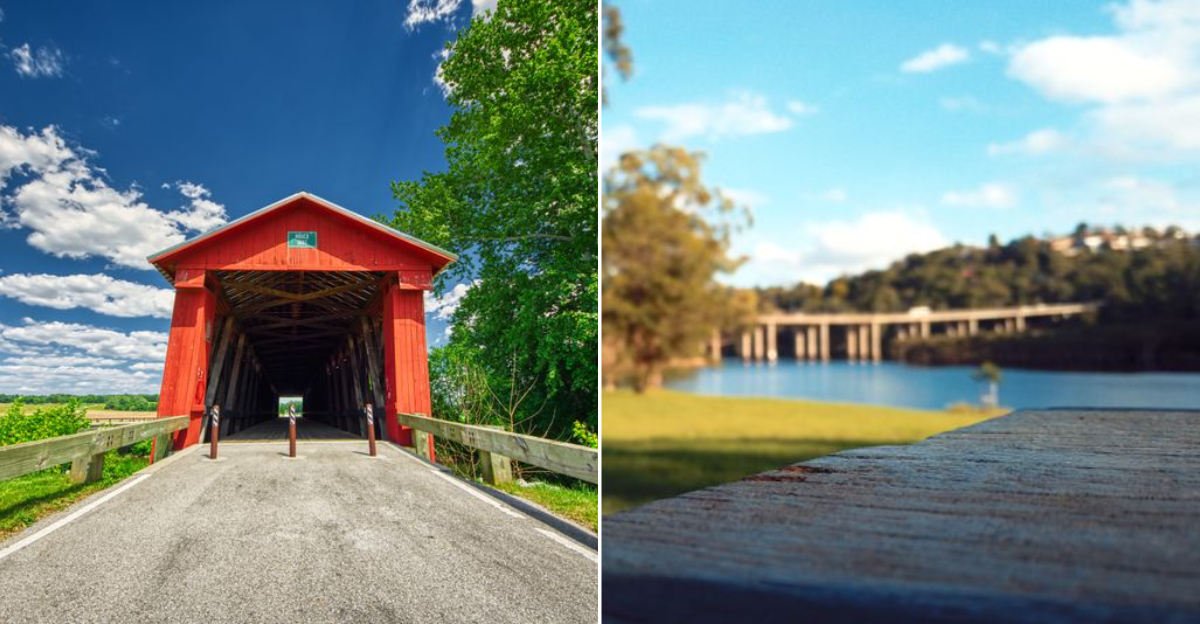
Indiana wears its history in red paint and timber trusses, and the covered bridges scattered across the state feel less like landmarks and more like pauses in the road where time agrees to slow down.
Driving toward them usually means leaving highways behind for narrow farm roads, where cornfields stretch long and quiet, creeks flash silver through trees, and hand-painted signs appear just in time to reassure you that you are still going the right way.
Each bridge arrives with its own small ceremony: the temperature drops a notch inside the wood frame, tires hum differently underfoot, and the outside world briefly narrows to beams, shadows, and the sound of water moving patiently below.
These crossings were built to work, not to charm, yet they end up doing both, framing mill towns, pastures, and bends in the river like postcards you accidentally walked into.
Locals still talk about them with a mix of pride and familiarity, as if they were neighbors who have simply always been there.
This trip winds through places where schedules stay gentle, where hay dries in the sun, and where evenings settle in early.
Walk slowly, listen closely, and let these bridges show you how Indiana remembers itself, one quiet span at a time.
1. Mansfield Bridge, Mansfield
Morning mist often settles low along Big Raccoon Creek, drifting beneath Mansfield Bridge in a way that softens the mill village and makes the Burr arch truss feel like part of the weather rather than a structure imposed on it.
Built in 1867 by J. J. Daniels, the bridge anchors Mansfield Village with quiet authority, its deep red siding and heavy timbers working in concert with the nearby mill wheel that turns steadily as if marking time for the entire valley.
The air smells faintly of damp wood, grain, and kettle corn during festival days, blending history with the very present reality of people still using the space.
During the Covered Bridge Festival the village fills quickly, but early mornings retain a hush that lets you hear water answering the mill’s rhythm.
Parking requires care because the road bends sharply near the approach, reinforcing the idea that this is not a place meant for speed.
Sunlight slides slowly along the interior boards, revealing tool marks and repairs accumulated over generations.
Leaving Mansfield almost always happens at a slower pace than arriving, as if the bridge quietly insists you carry its tempo with you.
2. Bridgeton Bridge, Bridgeton
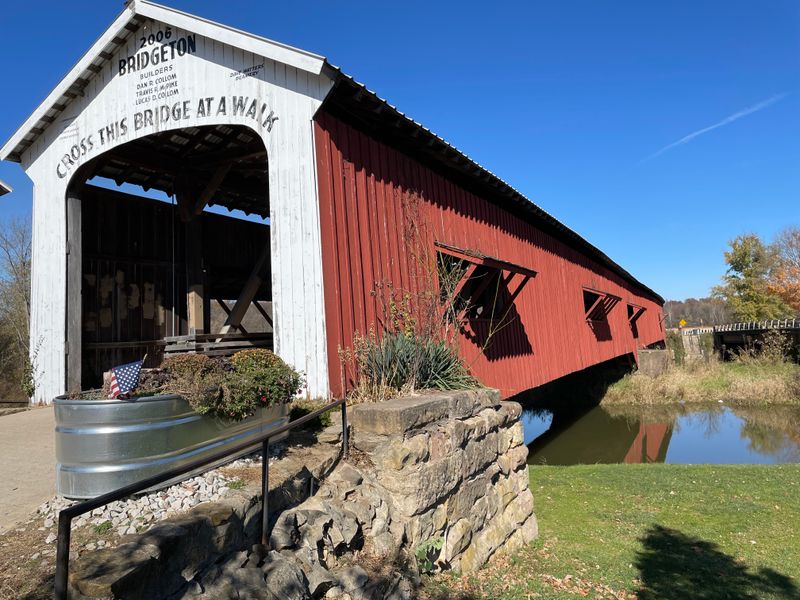
Water spilling over the Bridgeton Mill dam turns the entire scene into movement, lace-like and constant, framing the covered bridge in sound as much as in sight.
Although the current structure dates to 2006, rebuilt faithfully after arson to match J. J. Daniels’ 1868 design, it carries itself with the confidence of something much older.
The working mill across the way still grinds grain, dusting the air with a faint flour smell that makes the place feel lived-in rather than preserved.
Small shops and porches encourage lingering conversations that stretch longer than planned.
Festival days bring crowds and distant parking, while quieter hours reveal how gently the bridge sits in its setting.
Golden hour warms the timbers and dam spray simultaneously, making it difficult to tell where structure ends and landscape begins.
Walking downstream for a full profile view often becomes the moment people realize they have stopped checking the time.
3. Cox Ford Bridge, Bloomingdale
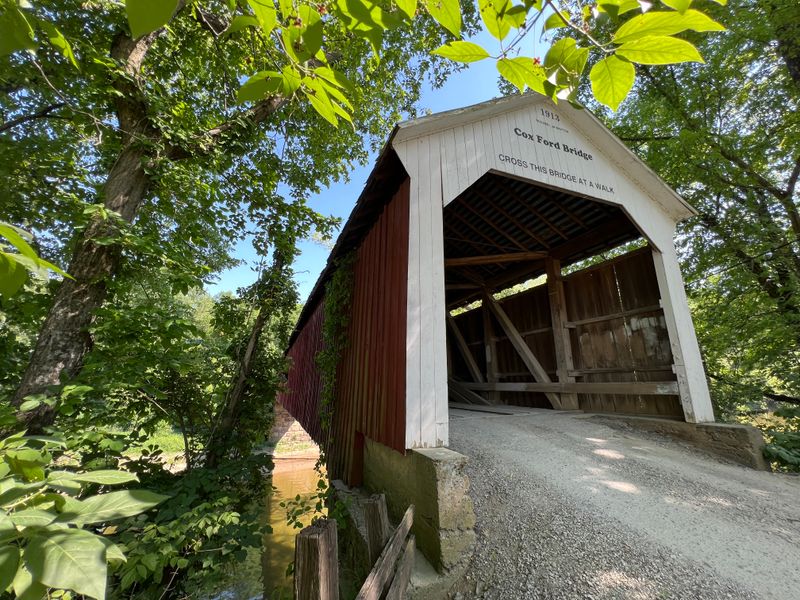
At the edge of Turkey Run State Park, Cox Ford Bridge crouches low over Sugar Creek, its posture practical and unshowy in a way that suits the surrounding sandstone ravines.
Built in 1913 by J. A. Britton, the Burr arch truss here feels compact and hardworking, as if designed specifically for muddy boots and quiet crossings rather than spectacle.
Hikers pass through with calves dusted in trail grit, pausing just long enough to appreciate the shade before continuing on.
The smell of wet leaves, creek water, and old timber mixes into something distinctly park-like.
Parking near the ford is limited, reinforcing the sense that this bridge prefers fewer visitors at a time.
Inside, the boards creak with a familiar floorboard honesty rather than complaint.
Crossing it feels less like visiting a landmark and more like borrowing something dependable for a moment.
4. Narrows Bridge, Bloomingdale
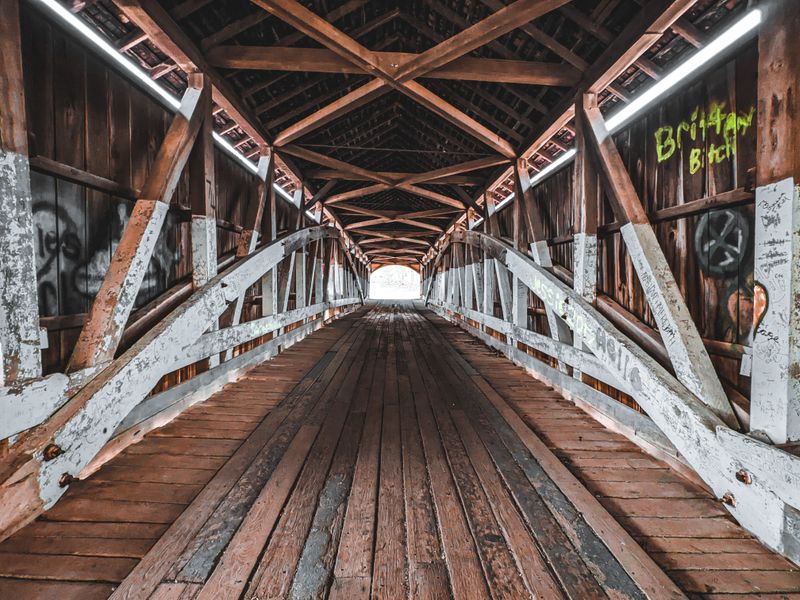
Sound tightens and intensifies at the Narrows, where Sugar Creek squeezes itself into a narrower channel and sends its rippling echoes straight up into the timbers of this 1882 J. J. Daniels bridge, making the act of simply standing still feel like participation in a quiet conversation between water, wood, and gravity.
The red siding frames a compressed corridor of shifting light, and when swallows dart through the portals tracing fast, calligraphic arcs, the whole structure seems briefly animated, less an object and more a moment that happens to be repeating itself.
Everything here feels intimate and slightly enclosed, as if the landscape leaned inward to listen more closely.
Trail markers nearby point hikers toward ladders and sandstone ravines, yet many people pause longer than expected, caught by the way the creek chooses its line beneath the span.
On weekends paddlers drift under the bridge, their voices softened by water and shadow, waving as they pass through the narrow throat of sound and light.
Late-day shadows settle the surface of the creek, flattening reflections until the bridge appears doubled, then blurred.
Standing at the center, watching the current commit to its path, often becomes the quiet hinge on which the rest of the day turns.
5. Jackson Bridge, Bloomingdale
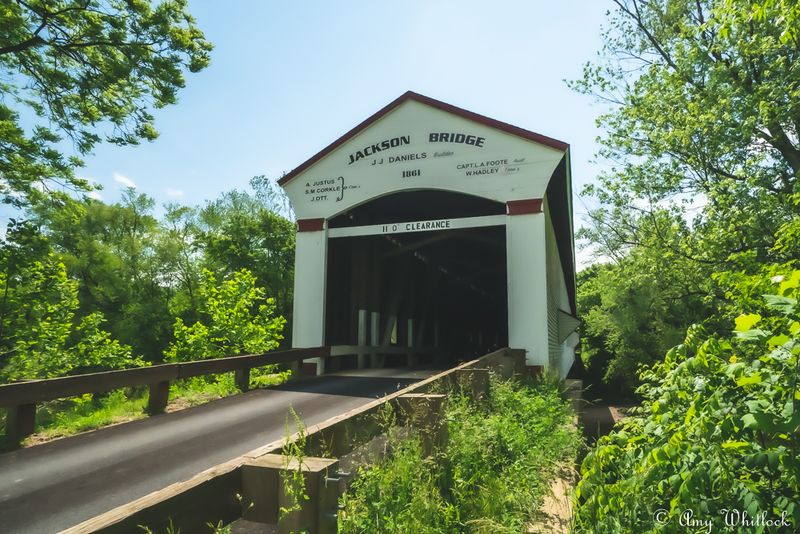
Jackson Bridge announces its age without apology, bearing the mark of 1861 and the confident hand of J. J. Daniels in proportions that feel resolved, balanced, and unconcerned with trends or commentary.
Rising higher over Sugar Creek than several nearby spans, the bridge holds itself with a kind of rural dignity, its Burr arch both elegant and sturdy, as if it expects to be relied upon rather than admired.
Cornfields nearby angle gently toward the water, tassels whispering whenever wind threads the valley, adding a soft agricultural soundtrack to the scene.
There is little signage and no theatrical framing, which somehow sharpens attention rather than dulling it.
Pulling off the shoulder requires care, reinforcing the idea that arriving here is an intentional act, not an accident.
Inside, the repeating timber pattern creates a rhythm that feels almost musical, steady and reassuring.
On calm days, reflections gather beneath the span and quietly mirror both the bridge and the mood you brought with you.
6. West Union Bridge, Montezuma
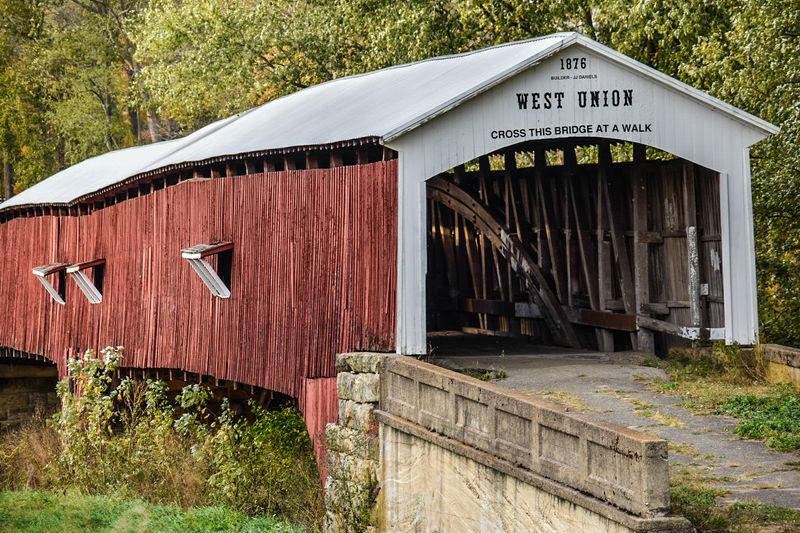
West Union Bridge carries itself like an elder with impeccable posture, spanning the Wabash River in a way that feels more civic than rustic, more architectural statement than pastoral ornament.
Built in 1876 by J. A. Britton, it stands taller and longer than most covered bridges, its squared portals and measured lines allowing the broad river below to provide all the drama necessary.
The soundscape changes immediately, replacing creek chatter with slower, heavier water and wind that moves uninterrupted across the surface.
Approach roads are narrow and deliberate, funneling visitors into a small parking area that emphasizes arrival over convenience.
As sunset approaches, bronze tones emerge from the siding while the Wabash throws back long, patient reflections.
Seen from downstream, the full length of the bridge assembles into a single, composed gesture against the sky.
The scale of river and span together has a quiet way of resetting your sense of proportion, leaving you standing a little straighter without quite knowing why.
7. Billie Creek Bridge, Rockville
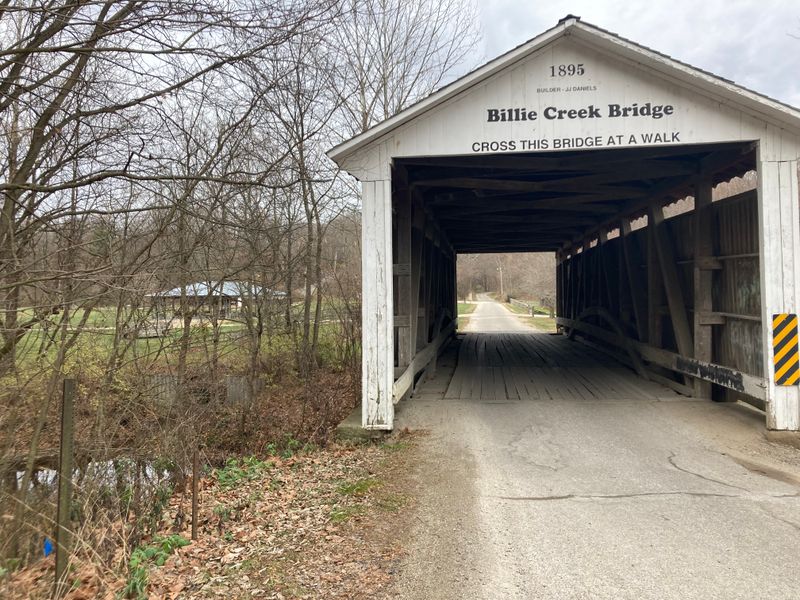
Within the living history setting that surrounds it, Billie Creek Bridge feels less like an isolated artifact and more like a working sentence in a longer story that is still being spoken aloud.
Constructed in 1895 by J. A. Britton, its compact Burr arch invites close inspection, rewarding anyone willing to slow down enough to notice joints, pegs, and the logic of repetition.
School groups cross in tidy lines, counting roof supports or inventing small arithmetic games, their voices echoing lightly off the interior boards.
A nearby steel truss bridge stands as a quiet comparison, offering an unspoken lesson in engineering eras without needing explanation.
Festival weeks bring music and kettle steam, while ordinary days retain a gentler, instructional calm.
Clear signage and easy parking encourage brief but thoughtful stops rather than rushed checklists.
Many visitors leave with the lingering sense that history can be handled carefully, without being squeezed into spectacle.
8. Roseville Bridge, Rosedale
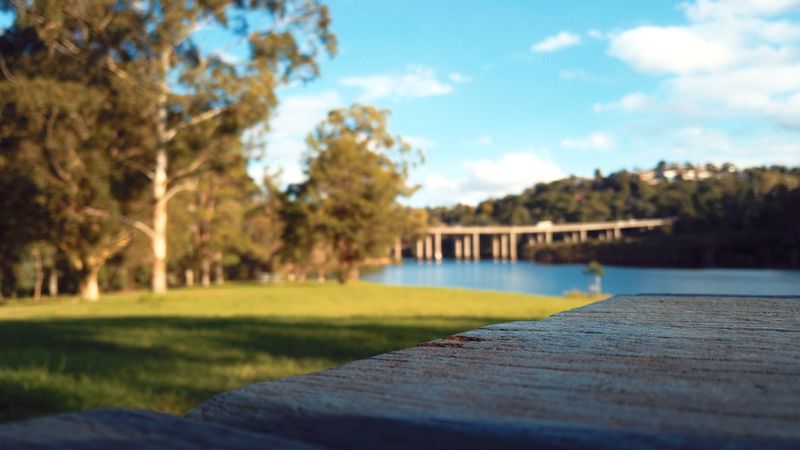
Roseville Bridge looks perpetually ready for work, as if wagons, tractors, or pickup trucks might appear at any moment needing reliable passage across Big Raccoon Creek.
Built in 1910 by J. A. Britton, its no-nonsense Burr arch favors function over flourish, a choice that feels entirely appropriate for its agricultural surroundings.
The red siding softens into the trees, allowing the creek to dominate the sensory field with water movement and reflected light.
Anglers quietly stake their positions along the bends, while trucks idle nearby with polite patience.
Limited pull-off space makes advance planning part of the visit rather than an inconvenience.
Dragonflies patrol the air during warmer months, hovering and darting like tiny machines.
The bridge offers an unspoken permission to pause without justification, and many people accept the invitation without realizing it.
9. Medora Bridge, Medora
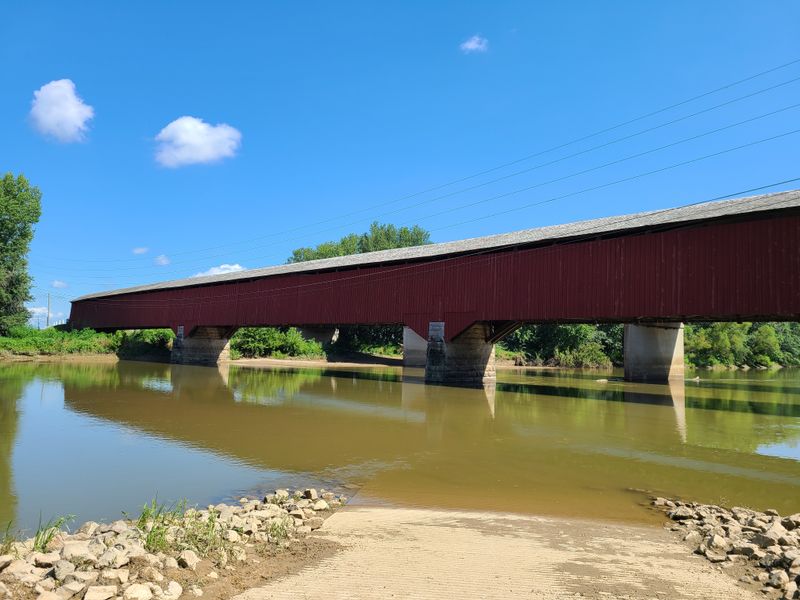
Stretching farther than any other covered bridge in Indiana, Medora Bridge spans the East Fork of the White River with a calm persistence that feels less like an attraction and more like a piece of working countryside that simply never stopped doing its job.
Built in 1875 by J. J. Daniels, the three-span structure favors length and balance over ornament, its weathered red siding reading closer to a barn wall than a postcard flourish, which somehow makes its scale feel even more honest.
Wind moves freely across the open valley here, combing the surrounding fields and carrying dust and grass seed into the trusses, where the smells of river water and sun-warmed timber mingle quietly.
Parking near the interpretive signs is straightforward, encouraging visitors to approach on foot rather than rush through by car.
The river below spreads wide and shallow, braiding itself into reflective channels that change shape with the light.
Inside the bridge, footsteps echo clearly and then fade, answered by the hollow resonance of boards that have absorbed generations of crossings.
Nothing about the structure urges you onward, and that unspoken permission to linger often becomes the most memorable part of the visit.
10. Spencerville Bridge, Spencerville
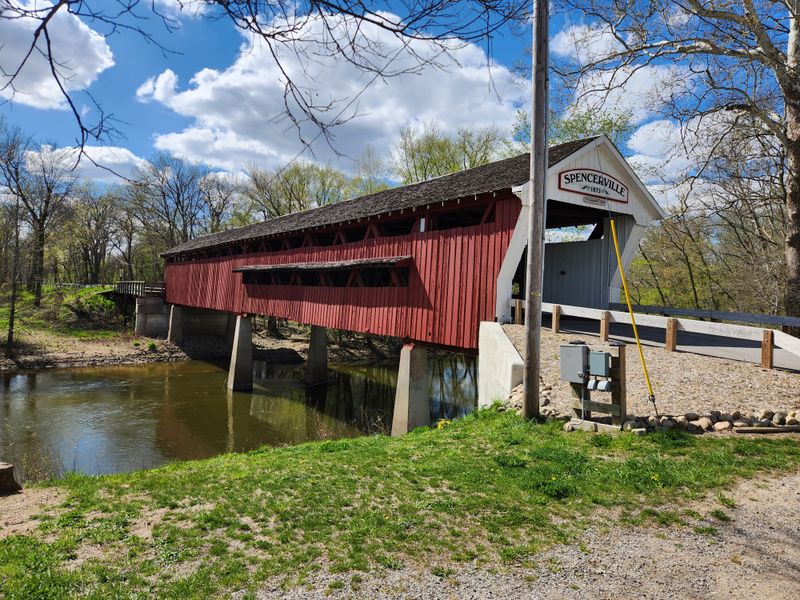
Spencerville Bridge slips easily into postcard territory during winter snowfalls, yet its appeal remains steady year-round, shifting mood with the seasons rather than relying on a single dramatic moment.
Constructed in 1873 by John McKay, the rare Smith truss design gives the interior a distinctive geometry, with diagonal members creating a visual rhythm that feels both intricate and quietly logical.
Cedar scents mix with cold river air, while the St. Joseph River passes beneath at a steady pace that seems indifferent to weather or spectators.
Local residents cross the bridge with the ease of familiarity, slowing naturally as if the structure itself sets the tempo.
There is room to park on the north side, though winter approaches demand patience and careful footing.
Morning light filters through the openings and stripes the interior with alternating bands of warmth and shadow.
Tracing the diagonal beams with your eyes or hand feels like reading a signature that has survived decades of use without losing its meaning.
11. Cataract Falls Bridge, Cataract
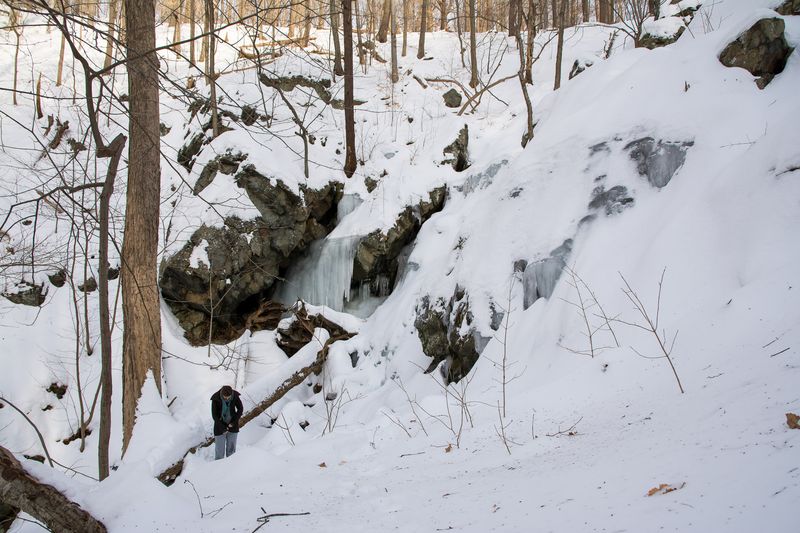
The constant thunder of Indiana’s largest waterfall forms a dramatic backdrop at Cataract Falls Bridge, where sound becomes as much a part of the experience as the sight of red timbers against moving water.
Built in 1876 by J. A. Britton, the bridge sits between the upper and lower falls inside Lieber State Recreation Area, positioned so that mist and motion never fully leave the frame.
Fine spray drifts across the deck on busy days, leaving the air tasting mineral-bright and cooling skin even in warm weather.
Families move between overlooks while photographers set up patiently, tripods rising and folding in practiced cycles.
Park gate hours shape the visit here, encouraging planning rather than spontaneous drive-bys.
After heavy rains the falls roar with authority, yet moments of quiet return more quickly than expected once crowds thin.
Standing downstream with both bridge and waterfall aligned often produces a strange, satisfied stillness, as if the landscape briefly agreed to hold its breath with you.
12. Baker’s Camp Bridge, Bainbridge
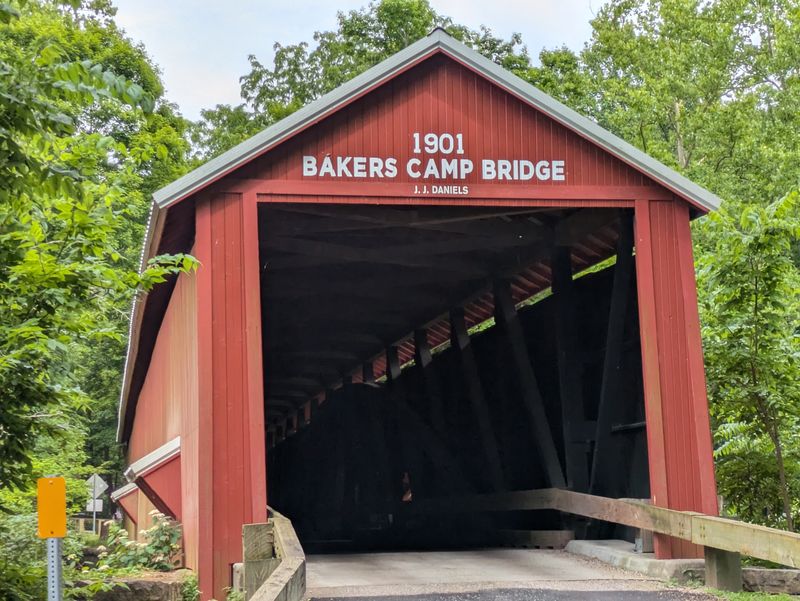
Baker’s Camp Bridge sits low and shaded along Big Walnut Creek, where limestone shelves cool the air even in midsummer and the approach road feels deliberately slowed by trees that seem to lean inward with quiet familiarity.
Built in 1901 by J. A. Britton, the Burr arch construction carries a workmanlike confidence, its red siding worn softly like a favorite jacket rather than a museum piece meant to be admired from a distance.
The creek beneath gossips constantly over stone, producing a layered soundscape of trickles and pauses that settles the body almost immediately after arrival.
Beech and maple trees frame the entrance, and birds trade short, sharp calls across the roofline as if keeping score.
Locals use the small pull-off for picnics and quick rests, treating the bridge as a shared amenity rather than a destination that demands ceremony.
After storms the gravel ruts slightly, encouraging slow driving and careful footing that matches the place’s unhurried tone.
Sitting on the abutment and listening to wind move through the timbers can feel less like sightseeing and more like borrowing a pocket of calm that the bridge has been holding onto all along.
13. Edna Collins Bridge, Greencastle
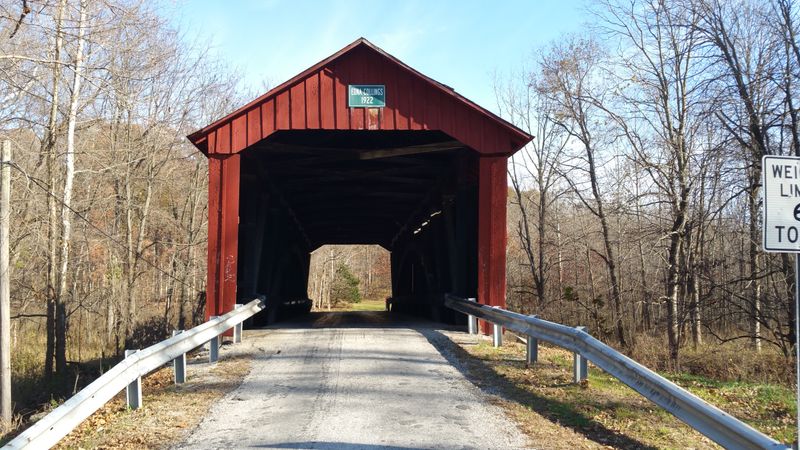
Edna Collins Bridge reveals itself most clearly at dusk, when shadows lengthen quickly and the red siding absorbs light instead of reflecting it, turning the structure into a quiet silhouette against Little Walnut Creek.
Constructed in 1922 by J. A. Britton, this bridge favors simplicity over flourish, its clean lines and modest proportions allowing the surrounding landscape to do most of the expressive work.
Local folklore clings to the site, with whispered ghost stories about soft knocks and unseen footsteps circulating more out of tradition than conviction.
During daylight hours the bridge feels entirely neighborly, welcoming dog walkers, anglers, and curious passersby who pause briefly and move on without fuss.
Parking near the approaches requires courtesy and attention, especially as evening falls and headlights can easily overpower the narrow space.
Inside, the acoustics amplify small sounds, turning a casual greeting or footstep into a brief echo that lingers longer than expected.
Whether or not you believe the stories, the combination of fading light, water movement, and timber resonance makes it easy to understand why imagination tends to fill the quiet here.
14. Houck Bridge, Greencastle
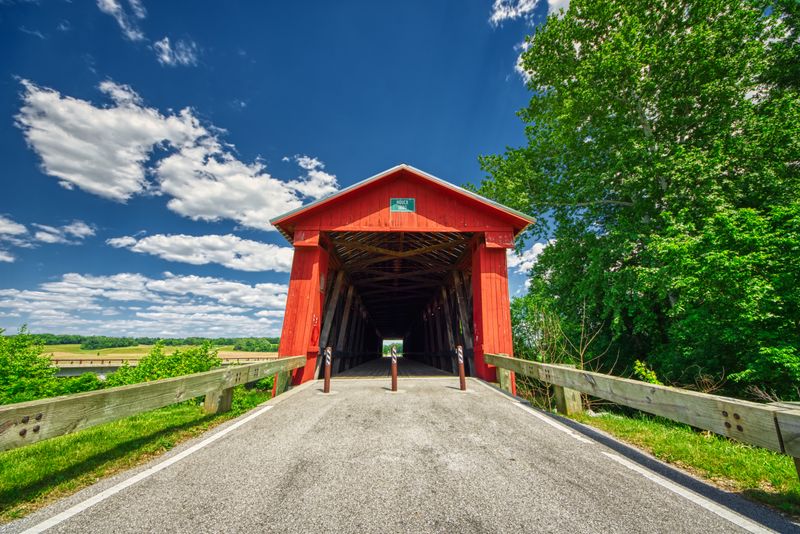
Houck Bridge maintains a deliberately low profile, tucked among fields and a gentle bend of Big Walnut Creek where agriculture and water quietly negotiate space year after year.
Built in 1880 by Joseph A. Britton, the Burr arch reveals careful joinery to anyone willing to slow down and look closely at how beams meet and support one another.
Cicadas often dominate the soundscape in warmer months, their steady pulse occasionally interrupted by the distant engine of a tractor or the splash of a fish breaking the surface downstream.
The pull-off is small and requires thoughtful parking, reinforcing the sense that visits here are meant to be brief, respectful, and shared.
Afternoon light transforms the siding into a deep red-brown that feels restrained rather than showy, a color that sits comfortably against cornfields and sky.
Anglers favor the downstream bank, trading quiet observations about water clarity and recent rains without raising their voices.
It is difficult not to speak more softly here, as if the bridge itself asks for a lower register, answering in return with shade, woodgrain, and a feeling of having arrived exactly where you were supposed to stop for the day.