
11 North Carolina Vintage Theaters Only Locals Remember
Growing up in North Carolina, I discovered magic wasn’t just in movies but in the theaters themselves.
These vintage movie palaces and playhouses transported us to another era with their ornate architecture, velvet curtains, and crackling film projectors.
While some have been restored to their former glory, others live on only in the memories of longtime residents who once lined up for Saturday matinees or first dates under their marquees.
1. Carolina Theatre (Greensboro): Where First Dates Became Lifelong Memories
My grandpa proposed to my grandma in the balcony of this 1927 gem! Originally a vaudeville venue, the Carolina Theatre hosted everything from silent films to traveling Broadway shows before falling into disrepair in the 1970s. The ornate Spanish-style interior featured hand-painted ceiling murals that made moviegoers feel like they were sitting under a Mediterranean sky.
Local teenagers would save up for weeks just to afford balcony seats – the prime real estate for high school sweethearts. After narrowly escaping demolition thanks to passionate locals who formed the ‘United Arts Council,’ this historic landmark reopened in 1989. Some elderly Greensboro residents still swear they can smell the original popcorn machine when they walk through the lobby today.
2. Carolina Theatre (Durham): The Downtown Crown Jewel That Refused To Fade
Sneaking candy into this majestic Beaux-Arts theater was practically a Durham rite of passage! Built in 1926, this downtown landmark survived fires, segregation, and several near-demolitions to become the cultural heartbeat of the Bull City. Famous for its Fletcher Hall with intricate woodwork and 1,000+ plush seats, the theater hosted everyone from Ronald Reagan to Ray Charles.
I still remember my dad pointing out the ‘colored entrance’ – a sobering reminder of the separate staircases and balcony section from segregation days. The theater went dark in the 1980s until community activists rallied to save it. Now restored to its former glory, it hosts film festivals and concerts while maintaining its vintage charm – complete with the original ticket booth where my mother once worked summers during college.
3. Fletcher Hall (Durham): The Acoustic Wonder With Hidden Passages
Rumor has it ghosts still roam the catwalks of this acoustic marvel! As the main auditorium of Durham’s Carolina Theatre complex, Fletcher Hall dazzled audiences with its perfect sound design long before digital enhancement existed. The hall’s claim to fame wasn’t just movies – it hosted vaudeville acts with hidden dressing rooms connected by mysterious backstage passageways.
My theater teacher once snuck us through these corridors during a field trip, pointing out signatures on the walls from performers dating back to the 1930s. With proscenium arches and original Wurlitzer organ pipes (though the organ itself disappeared decades ago), Fletcher Hall transported audiences to another world. Many Durham old-timers still recall the 25-cent Saturday morning cartoon marathons that kept kids entertained while parents shopped downtown.
4. The Paramount Theatre (Goldsboro): Small-Town Splendor With Art Deco Flair
Saturday afternoon monster movie marathons at the Paramount defined my childhood summers in Goldsboro! This Art Deco jewel opened in 1919 and survived a devastating fire in the 1930s before being rebuilt with even more spectacular details. The vertical neon sign could be seen from blocks away, beckoning moviegoers with its electric blue glow. Inside, geometric patterns adorned every surface from the carpets to the ceiling tiles, while drinking fountains were disguised as ornate wall sculptures.
Unlike bigger city theaters, the Paramount maintained a family atmosphere where the owner knew regulars by name. After decades of decline and a period as a neglected discount theater, community efforts restored this gem in 2008. The renovation team found original 1940s movie posters sealed behind walls during construction!
5. The Gem Theatre (Kannapolis): Where Mill Workers Escaped Reality
The smell of fresh popcorn wafting from the Gem’s lobby could draw crowds from three blocks away! Built in 1936 by Cannon Mills for its textile workers, this single-screen wonder offered affordable entertainment when factory life got too monotonous. The Gem’s iconic curved white facade and neon marquee became symbols of downtown Kannapolis. My grandmother told stories about mill workers rushing to catch midnight showings after their shifts, still wearing dusty work clothes as they sank into the crimson seats.
A Christmas Day fire in 1942 nearly destroyed it completely, but the theater was rebuilt and reopened within months – the town simply couldn’t bear to lose its entertainment hub. Miraculously, the Gem still operates today as one of America’s oldest continuously running theaters, with ticket prices that seem frozen in time compared to modern multiplexes.
6. The Wilson Theatre (Wilson): Tobacco Money Built This Palace
Walking into the Wilson Theatre as a kid felt like stepping into a European palace! Tobacco fortunes financed this opulent 1919 showplace, which boasted gilded everything – from ceiling medallions to bathroom fixtures. The theater’s massive chandelier contained over 5,000 crystal pieces and required a specialized team just for cleaning. During its heyday, ushers wore formal white gloves and directed patrons with flashlights shaped like tobacco leaves – a nod to the industry that built Wilson.
Live orchestras accompanied silent films from the orchestra pit, where my great-uncle once played violin before talkies arrived. Though the original structure was demolished in the 1960s (a loss locals still lament), photographs reveal a level of grandeur rarely seen in small-town theaters. Former patrons fondly recall the marble staircase where debutantes would make grand entrances on premiere nights.
7. The Colonial Theatre (Canton): Paper Mill Town’s Pride And Joy
Blue collar to the core, the Colonial served more as community center than mere movie house! Built in 1932 when Canton’s paper mill was booming, this Art Deco theater became the social hub for generations of mill workers and their families. Unlike fancier theaters in bigger cities, the Colonial embraced its working-class roots. The lobby displayed photos of mill workers, and special screenings celebrated production milestones.
My uncle worked as a projectionist there in the 1950s, sneaking in neighborhood kids through the back door when the manager wasn’t looking. The theater survived devastating floods that ravaged Canton multiple times – locals joke that the sticky floors weren’t just from spilled sodas but from river water too! Though humble compared to urban movie palaces, the Colonial’s enduring charm came from being the one place where paper dust was banned and dreams were allowed to flourish.
8. The Stevens Center (Winston-Salem): From Silver Screen To Symphony Hall
Velvet ropes and uniformed doormen greeted patrons at what was originally called the Carolina Theatre when it opened in 1929! This downtown Winston-Salem landmark began as a silent movie palace before transforming into the premier performing arts venue it is today. The eight-story building housed not just the theater but offices and retail spaces, making it a true downtown destination.
I attended my first ballet here in the 1980s, marveling at the same gold-leaf ceiling details that had watched over moviegoers decades earlier. During WWII, the theater ran 24 hours a day to accommodate Reynolds tobacco factory workers on all shifts. Renamed the Stevens Center in 1983 after extensive renovation, this grand dame now hosts the NC School of the Arts performances. The original projection booth remains intact – a nostalgic nod to its cinematic beginnings.
9. The Varsity Theatre (Chapel Hill): Where College Memories Were Made
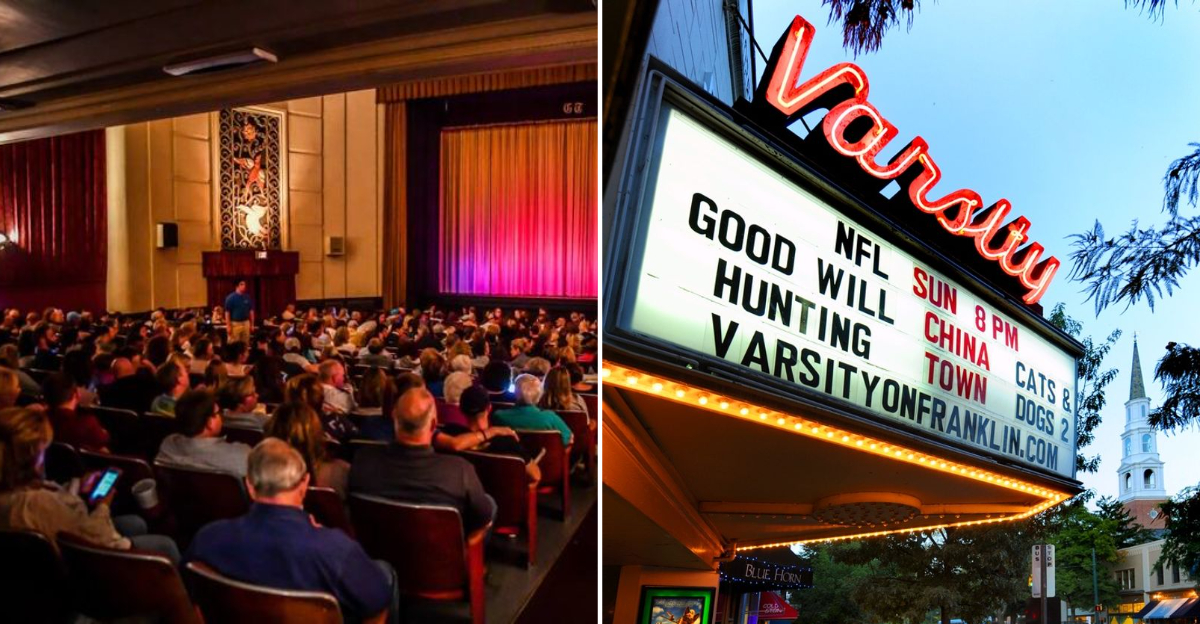
Late night Rocky Horror Picture Show screenings at the Varsity defined UNC student life for decades! This Franklin Street institution opened in 1927 and quickly became intertwined with university culture, hosting everything from foreign films to midnight cult classics. The theater’s Art Moderne facade with its distinctive V-shaped marquee served as a popular meeting spot – “I’ll meet you under the Varsity sign” was a common phrase among students.
My college roommate worked the concession stand, smuggling us free popcorn during exam week movie breaks. Unlike pretentious art houses, the Varsity embraced its slightly shabby charm with mismatched seats and occasional ceiling leaks during rainstorms. Students joked that the sticky floors preserved footprints from generations of Tar Heels. Though it closed in 2009, alumni still reminisce about first dates and film society gatherings in this beloved campus landmark.
10. The Raleigh Little Theatre & Stephenson Amphitheatre: Stars Under The Stars
Summer Shakespeare productions with lightning bugs providing additional illumination! This unique theater complex, built in 1936 as a WPA project, combined indoor performances with an outdoor amphitheater carved into a hillside. Unlike commercial movie houses, the Raleigh Little Theatre focused on community productions where local talent took center stage. The rose garden surrounding the amphitheater made intermissions as memorable as the shows themselves.
My first acting role was on this stage – a terrified 10-year-old with two lines in A Midsummer Night’s Dream. During WWII, the theater hosted USO shows for soldiers training at nearby camps. The stone seating of the amphitheater, designed to accommodate 2,000 spectators, was constructed by local stonemasons using native North Carolina granite. Many Raleigh families can trace their theatrical traditions through generations of performances in this beloved cultural landmark.
11. The Ram Theatre (Ramseur): One-Stoplight Town’s Cinematic Treasure
Nobody cared if your shoes stuck to the floor at the Ram – that just meant you were part of the family! This single-screen theater in tiny Ramseur (population barely 1,600) opened in the 1940s and quickly became the weekend highlight for rural Randolph County residents. The Ram’s claim to fame was its owner, Mr. Wilson, who personally greeted every patron and remembered not just names but preferred candy selections.
During summer months, the lack of adequate air conditioning meant doors were propped open, allowing moths and June bugs to become unexpected audience members. When money got tight in the farming community, the theater accepted produce as payment – my grandfather once traded a bushel of green beans for tickets to a John Wayne double feature! Though it closed in the 1970s and the building now houses a thrift store, elderly residents still call that corner of town “the picture show lot.”