
7 Old-School California Drive-Ins That Locals Still Miss (And A Few Still Standing)
Remember when a night at the movies meant piling into the family car with pillows, blankets, and maybe even a bag of homemade popcorn?
For decades, California’s drive-in theaters offered more than just a chance to watch the latest film—they served as beloved community landmarks where first dates, family outings, and neighborhood gatherings all played out beneath the stars.
With giant screens glowing against the night sky and car radios crackling with movie sound, the experience was uniquely magical. Though most have vanished, replaced by multiplexes and streaming services, the nostalgia for these open-air cinemas remains strong in the Golden State.
1. Gilroy Drive-In: Garlic Capital’s Silver Screen Gem
The scent of garlic fields mingled with buttery popcorn at this beloved Highway 101 landmark. I still remember summer nights in the 1980s, when my family would back our station wagon into a spot, tailgate open, facing the massive screen.
Kids in pajamas sprawled on blankets while teenagers snuck glances at each other between scenes. The Gilroy Drive-In wasn’t just a theater – it was where first dates, family traditions, and community gatherings happened for nearly three decades.
When it closed in 1996, locals lost more than a movie venue; they lost a cultural touchstone that had defined evenings in the Garlic Capital since 1967.
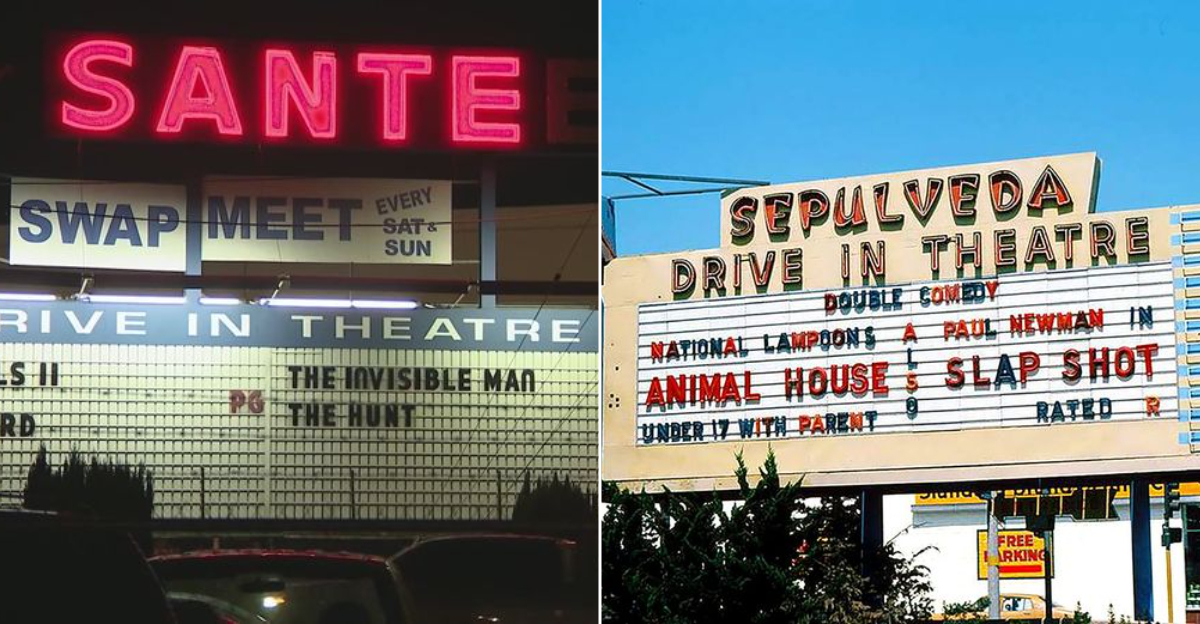
2. Sepulveda Drive-In: Valley’s Vanished Entertainment Haven
Tucked between Van Nuys Boulevard and the railroad tracks, this San Fernando Valley institution welcomed moviegoers for over four decades. My uncle tells stories about cruising there in his Mustang during the 1960s, when the Sepulveda was the coolest weekend destination.
What made this spot special wasn’t just the double features but the festive atmosphere. The playground beneath the screen entertained fidgety kids before showtime, while the snack bar’s famous chili dogs became legendary among Valley residents.
After closing in 1985, the property became a swap meet, but generations of Valley locals still point to the spot and reminisce about their celluloid memories.
3. Winnetka Drive-In: Chatsworth’s Cinematic Playground
Nestled against the Santa Susana Mountains, the Winnetka Drive-In’s screen seemed to float against Chatsworth’s dramatic landscape. Opening night in 1975 featured “Jaws” – I wasn’t born yet, but my mom swears people were afraid to drive home in the dark afterward!
This family-friendly venue boasted a western theme, with cowboy-hatted attendants directing traffic and a concession stand shaped like a frontier saloon. Weekend swap meets became almost as popular as the movies themselves.
Though it vanished in the early 1990s for retail development, former patrons still cruise past the shopping center, pointing out where they parked for “Star Wars” or “E.T.” decades ago.
4. El Monte Drive-In: San Gabriel Valley’s Starlit Cinema
Spanish-language films shared billing with Hollywood blockbusters at this cultural landmark, reflecting El Monte’s diverse community. Walking through the gates as a kid in the 1990s, I marveled at the massive screen looming over Rosemead Boulevard like a concrete sail.
The playground swings creaked beneath the screen where children burned energy before showtime. Families arrived hours early for prime spots, transforming the asphalt into a patchwork of picnics and portable radios tuned to the movie’s audio frequency.
Though demolished in 1999, the El Monte remains immortalized in countless family photo albums and the music video for Beach Boys’ “Fun, Fun, Fun.”
5. South Bay Drive-In: San Diego’s Surviving Cinema Sanctuary
Unlike its fallen comrades, this Palm Avenue institution continues delighting moviegoers since 1958! The neon-outlined palm trees still glow against the night sky, guiding visitors to this three-screen survivor.
My first visit last summer felt like time travel – the metal speaker posts remain, though most patrons now tune their car radios for sound. The snack bar still serves those impossibly orange nacho cheese chips and hot dogs that somehow taste better under the stars.
Beyond movies, the South Bay hosts San Diego’s largest swap meet by day. This resilient venue represents what we’ve lost elsewhere – a multi-generational gathering place where entertainment happens under shared skies rather than separate roofs.
6. Redwood Drive-In: San Jose’s Vanished Valley Venue
Before Silicon Valley was known for tech, the Redwood Drive-In dominated evening entertainment in San Jose. Opened in 1950, its towering redwood-themed marquee became a Capitol Expressway landmark that guided my grandparents on countless date nights.
The massive lot accommodated 750 cars beneath oak trees that sometimes dropped acorns on windshields during shows. Teenagers claimed the back row while families congregated near the playground, creating an unspoken geography of moviegoing traditions.
When it closed in 2001, locals mourned not just the loss of affordable entertainment but the communal experience of laughing, gasping, and sometimes smooching together beneath the same expansive sky.
7. Mission Tiki Drive-In: Montclair’s Polynesian Paradise
Massive stone moai heads guard the entrance to this Inland Empire treasure that refuses to fade into history. Originally opened in 1956 as the Mission Drive-In, it transformed into a Polynesian-themed experience in 2006, proving that reinvention can save these cultural landmarks.
Four screens still operate nightly, surrounded by tiki torches and palm trees. During my visit last month, families played card games in lawn chairs while waiting for darkness to fall and the projectors to flicker to life.
The Mission Tiki’s swap meet remains one of Southern California’s largest, helping sustain this vintage venue. While development threats loom, community support keeps this drive-in experience alive for new generations.
8. Sacramento 6 Drive-In: Capital City’s Lost Landmark
Six massive screens once dominated the skyline near Cal Expo, making this drive-in a Sacramento summertime institution. The sheer scale amazed first-time visitors – you could literally watch different movies by turning your head in different directions!
My college roommate grew up nearby and described epic movie marathons during the 1980s when her family would arrive for the first feature and stay until dawn. The snack bar’s special “Sacramento Burger” became so popular that people sometimes came just for dinner, movie optional.
Though it disappeared in 2005, former patrons still gather for annual reunion screenings at local parks, projecting films onto portable screens in homage to their vanished entertainment mecca.
9. Foothill Drive-In: Azusa’s Automotive Theater
Sandwiched between the San Gabriel Mountains and Route 66, this Azusa institution captured the essence of California car culture. Opening night in 1961 featured “The Absent-Minded Professor” with Fred MacMurray – my dad still has the commemorative ticket stub!
What distinguished the Foothill was its ingenious terraced design. Each parking spot sat slightly higher than the one in front, ensuring unobstructed views even for smaller vehicles. The playground featured a miniature drive-in theater where kids could pretend to be at the movies while actually being at the movies.
Though it closed in 1997, the Foothill’s distinctive yellow and blue color scheme lives on in vintage postcards celebrating America’s roadside attractions.
10. Studio Drive-In: Culver City’s Cinema Under the Stars
Hollywood glamour met casual comfort at this Metro-Goldwyn-Mayer adjacent venue where movie stars sometimes watched themselves on the big screen! Located near the famous studio lots, the Studio Drive-In frequently hosted premiere nights where celebrities arrived in convertibles to mingle with regular moviegoers.
Opened in 1948, its art deco tower became a Culver City landmark visible for miles. My film professor described watching “Singin’ in the Rain” there during a real rainstorm in the 1960s – a meta-experience that couldn’t be replicated in an indoor theater.
After closing in 1993, the property became a shopping center, but its iconic tower was preserved and incorporated into the new development – a rare nod to drive-in heritage.