
Starved Rock’s Sandstone Canyons Can Develop Seasonal Icefalls in Winter
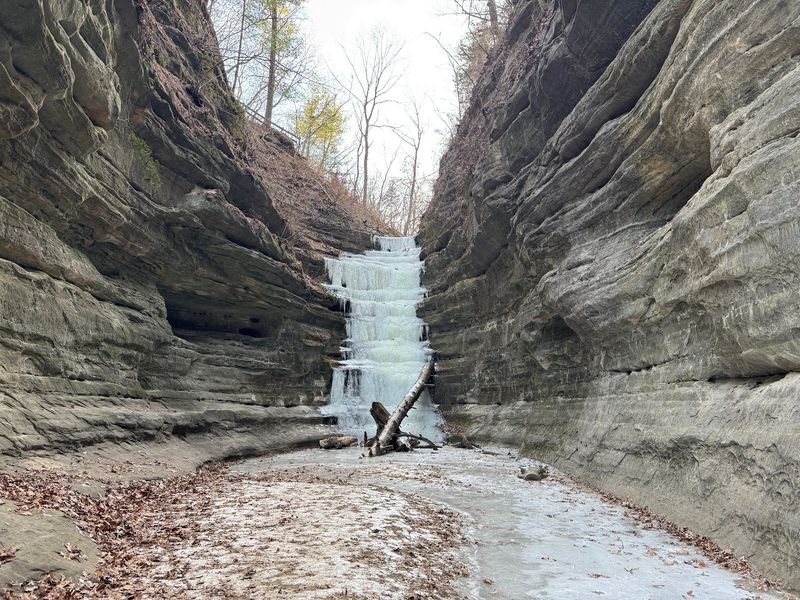
Tucked along the Illinois River in Utica, Starved Rock State Park is best known for its warm-weather waterfalls and sandstone canyons carved by glacial meltwater thousands of years ago. Come January, though, those same canyons can look completely different – flowing water slows, seeps, and freezes against the rock, building up icefalls that draw hikers, photographers, and winter explorers from across the region.
Whether the ice turns white, translucent, or occasionally blue depends on conditions that shift from week to week and year to year. Understanding what actually forms here, and how to see it safely, makes for a much better visit than showing up expecting guaranteed walls of blue ice.
Starved Rock’s sandstone canyons change character in winter
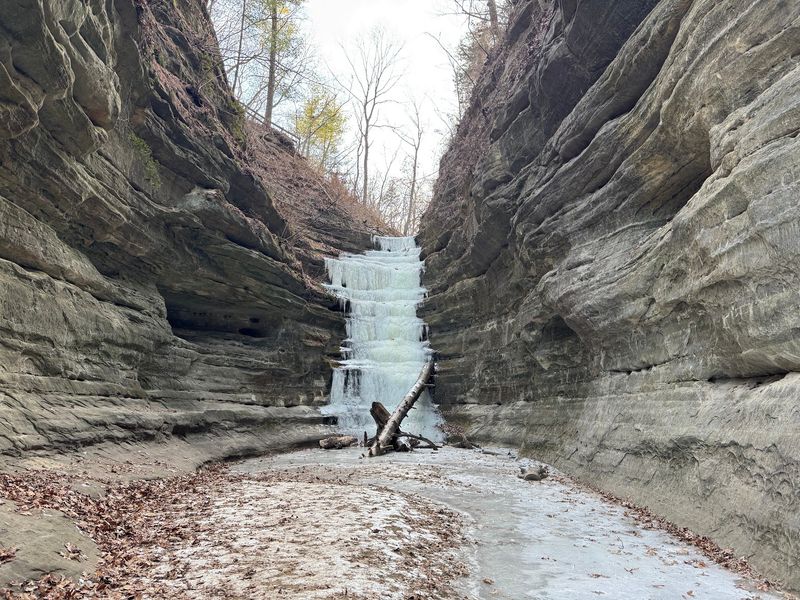
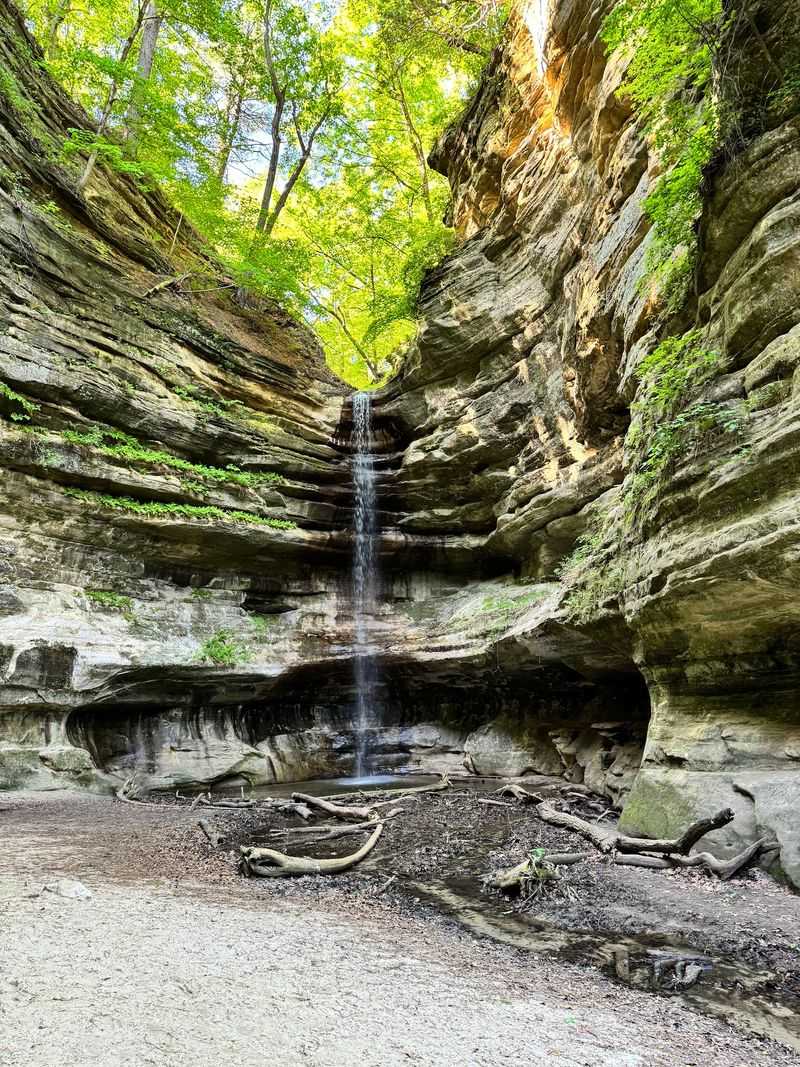
Starved Rock State Park sits in Utica, Illinois, about 90 miles southwest of Chicago, where the Illinois River cuts through a landscape of St. Peter sandstone shaped by glacial meltwater erosion over many thousands of years. The park’s canyons were carved by drainage from that melt, and the same water that shaped them still feeds the waterfalls today.
IDNR’s Starved Rock visitor Q&A identifies eight accessible canyon waterfalls by name: French, Wildcat, La Salle, Ottawa, Kaskaskia, Illinois, St. Louis, and Aurora.
Rainfall and snowmelt drive those waterfalls. IDNR notes that peak flow typically runs from March through June, but heavy rain, snowfall, and snowmelt can replenish them from November through March.
When temperatures drop and water continues to seep or flow over the canyon walls, icefalls can develop along the green-marked canyon trails, particularly in January. That winter transformation is real, but it is seasonal and conditional, not something every visit will catch.
The article’s title describes the park as hiding a canyon where waterfalls freeze into blue ice walls. A more precise way to put it is that Starved Rock’s sandstone canyons can develop icefalls when the right combination of water and cold arrives – and the color, shape, and size of those formations vary with conditions.
No single visit is guaranteed a dramatic result.
Matthiessen State Park, located a few miles south of Starved Rock, is a common source of mix-ups. Matthiessen also features a water-eroded sandstone canyon called the Dells, with its own waterfalls including Lake Falls, Middle Falls, and Cascade Falls.
Matthiessen’s official park page describes groundwater seepage, sandstone walls, and a 45-foot drop at Cascade Falls, but the strongest official documentation for named winter icefalls and designated ice-climbing areas belongs to Starved Rock. The two parks are worth visiting on separate trips, and their features should not be combined into a single description.
Water and repeated freezing—not the calendar alone—create icefalls
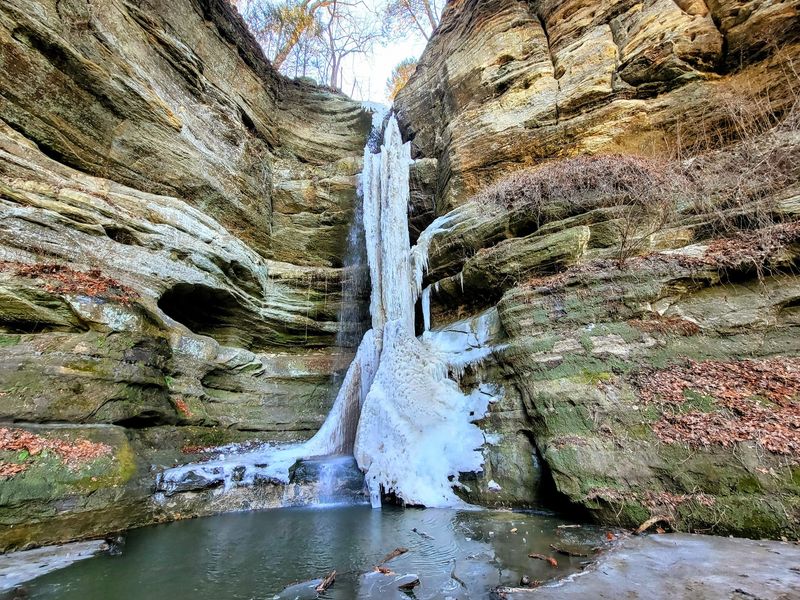
A cold snap in January does not automatically produce a frozen waterfall. The process requires water – enough of it, arriving consistently enough, to build up ice layer by layer as temperatures dip and hold.
Rainfall, snowmelt, and groundwater seepage all contribute to the flow that eventually freezes against canyon walls and ledges. Without that steady water supply, even a sustained cold spell may leave the canyons dry and the rock bare.
IDNR’s Starved Rock ice climbing brochure states that icefalls usually form from January into late February, which gives a rough seasonal window. But the park’s activity page acknowledges that a season can fall short when rainfall is insufficient, meaning the water supply matters as much as the temperature.
A winter that is cold but dry may produce thinner or less complete formations than one that brings adequate precipitation followed by hard freezes.
Freeze-thaw cycles play a role too. Water that seeps into cracks, freezes, partially melts during a warmer afternoon, and refreezes overnight builds structure differently than water that freezes all at once in a single cold event.
The duration of freezing conditions and the timing of warming spells both shape what visitors will find. IDNR’s visitor Q&A confirms that icefalls can be found along green-marked trails in January, but treats that as a seasonal possibility rather than a scheduled event.
Treat the January-to-late-February window as a rough guide, not a promise. A visitor who checks current conditions closer to their travel date, rather than booking based on the calendar alone, will have a much clearer sense of what to expect.
The park’s official activity and closure pages are the best places to look for up-to-date information on whether formations are developing in a given season.
Blue is a possible appearance, not Starved Rock’s guarantee
Photographs of Starved Rock’s winter icefalls sometimes show a faint blue cast, and that can be genuinely striking. But blue is not a reliable characteristic of the formations here – it is one possible appearance among several, depending on conditions that shift from formation to formation and day to day.
The same icefall might look white and opaque after a fresh snowfall, gray against shaded sandstone, translucent in bright afternoon sun, or carry a hint of blue when the ice is thick, relatively clear, and the light hits it at the right angle.
The general science behind blue ice tones helps explain why the color appears at all. USGS guidance on glacier ice color explains that ice absorbs more red wavelengths of light over longer optical paths, allowing blue wavelengths to dominate in dense, relatively bubble-free ice.
That same principle can apply to any sufficiently thick and clear ice – not just glacial ice. If a waterfall icefall builds up enough depth and contains few enough trapped air bubbles, it may transmit light in a way that produces blue tones.
The key qualifier is that ordinary waterfall ice is not glacier ice. Peer-reviewed research on waterfall ice formation shows that seasonal icefalls form over days or weeks, not centuries.
They do not carry glacial history, and they are not compressed by the weight of thousands of years of accumulated snow. Glacier-specific explanations about age and pressure do not apply to what forms on Starved Rock’s canyon walls each January.
No reliable park-specific source confirms that Starved Rock’s icefalls consistently appear blue, reach the optical density required for that effect, or produce it on any particular visit. Visitors who arrive hoping for vivid blue walls may find them under the right conditions, or they may find white, gray, or glassy formations that are no less worth seeing.
The color is a bonus, not the main event.
Four canyons have designated ice-climbing areas
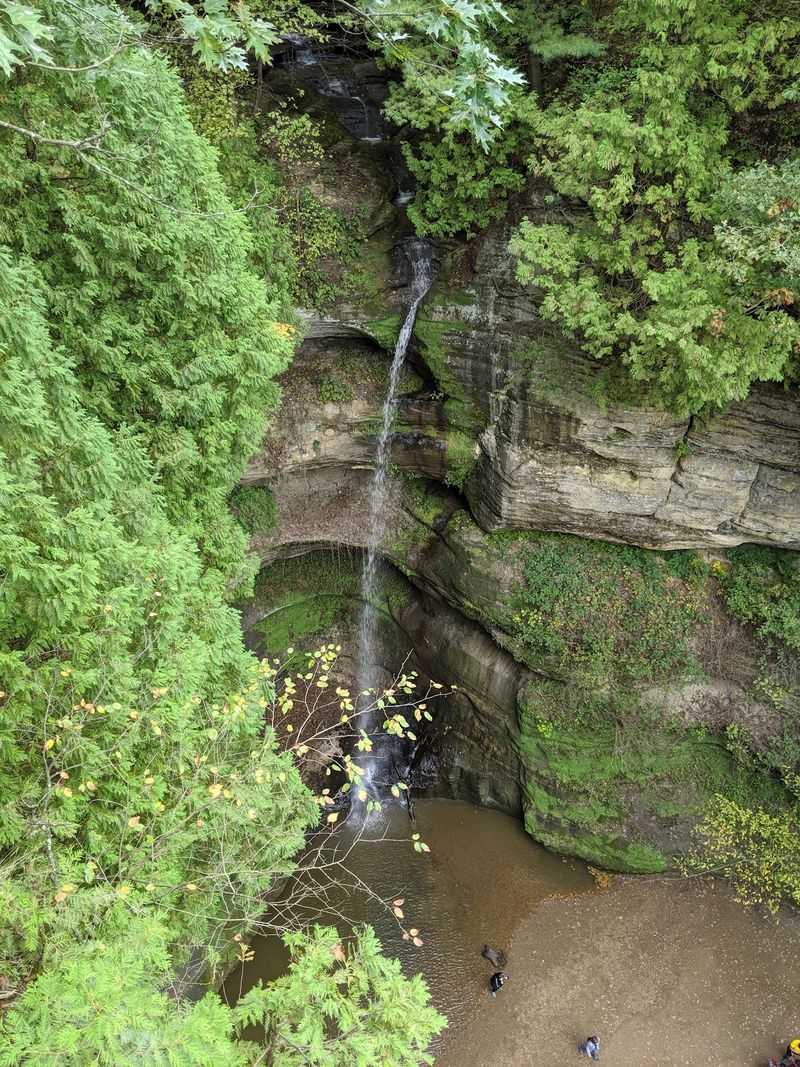
Starved Rock permits technical ice climbing in four designated canyons: Wildcat, La Salle, Ottawa, and Tonti. These are the only locations in the park where ice climbing is allowed, and the designation reflects where conditions and canyon geometry have historically supported climbable formations.
Visitors who want to observe icefalls from the trail can do so in other parts of the park as well, since the green-marked canyon trail system passes near several waterfall locations.
IDNR’s ice climbing brochure lists example formations in each of the four designated canyons with approximate heights drawn from the brochure itself. Wildcat Canyon includes a formation called the Chandelier, listed at more than 90 feet.
La Salle Canyon includes a Bridal Veil formation at more than 20 feet. Ottawa Canyon has its own Chandelier at more than 35 feet, and Tonti Canyon features a formation listed at more than 60 feet.
Those figures describe what the brochure documents as examples – they are not current measurements, seasonal guarantees, or rankings of the park’s scenery.
The four-canyon designation tells climbers where they are permitted to climb, not which canyons hold the park’s most impressive views. Hikers who stay on marked trails may encounter striking icefalls in canyons outside the designated climbing areas, and formations in the climbing canyons may be larger, smaller, or absent depending on the season’s conditions.
The brochure’s height examples are starting points for planning, not a leaderboard.
Rock climbing, rappelling, and climbing the sandstone walls themselves are prohibited throughout the park. The ice-climbing permission is specific to seasonal ice formations in those four canyons and does not extend to the surrounding rock.
Hikers who arrive to view formations rather than climb them have a wide range of canyon trails to explore, subject to current access conditions.
Plan a marked-trail visit around traction and access updates
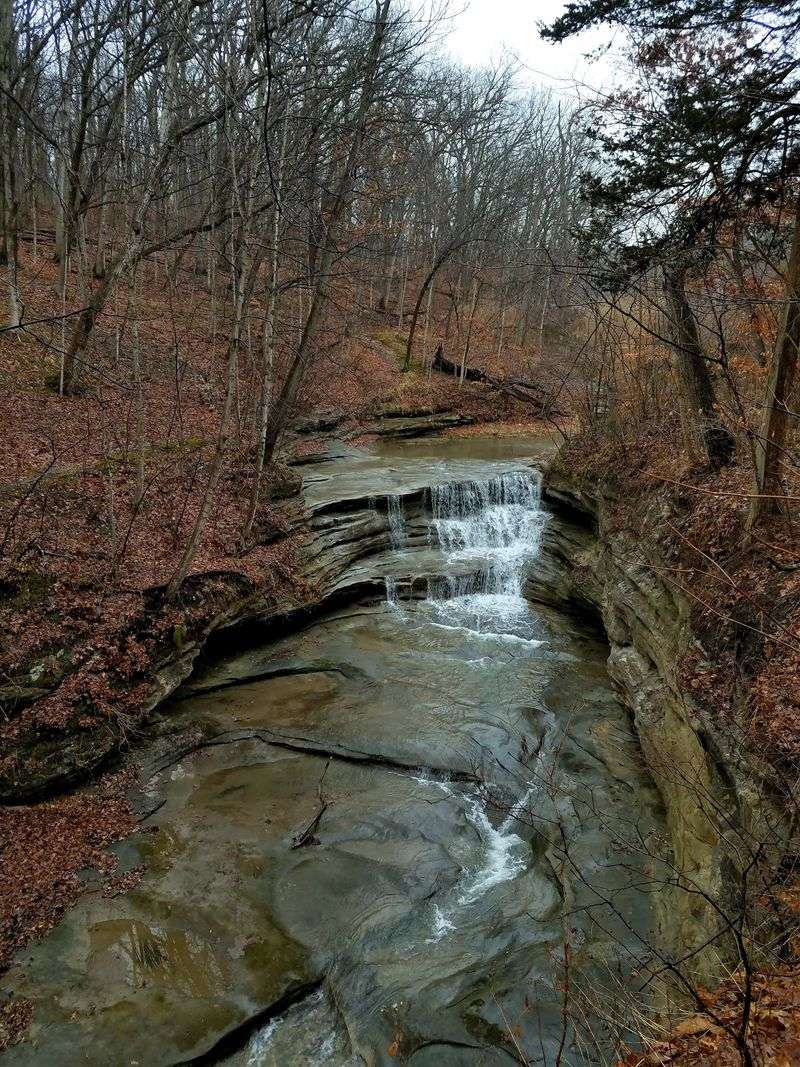
Getting to the icefalls at Starved Rock is a hiking trip, not a technical expedition, but winter trail conditions demand more preparation than a summer visit. Canyon paths can become slick with ice and packed snow, and some routes involve narrow ledges above stream beds.
Footwear that works fine on a dry summer day can become a liability when the same trail is glazed over in January.
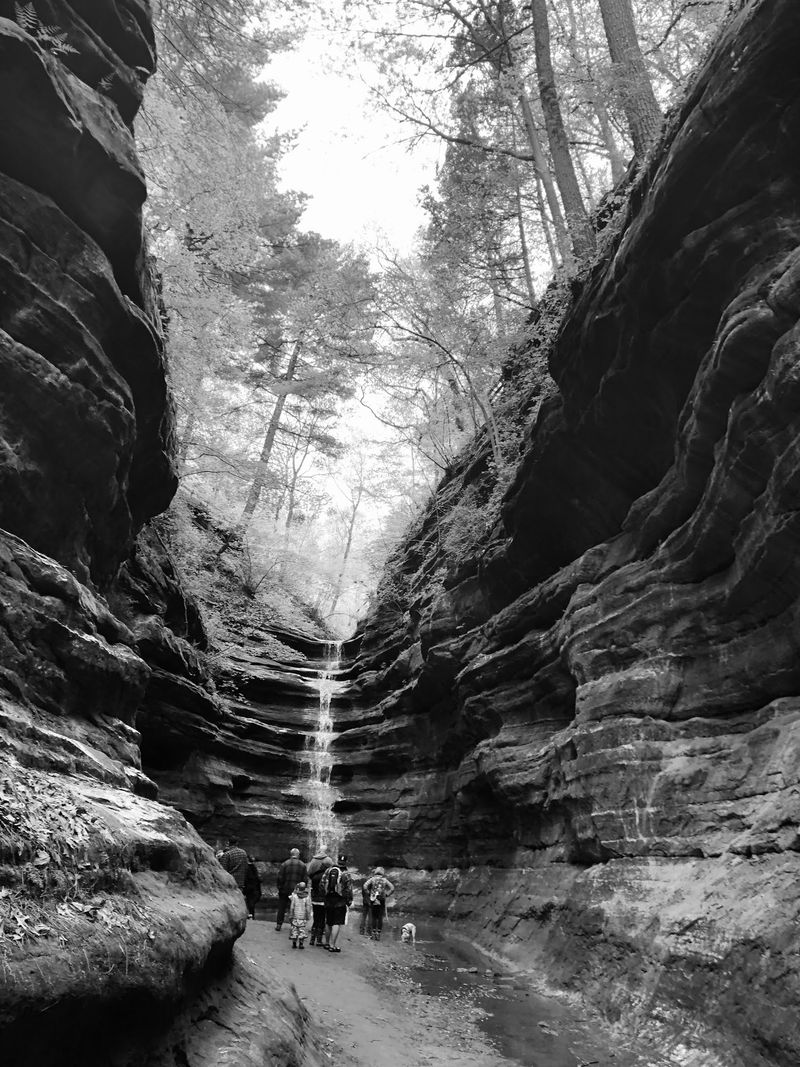
IDNR’s visitor Q&A specifically flags French Canyon and La Salle Canyon as unsuitable in winter for anyone without micro-cleats or Yaktrax. That is a practical safety note from the park itself, not a general precaution.
Traction devices strap over regular hiking boots and improve grip on icy surfaces. They are worth packing even for canyons not specifically named, since shaded areas and stream crossings can freeze in ways that are hard to predict from the trailhead.
Traction devices improve footing on slippery paths. They do not make technical ice climbing appropriate for ordinary hikers, and they should not be treated as a substitute for the training, equipment, and partner protocols that ice climbing requires.
The line between a hiker with Yaktrax and a technical ice climber is not just gear – it is training, rope systems, helmets, and experience.
Access can change with little notice. IDNR’s Starved Rock trail improvement project page lists current construction notices and temporary restrictions that may affect canyon and waterfall areas.
The park’s activity page is the best source for up-to-date information on which trails are open and what conditions are like before a trip. Checking both pages a day or two before traveling avoids the frustration of arriving to find a preferred canyon closed for construction or hazardous conditions.
Treat frozen waterfalls as unstable formations, not solid walls
A frozen waterfall looks solid. The surface can appear thick, glassy, and permanent, especially when photographed from a few feet away with good winter light behind it.
That appearance is misleading. Water keeps moving inside and behind most waterfall ice formations, even when the exterior looks fully frozen, and the structure can be hollow in places where the flow has shifted or where the ice has pulled away from the rock face.
Peer-reviewed research on waterfall ice structure documents that continued internal water flow is common in developing icefalls, and that temperature changes can trigger cracking, partial detachment, or sudden collapse. A warming afternoon that raises air temperature by ten degrees can shift the structural integrity of a formation that looked stable that morning.
There is no visual inspection from the trail that can confirm whether a given icefall is safe to approach, touch, or stand beneath.
IDNR’s Starved Rock activity page and the park’s general safety guidance make clear that hikers must stay on marked trails. Steep cliffs and deep canyons carry real fall hazards, and canyon stream beds are off-limits for wading or swimming.
Approaching a frozen waterfall from below, touching the ice, or positioning yourself directly under a formation to get a better photograph puts you in the fall zone if the ice shifts.
The practical boundary is the marked trail. Photographing an icefall from a designated viewpoint along the trail is the intended visitor experience.
A telephoto lens, or simply patience while the light changes, produces better images than proximity to a formation whose internal structure cannot be assessed from the outside. IDNR’s canyon safety guidance reinforces that off-trail travel near cliffs and frozen water features is not a calculated risk – it removes the margin that keeps visitors safe.
Technical ice climbing follows separate park rules
For visitors who do hold ice-climbing experience and gear, Starved Rock offers a permitted climbing season that is uncommon for a Midwest state park. IDNR’s ice climbing brochure sets out the conditions: climbing is permitted only for experienced climbers using their own equipment, with a partner or group, during daylight hours, and exclusively in Wildcat, La Salle, Ottawa, or Tonti canyons.
Climbers proceed at their own risk and are responsible for evaluating whether a formation is suitable on any given day.
Those requirements exist because technical ice climbing involves hazards that traction devices and trail experience cannot address. Route assessment, rope systems, helmets, ice axes, crampons, and partner protocols are all part of managing a climb safely.
A hiker who arrives with Yaktrax and decides to step off the trail and attempt a formation is not equipped for what the ice may present – hollow sections, detached curtains, or sudden temperature-driven fractures. Traction gear and technical climbing gear serve completely different purposes.
The distinction between permitted ice climbing and prohibited activities matters here. Rock climbing, rappelling, and ascending the sandstone walls are not allowed anywhere in the park.
IDNR’s activity page separates permitted ice climbing on seasonal formations from the general prohibition on climbing the park’s rock. A climber who attempts a sandstone face rather than an ice formation is violating park rules regardless of experience level.
For everyone else, the winter canyons are still very much worth visiting. Icefalls observed from marked trails are striking on their own terms, and the canyon atmosphere in January – quiet, cold, the sound of water somewhere behind the ice – is different from anything the park offers in warmer months.
Check current trail conditions and closures before setting out, bring traction, and let the formations be what they are: temporary, weather-dependent, and genuinely worth the trip when conditions cooperate.