
12 Strange Florida Museums You Have To See To Believe
Ask a Floridian about the state’s museums, and you’ll get more than art galleries and history halls. Hidden in small towns and backroads are collections so strange they blur the line between fact and folklore.
From cryptids to curiosities, these attractions celebrate Florida’s most eccentric stories.
1. Coral Castle Museum: One Man’s Mysterious Monument
A single Latvian immigrant somehow moved and carved over 1,100 tons of coral rock without modern equipment. Edward Leedskalnin worked mostly at night, closely guarding his methods.
No one ever witnessed his building methods. The resulting stone garden features massive furniture, celestial carvings, and a 9-ton gate that was once so perfectly balanced it could move with just a finger’s touch.
Visitors can tour this engineering marvel in Homestead Thursday through Monday; the museum is closed Tuesdays and Wednesdays.
2. Skunk Ape Research Headquarters: Florida’s Bigfoot Central
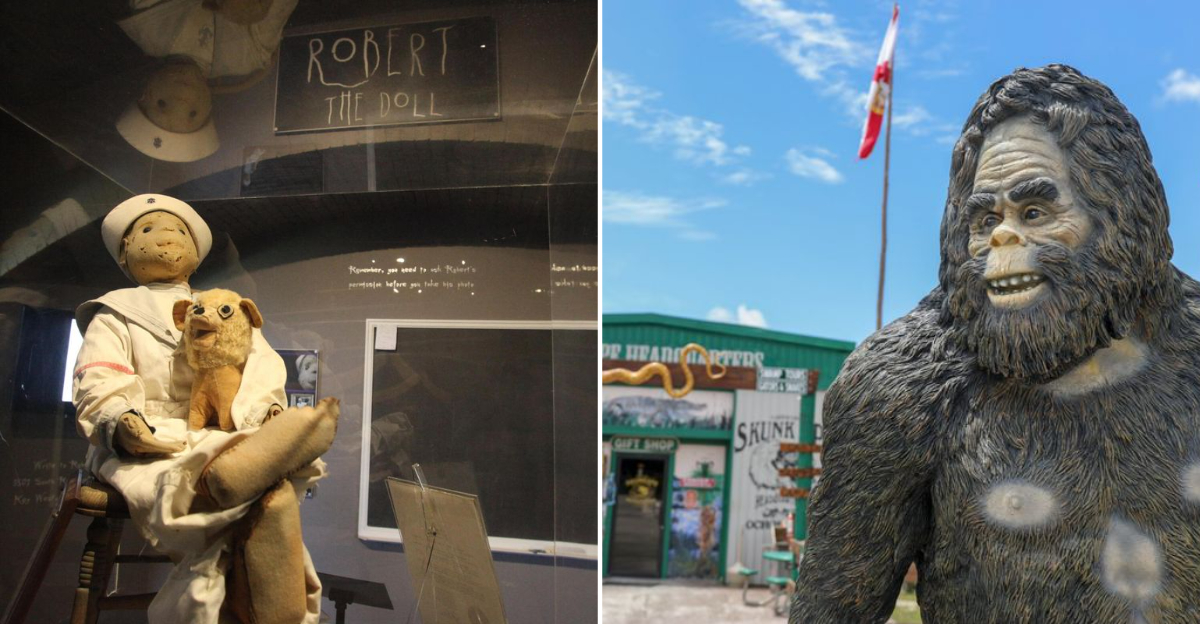
Tucked away in the swampy wilderness of Big Cypress sits a ramshackle research center dedicated to Florida’s most elusive cryptid. The legendary Skunk Ape, named for its reported foul odor, is said to roam the Everglades.
The museum displays alleged footprint casts, photographs, and eyewitness accounts. Beyond Bigfoot lore, visitors can meet rescued reptiles and learn about Everglades wildlife.
The roadside attraction maintains that laid-back Old Florida charm that’s increasingly rare in the tourist-heavy state.
3. International Independent Showmen’s Museum: Carnival Life Preserved
Step right up to this 54,000-square-foot treasure trove of carnival history! Vintage rides, hand-painted sideshow banners, and restored midway games fill this massive space in Riverview (Gibsonton area), once known as the winter home for circus performers.
I remember visiting as a kid and being mesmerized by the expansive miniature carnival exhibit, complete with intricate, tiny rides and midway scenes. The volunteer guides often include retired carnival workers with amazing stories.
From fortune-telling machines to the history of the human cannonball, this museum captures America’s vanishing carnival culture.
4. The Wizard of Oz Museum: Yellow Brick Road to Wonder
Cape Canaveral might seem an unlikely home for the world’s most comprehensive Oz collection, but this museum will transport you straight to the Emerald City.
Room after room recreates scenes from the beloved story, surrounded by rare memorabilia spanning over a century.
From first-edition books to movie props, the collection spans the entire Oz universe. Kids can follow an actual yellow brick road through interactive exhibits.
The museum houses thousands of pieces (over 3,000) of Oz history, making it a must-visit for fans of the books and films alike.
5. Fort East Martello Museum: Home to America’s Most Haunted Doll
Robert the Doll sits in a glass case, watching visitors with his button eyes and sailor suit. The story goes that Robert was given to artist Robert Eugene Otto in 1904, who claimed the doll moved on its own and caused mischief throughout his childhood.
I once visited without asking Robert’s permission to take his photo – supposedly a terrible mistake. My camera mysteriously malfunctioned until I apologized aloud.
Beyond the famous doll, this Civil War-era fort houses fascinating Keys artifacts, including items salvaged from shipwrecks and early settler memorabilia.
6. The Ringling Circus Museum: Big Top History Comes Alive
Sarasota’s crown jewel houses the world’s largest miniature circus. The Howard Bros. Circus Model recreates a 1920s traveling show with over 44,000 pieces, each hand-carved with incredible detail.
Vintage posters, elaborate costumes, and ornate circus wagons transport visitors to the golden age of American entertainment. The museum’s centerpiece is the original private railcar of John and Mable Ringling, restored to its 1920s luxury.
Clowns, acrobats, and ringmasters come to life through interactive exhibits that reveal the behind-the-scenes magic of circus life.
7. Museum of the Man in the Sea: Underwater Exploration Unveiled
Navy diving helmets line the walls like sentinels from another world. Panama City Beach’s tribute to underwater pioneers showcases the evolution of diving technology, from primitive wooden diving bells to modern submersibles.
Visitors can climb through the SEALAB I habitat and a submersible and try on replica diving gear. The collection includes equipment from the SEALAB program, America’s first attempt at underwater living.
When I volunteered here one summer, an 80-year-old former Navy diver would visit weekly to share stories about wearing those massive copper helmets that now seem more steampunk than practical.
8. St. Augustine Pirate & Treasure Museum: Plundered Booty on Display
See the only known authentic pirate treasure chest in existence at this interactive museum near Castillo de San Marcos. The collection boasts over 800 artifacts, including Blackbeard’s original blunderbuss and pieces of gold recovered from his flagship.
Audio stations throughout the museum let visitors hear tales of piracy directly from actors playing famous buccaneers. The dimly lit galleries recreate the atmosphere of a pirate ship.
Unlike many pirate attractions, this museum focuses on historical accuracy while still maintaining the swashbuckling excitement that makes pirate lore so captivating.
9. Key West Shipwreck Treasure Museum: Salvaged Secrets from the Deep
Before tourism, Key West was America’s richest city per capita thanks to the dangerous business of shipwreck salvaging. This museum celebrates the “wreckers” who raced to sinking ships, rescuing both people and valuable cargo.
The highlight is climbing the 65-foot lookout tower that offers panoramic views of the island. Below, treasure hunters once scanned the waters for foundering vessels.
I remember climbing those tower stairs on a sweltering August day, thinking about the wreckers who made that climb hourly in the days before air conditioning, driven by the promise of Spanish gold.
10. Bailey-Matthews National Shell Museum: Molluscan Marvels
Sanibel Island’s shell-strewn beaches have a fitting tribute in this museum housing over 600,000 specimens from around the world. Giant clams, microscopic shells, and everything in between fill the scientifically arranged displays.
The recently added aquariums allow visitors to see living mollusks in action. Watch octopuses solve puzzles or touch live sea stars in the hands-on pools.
Each shell tells a story of adaptation and survival, from the perfectly camouflaged fighting conch to the lethal beauty of the cone shell, whose venom can take a life of human in minutes.
11. St. Petersburg Museum of History: Baseball Cards and Bizarre Relics
The world’s largest collection of autographed baseballs shares space with one of Florida’s strangest artifacts: a 3,000-year-old Egyptian mummy.
This eclectic museum on the downtown pier celebrates St. Petersburg’s unique history with delightfully random exhibits.
Schrader’s Little Cooperstown features over 5,000 signed baseballs, earning it a Guinness World Record. The flight gallery includes a working replica of the Benoist XIV, the aircraft used for the world’s first scheduled commercial airline flight.
Local oddities abound, including the museum’s two-headed calf, a longtime favorite.
12. Tampa Bay Automobile Museum: Engineering Marvels on Wheels
Car enthusiasts flock to this hidden gem in Pinellas Park, showcasing vehicles that revolutionized automotive design. Unlike typical car museums focused on luxury or speed, this collection celebrates engineering innovation.
Many exhibits feature rare European prototypes never mass-produced, including front-wheel drive vehicles from the 1920s and experimental propulsion systems. The centerpiece is a working replica of the world’s first self-propelled vehicle from 1770.
Each car includes detailed explanations of its mechanical innovations, making this museum fascinating even for visitors who don’t know a carburetor from a crankshaft.