
Stunning Stops Along Colorado’s San Juan Skyway Road Trip
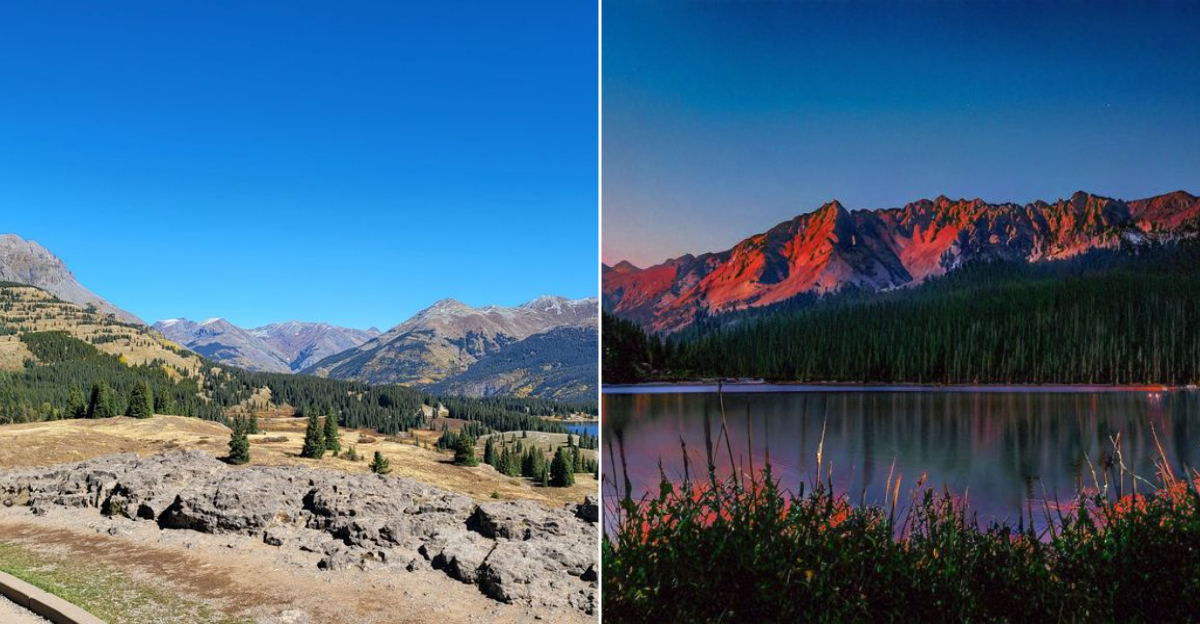
A road trip earns bragging rights when the scenery keeps stealing attention from the destination.
Winding through the southwestern mountains of Colorado, this roughly 236-mile loop delivers the kind of views that make quick photo stops turn into twenty-minute detours.
One stretch climbs past forests and sharp peaks, while the next opens onto alpine water, historic communities, and roads that seem designed for slow driving. The appeal is not just the scenery, either.
Every stop changes the mood, so the journey never feels like one long blur through the windshield. Families can build an easy weekend around it, couples can turn it into a relaxed escape, and photographers may need extra memory cards.
By the time the route curls through another dramatic corner of Colorado, checking attractions off a list feels beside the point. Fill the tank, charge the camera, and leave room in the schedule for unplanned stops too.
1. Haviland Lake, North of Durango
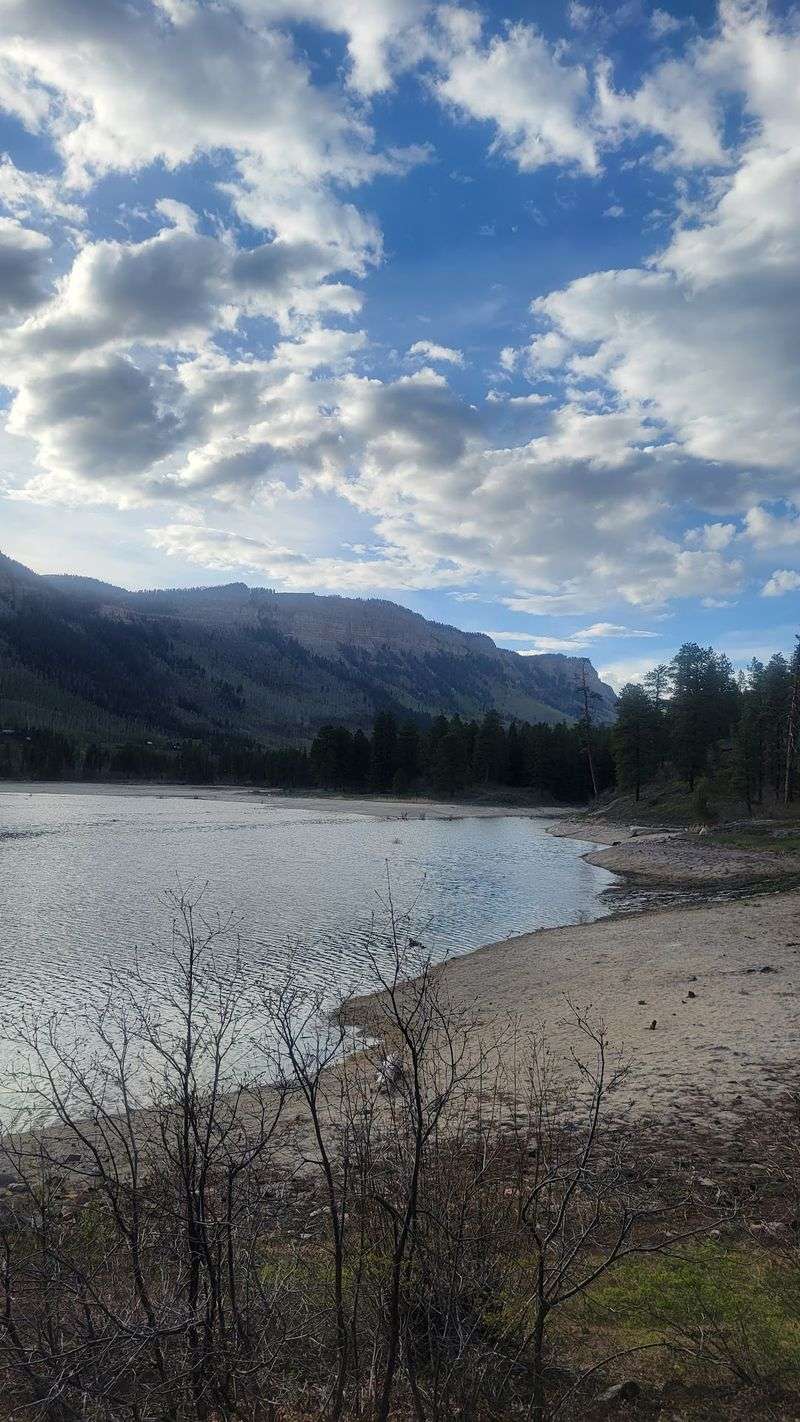
There’s a particular magic about arriving at Haviland Lake before the rest of the world has finished its coffee. Tucked north of Durango along U.S. 550, this small but strikingly pretty reservoir sits inside a ponderosa pine forest that smells like a postcard you can actually breathe in.
The campground here is low-key and well-maintained, making it a natural first stop if you’re easing into the Skyway at a sensible pace.
Fishing is a genuine draw, with trout regularly tempting anglers who set up along the calm shoreline. The surrounding trail network is manageable for kids and adults alike, looping through trees without demanding serious athletic commitment.
I walked the perimeter once on a Tuesday morning and had the whole place almost entirely to myself.
Picnic tables dot the lakeshore, so bring lunch and resist the urge to rush. Haviland Lake rewards slow travelers.
It’s the kind of opener that sets a generous, unhurried tone for everything that follows on the Skyway, reminding you that the journey itself is the whole point of being here.
2. Andrews Lake, Near Coal Bank Pass
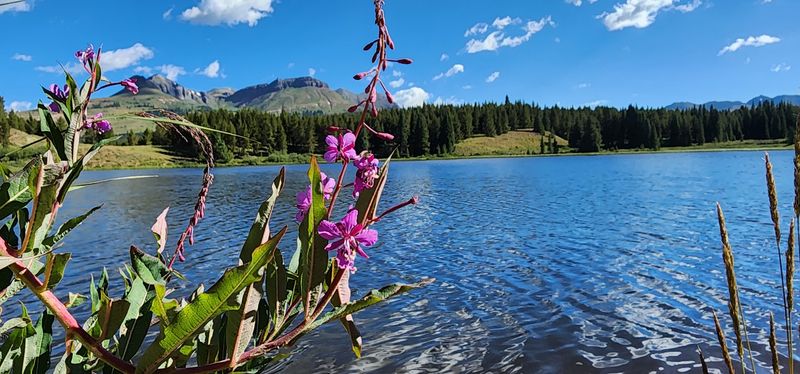
Andrews Lake sits at roughly 10,700 feet, which means the air hits you differently the moment you step out of the car. Located just off U.S. 550 near Coal Bank Pass, this alpine gem is compact enough to feel intimate but dramatic enough to stop you mid-sentence.
The reflection of the surrounding peaks in the glassy water is the kind of view that makes people rethink their entire screen saver situation.
A short, easy trail loops around the lake, passing through willows and wildflowers depending on the season. Summer visits reward hikers with bursts of color that feel almost theatrical against the gray granite slopes.
Fall brings a golden palette that photographers travel specifically to capture.
Fishing is allowed, and the lake reportedly holds brook and rainbow trout for anyone willing to cast a line in the thin mountain air. I personally recommend arriving mid-morning when the light hits the water at just the right angle.
Andrews Lake is the kind of stop you budget twenty minutes for and end up staying two hours at, which is, honestly, exactly the right outcome.
3. Coal Bank Pass, U.S. 550
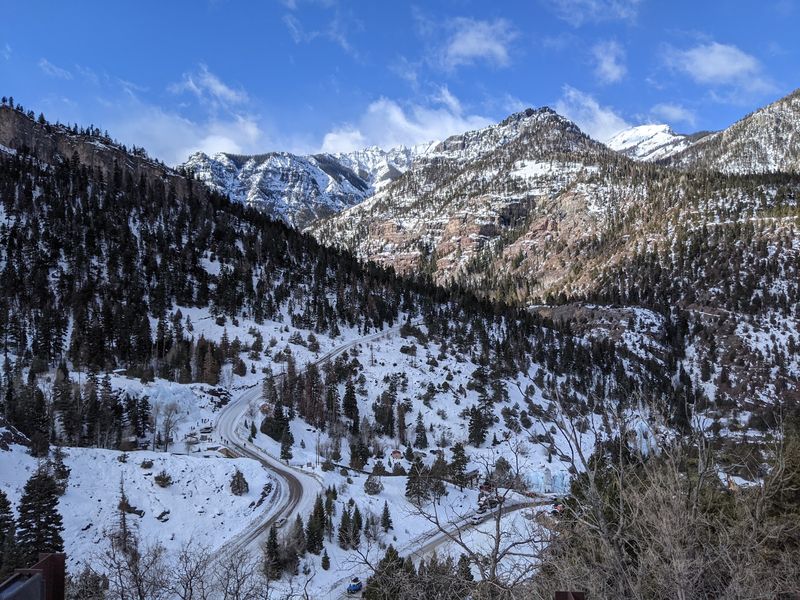
Coal Bank Pass at 10,640 feet is the kind of mountain crossing that makes your ears pop and your spirits rise in equal measure. Sitting along U.S. 550 between Durango and Silverton, it marks the transition from forested foothills into true high-country terrain.
The drive up is a gradual build of anticipation, with each curve revealing more sky and fewer trees until the summit opens up wide.
There’s a small pullout at the top where most people stop to stretch and stare, which I highly recommend doing without apology. The views south toward the Needles Range are worth a few minutes of respectful silence.
In winter, the pass transforms into something almost otherworldly, blanketed in snow with ice-edged spruce trees lining the road like a scene from a fairy tale with good insulation requirements.
Summer wildflowers carpet the open slopes near the summit, turning the roadside into a rolling meadow that feels almost too cheerful to be real. Coal Bank Pass is not just a place to pass through.
It’s a genuine landmark that signals you’ve entered a different, higher world on the Skyway.
4. Molas Pass Overlook, South of Silverton
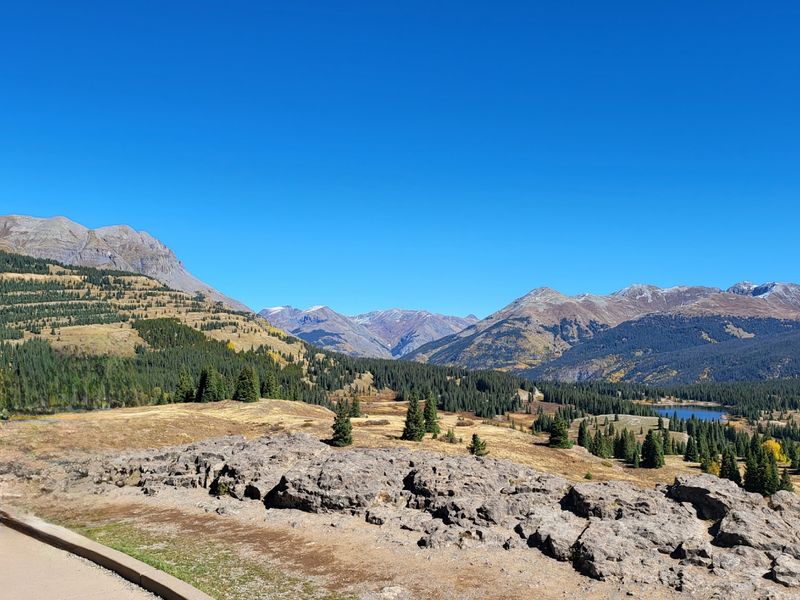
At 10,910 feet, Molas Pass Overlook is one of those places where the scenery is so extravagant it almost feels impolite. Situated south of Silverton along U.S. 550, the overlook delivers a sweeping panorama of the Animas River valley framed by the jagged, snow-capped ridgelines of the San Juan Mountains.
Honestly, the view here does things to people. I’ve watched strangers spontaneously hug.
The pullout area is generous, giving you room to park, pace around, and absorb the scale of what you’re looking at without feeling rushed. Early morning visits are particularly rewarding when low-hanging mist fills the valley below and the peaks glow in the first light.
Photographers make dedicated pilgrimages here for exactly that reason.
Little Molas Lake sits just below the overlook area, and the two stops pair naturally into a single, unhurried visit. Bring layers regardless of the season, because the wind at this elevation has opinions.
Molas Pass Overlook is the Skyway stop that tends to appear most often in people’s trip reports, and after standing there yourself, the enthusiasm becomes completely understandable.
5. Little Molas Lake, Near Molas Pass
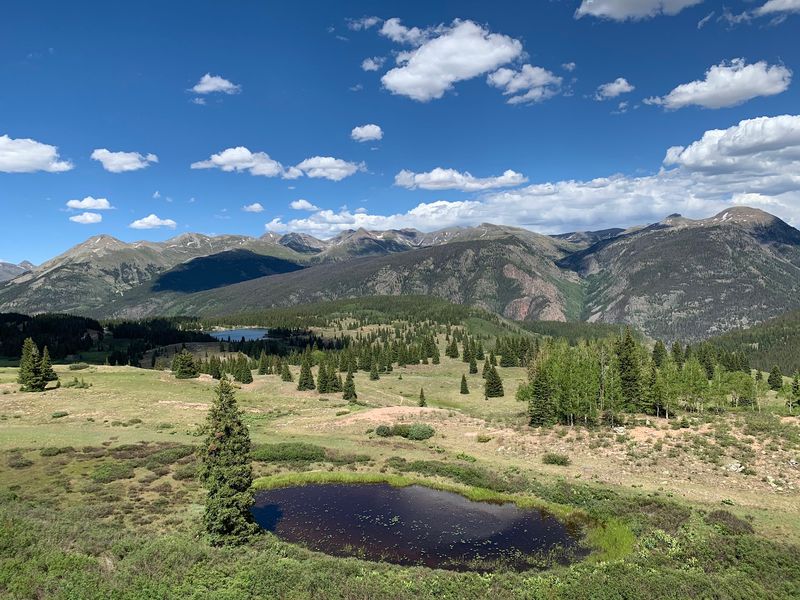
Little Molas Lake earns its name honestly. It’s not enormous, but what it lacks in size it absolutely compensates for in personality.
Sitting near Molas Pass just off U.S. 550, the lake occupies a wide alpine meadow that blooms with wildflowers in July and August in a way that seems almost competitive. The surrounding peaks loom close enough to feel like neighbors rather than distant scenery.
The campground here is popular for good reason. Waking up at this elevation with that view is an experience that recalibrates your sense of what ordinary mornings should look like.
Day visitors can park near the lake access road and walk the short distance to the shoreline without any significant effort.
Fishing is permitted, and the lake holds trout that reportedly reward patient anglers. I prefer simply sitting near the water and watching the light shift across the mountains while eating something from a bag I should have planned better.
Little Molas Lake feels like a secret the Skyway keeps tucked just off the main road, close enough to find easily but quiet enough to feel like a genuine discovery every single time.
6. Bear Creek Falls Overlook, South of Ouray
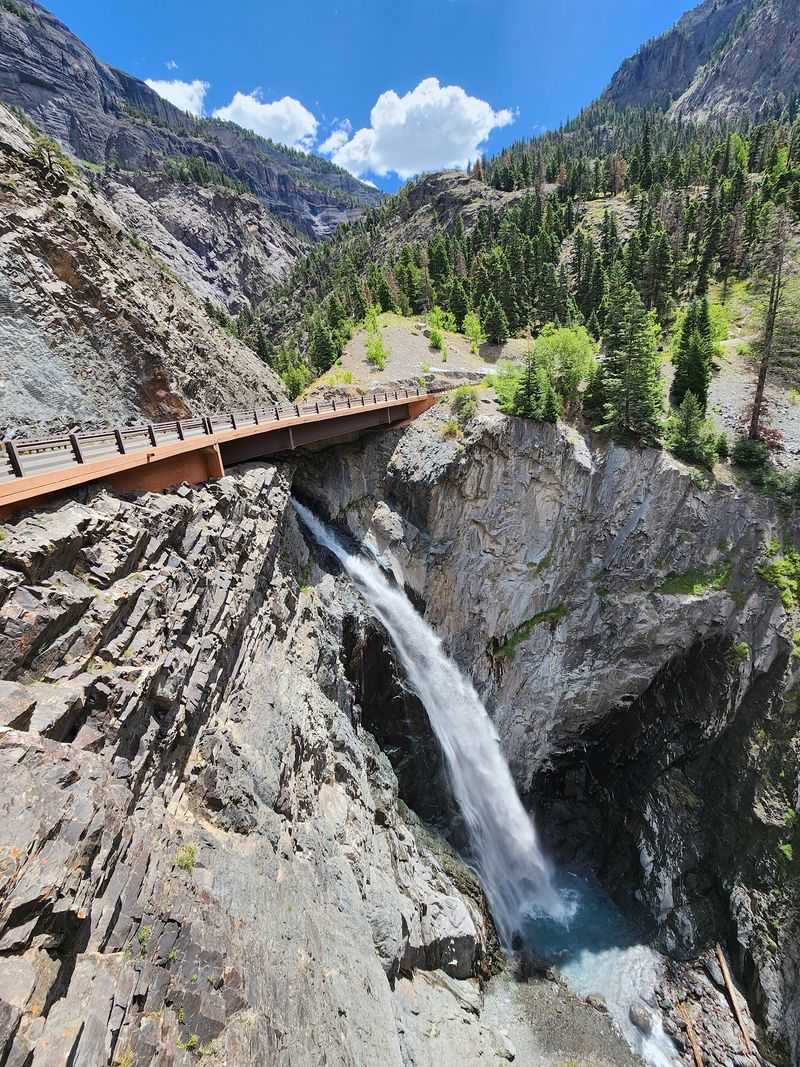
The stretch of U.S. 550 south of Ouray is famously nicknamed the Million Dollar Highway, and Bear Creek Falls Overlook is one of the most dramatic reasons why. The waterfall drops sharply down a rocky canyon wall right beside the road, close enough that you can feel the cool mist on a warm afternoon if you’re standing at the right angle.
It’s the kind of natural feature that rewards people who actually pull over instead of just slowing down.
The overlook itself is small, so timing matters. Arriving early or late in the day gives you a better chance of having the space without competing for elbow room.
The canyon walls here rise steeply on both sides, creating a verticality that makes even non-hikers feel like they’re inside something genuinely magnificent.
Bear Creek Falls carries snowmelt through spring and early summer, which is when the flow is most impressive and the roar most satisfying. By late summer, the volume drops but the setting remains striking.
South of Ouray, this overlook is a reminder that the Million Dollar Highway earned its reputation one jaw-dropping mile at a time, and this stop is a reliable highlight.
7. Dallas Divide, Between Ridgway and Placerville
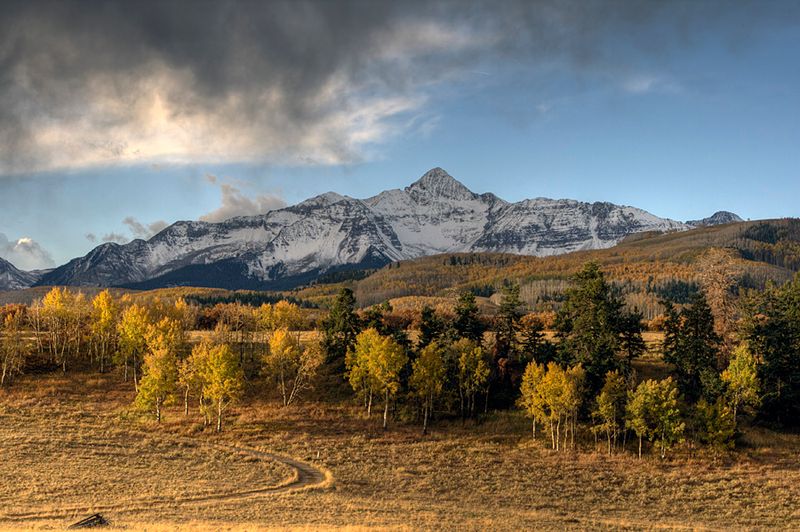
Few mountain views in Colorado land with the quiet authority of the one from Dallas Divide. Positioned along CO 62 between Ridgway and Placerville, this high point in the road frames the Sneffels Range in a way that landscape painters have been trying to do justice to for over a century.
The scale here is almost disorienting in the best possible way.
Fall is when Dallas Divide truly shows off. The aspen groves on the lower slopes turn a shade of gold so saturated it looks like someone adjusted the color settings on the whole landscape.
Photographers line up along the roadside during peak foliage season, tripods out, expressions of intense concentration firmly in place. I understand them completely.
Summer visits offer wide-open views of wildflower-covered rangelands with the jagged peaks rising behind them like a backdrop that nobody ordered but everyone appreciates. The divide sits at around 8,970 feet, accessible and welcoming without requiring any hiking commitment.
Pull over, breathe the clean air, and take your time. Dallas Divide is the kind of stop that changes the whole character of a road trip simply by existing where it does.
8. Trout Lake, South of Telluride
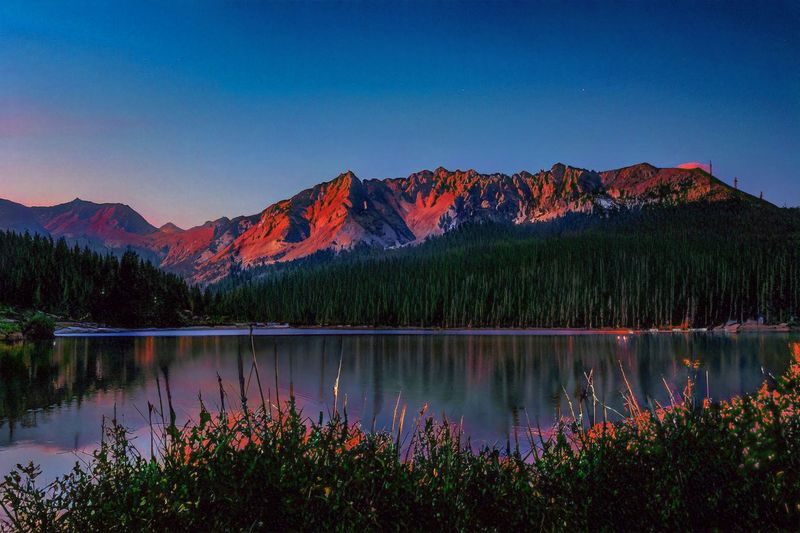
Trout Lake sits at around 9,700 feet and carries the kind of quiet beauty that makes you wonder why it doesn’t get more attention. Located south of Telluride along Colorado 145, the reservoir is framed by a dense mix of aspen and spruce with the San Juan peaks rising sharply behind the tree line.
The whole composition looks like something a landscape architect spent years designing, except nature did it without a budget meeting.
The lake has a history worth knowing. It was originally created as a reservoir in the late 1800s to support hydroelectric power generation in the Telluride area.
That backstory adds a certain texture to the visit, layering industrial heritage onto what now reads as purely scenic.
Non-motorized boating is permitted on the lake, and the shoreline offers pleasant walking with views that improve with every few steps. I find Trout Lake most compelling in early morning when mist lingers over the water and the peaks are just beginning to catch the first light.
Paired with the short drive into Telluride for lunch afterward, this stop makes for a deeply satisfying half-day loop that feels effortless but looks impressive in every photo.
9. Lizard Head Pass Interpretive Site, CO 145
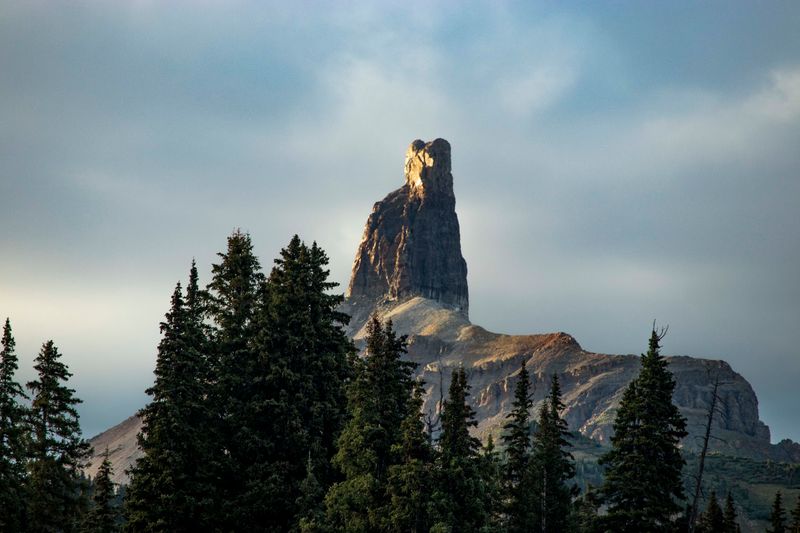
Lizard Head Pass sits at 10,222 feet along CO 145 and takes its name from a volcanic rock spire that rises above the treeline like something a geologist and a science fiction writer designed together. The interpretive site at the summit offers panels explaining the natural and human history of the area, which is worth a few minutes of genuine reading rather than the usual guilty skim.
The open tundra here feels expansive and spare in a way that contrasts sharply with the forested sections of the Skyway. Wildflowers carpet the meadows in summer, and the views toward the Wilson Peaks are the kind that make even reluctant sightseers put their phones down voluntarily.
That alone qualifies this as a significant location.
The pass also marks a key point on the Colorado Trail and the Lizard Head Wilderness boundary, so hikers passing through have a specific reverence for this spot that day visitors can appreciate without matching. I’ve stopped here in multiple seasons and each version is compelling in a different way.
In fall, the aspen color frames the volcanic spire dramatically. In summer, the meadow practically hums.
Lizard Head Pass rewards every stop without demanding much in return.
10. Rico, Dolores County
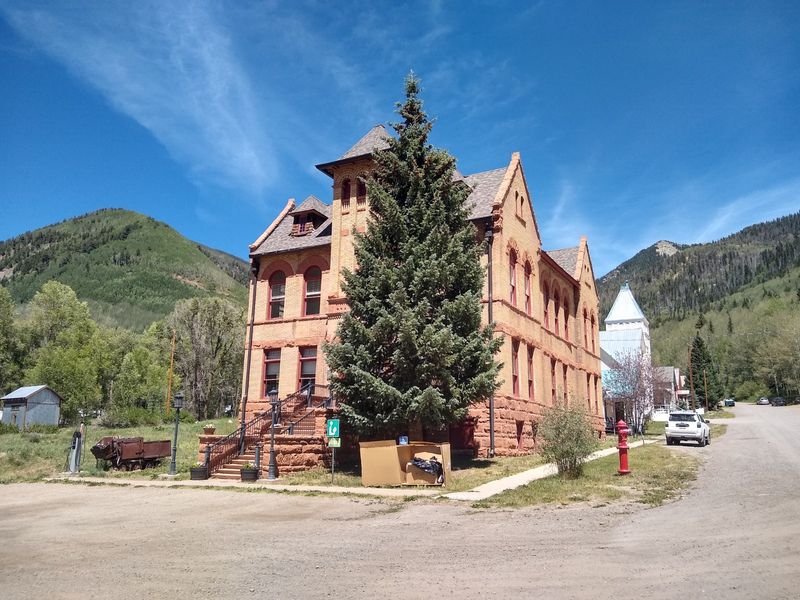
Rico is the kind of Colorado mountain town that didn’t get polished into a tourist destination, and that’s precisely what makes it worth stopping in. Sitting in Dolores County along CO 145, this small community was once a booming silver mining hub in the late 1800s.
The history is still visible in the architecture, with Victorian-era buildings lining the compact main street in various states of dignified weathering.
The population hovers around a few hundred people, which gives Rico a genuine small-town texture that feels refreshingly unperformed. There are no celebrity chef restaurants or boutique hotels with ironic names.
What you get instead is a community that exists for itself, which is increasingly rare along scenic byways that have been discovered and commercially optimized.
Stopping in Rico for a stretch and a look around takes maybe thirty minutes, but the impression lasts considerably longer. The Dolores River runs nearby, the mountains crowd in close on all sides, and the whole place carries a quiet confidence about its own identity.
I find Rico genuinely charming in the way that unpretentious places often are, more interesting than they initially appear and better remembered than more famous stops along the same route.
11. McPhee Reservoir, Dolores
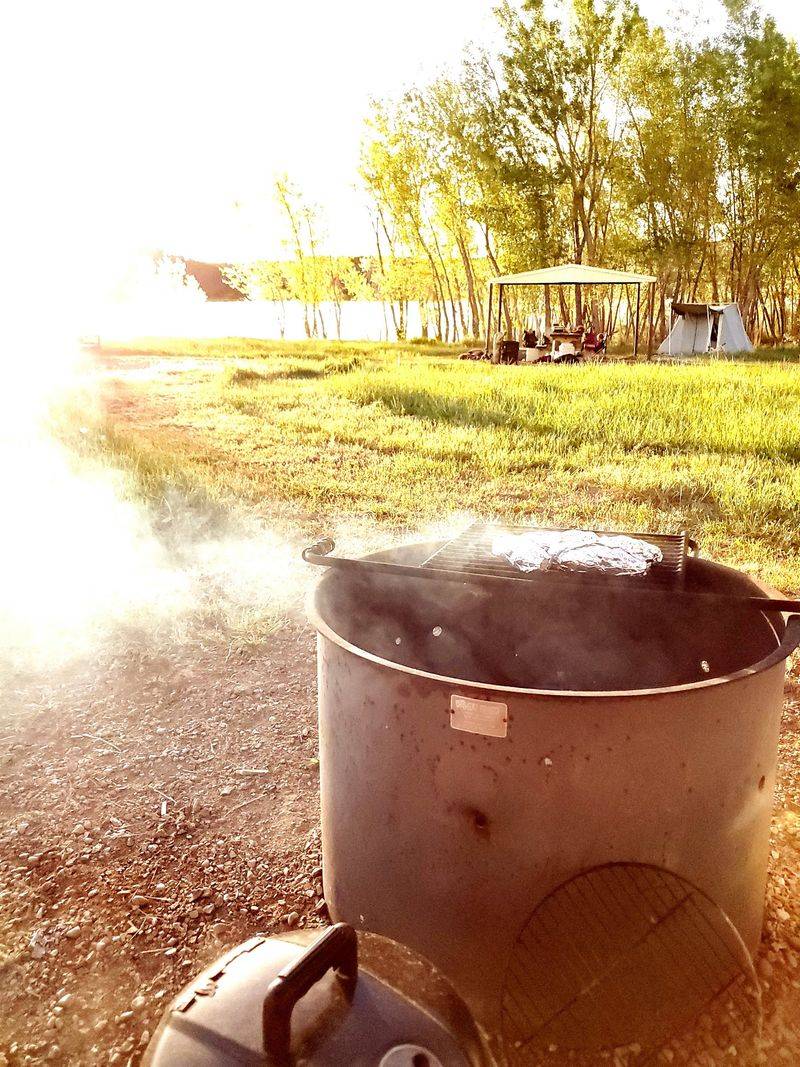
McPhee Reservoir near Dolores is Colorado’s second-largest reservoir, and it carries a scale that surprises most first-time visitors who arrive expecting something modest. The red rock canyon walls surrounding the water give the whole place a distinctly southwestern personality that feels different from the alpine lakes higher up on the Skyway.
The contrast is genuinely interesting and worth the short detour.
Boating, fishing, and camping are all popular here, and the marina provides basic services that make a longer visit practical rather than aspirational. Kokanee salmon and largemouth bass attract anglers who know what they’re doing, while the wide water and open skies draw everyone else who simply wants to sit somewhere beautiful without hiking to get there.
The reservoir was completed in 1985 and serves both water storage and recreation purposes for the region. That practical origin doesn’t diminish the scenery one bit.
I find McPhee particularly appealing in late afternoon when the light goes warm and the canyon walls shift through shades of amber and rust. It’s a stop that earns its place on the Skyway itinerary by offering something genuinely different from the high passes and alpine lakes that dominate the northern half of the loop.
12. Mancos State Park, Mancos
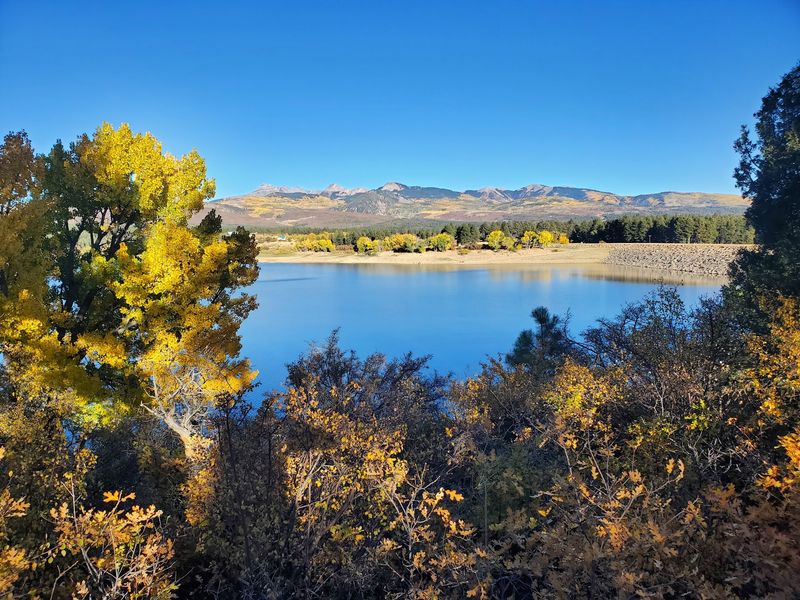
Mancos State Park wraps around Jackson Gulch Reservoir in a setting that feels like a comfortable exhale after the high drama of the mountain passes further north. The park sits near the town of Mancos with Mesa Verde’s plateau visible in the middle distance, giving the landscape a layered quality that connects alpine forest to ancient cultural history in a single glance.
Fishing, kayaking, and paddleboarding are popular on the reservoir, and the campground here draws visitors who want a base for exploring both the park and nearby Mesa Verde National Park without paying resort prices. The trail network is approachable and well-marked, suitable for families with younger kids who’ve had enough of sitting in the car and need to move their legs.
Wildlife sightings are common in and around the park, with deer, wild turkeys, and various bird species making regular appearances for those paying attention. I think Mancos State Park works best as the final stop on a clockwise Skyway loop, serving as a gentle landing after days of high-altitude intensity.
The town of Mancos itself is worth a brief stroll, with a low-key main street that has the good sense not to try too hard.