
5 Texas Ghost Towns That Became Ruins & 5 That Locals Turned Into Quirky Getaways
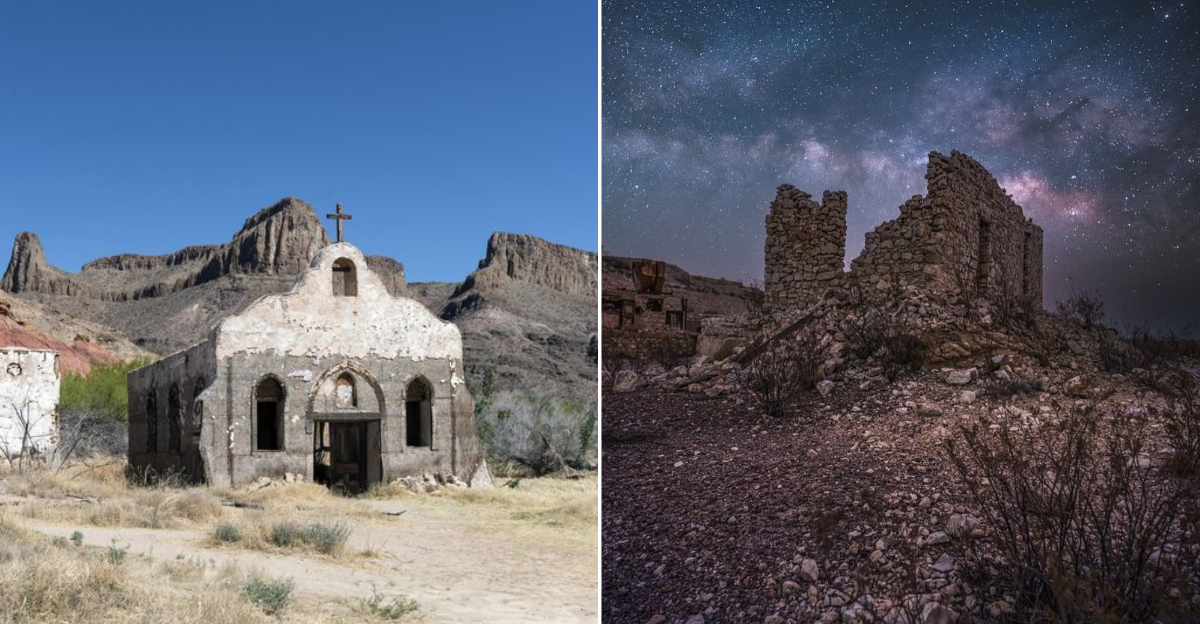
Texas is home to hundreds of ghost towns, each with its own unique story of boom and bust.
I’ve always been fascinated by these forgotten places, wondering what happened to the folks who once called them home.
Some of these abandoned settlements have crumbled into dusty ruins, while others have been reborn as offbeat destinations that attract curious travelers.
Join me as we explore 10 Texas ghost towns that met very different fates.
1. Terlingua: The Mercury Mining Town That Nature Reclaimed
My first encounter with Terlingua left me speechless – collapsed stone cottages scattered across a harsh desert landscape like some apocalyptic movie set. This former mercury mining boomtown flourished in the early 1900s when the mineral was in high demand for making explosives during World War I.
After the market crashed and the mines closed in the 1940s, residents simply walked away. The unforgiving desert sun has since baked what remains into a haunting collection of crumbling structures.
Walking through Terlingua’s cemetery, with its wooden crosses and stone graves decorated with colorful trinkets, feels like stepping between two worlds. The nearby trading post and a handful of new businesses hint at the area’s second life as a tourist spot, but most of original Terlingua lies in beautiful decay.
2. Sherwood: The County Seat That Lost Its Crown
Sherwood’s story always reminds me how quickly fortunes can change on the Texas frontier. Once the proud seat of Irion County, this settlement’s decline began with something as simple as a railroad route decision.
Founded in 1881, Sherwood boasted a courthouse, jail, hotel, and several businesses. When railroad officials decided to bypass Sherwood in 1889, a rival town called Mertzon sprang up along the tracks. After a heated election, Mertzon snatched away Sherwood’s county seat status in 1936.
Today, only the old sandstone courthouse remains standing, alongside a few stone foundations and the small cemetery. I found something deeply poetic about this empty building – once the center of local power – now standing alone in a field, its windows like hollow eyes gazing across the prairie where a town once thrived.
3. Indianola: The Coastal Boomtown Swept Away By Hurricanes
Standing on the windswept shore where Indianola once stood, it’s hard to believe this empty stretch of coastline was once poised to become Texas’ largest port city. Founded in 1846 on Matagorda Bay, Indianola quickly grew into a bustling seaport with over 5,000 residents.
Mother Nature had other plans. A devastating hurricane in 1875 damaged much of the town, but stubborn residents rebuilt. When a second massive hurricane hit in 1886, followed by a fire that consumed what remained, the survivors finally admitted defeat.
The sea has claimed most evidence of Indianola’s existence. Only a few concrete cisterns, the cemetery, and some foundations remain visible at low tide. I’ve visited several times, and there’s something profoundly humbling about watching waves crash over a place where elegant homes and busy streets once stood.
4. Barstow: The Farming Community That Dried Up
“Water is more precious than gold in West Texas.” That old saying came vividly to life when I visited Barstow, a ghost town that literally dried up and blew away. Founded in 1891, this once-thriving farming community boasted lush orchards and vineyards thanks to an elaborate irrigation system fed by the Pecos River.
Disaster struck in 1904 when the dam providing water to Barstow broke. The replacement dam delivered mineral-heavy water that poisoned the crops. A devastating drought in 1910 delivered the final blow, and families began abandoning their farms.
Today, I could barely find traces of old Barstow among the scattered ruins. A few crumbling adobe walls, the old schoolhouse foundation, and an abandoned church are all that remain. The wind whistling through these empty structures tells a cautionary tale about building dreams on unreliable resources.
5. Aldridge: The Sawmill Town Swallowed By Forest
Hidden deep in the East Texas piney woods, Aldridge offers the most dramatic ruins I’ve encountered in the Lone Star State. This former lumber boomtown operated three massive sawmills between 1906 and 1923, processing the region’s abundant timber.
After devastating fires and dwindling resources forced operations to close, nature began reclaiming the site with remarkable speed. Towering concrete structures from the sawmill operations now stand like ancient temples in the forest. Massive brick kilns, boiler rooms, and engine foundations create an industrial Stonehenge effect.
What makes Aldridge especially eerie is how the forest has infiltrated every crack and crevice. Vines climb walls, trees grow through floors, and moss carpets the concrete. Unlike many Texas ghost towns baking in open desert, Aldridge feels like a lost civilization being devoured by a hungry forest.
6. Lobo: From Forgotten Wasteland To Desert Art Collective
The first time I rolled into Lobo, I thought my GPS had malfunctioned. This tiny collection of buildings in the middle of nowhere seemed completely abandoned – until I spotted the art installations peeking from behind dilapidated structures.
Lobo began as a water stop for the Texas & Pacific Railway in the 1880s and briefly boomed during the 1940s cotton era. By 1991, the town was completely deserted. Its fascinating rebirth began in 2001 when a group of artists from Germany purchased the entire ghost town for $20,000 and transformed it into a creative commune.
Today, Lobo hosts art residencies where creators live among the restored buildings and use the desert landscape as their canvas. The old gas station, post office, and motel have been repurposed with a quirky artistic flair. Spending a night here feels like sleeping in an art gallery where the line between installation and abandonment delightfully blurs.
7. Villa Terlingua: Where Mining Shacks Became Desert Chic Rentals
“Would you like to stay in a haunted mining shack?” That’s how my host greeted me at Villa Terlingua, and I knew immediately this wasn’t your typical accommodation. Adjacent to the more famous Terlingua ruins, this cluster of restored miners’ homes offers one of the most unusual overnight experiences in Texas.
Local entrepreneurs have transformed these humble stone structures into surprisingly comfortable vacation rentals while preserving their historic character. My casita still had the original rock walls and tiny windows, but now featured artistic touches, comfortable bedding, and solar power.
The real magic happens at sunset when the adobe walls glow golden and the Chisos Mountains turn purple on the horizon. Sitting on my private porch, I watched javelinas wander between the scattered dwellings while fellow guests gathered at the community fire pit to share Big Bend adventures. It’s the perfect base for exploring nearby Big Bend National Park.
8. Marfa: The Military Base Reborn As An Art Mecca
Marfa defies every ghost town stereotype. This former army base and ranching community was circling the drain until minimalist artist Donald Judd arrived in the 1970s and saw potential in its abandoned buildings and quality of light.
I’ll never forget my first visit – driving hours through empty desert only to stumble upon world-class art galleries housed in former gas stations and military barracks. Judd’s massive concrete installations sit in fields where cattle once grazed. The decommissioned Fort D.A. Russell now houses the Chinati Foundation’s contemporary art collection.
Marfa’s renaissance has attracted a fascinating mix of ranchers, artists, and celebrities. You might grab coffee next to a Hollywood director or watch local cowboys ride past a fashion photoshoot. The town embraces its contradictions – high-end boutiques operate alongside feed stores, and food trucks serve gourmet fare in the shadow of historic adobe buildings.
9. Prada Marfa: The Fake Store That Became A Real Destination
Thirty miles outside Marfa stands what might be Texas’ most photographed ghost town – except it was never actually a town. Prada Marfa is a permanent art installation: a fake Prada store built in 2005 on an empty highway stretch near the tiny community of Valentine.
Created by artists Elmgreen and Dragset, this replica boutique features real Prada merchandise from the 2005 collection (though the shoes are bottomless and the bags have no bottoms to discourage theft). The structure was designed to slowly deteriorate back into the landscape, though frequent maintenance has preserved it as a major tourist attraction.
My first glimpse of this surreal sight – a luxury storefront standing alone against the vast desert – made me laugh out loud. Watching visitors pose for social media photos outside this commentary on consumerism creates an ironic meta-experience. The installation has spawned a micro-economy of Prada Marfa souvenirs in nearby towns.
10. Contrabando: The Movie Set That Outlived Its Films
“That’s where they filmed the bar shootout in ‘Desperado’!” I exclaimed, pointing to a weathered cantina facade at Contrabando. This fake ghost town was built as a movie set in the 1980s along the Rio Grande in Big Bend Ranch State Park.
After appearing in several westerns and action films, the set was abandoned but never dismantled. Nature and time have weathered the structures into an accidentally authentic-looking ghost town. The fake jail, saloon, and church now sport genuine decay that production designers would pay thousands to replicate.
What makes Contrabando especially fascinating is how it’s becoming a legitimate historical site in its own right. Visitors can wander freely through the deteriorating buildings, which offer spectacular views of the Rio Grande and Mexico beyond. Park rangers now preserve the site as both a cultural attraction and a unique example of how our entertainment becomes intertwined with history.