
The Hidden California State Park That Holds A Natural Wonder You Won’t Believe Exists
I stumbled across Calaveras Big Trees State Park during a road trip detour, and honestly, I wasn’t prepared for what I found.
Towering giant sequoias—some older than human civilization itself—stand in quiet groves that most tourists completely overlook.
This hidden spot in California’s Sierra Nevada mountains isn’t just beautiful; it’s a living time capsule that tells stories of discovery, survival, and nature’s unbelievable power.
The Hidden California Forest That Time Forgot
Calaveras Big Trees State Park sits tucked away in the Sierra Nevada foothills, about 150 miles east of San Francisco. Most people speed past it on their way to Yosemite, completely unaware they’re missing one of California’s most jaw-dropping natural wonders.
The park protects two groves of giant sequoias—trees so massive they make redwoods look like toothpicks. These botanical behemoths can live for over 3,000 years, meaning some were saplings when the pyramids were being built.
Walking among them feels like stepping into another dimension. The air smells different, the silence is deeper, and you can’t help but feel impossibly small. I spent an entire afternoon just wandering, neck craned upward, trying to wrap my brain around their sheer size.
Walking Among The Giants Of Calaveras Big Trees State Park
North Grove Trail is where most visitors start, and for good reason—it’s paved, accessible, and absolutely packed with giants. The loop takes about an hour at a leisurely pace, winding past some of the park’s most famous residents.
You’ll encounter trees with circumferences wider than city buses. The Father of the Forest, a fallen giant, stretches so long you could park several cars end-to-end along its trunk. Kids love scrambling over the massive root systems.
My favorite moment? Standing inside a fire-scarred hollow at the base of a still-living sequoia, realizing the tree had survived multiple catastrophic fires and was still growing strong. These survivors know something about resilience we humans have forgotten.
The Discovery Tree: When Curiosity Met Tragedy
In 1853, a hunter named Augustus T. Dowd stumbled upon the North Grove while chasing a wounded bear. He rushed back to tell others, but nobody believed him—trees that big simply couldn’t exist, they insisted.
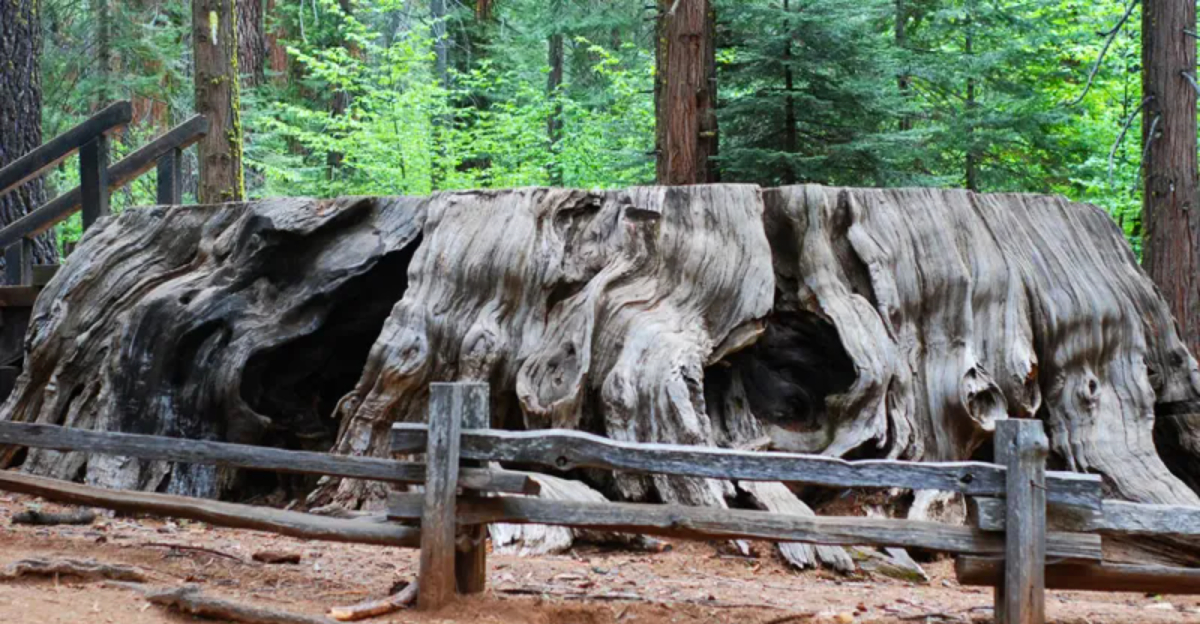
Eventually, curiosity won out. Entrepreneurs saw dollar signs and felled the Discovery Tree—a giant over 300 feet tall and 1,244 years old. They stripped its bark and shipped it east as a traveling exhibit.
Ironically, people thought the exhibit was fake. The tragedy sparked America’s first conservation conversations, though. Today, you can visit the Discovery Tree’s stump, a sobering reminder that wonder and greed often collide. I stood there feeling equal parts amazed and heartbroken.
North Grove Vs. South Grove: Two Worlds Of Wonder
North Grove gets all the attention, but South Grove? That’s where the magic really happens. It’s wilder, quieter, and requires a five-mile hike through pristine wilderness to reach the heart of the grove.
South Grove contains over 1,000 giant sequoias, including the park’s largest specimens. The trails are unpaved, the crowds are nonexistent, and the experience feels genuinely untouched. You might not see another human for hours.
I packed a lunch and hiked out there on a weekday morning. The silence was profound—just wind through branches and the occasional woodpecker. When I finally reached the grove’s center, surrounded by ancient giants, I felt like I’d discovered Narnia. Worth every blister.
Seasons Of Magic: From Snow-Draped Winters To Wildflower Springs
Summer brings the crowds, but visit during other seasons and you’ll witness transformations most people never see. Winter blankets the sequoias in snow, creating a scene straight from a fantasy novel—crimson bark against white powder.
Spring explodes with wildflowers carpeting the forest floor: lupine, Indian paintbrush, and dogwood blossoms everywhere. The meadows turn into kaleidoscopes of color while snowmelt feeds rushing creeks.
Fall offers golden aspens contrasting with evergreen giants, plus comfortable temperatures and practically empty trails. I visited in October once and had entire groves to myself. The crunch of leaves underfoot, the crisp air, the low-angle sunlight filtering through branches—absolute perfection for anyone seeking solitude.
Wildlife, Rivers, And Quiet Trails Few Tourists Ever See
Beyond the famous trees, Calaveras shelters an entire ecosystem most visitors overlook. Black bears lumber through in summer, foraging for berries. Mule deer browse meadow edges at dawn and dusk. Stellar’s jays scold hikers from overhead branches.
Beaver Creek and the Stanislaus River wind through the park, offering fishing spots and swimming holes. I discovered a perfect creek-side boulder one afternoon and spent hours reading, feet dangling in ice-cold water.
The park maintains over 100 miles of trails beyond the main groves. Bradley Grove Trail, Lava Bluffs Trail, and Three Senses Trail all offer solitude and surprises. Pack water, bring curiosity, and prepare for adventures that don’t involve sequoias at all.
How History Nearly Destroyed — And Then Saved — These Ancient Trees
The Discovery Tree’s destruction sparked outrage that eventually birthed America’s conservation movement. People realized these giants couldn’t be replaced—not in our lifetimes, not in our grandchildren’s lifetimes, maybe never.
By the early 1900s, logging threatened to wipe out California’s remaining sequoia groves. Conservationists fought back, and in 1931, Calaveras became a state park through public fundraising. Citizens literally bought the land to protect it.
Today, the park educates visitors about this near-disaster. Interpretive signs tell stories of both destruction and salvation. Standing among survivors, knowing people cared enough to save them, gives me hope. These trees have weathered ice ages, droughts, and human greed—and they’re still here, still growing.