
The Most Unique Tunnel In Ohio Comes With A Past That Still Amazes Locals
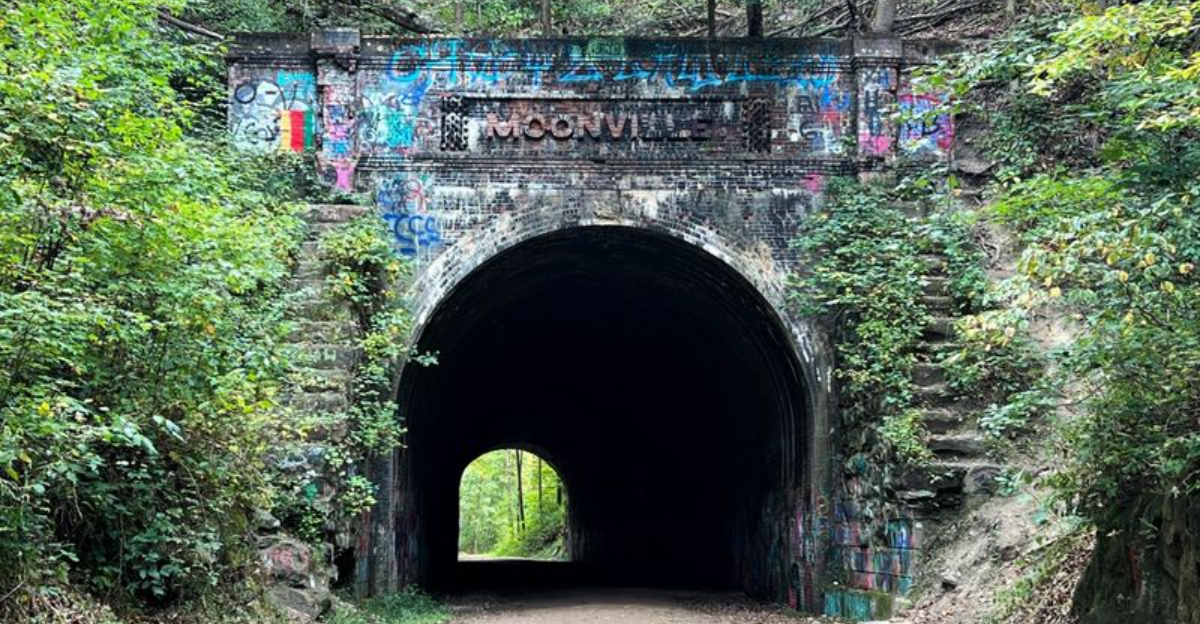
Deep in the dense forests of southeastern Ohio, far from highways and towns, rests a place that feels suspended between past and present.
The Moonville Tunnel, with its weathered brick archway, stands as a haunting reminder of the state’s coal-mining days, when trains and steam engines carved paths through frontier settlements.
I came across it during a crisp autumn hike, and what I found was more than just an abandoned railroad passage—it was a living piece of folklore. Legends of ghostly figures and whispered stories surround the tunnel, making it both a historical landmark and a portal to Ohio’s enduring mysteries.
Ghostly Encounters That Defy Explanation
My flashlight beam cut through the darkness as I entered the tunnel last October. The hair on my arms stood straight up – not from the autumn chill, but from something else entirely.
Countless locals swear they’ve spotted the infamous “Lantern Man” – a ghostly brakeman who fell under a train’s wheels in the 1880s. Now he allegedly wanders the tunnel with his phantom lantern, eternally searching for the train that left him behind.
What makes these stories stick isn’t just their spookiness. These tales have been passed down through generations, with grandparents telling wide-eyed children about the eerie glow that sometimes appears when no one’s there.
A Vanished Town’s Only Survivor
The tunnel outlived the very town it was built to serve! Moonville once bustled with coal miners, railroad workers, and their families – nearly 100 residents at its peak.
Now? Not a single building remains standing. The forest has reclaimed every foundation, every street, every sign of the community that once called this remote valley home.
Only this brick archway persists, stubbornly defying time. Walking through the tunnel feels like stepping through a doorway into Ohio’s industrial past. The ghosts here aren’t just supernatural – they’re the whispers of a vanished community whose only monument is this moss-covered passage through a hillside.
Engineering Marvel in the Wilderness
Constructed in 1857 when this region was practically wilderness, the tunnel represents an astonishing feat of 19th-century engineering. Workers carved through solid rock using nothing but black powder, hammers, and determination.
The perfectly arched brick ceiling has withstood over 160 years of freezing winters, flooding springs, and the rumble of countless coal trains. Even today, the craftsmanship is evident in the precisely laid brickwork.
I ran my fingers along those bricks, marveling at how they’ve outlasted the railroad company that built them, the town they served, and generations of people who once depended on this passage. Some stones still bear the marks of the original masons’ tools!
Bad Reputation That Fuels Local Legends
The tunnel earned its haunted reputation honestly – through tragedy. Records show at least five people passed in accidents in or near the tunnel between 1880 and 1920.
The most famous victim was the engineer whose ghost supposedly carries that spectral lantern. But there was also a drunken brawl that ended in a bad accident just outside the tunnel’s mouth in 1886.
Locals tell me about a woman in white – supposedly struck by a train while crossing through – who appears on misty evenings. Whether you believe in ghosts or not, the tunnel’s bad history is undeniable. These weren’t just accidents; they became the foundation for a century of supernatural folklore that continues to draw paranormal investigators from across the country.
Nature’s Dramatic Reclamation Project
Mother Nature works her magic here in the most breathtaking ways! Emerald moss carpets the tunnel’s entrance like velvet, while stubborn saplings sprout from seemingly impossible cracks in the brickwork.
During my spring visit, wildflowers had colonized the old rail bed, creating a stunning natural carpet leading to the tunnel’s mouth. The contrast between industrial ruin and wild beauty creates a photographer’s dream.
What struck me most was the sound – the tunnel creates a perfect acoustic chamber where birdsong echoes hauntingly. Water seeps through the ceiling in places, creating glistening mineral deposits that transform this human-made structure into something that feels almost organic, as if the forest is slowly digesting this piece of the past.
Community Preservation Against All Odds
Locals refused to let this historical treasure crumble away! When flooding threatened to undermine the tunnel’s foundation in 2017, residents formed the Moonville Rail Trail Association.
They didn’t just raise funds for preservation – they literally rolled up their sleeves and got to work. I met Tom, a 72-year-old former miner who personally helped reinforce the eroding embankment.
“This tunnel tells our story,” he told me while showing me old photos of coal trains passing through. The association now hosts an annual Moonville Tunnel Festival each fall, featuring history walks, ghost stories, and traditional Appalachian music. Their passionate dedication ensures this piece of Ohio’s past will survive for future generations to explore and wonder about.
Hidden Gem on the Appalachian Backroads
Finding Moonville Tunnel feels like discovering buried treasure! Tucked deep within Vinton County’s winding backroads, the journey itself becomes part of the adventure.
You won’t stumble upon it accidentally – you have to want to find it. The tunnel sits along the developing Moonville Rail Trail, connecting to other historical sites like King’s Hollow Tunnel and the remains of Hope Station.
Unlike commercialized attractions, there’s no gift shop or admission fee here. Just pure, authentic history waiting in the woods. I remember the moment the tunnel first came into view during my hike – that first glimpse of the brick arch emerging from the greenery felt like discovering something that belonged just to me, though it’s actually a gift shared by all who make the journey.