
The Oldest Masonry Fort In America Is Right Here In Florida And Most People Still Haven’t Seen It
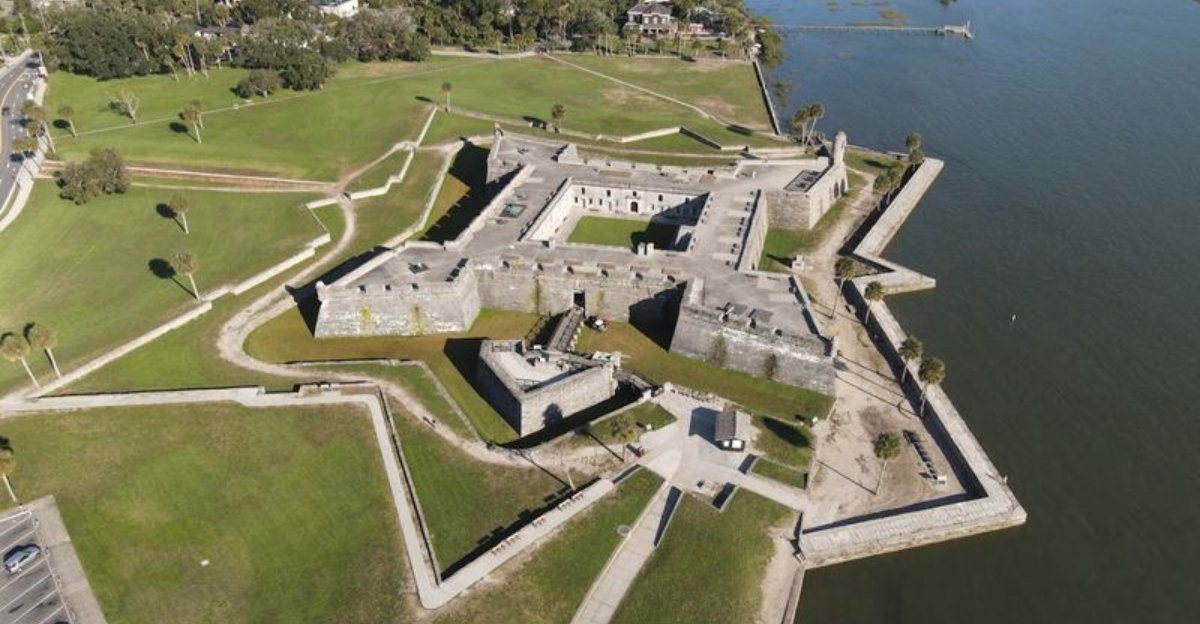
You can stand along the waterfront in St. Augustine and miss it completely if you’re not paying attention.
From a distance, it looks like just another historic structure in Florida. Then you get closer, look up, and realize how long those walls have been standing there.
More than 350 years later, this is still one of the strongest and most overlooked landmarks in Florida.
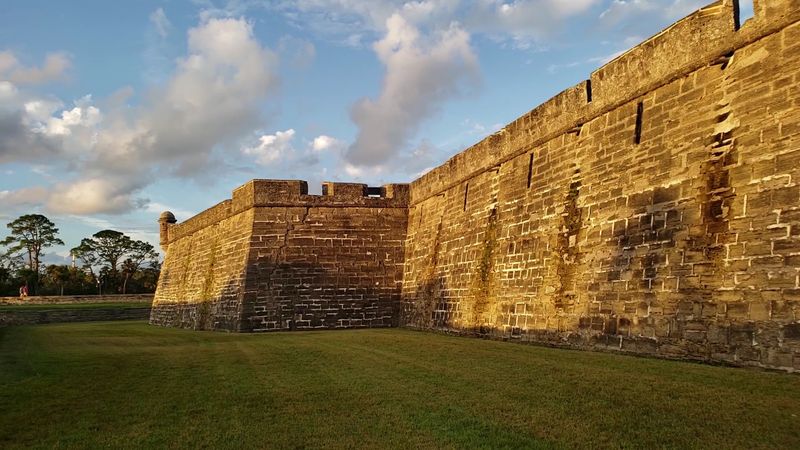
The scale doesn’t fully register until you’re right in front of it. Thick stone, sharp angles, a design built to last through things most places wouldn’t survive.
It doesn’t feel decorative. It feels deliberate.
People slow down here. They look up, walk the perimeter, and try to take in how much history has passed through the same space.
You know that moment when something feels more real in person than it ever did in photos?
That’s what this becomes.
And once you see it up close, it’s hard to believe how many people pass through Florida without stopping.
Built From A Stone That Actually Gets Stronger When Hit
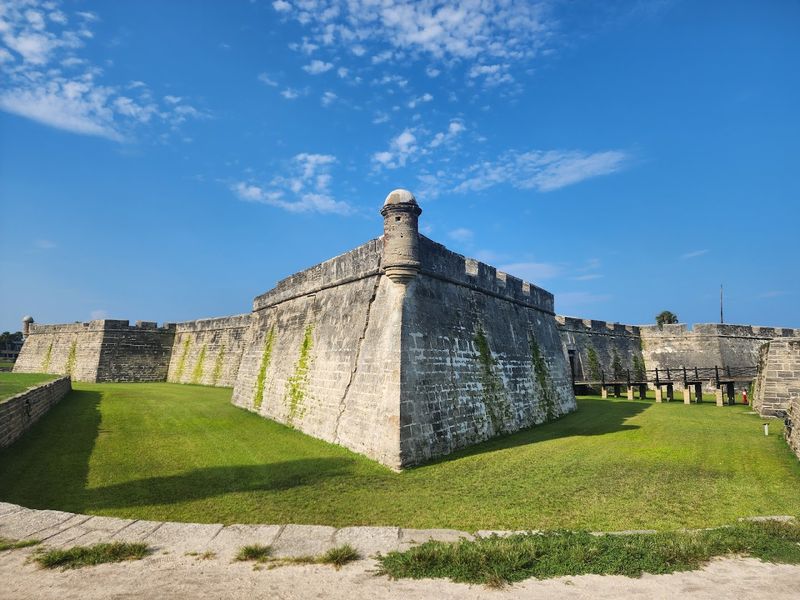
Most forts were built to resist cannonballs, but the castillo de San marcos was built from a material that practically laughs at them.
The entire structure was constructed using coquina, a naturally occurring sedimentary rock made of compressed shell fragments found along the coast of Florida.
When a cannonball strikes coquina, instead of shattering into dangerous shards the way brick or hard stone would, the soft rock absorbs the impact and crumbles just slightly, which actually prevents the kind of catastrophic damage that would bring down a harder wall.
Spanish engineers discovered this property while quarrying the material from nearby anastasia Island, and they made the smart call to use it as the primary building block of the entire fort.
Today, visitors who touch the walls can feel the texture of millions of tiny shells compressed over thousands of years, which makes the building material one of the most fascinating details you will notice on your first walkthrough.
Never Once Captured By An Enemy Force
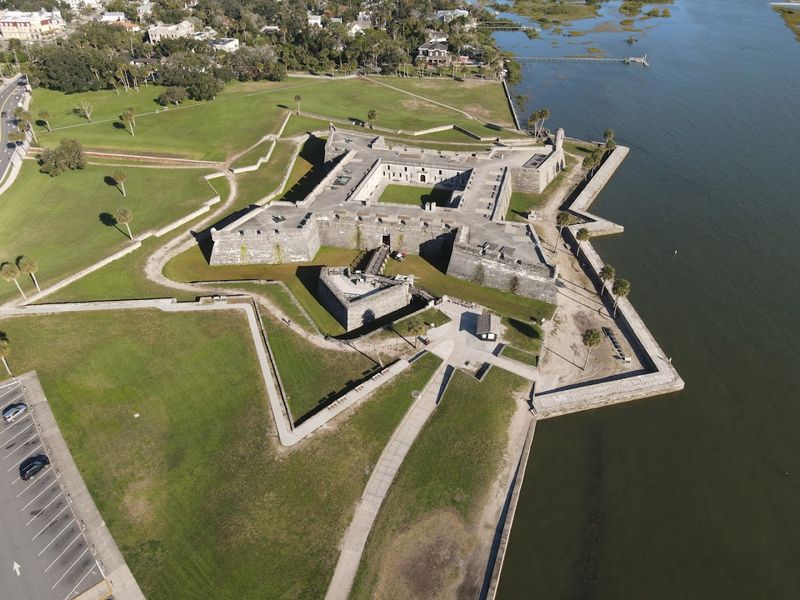
For a military fort that saw its share of sieges, bombardments, and territorial disputes, the castillo de San marcos holds an extraordinary record that very few fortifications in the world can match.
Not a single enemy force ever successfully captured it through direct military assault during its active service years.
British forces attempted a major siege in 1702, surrounding the fort for several weeks and firing relentlessly at the coquina walls, but the structure held firm while the Spanish garrison waited them out.
A second British siege in 1740 produced the same result, with the fort’s defenders outlasting the attackers until the British eventually withdrew.
That kind of unbroken defensive record is a big part of what makes the castillo so respected among military historians and architecture enthusiasts.
Walking through the entrance today, knowing that the same walls you are touching once stopped a full-scale military campaign, adds a layer of weight to the visit that no museum exhibit can fully replicate.
Construction Took Over 23 Years To Complete
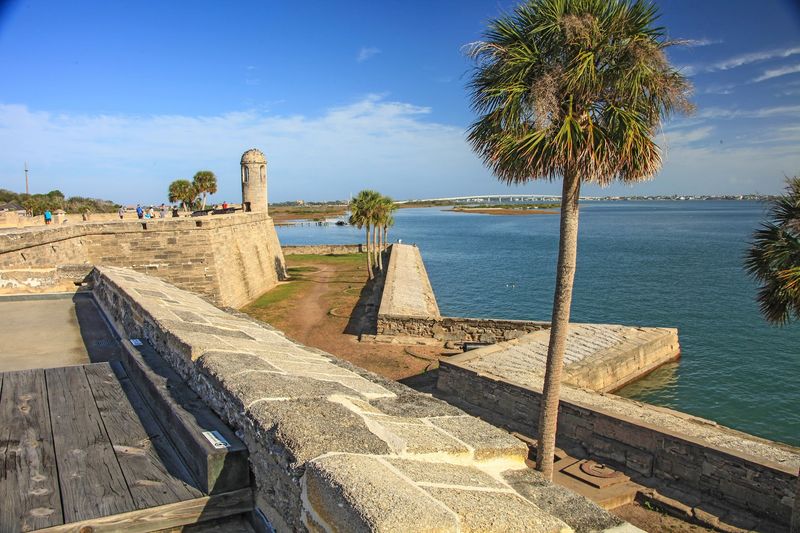
Starting a construction project in 1672 and finishing it in 1695 tells you something important about the scale and ambition of what the Spanish were building in St. Augustine.
Workers, many of whom were Indigenous laborers and enslaved people, spent more than two decades quarrying coquina from anastasia Island, ferrying it across the water, and carefully laying the walls that still stand today.
The project required enormous logistical coordination in a time when there were no power tools, no cranes, and no modern engineering software to check calculations.
Materials had to be sourced locally, shaped by hand, and assembled with a level of precision that would challenge even experienced builders today.
The result was a four-sided fort with diamond-shaped bastions at each corner, a design specifically chosen to eliminate blind spots and allow defenders to cover every angle of attack.
Standing inside the courtyard and looking up at those walls, it is genuinely hard to believe that human hands built all of this without any modern assistance.
The Fort Has Changed National Flags Four Times
One of the more quietly dramatic stories attached to the castillo de San marcos is the number of times a different nation’s flag has flown above its walls over the centuries.
Spain built the fort and controlled it for most of the colonial period, but Britain took possession of Florida in 1763 as part of the treaty that ended the Seven Years War and flew the British flag over the fort for about 20 years.
Spain regained control in 1783 when Britain returned Florida as part of another treaty settlement, and the Spanish flag went back up.
When the United States acquired Florida in 1821, the American flag replaced the Spanish one, and the fort was renamed Fort Marion for a period.
During the Civil War, Confederate forces briefly occupied the fort before Union troops retook it.
That sequence of four different national identities playing out on a single piece of real estate over roughly 150 years makes the fort one of the most historically layered sites in the entire country.
A Working Drawbridge Still Greets Every Visitor
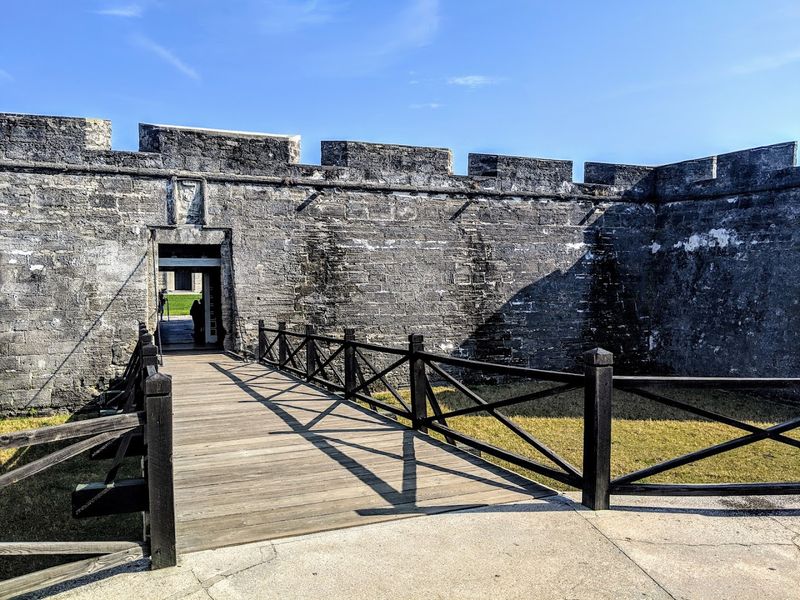
Not many places in the United States let you walk across an actual functioning drawbridge to enter a 17th-century fortification, but the castillo de San marcos pulls it off with complete authenticity.
The drawbridge spans the fort’s moat, which was originally designed to slow down attackers and make any direct assault on the walls far more difficult and costly.
When the fort was fully operational as a military installation, the drawbridge could be raised to cut off access entirely, turning the fort into an island that could only be reached by water.
Today the drawbridge stays down for visitors, but crossing it still gives you a physical sense of the barrier it once represented.
The moat itself, while no longer filled with water in the traditional sense, is still clearly defined around the perimeter of the fort.
First-time visitors often pause on the bridge to take photos before even stepping inside, and honestly, that instinct makes complete sense once you see how dramatically the entrance is framed by the surrounding stonework.
Cannon Firing Demonstrations Bring The History To Life
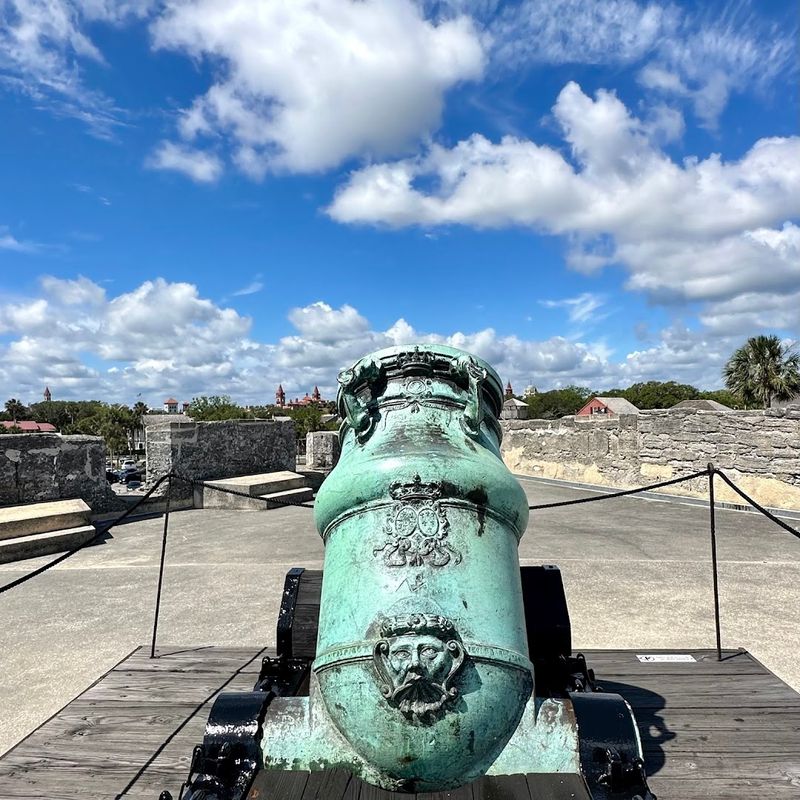
Reading about colonial-era cannons in a textbook is one thing, but standing on the gun deck of the castillo de San marcos while a ranger in period uniform fires an actual cannon is something else entirely.
The live cannon demonstrations are among the most talked-about experiences at the fort, and visitors who plan their trip around a scheduled firing day consistently say it elevates the whole visit.
The sound alone is enough to shake the chest and rattle the senses in a way that makes the fort’s military history feel immediate rather than distant.
Rangers explain the process of loading and firing in careful detail before the demonstration, covering the mechanics of 17th and 18th-century artillery and the role cannons played in the fort’s defensive strategy.
The gun deck offers sweeping views of matanzas Bay, so the combination of dramatic scenery and a live cannon blast creates one of the most memorable moments available at any historic site in Florida.
Check the schedule before your visit so you don’t miss it.
Views Of Matanzas Bay Make The Visit Even More Rewarding
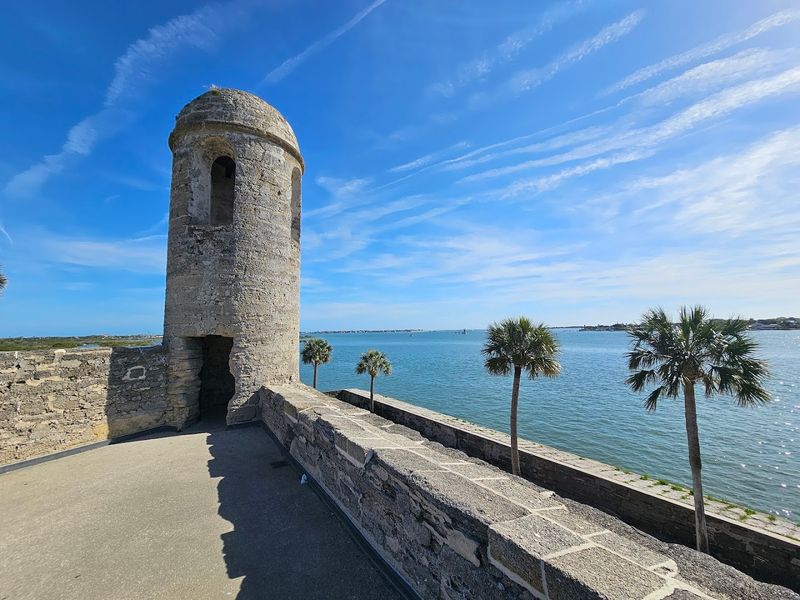
Some historic sites are fascinating but not particularly pretty, and some beautiful spots have little historical depth, but the castillo de San marcos manages to deliver both in the same afternoon.
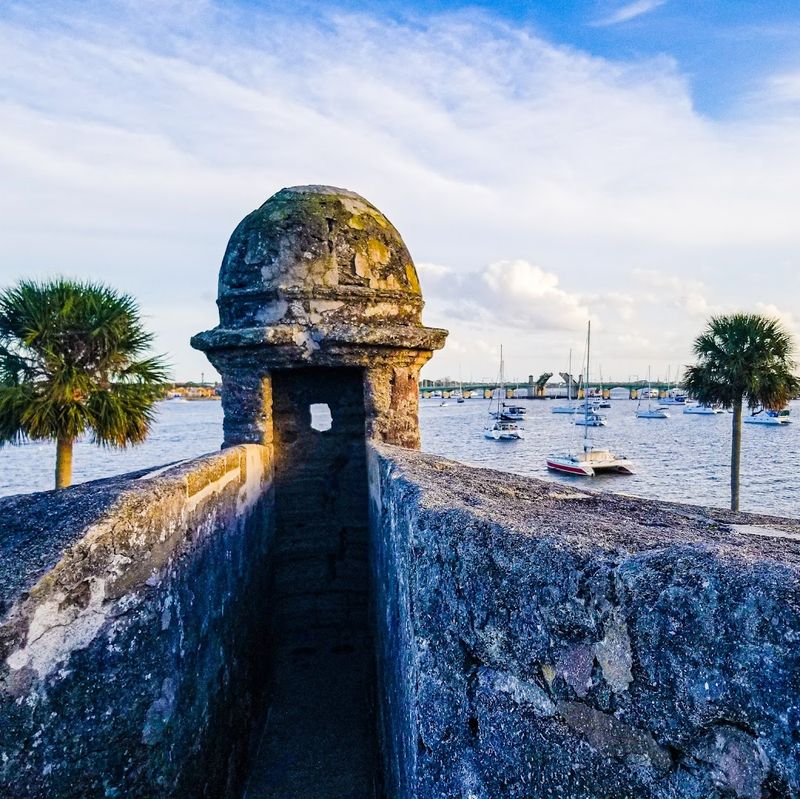
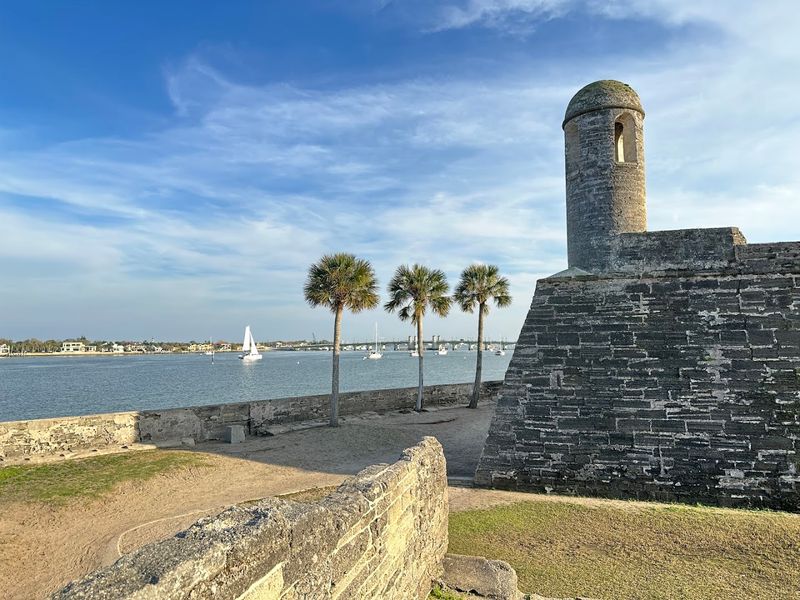
Walking the upper walls of the fort puts you at a height that frames matanzas Bay in a way that feels almost cinematic, with the open water stretching out toward the horizon and the St. Augustine skyline visible in the background.
Early morning visitors often describe the sunrise over the bay from the fort walls as one of the most peaceful experiences in the entire city.
Late afternoon visits have their own appeal, with the golden light hitting the coquina walls and the water taking on deeper shades of blue and green as the sun drops lower.
The views also help explain why the Spanish chose this exact location for the fort, since the elevated position over the water gave defenders a clear line of sight to any approaching ships.
Beauty and strategy turned out to make excellent neighbors in this case.
The Fort Once Served As A Prison For Native American Leaders
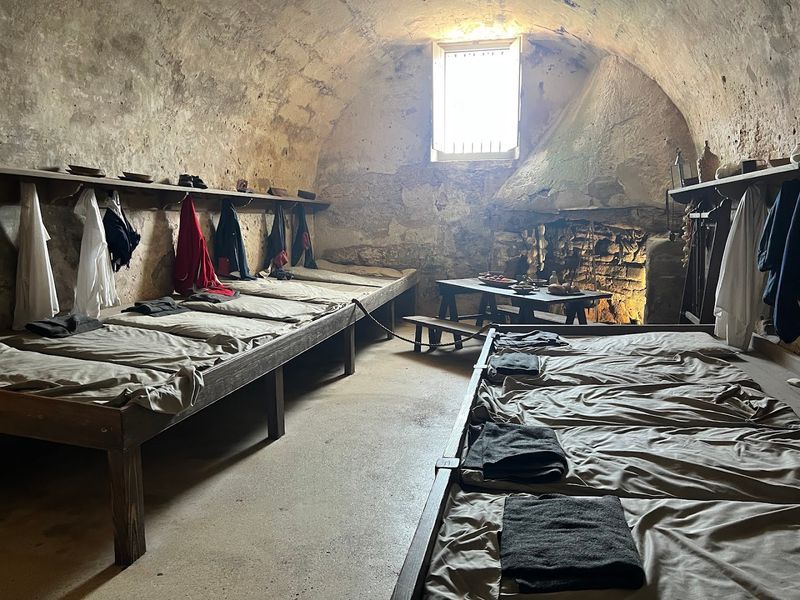
Beyond its role as a military defensive structure, the castillo de San marcos carries a more sobering chapter in its history involving its use as a prison for Native American leaders in the late 19th century.
Following the conclusion of the Indian Wars on the southern plains, the U.S. government transferred dozens of captive Native American leaders and warriors to the fort in 1875, holding them in the same stone rooms that once housed Spanish soldiers.
Among those imprisoned were members of the kiowa, comanche, cheyenne, and arapaho nations, some of whom used their time at the fort to create ledger art, a form of drawing on paper that documented their lives and culture.
Some of that artwork survived and is now considered historically significant as a record of Indigenous experience during a deeply difficult period.
The park service addresses this chapter of the fort’s history through exhibits and ranger programs, making it clear that the castillo’s story is not only one of Spanish colonial ambition but also of the broader and more complicated history of the American continent.
Park Rangers Make The Self-Guided Experience Feel Personal
One thing that repeatedly stands out in visitor accounts of the castillo de San marcos is how much the National Park Service rangers add to the experience.
The fort is open for self-guided tours, which means you can move at your own pace through the rooms, along the walls, and across the gun deck without following a rigid schedule.
But rangers are stationed throughout the fort and are genuinely enthusiastic about sharing what they know, so if you stop to ask a question you are likely to end up in a 15-minute conversation that covers details no exhibit panel could fit into a few paragraphs.
Multiple visitors have noted that the rangers have a way of making history feel exciting rather than academic, which is particularly helpful if you are visiting with children who might otherwise lose interest in a room full of old plaques.
The combination of freedom to explore and access to knowledgeable guides creates a visit that feels both independent and richly informed.
Plan to spend at least two hours to do the place proper justice.
Admission Is Free With A National Parks Pass
Here is a practical detail that a surprising number of people do not know before they show up at the gate: if you have an America the Beautiful annual pass, your entry to the castillo de San marcos is completely covered.
The standard adult admission fee is $15, which is honestly a fair price for everything the fort offers, but free is always better.
Active military personnel and their accompanying visitors also receive free admission, a benefit that applies at all National Park Service sites across the country.
Senior passes, which are available to U.S. citizens and permanent residents aged 62 and older, also cover entry costs.
If you are planning a trip that includes other national parks or monuments in the same year, the America the Beautiful pass pays for itself very quickly and makes spontaneous stops like this one much easier to justify.
The fort is open daily from 9 AM to 5 PM, and you can reach the visitor information line at +1 904-829-6506 or visit the official site at https://www.nps.gov/casa/index.htm before your trip.