
These 10 Forgotten Pennsylvania Ruins Are Packed With Creepy History
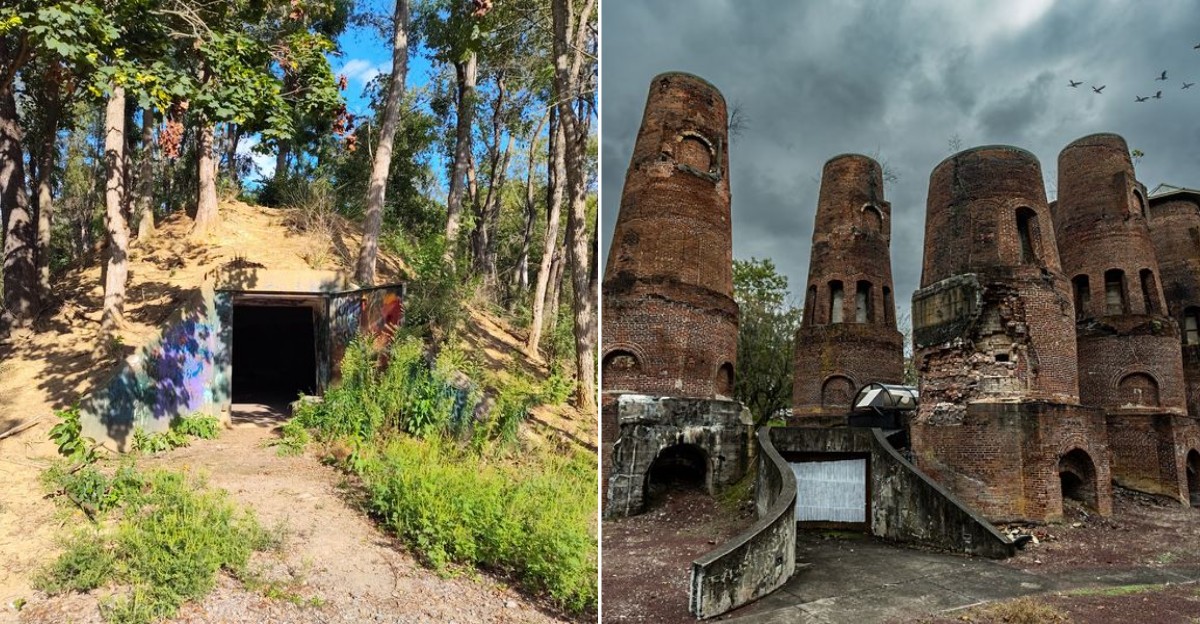
Ruins have a strange talent for making silence feel louder. Across Pennsylvania, old foundations, empty walls, and forgotten structures still hold pieces of stories that never quite disappeared.
Some are tied to industry, others to abandoned communities or buildings that outlived their original purpose. What makes them compelling is not just the decay.
It is the feeling that you are looking at the remains of something that once mattered enough for people to build, use, and eventually leave behind.
I have always found places like that harder to shake than polished historic sites.
Once, I stood beside a crumbling stone wall and caught myself wondering who had touched it when the building was still whole.
That thought followed me long after I left. Creepy history works best on me when nothing dramatic happens at all.
Give me an empty doorway, a bit of weathered stone, and one unanswered question, and my imagination will happily do the rest without anyone needing to tell me more.
1. Abandoned Pennsylvania Turnpike, Breezewood And Fulton County
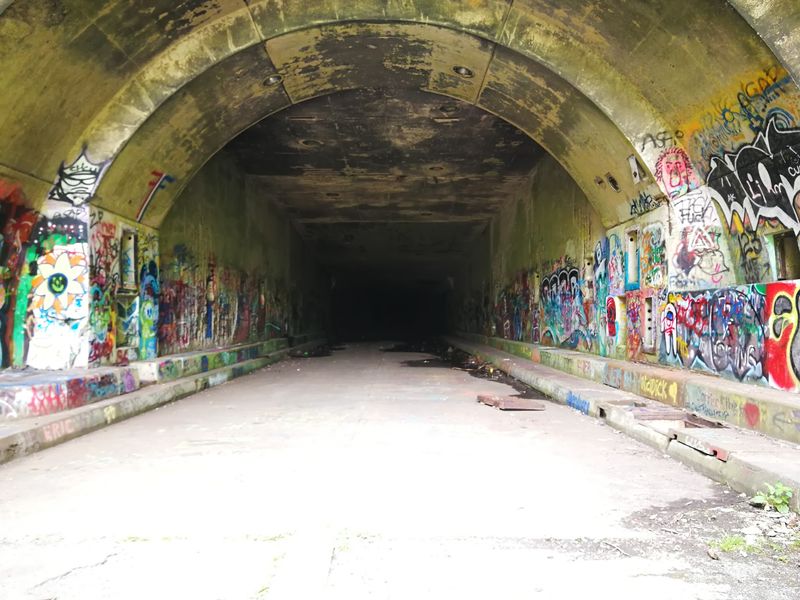
The public eight-and-a-half-mile corridor sitting empty is a strange thing to walk down, and yet here you are.
The Abandoned Pennsylvania Turnpike was bypassed in 1968 when traffic outgrew its narrow two-lane tunnels. The public section is managed for the developing Old PA Pike multiuse trail.
Two long tunnels remain, Rays Hill and Sideling Hill, and both are pitch black inside. Sideling Hill stretches over a mile, so a headlamp is not optional unless you enjoy walking blind with water dripping on your neck.
Bikers love this stretch because the pavement is flat and completely car free. Cracks split the asphalt, saplings push through the median, and old mile markers still stand at attention.
Spring and fall are the friendliest seasons since the tunnels hold cold air year round and can feel bitter in winter.
Western access is near Tannery Road and US 30 east of Breezewood, while the eastern trailhead is off Pump Station Road in Fulton County.
Bring gloves, bring a friend, and bring more light than you think you need. The Abandoned Pennsylvania Turnpike rewards anyone willing to walk into the dark.
2. Bunkers Of Alvira, West Chillisquaque Township
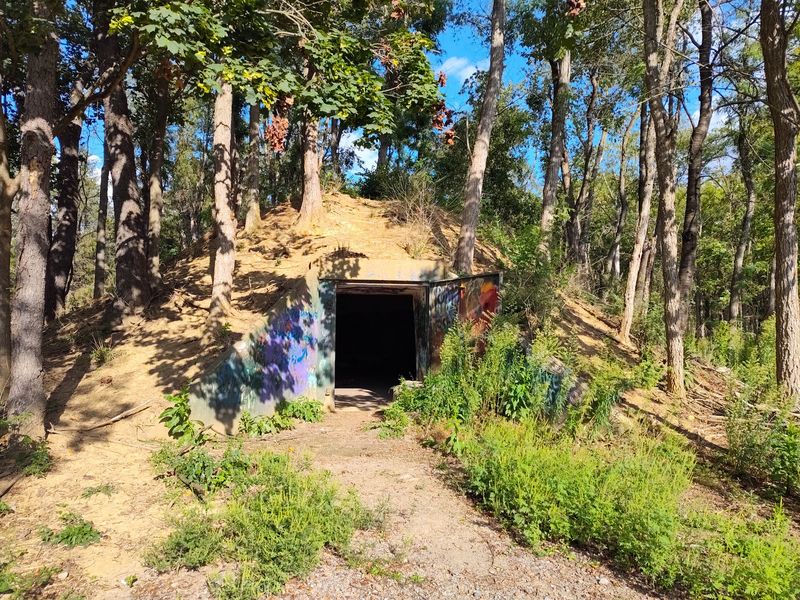
Over one hundred concrete domes sit in rows in the woods, half swallowed by grass and silence.
The Bunkers of Alvira were built in 1942 to store explosives during the Second World War.
To make room for them, the government condemned about 8,500 acres, displacing residents from 163 farms and 47 other properties around the village itself.
What remains is a strange grid of igloo shaped structures with heavy steel doors, some open, some sealed shut.
Deer wander between them, and hunters use the surrounding State Game Lands 252 all season long.
A few foundations from the old town still hide in the underbrush, along with a small cemetery that survived the relocation.
Fall brings the best colors, though hunting seasons mean you should wear bright orange and check the dates before heading out.
The bunkers sit along Alvira Road in Gregg Township west of Allenwood. State Game Lands 252 has seventeen parking lots, and foot travel is allowed on gated maintenance roads.
Standing inside one of the Bunkers of Alvira, the temperature drops and the echo does the rest.
3. Camp Michaux Ruins, Michaux State Forest
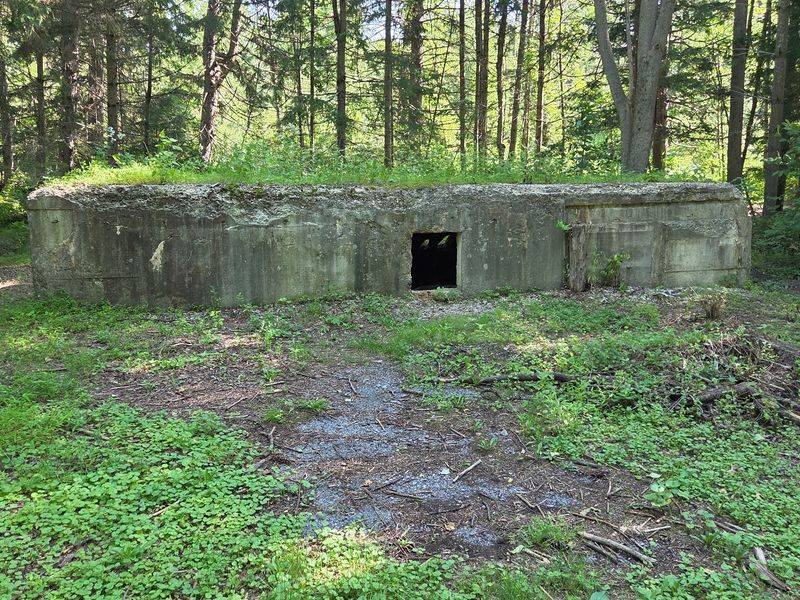
Few forest clearings carry three separate histories stacked on top of each other like this one.
Camp Michaux began as Bunker Hill Farm, tied to iron industry from 1787, later became a Civilian Conservation Corps camp during the Depression, then served as a secret interrogation camp for prisoners during World War II.
Afterward it was a church camp until it closed in 1972. Stone foundations, a spring house, and the outlines of barracks are scattered along a short interpretive loop.
Numbered posts explain what stood where, which makes the walk far more interesting than plain rubble. The trail is easy and roughly two miles, suitable for kids and anyone who does not want a workout.
Morning visits are quiet and cool, and the surrounding Michaux State Forest offers plenty of longer hikes if you want to stretch the day.
You will find Camp Michaux Ruins off Michaux Road near Pine Grove Furnace State Park in Cumberland County, Pennsylvania. Print the self guided tour before you go since service is spotty.
The stillness at Camp Michaux Ruins has a weight that photos never quite capture.
4. Austin Dam Ruins, Austin
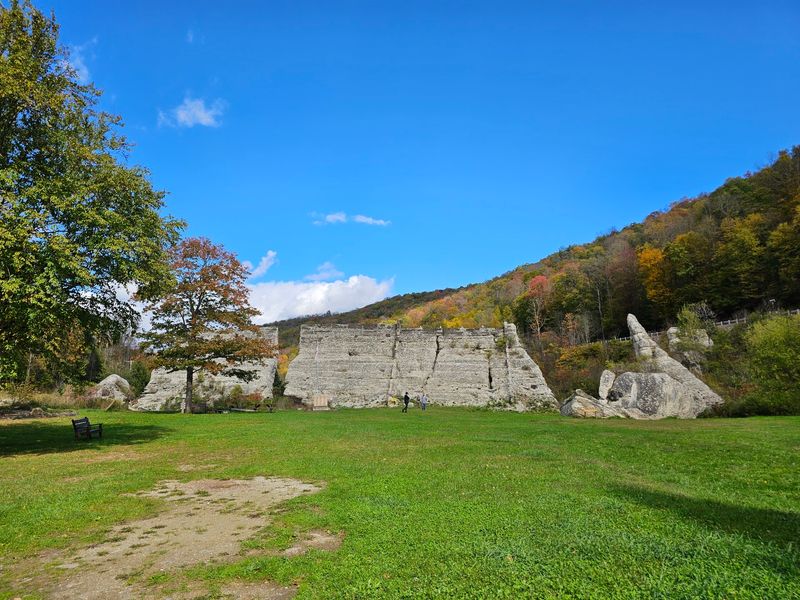
Giant slabs of concrete lie tipped over in a green valley, and the story behind them is grim.
Austin Dam Ruins mark the spot where the concrete dam failed on September 30, 1911, sending a wall of water toward the town of Austin.
The flood devastated Austin and Costello and ended lives of at least 78 people.
Huge chunks of the structure still sit where the failure left them, some leaning, some split clean in half. Viewing them safely from paths gives a sense of scale that no photograph delivers.
A memorial park surrounds the site with mowed paths, picnic tables, and signs explaining the disaster and the warnings that went ignored.
Summer brings live music events to the grounds, while quieter weekdays let you have the whole valley to yourself.
The Austin Dam Ruins sit just north of town along Route 872 in Austin, Potter County, Pennsylvania. Admission is free and parking is simple.
Potter County calls itself God’s Country, and the dark sky here is genuinely spectacular after sunset, so consider lingering past dusk near the Austin Dam Ruins.
5. Kinzua Viaduct Ruins, Mount Jewett
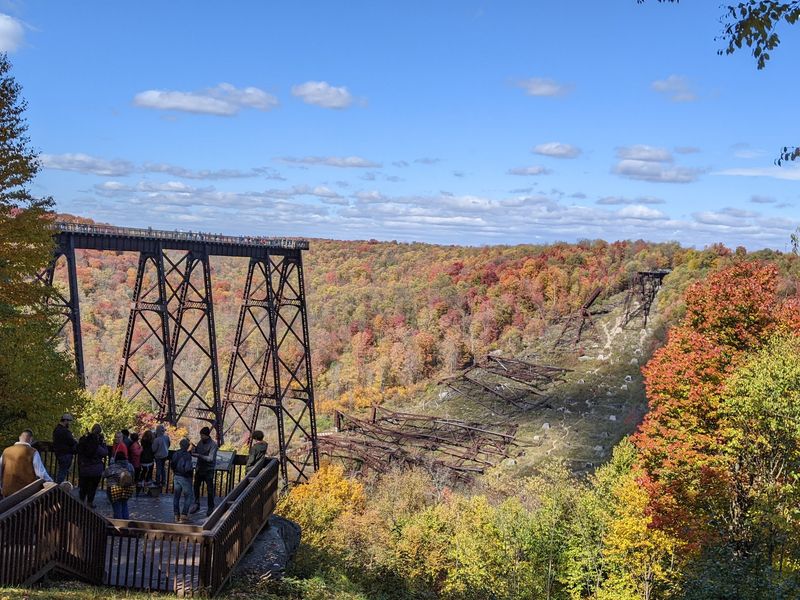
A tornado did what more than a century of trains could not, and the wreckage is still down there.
Kinzua Viaduct Ruins are the remains of a railroad bridge that once stood 301 feet above the valley and stretched 2,053 feet across.
In July 2003 a tornado tore through and twisted eleven towers off their bases.
Rather than remove the debris, the state turned the surviving section into the Kinzua Sky Walk, which ends with a partial glass floor looking straight down toward the valley.
Standing on that glass panel is a proper nerve test, and the view of the fallen towers below is unforgettable.
Autumn brings the Allegheny hills to life in color, and the Sky Walk is open September 1 through October 31 during the 2026 rehabilitation project.
Kinzua Bridge State Park sits at 296 Viaduct Road near Mount Jewett in McKean County, Pennsylvania, with a visitor center, free parking, overlooks, and trails.
Walking beneath the Sky Walk and around fallen towers is prohibited for safety, so check park alerts before visiting.
6. Concrete City, Nanticoke
Roofless concrete duplexes stand in a square in the woods, covered wall to wall in graffiti.
Concrete City was built in 1911 by the Delaware, Lackawanna and Western Railroad as model housing for selected coal company workers.
The homes offered unusually modern amenities for company housing at the time.
The problem was sanitation. After owners declined sewer upgrades, the development was abandoned in 1924 and residents left.
Demolition crews tried dynamite and gave up because the concrete refused to break.
Now the shells sit in a rough rectangle with an old wading pool in the middle, all of it repainted constantly by street artists.
Paintball players used the site for years, so watch your step around debris and broken glass. Sturdy boots matter more here than anywhere else on this list.
Concrete City is not a managed visitor attraction, and current access information conflicts, so verify local conditions before attempting the unmarked route from Front Street near Nanticoke, Luzerne County, Pennsylvania.
Photographers love the light that pours through missing roofs, and Concrete City looks completely different depending on the season you catch it in.
7. Scranton Iron Furnaces, Scranton
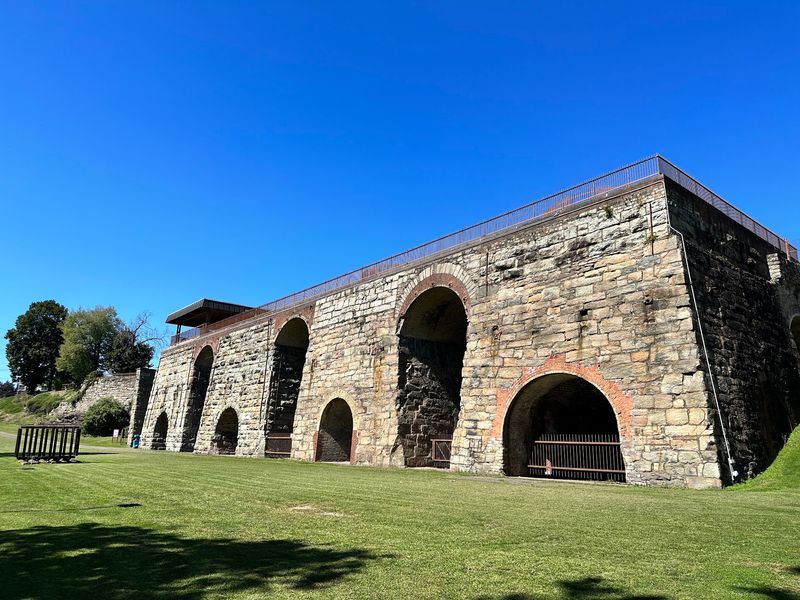
Four enormous stone arches rise out of downtown like the remains of some forgotten fortress.
The Scranton Iron Furnaces once powered one of the largest iron producers in the country, running from the 1840s into the early 1900s.
Rails made here helped build America’s railroad network, and the city itself grew up around the heat.
Each stack is built of rough cut stone and stands several stories tall, with ivy climbing the walls and interpretive panels explaining how molten iron was tapped and poured.
The site is free, open during daylight, and takes maybe thirty minutes to walk unless you stop to read everything.
Evening light hits the stonework beautifully, and the furnaces occasionally host events and holiday lighting that make the arches glow.
You will find the Scranton Iron Furnaces at 159 Cedar Avenue in Scranton, Lackawanna County, Pennsylvania, an easy stop alongside the nearby steamtown railroad attractions.
Few industrial ruins sit this comfortably in the middle of a working city, and the Scranton Iron Furnaces make a fine first stop for anyone new to Pennsylvania’s industrial past.
8. Coplay Cement Company Kilns, Coplay
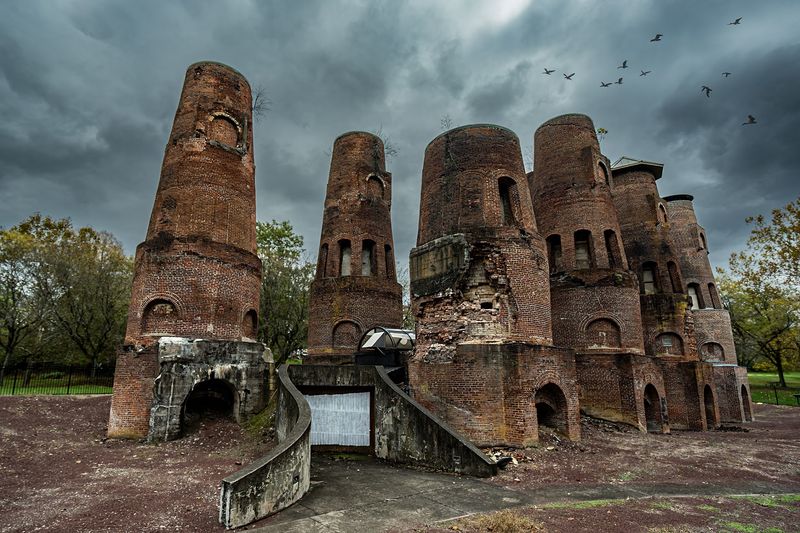
Nine brick chimneys stand shoulder to shoulder like something out of a strange industrial cathedral.
The Coplay Cement Company Kilns are Schoefer vertical kilns built in the 1890s, and they are the last surviving group of their kind in the United States.
They produced portland cement until 1904, when better technology made them obsolete.
Each kiln rises around ninety feet, and the site now operates as Saylor Park Cement Industry Museum with a small building explaining how cement shaped the Lehigh Valley.
The museum keeps limited seasonal hours, but the grounds stay open so you can admire the stacks anytime during daylight.
Cement from this region built the Panama Canal locks, which is a fact worth mentioning next time someone calls concrete boring.
Picnic tables and shade make it a pleasant stop with kids, and the walk around the kilns is flat and short.
The Coplay Cement Company Kilns sit at 245 North Second Street in Coplay, Lehigh County, Pennsylvania.
Parking is free and rarely crowded, so the Coplay Cement Company Kilns feel oddly private for a roadside landmark.
9. D*ad Man’s Hollow Industrial Ruins, Liberty Borough
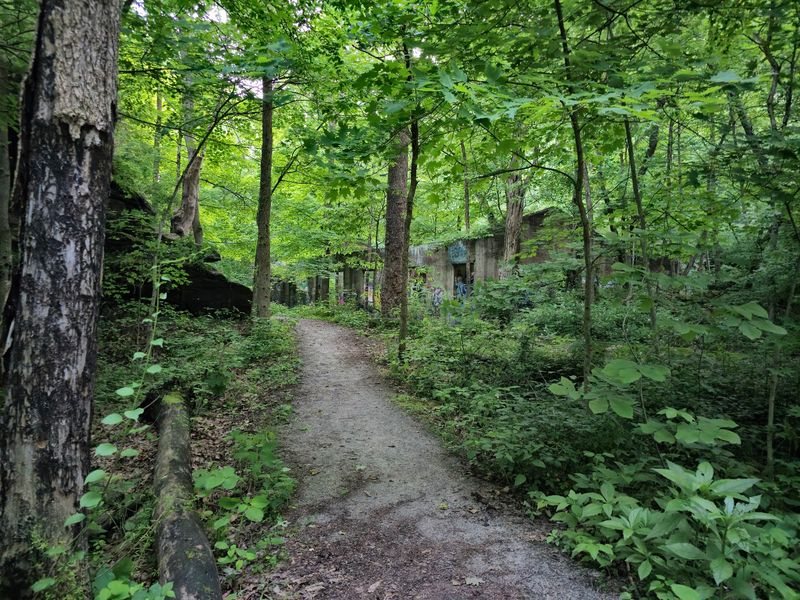
The name alone gets your attention, and the crumbling brickwork in the woods does the rest.
D*ad Man’s Hollow Industrial Ruins sit inside a conservation area near the Youghiogheny River, where a pipe factory operated before ending in the 1920s.
Moss covered walls, kiln foundations, and scattered industrial remains still survive there.
The hollow’s unsettling name is tied to several local stories about passings and discoveries, but no single origin has been firmly documented.
Today the Allegheny Land Trust manages around 450 acres here with marked trails, wildflowers in spring, and plenty of birdsong to soften the mood.
Trails connect to the Great Allegheny Passage, so cyclists can easily detour in for a look. Rain turns the paths slick around the ruins, so pick a dry day and keep off the unstable walls.
The main access is from the Great Allegheny Passage near its Boston parking area, with additional trailheads at Catfish Pond and Calhoun Road.
Morning fog settles low through D*ad Man’s Hollow Industrial Ruins, and that is when the place earns every bit of its reputation.
10. Colonial Springs Bottling Plant Ruins, Valley Forge
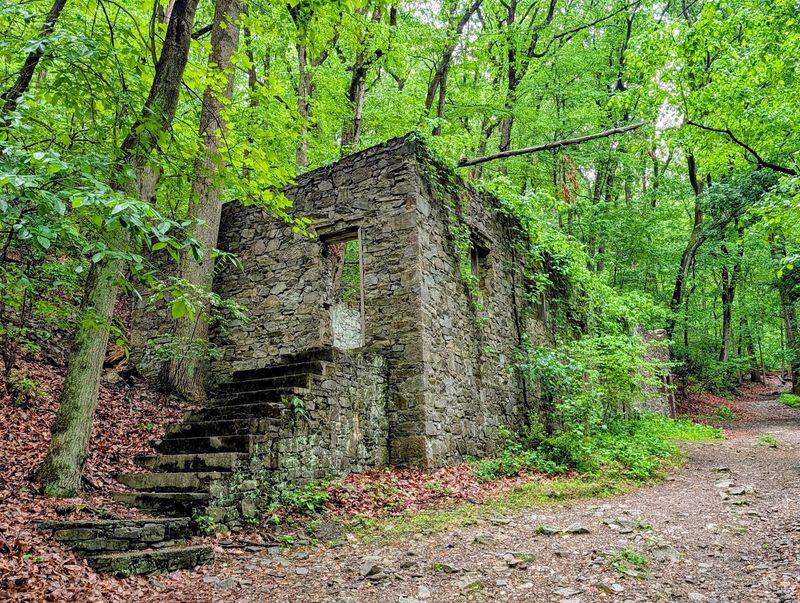
A stone shell beside a spring looks surprisingly eerie once the woods close around it.
The Colonial Springs Bottling Plant Ruins sit on Mount Misery inside Valley Forge National Historical Park, reached along the Horse-Shoe Trail.
The plant was built in the late 1800s above a natural spring called Cold Spring. In 1908, the Colonial Springs Company took over the operation and bottled water for customers.
Later, the property passed to Charles Hires and the Hires Company, which sold the spring water under the Purock name.
Valley Forge State Park acquired the land in the 1930s, and the building was abandoned. The National Park Service stabilized the masonry in 2017 to preserve the ruin and keep hikers safer.
Stone walls, old dam remains, and flowing water make the site feel farther from civilization than it really is.
The ruins are reached from the Horse-Shoe Trail near Washington’s Headquarters, where parking is limited.
Do not drink from the spring, since the National Park Service warns that the water can make visitors sick. The Colonial Springs ruins turn a Valley Forge hike into something stranger than expected.