
This Forgotten Nebraska Railroad Town Still Tells Stories Through Its Ruins
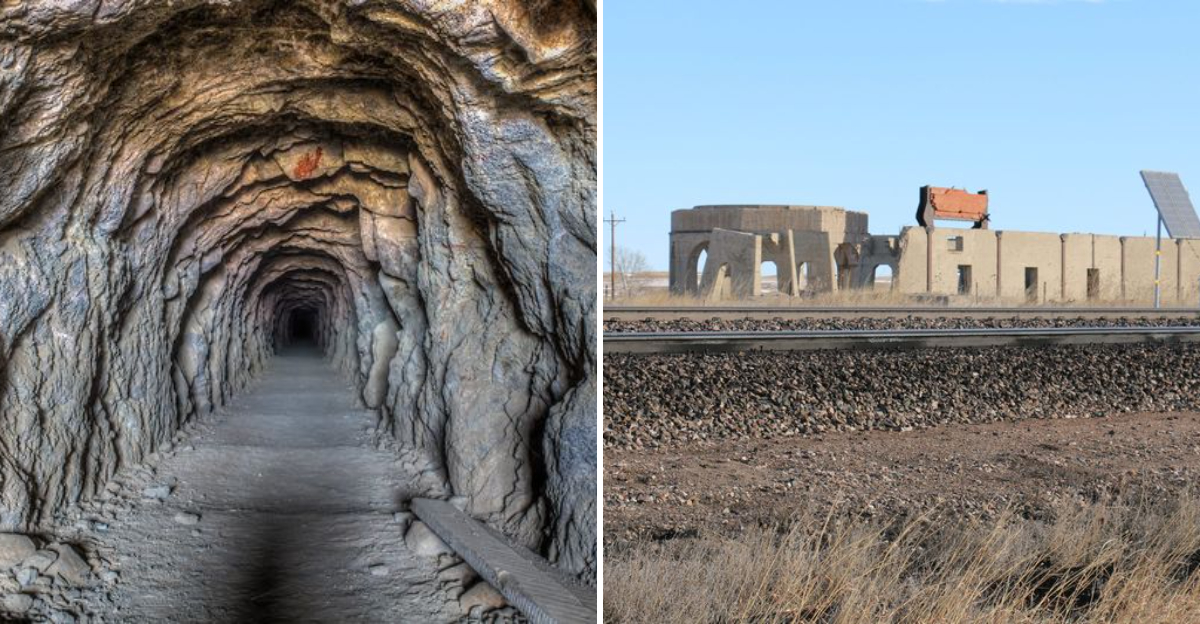
In the rolling prairies of western Nebraska sits Belmont, a once-thriving railroad town now reduced to quiet ruins.
Founded in the late 1800s along a key rail line, Belmont bustled with trains, shops, and families before progress rerouted the tracks and left the community behind.
Today, stone foundations, weathered timbers, and the yawning mouth of its old tunnel stand as haunting reminders of the grit and ambition that built the American frontier.
Walking through what remains feels less like exploring a ruin and more like opening a storybook written in iron, stone, and prairie wind.
The Haunting Belmont Tunnel Speaks Of Engineering Marvels
Holy smokes, the Belmont Tunnel nearly took my breath away when I first laid eyes on it! This massive stone portal, carved right through a hillside, stands as the most impressive remnant of this railroad ghost town.
Railroad workers chiseled this engineering marvel by hand in 1888, using nothing but dynamite, pickaxes, and pure grit. When I touched those rough-hewn walls, I couldn’t help but feel connected to the men who sweated and strained to create this passage.
The tunnel once thundered with the daily rumble of Union Pacific trains carrying passengers and freight westward. Now it’s eerily quiet, with only wind whistling through its shadowy interior. Locals say if you stand inside at sunset, you might hear phantom train whistles – though that might’ve just been my imagination playing tricks on me!
Rusty Rails And Rotting Ties Mark Where Dreams Once Traveled
Fragments of the original track still poke through prairie grass like metallic fossils from another era. I knelt down to run my fingers along a rusty rail spike and wondered about the last train that rumbled over these very tracks.
The railroad was Belmont’s lifeblood, bringing supplies, mail, and newcomers seeking fortune in the West. When the new line bypassed the town in 1908, it effectively sealed Belmont’s fate. Walking along the old rail bed, I spotted wildflowers growing between rotting wooden ties.
Nature slowly reclaims what humans abandoned. Yet somehow, these deteriorating rails tell a more compelling story now than when they were shiny and new. They’re like the wrinkles on an elder’s face – each one representing a journey, a memory, a piece of history that shaped the American frontier.
Water Tower Foundations Reveal The Town’s Vital Lifeline
“Watch your step!” I warned my friend as we circled the massive concrete ring – all that remains of Belmont’s water tower. This circular foundation, about twenty feet across, once anchored the town’s most critical infrastructure.
Steam locomotives were thirsty beasts, guzzling thousands of gallons at each stop. Without this water tower, Belmont simply couldn’t have existed as a railroad town. The tower stood tall for decades, a landmark visible for miles across the prairie, before collapsing sometime in the 1940s.
Kids from nearby farms used to dare each other to climb it, according to an elderly rancher I met who grew up in the area. He chuckled as he told me how his older brother once got stuck at the top for hours. These crumbling concrete chunks might look unimpressive to passersby, but they represent the technological backbone that made western expansion possible.
Stone Foundations Map A Once-Thriving Main Street
Rectangular stone outlines scattered across the prairie grass create a connect-the-dots puzzle of Belmont’s former downtown. During my visit, I mapped them out in my notebook – here the general store, there the blacksmith, over yonder the saloon where railroad workers unwound after long shifts.
At its peak in the 1890s, Belmont boasted nearly 800 residents and dozens of businesses. The town had everything a frontier community needed: a schoolhouse, church, post office, and even a small hotel for travelers. Summer thunderstorms have washed away much evidence, but these stubborn stone foundations refuse to disappear completely.
I found a rusty horseshoe near what must have been the blacksmith’s shop and pocketed it as a souvenir (don’t tell the historical society!). Standing amid these ghostly rectangles as the wind whispered through the grass, I could almost hear the bustle of commerce and conversation that once filled this now-silent space.
Cemetery Headstones Chronicle The Human Side Of Belmont’s Story
“Beloved wife and mother” reads a weathered marble headstone tilting at an odd angle in Belmont’s small hillside cemetery. This peaceful spot, overlooking what remains of the town, offers the most personal connection to those who once called this place home.
I spotted dates showing multiple losses on a single day in 1889, likely from a construction disaster at the tunnel. Several tiny markers for children reflect the harsh realities of frontier life before modern medicine.
The newest grave dates to 1915, years after most residents had already abandoned the town. Someone must have requested burial alongside family members despite Belmont’s decline. These silent stones tell the most human stories of all – of loves and losses, of dreams and disappointments, of the real people who briefly called this forgotten railroad town home.