
This Historic Ohio Covered Bridge Turns A Short Walk Into Time Travel
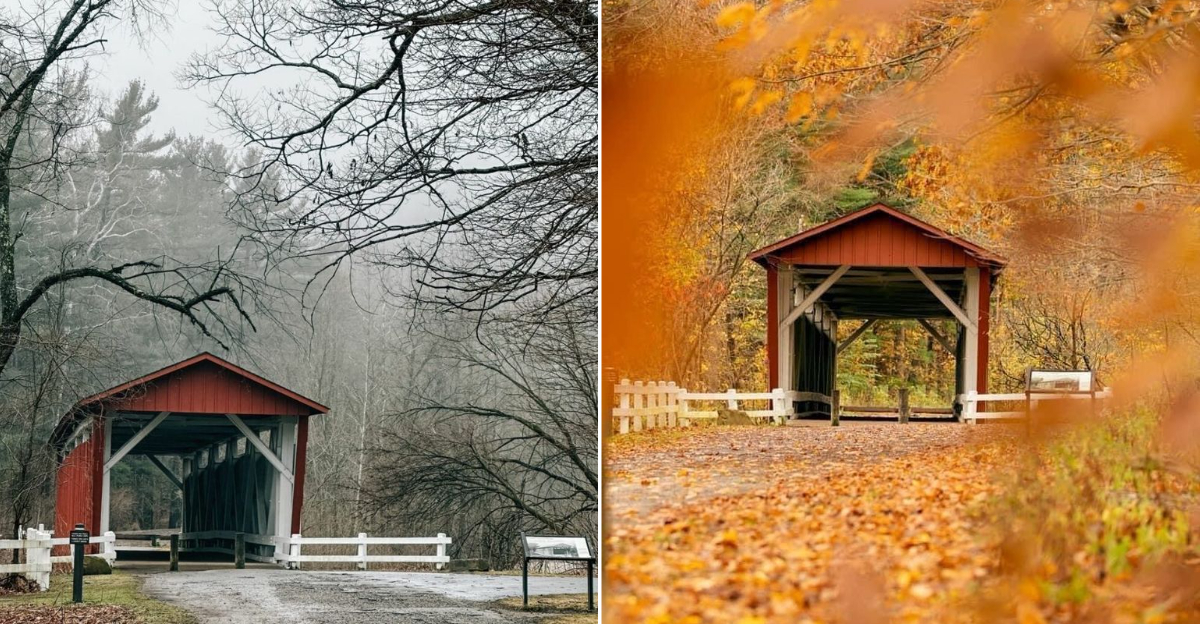
In the quiet heart of Cuyahoga Valley National Park, the Everett Road Covered Bridge waits like a storybook turned real. Its timber trusses stretch across Furnace Run, red paint glowing against the green woods in summer and the snow in winter.
Standing inside feels like stepping through a portal, the creek whispering below while history presses close. Built in the 1800s and rebuilt after floods, it’s the last of its kind in the park.
Walk slowly, let the boards creak beneath you, and you’ll sense why this bridge has carried both travelers and memory for generations.
Postcard Setting
Sunlight hits the red siding and suddenly the bridge feels like it belongs on a postage stamp. Furnace Run slides beneath it, catching the color and sending it back doubled. It’s the kind of view that arrests you mid-step, even if you’ve seen photos before arriving.
Standing at either bank, the whole scene composes itself, water, wood, and trees aligning into a perfect frame. This isn’t just about crossing; it’s about pausing long enough to let the geometry sink in.
I couldn’t help smiling here. The bridge isn’t dramatic in scale, but it radiates charm. If I lived nearby, I think I’d end up visiting whenever I needed to reset my head.
Convenient Access
Parking comes first, and here it’s almost too easy: a small lot, a flat path, and before you’ve had time to second-guess the turn, you’re standing at the edge of history. No winding trails or hidden detours to frustrate you.
That simplicity makes it possible for almost anyone to visit. Parents pushing strollers, older travelers, or folks making a quick stop all have the same welcome. Accessibility adds its own kind of generosity to the visit.
If you come midweek, use that ease to your advantage, arrive early, stay long, and you might just get the bridge nearly to yourself.
Valley’s Legacy
The wood beneath your shoes is newer than it looks. The original bridge was lost to a flood in 1975, but a decade later the community rebuilt it, plank by plank. That resilience is part of the bridge’s presence, you can feel it in the grain.
Every crossing becomes a walk through history layered with memory. It isn’t the first Everett span, but it honors what came before while standing firm for what came after.
I loved that sense of renewal. Knowing it rose again by local hands made the whole experience more intimate, as if the valley itself insisted on keeping its bridge.
Smith Truss Design
Step inside and look upward, the crisscross of beams draws the eye in repeating patterns that almost hum with rhythm. It’s the 1869 Smith truss at work, balancing strength with elegance.
This design was once common in Ohio, a practical choice for builders who needed durability and efficiency. The Everett bridge carries that tradition forward, reminding us that engineering can be as beautiful as it is functional.
Take a moment mid-span to trace the angles. The way light slips through feels deliberate, like architecture teaching you how to see.
Summit County’s Survivor
Covered bridges once dotted this county, but time and progress erased nearly all of them. Only Everett Road remains, a lone figure holding the memory of what was once a whole network.
Its endurance says as much about preservation as it does about history. Locals fought to keep it standing, not out of nostalgia alone but to keep connection alive.
Personally, I felt the rarity most keenly here. Knowing it’s the last one gives each creak of wood more weight, as if I was listening to a voice that doesn’t want to vanish.
Serene Creek Sounds
Before you even reach the span, your ears pick up the murmur of Furnace Run. The creek threads beneath, its water carrying a kind of soft percussion that shapes the atmosphere.
That sound alters the rhythm of the visit. Instead of rushing across, you find yourself slowing to match its pace, noticing reflections and ripples that shift with each gust of wind.
The mix of wood above and water below made me linger longer than expected. It’s rare to find a place where silence feels textured by sound.
Autumn’s Embrace
October pulls a kind of theater curtain over the valley, maples and oaks igniting in a riot of reds and golds. The bridge becomes the centerpiece of the show, its siding glowing even brighter against the foliage.
History here isn’t just in dates, it’s in repetition. Every fall the trees return to dress the bridge in seasonal splendor, renewing the scene for photographers and walkers alike.
I’ll admit, I’ve never seen a frame so naturally perfect for autumn photos. Standing there felt like stepping into a painting that didn’t want me to leave.
Winter’s Tranquility
Snow softens everything. The roofline gathers a white edge, trails crunch underfoot, and even the creek lowers its voice. It’s a shift that changes the bridge from bright landmark to quiet refuge.
Long before visitors with cameras, locals knew this hush well. Winter kept the valley still, and bridges like this carried life across when the world felt frozen.
If you’re willing to brave the cold, bring warm gloves and good boots. The reward is solitude, and a bridge that feels like it belongs only to you.
Interactive History
A weathered plaque waits at the entrance, easy to miss unless you’re curious enough to stop. Details unfold there, dates, floods, rebuilds, condensing the story into a few etched lines.
That small act of reading changes the walk. Suddenly the boards beneath your shoes are not just wood, but echoes of another bridge and the effort it took to restore this one.
I loved that pairing of fact and presence. It grounded me, reminded me that travel isn’t only about sights but about connecting to what came before.
Photography Haven
Angles multiply the moment you step back from the bridge. From upstream, the red siding sharpens against green slopes; from downstream, it seems to float above its reflection. Light changes everything here, minute by minute.
The structure itself offers built-in geometry, every beam forming a natural frame. That’s why both casual visitors and serious photographers spend long stretches trying new vantage points.
I couldn’t resist taking too many shots myself. Each looked different, none felt redundant. The bridge teaches you how to see it anew.
Picnic Perfection
Benches line the edge of the clearing, shaded just enough to soften the midday sun. It feels like the park wanted you to sit down and stay a while.
Generations once used covered bridges as meeting spots, gathering before church or on long walks home. Eating by Everett Road keeps that spirit alive, even if it’s just sandwiches from a cooler.
If you come late in the day, bring extra layers. The air cools fast near the creek, but the evening light makes every bite feel like a reward.